Forget Bitcoin, Is This A Stock Market Bubble I See Before Me?

79B967CD-A963-4032-A54A-C8CB559E76AE-52791-000027C7AAB88FC0

Bitcoin has had a stellar year rising from a low of under $1000 a coin at the start of the year to an unprecedented high of almost $20,000 just last week. The general consensus is that Bitcoin is in a dangerous bubble that will pop very soon akin to the Dutch Tulip and South Sea bubbles of many moons ago. Yet the price keeps on rising. Analysts have been pronouncing the death of Bitcoin ever since the price was just a mere $0.23 a coin back in 2010. You can visit the website 99 Bitcoins to view the countless botched BTC obituaries. No matter whether you believe Bitcoin will continue on its dizzy heights or crash and burn, there’s no denying that the underlying blockchain technology will play a paramount role in the transition towards a cashless society.


A look at UK Fund manager Neil Woodford

With every person and their Jack Russell engulfed in the current crypto-mania epidemic, it is easy to overlook other potential red alerts on the financial landscape. Earlier this month, top fund manager Neil Woodford went on record stating that financial markets are entering a bubble phase yet elaborated on this by saying that while many stocks are overvalued there are also many companies, which are undervalued. Woodford has come under a lot of heat these last few months after a number of stocks in his CF Woodford Equity Income Fund portfolio have fallen substantially in value. Yet the stock selection of his portfolio is interesting. While the portfolios of other fund managers are weighted more towards large multinational and defensive companies such as consumer brands company Unilever or alcohol goliath Diageo, and are minimising exposure to the UK in the wake of all the uncertainty created by the 2016 Referendum result (as well as the possibility of an anti-business Jeremy Corbyn led Labour government abruptly coming to power), Woodford’s portfolio is heavily exposed to the UK. Woodford thinks that there is too much negative sentiment towards the U.K. economy and as a result many domestic U.K. companies are very attractively priced (due to panicky investors reducing their exposure to UK stocks) with potentially minimal downside and plenty of upside should sentiment towards the U.K. economy improve.


Warren Buffett, NASDEQ all time highs, and the 2000 dot-com crash

Any good student of the world’s most famous living value investor Warren Buffett would spot these opportunities and at the same time be very cautious of stocks with high valuations trading at close to all time highs. In the USA, the FANG (Facebook, Amazon, Netflix and Google) stocks fit the bill as well as several other stocks trading on the NASDEQ index which has been on an off the charts bull run. The incredibly high valuation of the NASDEQ Index combined with the mesmerising new highs breached by Bitcoin and other cryptocurrencies like Ethereum and Litecoin create the perfect storm for a repeat of the spectacular Dot.com crash of the early 2000s. At the height of the dot.com bubble, the NASDEQ composite shot up to a high of 5000 points around the turn of the new millennium before crashing to almost a 1000 points in 2002. Since the beginning of 2009, after the 2008 Financial Crash, the NASDEQ has been on an incredible run motoring from 1200-300 points to almost 7000 points reaching an all time high of 6,914 points this year. It is today trading very close to that high in the range of 6,840-80 points. Whether history has a habit of repeating itself or not it sure has a habit of rhyming, to quote Mark Twain.


Market sentiment and looking beyond it

One of Buffett’s most famous and often quoted mantras is; ‘be fearful when others are greedy and greedy when others are fearful’. Yet the Buffett pearl of wisdom I’ve always taken to my bosom is; ‘the market can remain irrational longer than you can stay solvent’. One would like to think that stocks are priced according to their fundamentals but it is always sentiment that is the winner. The current Bitcoin craze is the perfect example. Sentiment is incredibly positive and gung-ho towards this creation that is seen as revolutionary and a disruptive game changer in the world of money, and consequently many want in whatever the price. The FOMO (fear of missing out) bug is very strong. But sentiment can always change at the flick of a switch and when that happens it will be the fickle inexperienced investors with weak hands who bail out the first even if that means incurring staggering losses.

Neil Woodford is the quintessential student of Warren Buffett who is periodically on the look out for undervalued and unloved stocks whilst steering clear of expensive and hot overvalued stocks. If positive sentiment towards the U.K. economy returns at some point in the future and Sterling makes further gains against other major currencies, Woodford’s fund will end up not only beating the FTSE index but substantially outperforming the funds of other star fund managers. (Note from June 10th 2020 – I more than realise that I got my prediction on Neil Woodford horribly wrong. To be clear, I am referring here to his ‘value investing’ strategy of finding unloved, but robust dividend paying blue chip companies. A huge part of his downfall was due to him straying away from his investment strategy that for so many years had worked very well for him. Instead, he decided to allocate a substantial percentage of the portfolios of his new funds towards highly speculative start-up growth companies mostly in the biotech field.)  


Why has the FTSE been reaching all time high levels?

The root of the FTSE trading at a very high level is because of the high valuations of big multi national companies such as Unilever, Diageo and British American Tobacco trading at (or at least close to) all time high levels and their current combined market caps representing a humongous slice of the total FTSE 100 pie. At around the beginning of 2000, shares in Diageo were trading below £5 a share. They recently reached a high of almost £27 with a total market cap in excess of £65 billion. Shares in British American Tobacco were also trading at below £5 a share around that same time period and over the years have performed very well reaching an all time high of £56.43 earlier this year with a market cap in excess of a whopping £120 billion. Unilever shares less than ten years ago in 2009 after the 2008 Financial Crisis could be snapped up for under £15. Earlier this year they reached a record high of £45.57 a share with a market cap almost nudging £60 billion.

One of the principle reasons why many FTSE companies have been reaching all time high levels in the last 12 months is because, since they are global companies, their earnings are received in many different currencies. When the Referendum result was announced in the U.K. last year Sterling dropped to a 30 year low of 1.34 against the dollar. Since this time, the value of Sterling continued to decline bottoming around the 1.20 mark against the dollar before returning to that initial 1.34 level against the dollar that it was just after the Referendum result. During the last 18 months, these multi national companies have benefited enormously from a weak Sterling valuation and yet in spite of this some are still trading on PE (A company’s share price against it’s earnings per share) ratios of 20 or more. Now what would happen if sentiment towards the U.K. economy were to improve and consequently Sterling were to climb to pre Referendum valuations of 1.40 to the dollar or higher? This would affect the foreign earnings of these multi national companies when converted back into stronger Sterling. And by extension lower their earnings per share. Their share prices would likely cool down quite significantly


Out of the Sinking: Recent performance of recovering blue chip miners

The Holy Trinity of Unilever, Diageo and BAT are all solid bullet proof defence companies but cheap they are not. At the height of the commodities slump less than two years ago around the start of 2016 all of the blue chip mining companies were trading at unimaginably low levels. Today with sentiment towards these mining companies vastly improved, they are trading at much higher levels and, consequently, are not the bargains they once were not so long ago. During that time one could have hovered up shares in Australian mining titans BHP Billiton and Rio Tinto at just over £5 and £19 a share respectively. Earlier this year BHP shares were trading at over £15 each (with an LSE market cap on the LSE in excess of £30bn) whilst Rio shares went over £38 (with an LSE market cap at one point breaching £50bn). Even more impressive is Anglo-Swiss multinational commodity trading and mining juggernaut Glencore. Today the shares are trading at over £3.50 (LSE market cap over £50bn). At the height of the slump Glencore shares could have been snapped up at less than 70p. Many junior mining companies with higher production costs didn’t survive the slump in iron ore prices but the blue chip mining companies with lower production costs got through this difficult period. Sentiment towards all miners at the time was very bearish and that was reflected in the share prices. But those investors brave enough to take the plunge are now, providing they are still holding their shares, sitting on enormous paper profits.


Hunting for bargains

Although some companies are trading at, or close to, historic highs and thus pushing the FTSE index close to record high levels and fuelling fears of a stock market bubble, a large number of companies are trading at heavy discounts. Interestingly the vast majority of these companies are UK domestic companies where sentiment towards the U.K. economy is poor. For example, many of the UK house-building companies, while not trading at the very low levels they once were after the Referendum result was announced, are trading on low PE ratios in the region of 10-11, which is less than the accepted fair value PE of 15. These include FTSE 100 companies Barratt Developments and Taylor Wimpey (both firmly in Neil Woodford’s fund) trading today at £6.28 and £2.03 respectively and both with similar market caps around the £6.5bn mark. If there is any future further weakness in the share prices that would obviously make them even more attractive as investment opportunities.

Two other UK companies in Neil Woodford’s portfolio which are currently very depressed are the FTSE 100 company Capita and the FTSE 250 company Provident Financial. The share price of the latter company collapsed spectacularly back in August this year from a high of close to £35 a share to at one very brief interval sinking to below a fiver. Since then they have currently been trading in the £7-£9 range and can currently be bought for around £8. The crash was rooted in the problems encountered in the business’s Home Credit division. It is a risky share and more downside cannot be ruled out but the potential upside if the business were to recover is huge. Woodford has taken a lot of criticism for the performance of this share yet he remains unfazed and in fact has been accumulating more shares at these new depressed levels. The business support services company Capita has also experienced a huge share price decline tanking from a high two years ago of over £12 a share to its current price of £4.74 a share. The decline in the share prices of both companies means that they now pay very generous dividends. Whether they will be maintained is anyone’s guess but in the case of Provident the current yield is too good to be true at over 15% and for Capita it’s just under 7%.

Two enormous British multi billion pound companies trading at depressed levels are BT Group and energy giant Centrica. BT shares have almost halved in value from a high of around £5 back in 2015 to a low of £2.42. The shares are currently trading at £2.70 with a current market cap of close to £27bn (with nearly that same amount wiped off its from its all time high – quite a dent to the overall FTSE index) and paying a generous dividend yield of over 5%. Centrica has been experiencing an even rougher ride falling from a high of over £4 in 2013 to a low of just £1.33 this year. The last time the share price was below £1.50 was over ten years ago in 2003. Currently the shares are trading at £1.45 and at this level paying a dividend of more than 8%. And at this price the market cap of the company is over £8bn (with around £14bn wiped off the company’s value from its high in 2013). The root of BT’s fall from grace is an accounting scandal at the Italian division of the company. Centrica is struggling with the prospect of political intervention via price caps for its customers and increasing competition. Both companies display certain levels of risk and sentiment is poor for those reasons. One could also come to the conclusion that much of these risks are priced in to the depressed share prices. There is also the risk that those companies now experiencing huge dividend yields because of their low share prices risk having their dividends cut. That cannot be ruled out.

Not all big multinational companies are trading at close to all time highs. The pharmaceutical giant GlaxoSmithKline has a huge global presence and is currently trading at above £13.14 after having fell to £12.70 from a high of over £17 all within the space of this year. At its current level it still has a collosel market cap at around £64.5bn and is now paying a dividend yield in excess of 6%. The company does come with quite a lot of risk despite its size. It has very high levels of debts and the pharmaceutical industry is very competitive. In spite of this GSK is a diversified pharmaceutical business and a huge money spinner. However I think it can still fall further especially if the dividend is cut (which may be a sensible idea to reduce the company’s debt pile) which I see as very likely. This would probably create further weakness in the share price and would be an absolute steal if £10 or less were breached (being a huge company further deterioration in the share price would dent the FTSE 100 composite substantially – every time the share price loses a pound in value, GSK – and by extension the FTSE 100 – becomes £4.9bn poorer).

One more solid British company, which I like that is trading at a low valuation is the defence and engineering service company Babcock. In 2008 after the Financial Crash, the shares were trading under £4 before going on an upward trend reaching an all time high above £14 in 2014. Since that high was reached the shares have been on a downward trend and are now priced at £6.76. This is a substantial discount to it’s all time high. As well as the attractive price its trading on a forward PE of less than 10 and currently offers a not to be sniffed at 3.89% yield. Babcock is also featured in Neil Woodford’s portfolio. What’s more, I see plenty of potential upside to the current price and even the possibility of the dividend being increased.


Disclaimer: For the record I am not a qualified financial adviser. I am not Nostradamus. I have no crystal ball. As always it is very important that you do your own research before making any investments. Never ever make investment decisions based solely on what someone says.


By Nicholas Peart

Written: 11th – 12th December 2017

©All Rights Reserved

Image: Clipart



Solutions In The Age Of Job Security Decline

IMG_0790

This is an unpublished piece I wrote back in May 2017

Today we are living during an extraordinary time where technology is advancing at an exponential pace. The growth of the internet and powerful emerging technologies like Artificial Intelligence are disrupting industries and jobs that were once considered safe. It seems to me that the traditional Industrial Age job seeker 9-5 modal of working and job security are in decline. Replacing this is the rise of the precarious gig economy of job scraps with zero hour contracts.

Any job where the work is repetitive and/or is work where there are patterns in the tasks is most certainly at risk from potential automation. In fact the whole notion of ‘a job’ is changing. Restricting yourself to the mindset of solely looking for work is restricting yourself to a periodically shrinking pool of increasingly scarce opportunities. On the other hand, if you can move away from the mindset of a job seeker to one of a job creator or entrepreneur than you have already prepared yourself. That is the new job security.


Solutions for Workers in low paid Unskilled Jobs

Low paid jobs such retail and bank clerk jobs, cleaning jobs, transportation driver jobs, factory workers and all kinds of call centre and admin work etc are the most at risk from automation. In fact many of the jobs in these industries have already been automated. It is important that people in these jobs take a moment to retreat and try to understand a bit more about themselves. What are your interests and passions? What inspires you? If you have a passion, say for example, for cooking or gardening, you could start a blog and connect with people and impart some unique and sought after tips and extend this into offering a paid service like cooking or gardening classes/workshops. There are also more potential revenue streams like providing advertising space on your website especially if you have lots of subscribers and followers. You could also focus on a more specialised form of something that you are passionate about which would make you stand out if the market of the area you are focusing on is overly saturated.


Solutions for Professionals

Professionals in the medical, legal and financial services require more skills than people in low paid unskilled work yet it does not mean that their jobs are not immune from the potential threat of automation. As I already mentioned, it is important to understand and know what interests and inspires you as it can potentially be translated into a successful online business or project. Alternatively, if you are, for example, a lawyer working for a large law firm and you want to remain in the industry, you could start your own online law business in an area of law you are most interested in. In a way, AI will be very beneficial to the legal industry since super intelligent deep learning systems will be able to (and already are to a degree) crunch through reams of dry data and documents in far less time than a human can. This will have the added benefit of freeing up more time to work on more cases and more interesting aspects of law. Furthermore, all these new technologies will make running your own business easier, saving you both time and money.


Solutions for Creatives

If you are an artist, musician, writer or fashion designer etc, the most important thing is finding and connecting with your biggest and most loyal fans since they are the ones who will always willingly fund what you do whenever you try to sell your products and services. With the rapid growth of the internet and social network sites this is easier to do than ever before. All this enables creatives to potentially bypass middle agents and deal directly with their fans, meaning all profits go directly to you without any middle people taking a cut. Twitter is an indispensable social networking site for constantly networking, connecting and keeping your fans up to date with all your developments. Instagram was made for creatives and is a very powerful platform to network and showcase your uniqueness.

If you are a creative that is shy and feels uncomfortable with networking and are inexperienced in the business side of things then my advice is to find a trustworthy and experienced manager to do all the networking, promoting, funding and sales on your behalf in exchange for an agreed percentage of your net revenues.

It is very important that you are constantly connecting with your fans and making them feel a part of your creative journey, since if you ever wanted to raise funds for your projects via crowdfunding platforms such as Kickstarter, you will stand a higher chance of reaching your financial targets.
 

By Nicholas Peart

©All Rights Reserved

Modern And Contemporary Art In Sarajevo

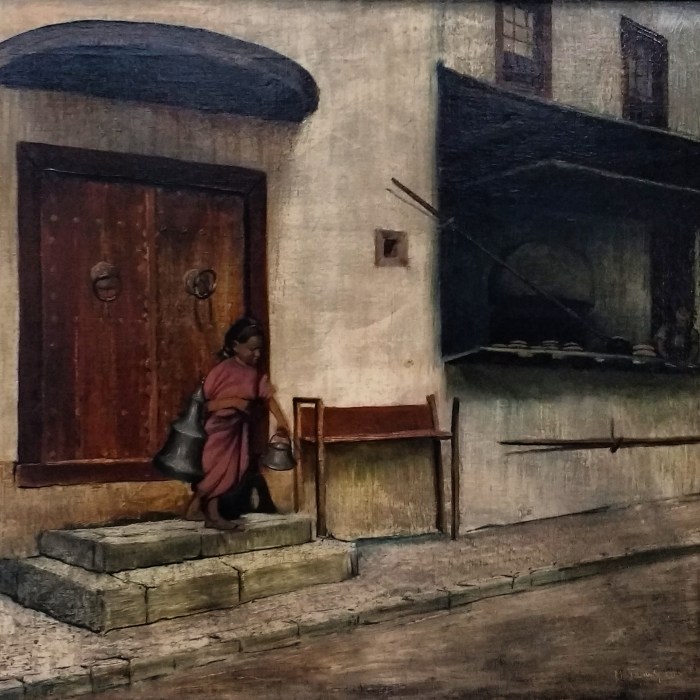
Earlier this year in September, I spent many days in Sarajevo. Whilst exploring the city I made sure that I set aside a decent portion of time to investigate and discover some of the city’s art. The first place I visited was a cultural centre called the Bosniak Institute. When I visited one Saturday afternoon, there were not many visitors, which was a shame as it has so much to offer and the entrance fee is only a few KMs. One wing of the institute over a few floors consists of a permanent collection of paintings from different decades of the 20th century by Bosnian artists. There is a street painting of a corner of the historic Ottoman style Baščarsija district of the city dating back to 1920 by an artist called Doko Mazalić. Elsewhere there are two Expressionist style paintings from the mid 1950s by the artist Rizah Stetić, one of which is of the main square of Baščarsija where the famous wooden Sebilj fountain is located.

IMG_20170917_165243_306

1920 painting of the historic Ottoman style Baščarsija district of the city by Doko Mazalić


IMG_20170917_172703_683IMG_20170917_173140_999

Paintings from the mid 1950s of the Baščarsija district by Rizah Stetić

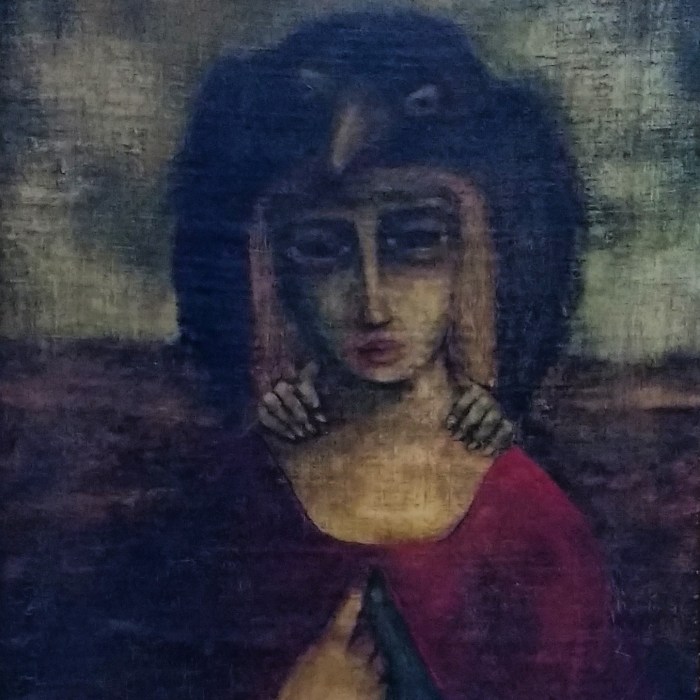
Two other paintings from the early 1960s catch my eye by the artist Ibrahim Ljubovic. The first painting is of a woman with heavy, tired and anxious eyes. A black half chimp half crow beast clings to her shoulders. The background is sombre and bleak; like a vulture’s playground.

IMG_20170917_170720_135IMG_20170917_165842_516

Paintings from the early 1960s by Ibrahim Ljubovic

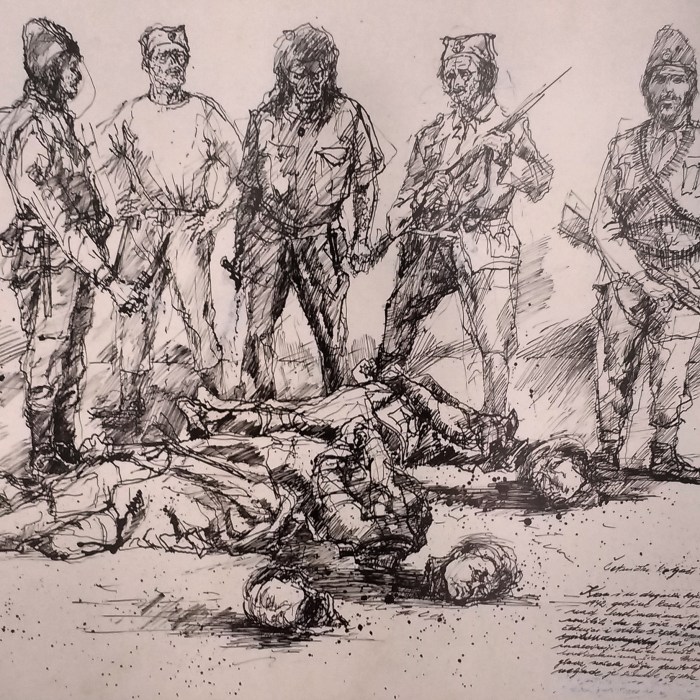
In another corner is a Naive Art style painting by an unknown artist likely created sometime around the middle part of the 20th Century and a tapestry on the wall by one of the stairs. Back on the ground floor level at the entrance is a small but powerful temporary exhibition of drawings documenting the 1992-5 Bosnian War by the artist Mevludin Ekmečić.

IMG_20170917_174715_834IMG_20170917_175101_528IMG_20170917_182019_246IMG_20170917_180356_930

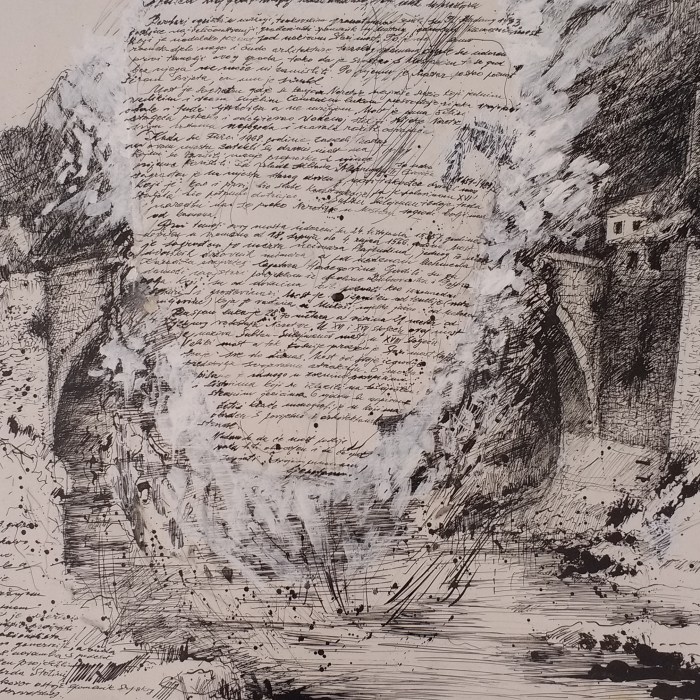
Drawings documenting the 1992-5 Bosnian War by Mevludin Ekmečić.

The exhibition, entitled “Drawing the War: Bosnia 1992-1995”, features a selection of barbaric, graphic and nightmarish chronicles of pain, reminiscent of Francisco Goya’s “Disasters of War” drawings he created between 1810-1820 at a time when Spain was struggling with many domestic and global conflicts. Spain is very similar to former Yugoslavia in that both countries are unions of different countries with deep roots. History sadly has a habit of repeating itself and today, with the current push for independence in Catalunya, Spain, in the worst outcome, could face a similar fate to Yugoslavia’s, perish the thought. Examining and studying these drawings in greater detail, they further convey to me the futility and insanity of war. Everybody suffers. There are no winners. In fact life for the so called ‘conquerors’ for me is hell on Earth; I wouldn’t want to be in the shoes of Ratko Mladić or Radovan Karadžić and the rivers of blood on their hands. The drawings show victims tortured, dead bodies on the ground with severed heads, a blood thirsty war general clutching a freshly decapitated head by its hairs and the destruction of the historic bridge in the city of Mostar. Each drawing also has written notes by Ekmečić where he describes the horrific images of the war (which he saw broadcasted on TV and in the newspapers when living in exile in Paris) and would then furiously sketch them with black ink.

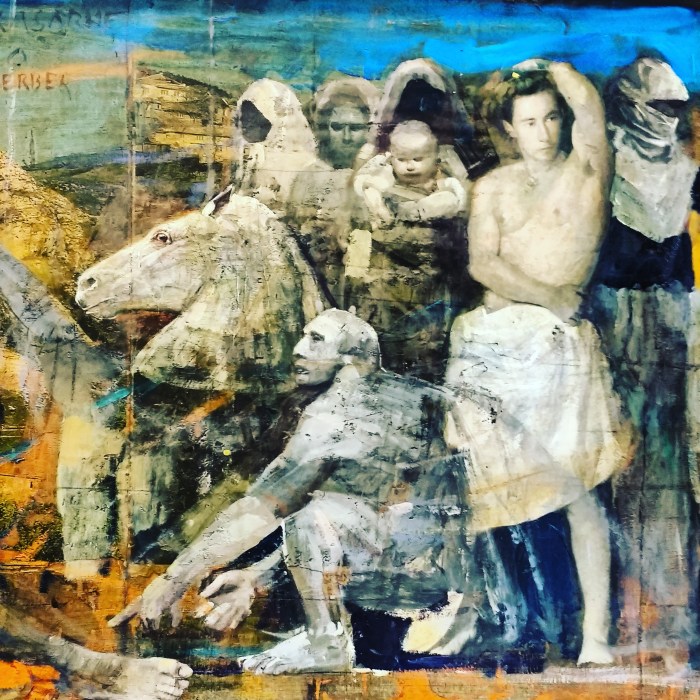
In another area of the institute is the Mersad Berber green salon featuring a permanent display of paintings donated by Berber. Mersad Berber is one of the best known and greatest Bosnian artists of the 20th century and true master artist in the classic sense. His works have an epic and profound quality to them spanning the great periods of art history from the Classical Greek and Roman periods to the Byzantine, Renaissance and Ottoman eras. His paintings are also spiritual, human and timeless. Observing his works in greater detail, he is a descendent of the old masters and there are subtle echoes of some of the greats like Caravaggio, Zurbarán and even Bosch. This broad palette of art history combined with his own mixed media techniques have positioned Berber as a unique artist with a distinct style. From 1978 until his death in 2012 he taught at the Academy of Fine Arts in Sarajevo and his work is featured in London’s Tate Gallery collection.
IMG_20170917_190416_105

The Mersad Berber green salon located inside the Bosniak Institute


IMG_20170918_001333_280IMG_20170917_193920_461

Paintings by Mersad Berber

The Ars Aevi Museum of Contemporary Art, a concrete Brutalist style building in a part of the city reminiscent of the Barbican in London, has a collection of donated works by global contemporary artists. It is a modest space over two floors with plywood interiors and a transient atmosphere, and gave the impression that the museum is lacking in funds and operating on a tight budget.

IMG_20170918_211733_599

The Ars Aevi Museum of Contemporary Art

Yet in spite of this I have read that there are plans to relocate the existing museum and its collection into a new building to be designed by the Italian architect Renzo Piano. There is a work by the legendary German artist Joseph Beuys in the collection of 100 bottles of olive oil. Two Spanish artists, sculptor Juan Muñoz and Txomin Badiola, each have a work in the museum. Muñoz’s piece is a hanging blue sculpture of a man and two smaller suspended white figures touching the right palm of the blue man.

IMG_20170918_213342_197

Joseph Beuys: Ölflasche (100 bottles of olive oil) (1984) 


IMG_20170918_214353_069

Juan Muñoz: L’Appeso (1998)


IMG_20170918_222221_311

Txomin Badiola: Double Trouble 2 (1990)

The Russian-American artist duo Komar & Melamid are featured with their 1995 installation, “50 Proposals for the United Nations”. The historical context of the work is interesting. During the Bosnian War in July 1995, the Bosnian town of Srebrenica fell and experienced the biggest genocide in Europe since the Second World War where over 8,000 civilians were killed. The United Nations had designated Srebrenica a safe zone but failed to protect the town and its civilians from the Bosnian Serb Army. At the time the UN was also approaching its 50th anniversary, yet this anniversary coincided at a time when the UN was experiencing great difficulties and challenges not just with the situation in Bosnia, but also the genocide in Rwanda, which the UN also failed to prevent. The installation features three head busts of Joseph Stalin, George Washington and Jesus Christ.

IMG_20170918_221512_706

Komar & Melamid: 50 Proposals for the United Nations (1995)

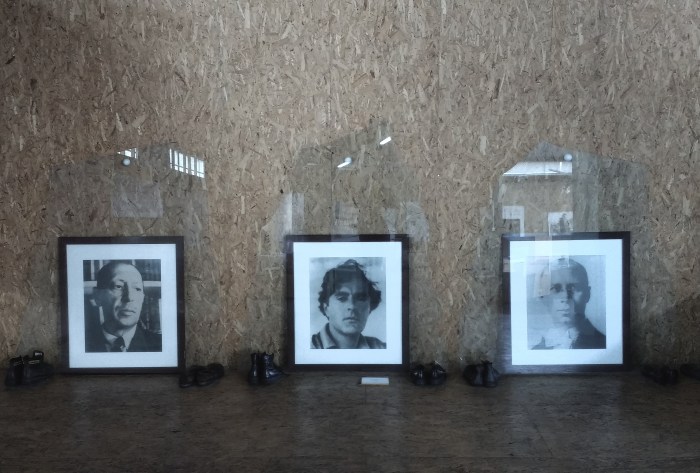
There are works by some notable Bosnian conceptual artists. The artist Braco Dimitrijević has an installation piece comprising of three black and white framed photographs of historical figures alongside six pairs of black shoes each positioned by the left and right sides of each photograph. Dimitrijević was a key figure in the development of conceptual art in former Yugoslavia during the 1970s. His best known work is his Triptychas Post Historicus installation series of works by famous artists in dialogue with everyday objects and fruits and vegetables.

IMG_20170918_215713_069

Braco Dimitrijević: Heralds of Past History (1997)

Two other Bosnian conceptual artists, both contemporaries of Dimitrijević; Edin Numankadić and Dean Jokanović-Toumin, have also donated works to the collection. Numankadić’s installation piece “Yesterday, Today, Tomorrow, Never” has those words each individually written on four framed black stone slabs propped on wooden crates. He is also the director of the 24th Winter Olympics Museum in Sarajevo, which opened on the year of the Winter Olympic Games in the city in 1984 to commemorate them.

IMG_20170918_232036_944

Edin Numandkadić: Yesterday, Today, Tomorrow, Never (1996)

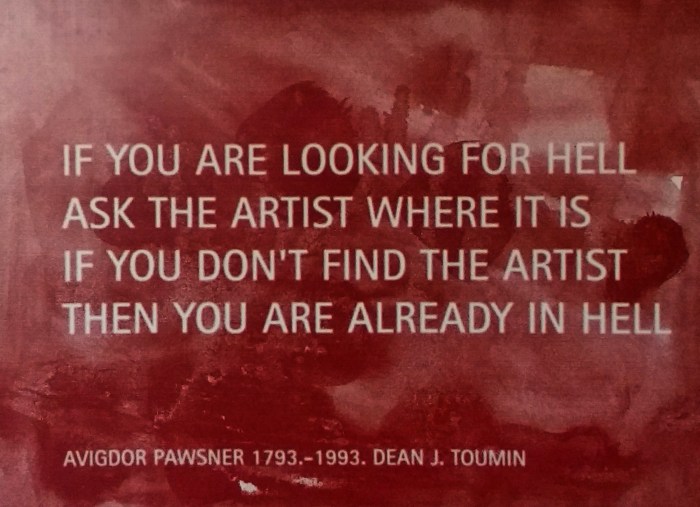
Toumin’s work on display is simply a quote from an 18th century writer called Avigdor Pawsner, “If you are looking for hell, ask the artist where it is. If you don’t find the artist, then you are already in hell”. This quote is also engraved on the wall by the entrance to the museum.

IMG_20170918_231440_679

Dean Jokanović-Toumin: If You Are Looking For Hell… (1993/98)

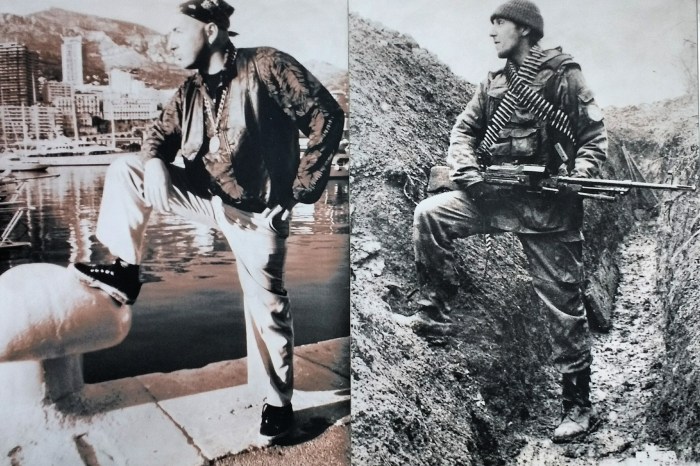
Elsewhere in the museum are two photographs by the Bosnian artist Nebojsa Seric Shoba entitled “Sarajevo-Monte Carlo”. Shoba lived through the 1992-5 Siege of Sarajevo when the city was surrounded by Bosnian Serb Army troops and it was very difficult for civilians to leave the city. In this period Shoba volunteered as a soldier protecting the city and it’s civilians against attacks from the BSA. The photograph on the right shows the artist as a soldier during the siege and the photograph on the left is of the artist in a similar pose in Monte Carlo wearing casual clothes taken after the war. In the first photograph the artist is thinner and in a constant state of tension and uncertainty with no end in sight to the war. In the Monte Carlo photograph, the artist has put on weight and is more relaxed and non defensive wearing funky clothes. Not so long ago he was in a war zone in a constant state of fight or flight and didn’t know whether he would live or die.

IMG_20170918_220447_807

Nebojsa Seric Shoba: Sarajevo – Monte Carlo (1998)

The National Gallery of Bosnia and Herzegovina, located in an old Austrian-Hungarian era building, has a collection of over 6,000 art works. When I visited there were two exhibitions on display that interested me. The first exhibition on the top floor, entitled Intimacies Of Space, is a permanent exhibition of works by modern and contemporary Bosnian artists and artists from other parts of former Yugoslavia. This exhibition is divided into five themes; “Garden”, “Interior”, “Atelier”, “Landscape” and “Window”. The Bosnian artist Behir Misirlic’s painting Small Part of the Garden (1969) is an ethereal and sensitive composition of meta-morphing forms and nuances, subtle colours and light and dark shades; of captured moments of fleeting beauty most naked eyes fail to perceive.

IMG_20170919_230836_241

Bekir Misirlić: Small Part of the Garden (1969)

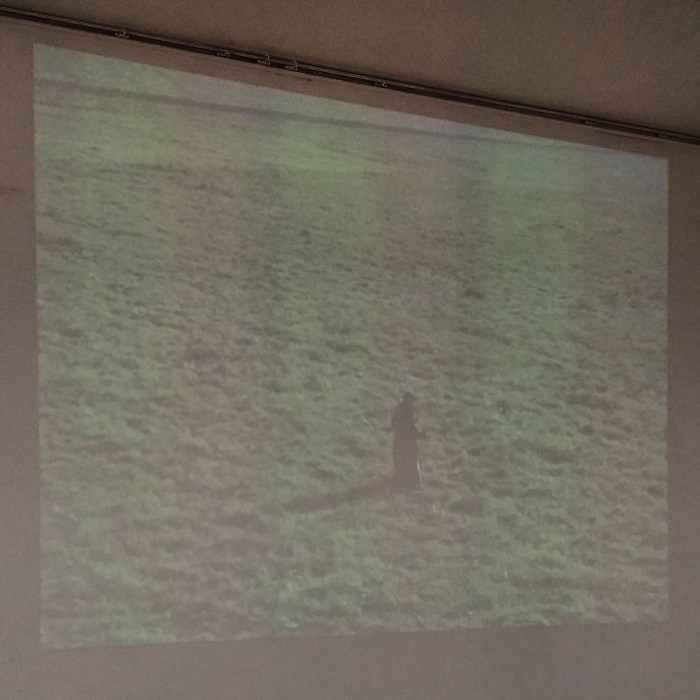
Green, Green Grass of Home (2002) by the Sarajevo born artist Maja Bajević is a video installation with a poignant story around the themes of identity and loss. In the video the artist is walking in a green field describing her apartment in Sarajevo where her grandparents lived and where she subsequently lived before the Bosnian war. Since the war other people have occupied her apartment and have refused to vacate it. All attempts to get it back have been in vain. In the film, as the artist is walking in the field, she tries to remember the flat and all the memories she has of it in as much detail as she can going from one room to the next with just the mental map of her memory to guide her.

IMG_20170919_232552_767

Maja Bajević: Green, Green Grass of Home (2002)

In the “Interior” section of the city exhibition there are three paintings by artists from former Yugoslavia which stand out. Mensur Dervisević’s oil painting “Space” is a desolate vacuum of black, burnt brown umber, pewter, green-brown olive and pale grey hues. In the darkest area of the painting is a lone mirage-like figure; an eternal spirit nailed to its place; stationary and ambiguous. It’s power and presence is augmented by the claustrophobic dark landscape enfolding it.

IMG_20170919_233343_363

Mensur Dervisević: Space

Ordan Petlevski’s oil composition “From the Interior” is similar in spirit to Dervisevic’s painting; a highly introspective work in dialogue with the core of the subconscious. The white, beige, dark and light brown middle area of Petlevski’s painting, for me, represents a process of animal metamorphosis. I see a head forming at the top of this area, like the head of a rabbit. A wing is developing at the bottom of the painting protruding the left side of the figure and at the bottom right, if you study it closely enough, you may be able to decipher a vague face with a fire-red opel eye. In the bottom left of the painting there is a gash of orange-red like a ray of light. Look closely and the face of a woman may appear.

IMG_20170920_113632_486

Ordan Petlevski: From the interior (1957) 

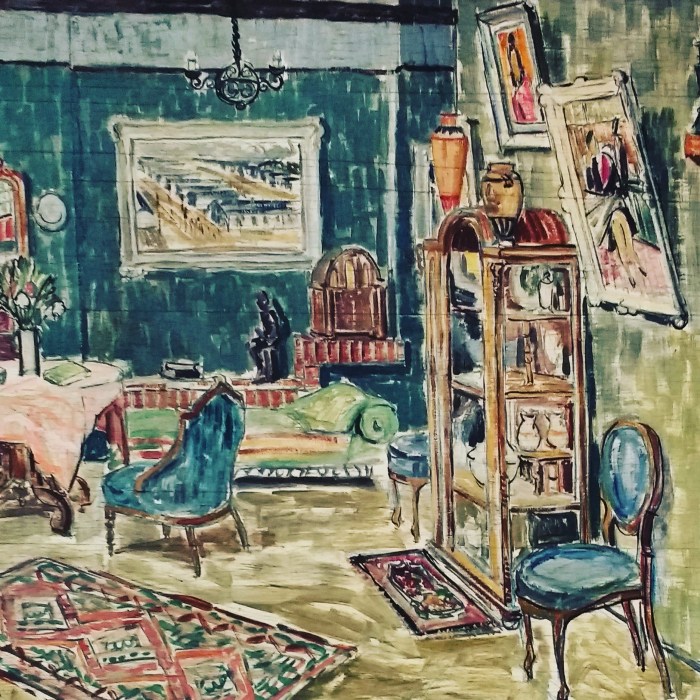
Ljubisa Naumović’s “Interior” oil painting from 1943 represents a well furnished and comfortable living room. It’s painted in a style which reminds me of some of the great early 20th century French painters, especially the Fauvist painters Raoul Dufy and Henri Matisse. “Interior with Open Windows” has a similar loose and free brushwork style and subject matter. Red is the prominent colour in many of Matisse’s interior paintings. In his landmark “The Red Studio” painting, everything is drowning in red. In Naumović’s painting, the dominant colour is green in three different hues; the blue cedar green front wall and three chairs, the olive green floor and right-side wall and the warm spring green bed by the blue cedar green front wall.

IMG_20170920_114743_009

Ljubisa Naumović: Interior (1943)

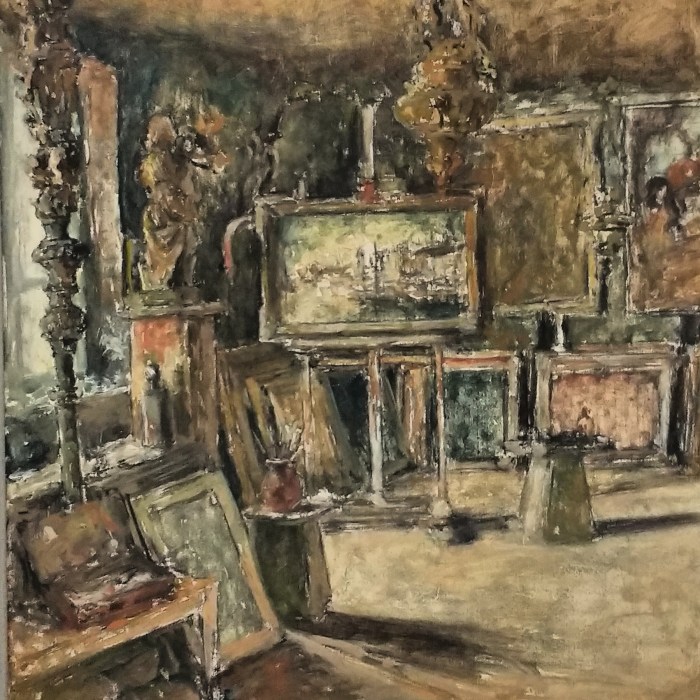
There are three works in the “Atelier” part of the exhibition, which register with me. Two of these works are oil paintings by artists from former Yugoslavia. Antun Sojat’s “From the Studio” is a painting of the artist’s studio with a cold, threadbare, dark and musty tone; a studio with limited to no natural light. Beautiful and tasteful objects such as the vase of flowers or the small grey-green statue and stand of fruits on the desk or the brown painting easel featuring a head bust resting on the bottom are all within a limited framework from which they can shine. There is abundant beauty buts it’s all entrapped and frozen. On the other hand, in Emanuel Vidivić’s “My Old Studio” painting, natural light bathes his studio. He is not kept in darkness. His studio is ample in space with many paintings leaning next to one another by the studio walls. It feels just as much a home than an artist’s studio.

IMG_20170920_115755_334

Antun Sojat: From the Studio


IMG_20170920_120936_702

Emanuel Vidivić: My Old Studio (1936-8)

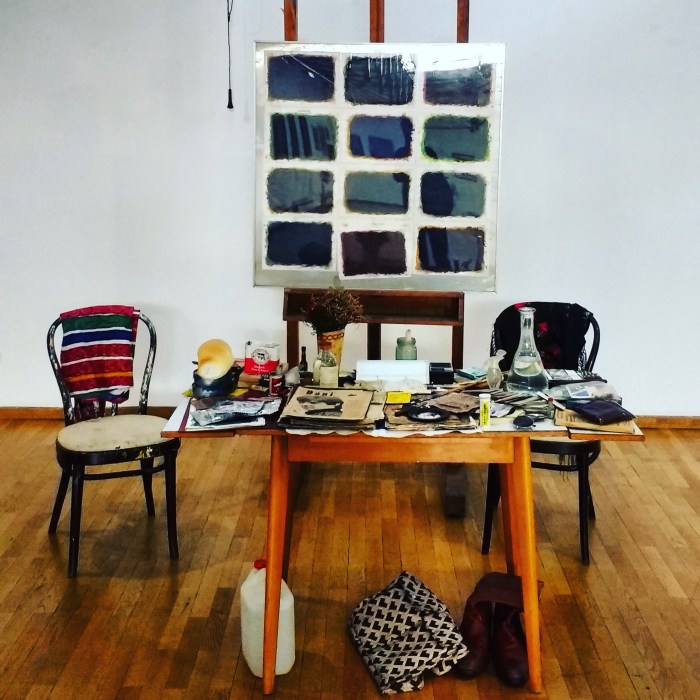
Artist Edin Numankadić features again here. The third work of the “Atelier” segment I am going to focus on is an installation by Numankadić called Traces Of War from 1993. This work is significant since it shows the artist’s studio as it was in Sarajevo when the city was under siege. In the other two works I focused on aesthetics and natural light. In this work, those subjects take a back seat. When you are creating art in a war zone and your city is surrounded, questions such as whether you are going to live or die or when will the war end are always at the fore of the mind’s landscape. There is a perpetual state of tension and anxiety.

IMG_20170920_120344_423

Edin Numankadić: Traces of War (1993)

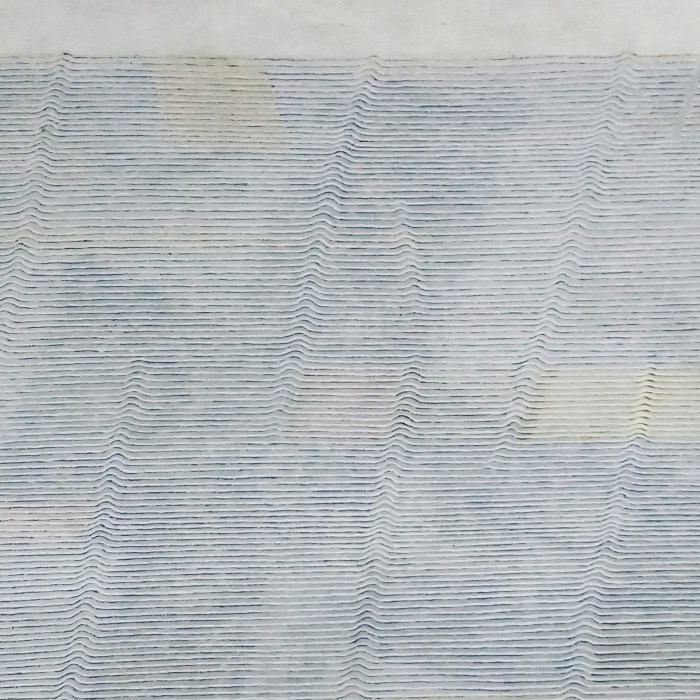
In the “Landscape” theme of the exhibition the Bosnian artist Gabrijel Jurkić’s painting “Blooming Plateau” is an epic wide and open landscape space painting of blooming bright yellow white floors under a pure cloudless ultramarine blue sky. The blooming landscape is punctured with snaking blue streams. Distractions are limited but the space offers one the opportunity to reflect and become connected and in touch with their surroundings; like climbing down from the intellect to the earth. Another painting featured in the same theme is Bosnian artist Bekir Misirlić’s “The White Plateau”. The white minimalism associated with the works of the American artists Robert Ryman and Agnes Martin springs to my mind when I study Misirlić’s painting. The lines on the white background, for me, are the metaphysical counterpart to Jurkić’s “Blooming Plateau” painting. It’s as if Misirlić’s “The White Plateau” is a reading and analysis of the heartbeat and vitality of the blooming plateau field in Jurkić’s work. The lines are rarely disturbed and undulate only at occasional intervals. There is little disturbance and volatility.

IMG_20170920_121908_107

Gabrijel Jurkić: Blooming Plateau (1914)


IMG_20170920_123500_586

Bekir Misirlić: The White Plateau

In the final “Window” section, there is a relief painting by the artist Narcis Kantardzić. Seeing the work from a distance, one could be under the illusion that they are inside one of the traditional old white houses on the Greek island of Santorini. Yet examining the work closer up, the two white buildings on the left and right edges of the painting appear more modern than traditional and the illusion slowly fades away.

IMG_20170920_124249_628

Narcis Kantardzić: Landscape (1986)

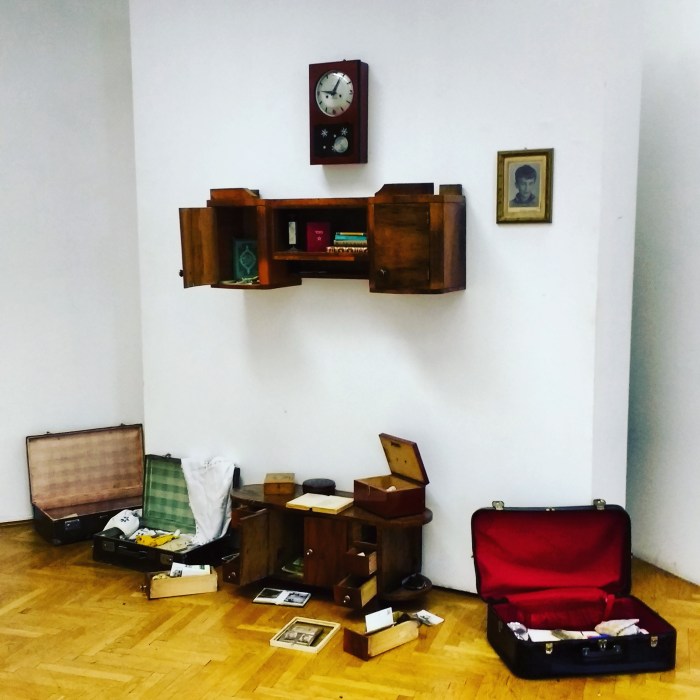
On another floor of the art museum there is a separate temporary exhibition featuring contemporary artists from Sarajevo and Zurich, Switzerland called “Sarajevo-Zurich: Unlimited 2017”. The first work I see on display in the exhibition is an installation entitled “Nostos Algos/Return Suffering” by an artist from Sarajevo called Adela Jusić, who is also a founder of Association for Culture and Art CRVENA, which focuses on various cultural and feminist projects. She is also a graduate of the Academy of Fine Arts in Sarajevo. Her installation recreates a living space comprising of a dated Tito era clock, furniture, a framed black and white photograph of a young boy, and three open suitcases and miscellaneous objects scattered across the floor. The artist lives in a house which she rents from a Bosnian family who fled during the start of the Bosnian war in 1992. The family ended up as refugees in Denmark where they still live. The difference now is that they are not refugees any more but Danish citizens. Once a year the family return to the house they left in Bosnia for a week or two. The objects left behind when they fled the war remain. Even though the family come back for such a short period each year, all these objects which they left behind are firmly connected to their memories. The clock and furniture may remind the family of happy times before the war broke out; of perhaps sitting down to meals together with three generations of family members set around the table. Each object has its own energy and connection to the family and triggers mental pictures of moments and events from the past each time the family return to their former home; returning to what they reluctantly and painfully had to leave behind, due to circumstances beyond their control, and to memories they’d since become detached from as they began their new life in Denmark.

IMG_20170920_125452_896

Adela Jusić: Nostos Algos/Return Suffering (2017)

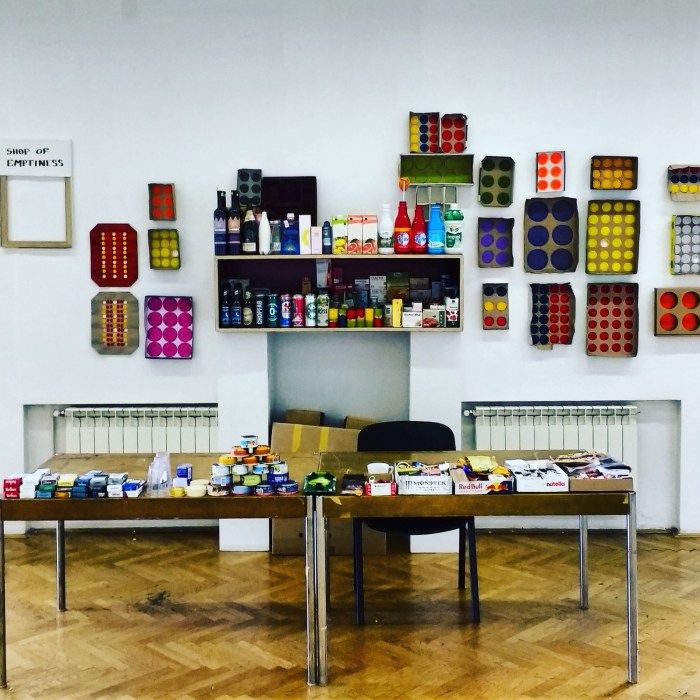
The next work from the exhibition I am drawn to is another installation by the well known Bosnian artist Jusuf Hadzifejzović. His work, “Shop of Emptiness”, features two tables and a shelf with used consumer grocery goods such as empty bottles, tins and cardboard containers (originally used to package these goods) transformed into artworks. Some of Marcel Duchamp’s (arguably the father of Conceptual Art) most well known works are his “readymades”; everyday mass produced consumer objects he appropriated and repositioned, turning them into works of art. Duchamp’s iconic 1917 “Fountain” urinal work is one fine example where he appropriated an everyday nondescript mass produced urinal fountain and signed it “R.Mutt”. In Hadzifejzović’s installation the empty disposable objects he presents are his own little readymades directly connected to his daily life. The curator and writer Jonathan Blackwood describes the displayed objects as “mute witnesses to the life of the artist”. Often when we consume, we consume mindlessly and with no awareness. We take for granted what we are consuming. These mass goods fill a very temporary need or urge and once it has been satisfied we forget about what we consumed and almost automatically dispose of the empty contents with no attachment to them. By retaining the empty objects, at least one can contemplate on them even after, in the words of Blackwood, “their original purpose has been filled”. “Shop of Emptiness” is a mindful report on Hadziferzuvić’s quotidian consumption over a period of time in his life; a meditation on his consumption and the particular memories, feelings and mental pictures each empty object conveys to him when they were consumed during those intervals in time.

IMG_20170920_130458_015

Jusuf Hadzifejzović: Shop of Emptiness (2012-15)

The established young Bosnian artist Bojan Stojčić, who’s also a professor at Sarajevo’s Academy of Fine Arts, has a photographic display series entitled “No Trace Promises The Path”. The photographs are visual extensions of lines from a book of poems of the same name written by Stojčić. Each photograph is a fleeting execution of specific interventions, situations, locations and emotional reactions. Of the montage of different photographs, one photograph is of a border crossing with queueing cars. At the crossing, the artist intervenes with a small vertical slip of paper with the words, “Fear Has No Border”.

IMG_20170920_131338_574IMG_20170920_132117_091

Bojan Stojčić: No Trace Promises The Path (2013-15)

Towards the end of the exhibition, there is a short video installation by the Sarajevo born and Academy of Fine Arts graduate Lana Čmajčanin. Like Adela Jusić, she is also a co-founder and member of the Association for Culture and Art CRVENA. The video, entitled “Geometry of Time”, features 35 different historical maps of the location of Bosnia and Herzegovina from Roman times until the Dayton Peace Agreement of 1995 which ended the war in Bosnia and led to the current formation of Bosnia and Herzegovina. During this time period Bosnia’s borders changed frequently. For over 400 years it was part of the Ottoman Empire, then after it was under the rule of the Austrian-Hungarian Empire before becoming part of Yugoslavia. The fall of Yugoslavia and the ensuing Bosnian war leading to the Dayton Peace Agreement resulted in the current Bosnia and Herzegovina state. The numerous interventions in Bosnia and Herzegovina during its history and the changes in its borders are a reflection on the ambitions and desire for power of its colonisers. Bosnia is a country that has always been colonised, never becoming a colonial power itself. In the video, the country becomes increasingly submerged in blackened marks enfolding all of South Eastern Europe. For a country that has been invaded and colonised throughout its history what do these borders really mean?

IMG_20170920_133026_098

Lana Čmajčanin: Geometry of Time

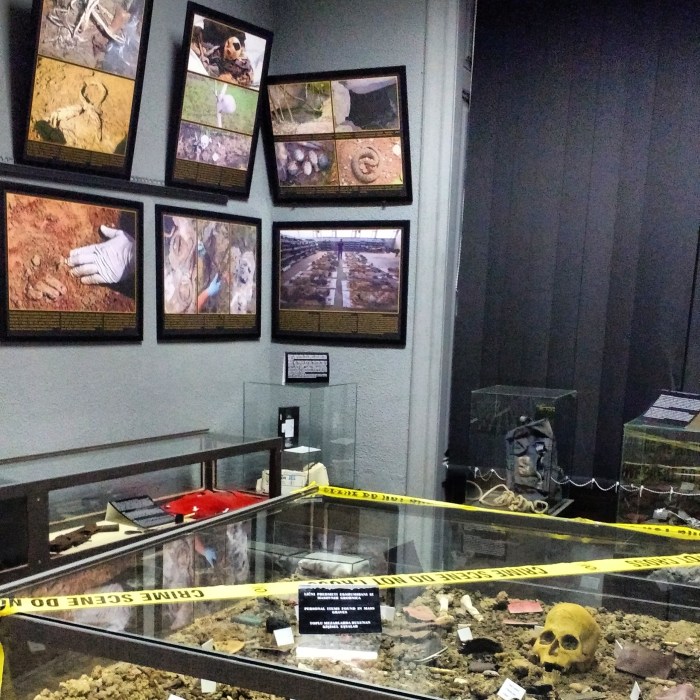
By the main city cathedral, I one day visited Galerija 11/07/95, a memorial gallery preserving the memory of the Srebrenica massacre of 11th July 1995 where over 8,000 civilians lost their lives. The permanent exhibition on display features a series of powerful black and white photographs by the Bosnian photographer Tarik Samarah, which documents the aftermath of the massacre. His photographs include graphic images of the skulls and dismembered bones and body parts of the victims dug up from multiple unidentified mass graves.

TA6
TA6

Photograph by Tarik Samarah from 2002 documenting the aftermath of the 1995 Srebrenica massacre

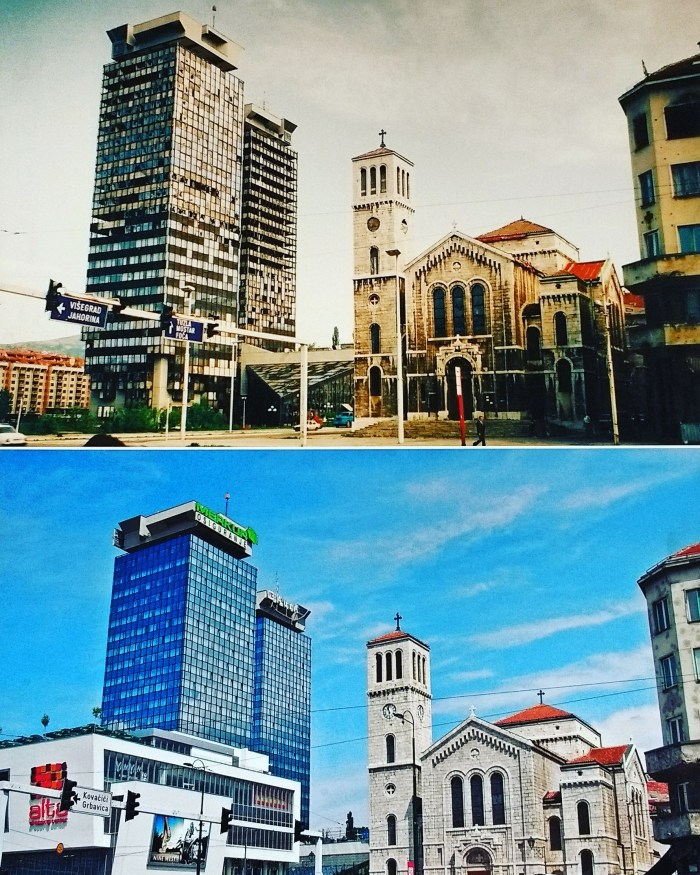
In the History Museum of Bosnia and Herzegovina opposite the American Embassy, I visit another photography exhibition, 15 years, of photographs by the Scottish photographer Jim Marshall. The photographs are of specific locations in Sarajevo in 1996, a year after the Bosnian war, and of those same locations 15 years later in 2011. The photographs from 1996 were taken on a modest Nikon 35mm film camera. The effects of the war are very vivid in these photographs; buildings are badly damaged and the city is scarred and mutilated. Yet slowly civilians were beginning to recover from the traumatic and devastating three year siege of the city and could finally experience a level of freedom which they were long denied. They didn’t need to run or hide any more and live under the constant threat of danger. Civilians could at last travel outside of the city. It was during this time that Sarajevo was beginning to heal.

IMG_20170920_143744_690

Photography by Jim Marshall from his solo exhibition 15 Years

When Marshall revisited the city 15 years later in 2011, he revisited those exact same locations and took new photographs with a digital Nikon camera. The differences are very noticeable. There are now few traces of the war and almost all of buildings which had been destroyed have been transformed and reconstructed.


By Nicholas Peart

Written: October – November 2017

©All Rights Reserved


A World Where Everybody Is An Entrepreneur Doing Something They Love

IMG_0545

This is an article I originally posted on Elixtacy on July 10th 2017


We are currently living in a time of great technological transformations. The internet has created enormous opportunities for individuals, entrepreneurs and businesses. The most clear game changer with the internet is the direct peer to peer contact it offers with all kinds of people from all around the world. It creates a fabulous opportunity to develop an online business or project in something you truly love and enjoy. In the process, you get to directly connect with many different people finding potential fans and clients who appreciate, love and value what you are doing.


Moving away from old Industrial Age model jobs

Currently many people are still stuck in Industrial Age jobs. These jobs are often of a repetitive nature even if, for now, they may provide a stable income and job security. And it could be argued that many people who do these kind of jobs don’t enjoy them (even if they may pretend that they do) and do them purely for the money. Yet these are the jobs most at risk from automation. These are not just jobs in the retail, manufacturing, construction, transport and basic service industries but also high skilled jobs in the legal, financial and, ironically, even tech industries (there will come a time when AI will be able to do most of the programming/data analysing jobs and create better software than humans can).


Tapping into your creativity 100%

When the above scenario occurs, instead of the dystopian reality that many predict, people will have a great opportunity to develop a business or project doing something they truly love. They will be using their creativity 100%. They will have to. They will have no other choice. It will be the most important “commodity” we have to offer. The alternative option is to be part of a society of “useless people” (a most disempowering term) who constantly lament about how they used to have a solid job and no longer have it due to automation. These are people who sadly haven’t tapped into their creative resources and the immense power within themselves. Instead they fail to change/adapt and are constantly stuck in the past. A very sad state of affairs but it doesn’t have to be like this!


The importance of using your initiative

In our current society only a small segment of the population use their initiative. Most people are crippled by fear, anxiety and low levels of self esteem to take the initiative to start their own business or project. They are more comfortable applying for a limited and dwindling supply of jobs. But one day in the future everyone may be forced to use their initiative. Yet it will be by utilising their creative gifts to their fullest capacity. After automation has made obsolete many jobs in existence our creativity will be king and the entire global economy will be full of individual entrepreneurs and startups all utilising their creativity and operating in something they love, which even benefits and contributes to society in a meaningful way. It will be a truly pure and direct sharing economy of people interacting and transacting with their unique services.


By Nicholas Peart

(c)All Rights Reserved

How Artificial Intelligence Can Be Your Friend

IMG_6528

This is an article I originally posted on Elixtacy on July 25th 2017. I have edited the original article.


Much has been said about artificial intelligence or AI. Often people have talked about AI in a very fearful way as something with catastrophic and apocalyptic consequences. Even highly regarded people like Elon Musk and Stephen Hawkings have warned of the potential dangers when AI becomes highly developed and sophisticated. There is no question that AI will develop exponentially and become an enormous industry. It will greatly augment other industries and increase their productivity in unprecedented ways.


What about when AI becomes more sophisticated than humans?

One of the hot topics surrounding AI and the main cause of most people’s concern is, what happens when AI becomes more sophisticated than humans? Most people view such a situation as a threat to humanity and there are perfectly legitimate and rational arguments as to how AI can be a real danger to the human race. But let’s look at AI and it’s potential in a more exciting and positive way. This is a technology, which has the power to change our lives and make our lives better and less gruelling. Already there exists different kinds of AI such as the electronic calculator, speech and image recognition, or the algorithms designed for automatic language translation, spelling and grammar corrections, and the ones tech goliaths Facebook, Google and Amazon use to create our daily news feeds and recommendations respectively etc. The Siri function on your Apple iPhone (or Amazon’s Alexa) is a very embryonic form of the ‘virtual assistant’ type of AI, which will grow and develop at an exponential rate. At some point in the future this kind of AI bot will be your 24/7 multi task virtual assistant, which you’ll be able to have intelligent two way conversations with about virtually (no pun intended!) anything. Based on all your digital data and spoken words, it will help you make all your decisions for you. This virtual assistant bot will help you with all kinds of issues whether they are legal and financial queries, relationship problems and generally try to help you to organise your life and make it more efficient and productive. A SMART Life! In some ways, it could be said that the future of the traditional Google Search engine, where you type what you are looking for, is ‘voice search’. Existing and continually developing search engine algorithms incorporating increasingly sophisticated speech recognition functions will develop into super smart virtual assistants where all quieries are answered and specific links and information to those quieries is provided through the already substantial amount of data and content on the net.


Job automation

People fear that AI will speed up the process of job automation and eventually make all jobs obsolete. This will happen yet it will happen to all Industrial Age, repetitive jobs with little to no creativity. Instead of being fearful, people should be happy. I mean do people enjoy repetitive, humdrum and uninspiring jobs? In our current culture there is this incomprehensible and irrational obsession with work; but work of an often soul destroying kind and not work that people enjoy and which can benefit and change society. AI will eventually automate all forms of repetitive and uncreative work and in the future people will be working far fewer hours.


A Post-Work society and why our creativity and ideas will be king

AI in the distant future will lead to a type of Post-Work society. Yet in these times people will be finally free from monotonous work and will likely be engaging and harnessing their creativity and ideas in doing something they love. Rather than being a threat, AI will be an indispensable and invaluable resource, which will augment, complement and greatly benefit our levels of creativity and ideas and help us to realise with the best results whatever we want to achieve. AI will greatly enhance our creativity and generation of ideas and help us to tap into them in unimaginable ways. And best of all, it will all most likely be free. No need to set aside money for expensive lawyers, financial advisors, planners and accountants. Or even software developers and digital data analysts and marketers. AI will be able to serve you in all these areas at no cost.


By Nicholas Peart

(c)All Rights Reserved

Low (to no) cost high strength satellite internet for every corner of the world

IMG_0759

Ever wondered if there would come a time when every corner of the planet, both on and off land, would be connected to the internet? Elon Musk wants to do just that via a satellite internet network called Starlink as part of his ambitious Space X project (founded in 2002 to further develop space technology and create the conditions for people to live on other planets). Musk plans on launching a Low Earth Orbit (LEO) broadband “constellation” of satellites, which would beam down high speed internet to every part of the globe. Space X is scheduled to start launching these satellites potentially in 2019 and hopes to have all the satellites in orbit and everything complete by 2024.

Musk’s project is not a brand new thing. A 1990s company called Teledesic along with two other companies, Iridium and Globalstar, tried to build a commercial broadband satellite constellation. Yet these companies didn’t succeed and Teledesic suspended its satellite construction work in October 2002. These companies were maybe too ahead of their time, but with the expansion of the space industry over time as well as the advancement of space technology development as more money continues to be invested in it, Musk’s Starlink satellite constellation has a higher chance of succeeding.


The end of cell tower network telecommunications companies?

Over half of the world’s population has internet access and some device to access the internet with, most commonly a smartphone. Yet most people still rely on assorted telecommunications companies to call and connect to the net. Telecommunications companies are still needed as long as their are landline connections, but with the world constantly becoming increasingly mobile and with so many people completely bypassing landlines for smartphones (especially in developing parts of the world where it’s cheaper to buy an inexpensive smartphone or dirt cheap cell phone than install a landline), the services provided by traditional telecommunications companies could potentially be bypassed if Elon Musk’s Starlink satellite internet project really does take off (no pun intended). For now we need these telecom companies as they still provide us with the essential connectivity infrastructure, yet unless they match or better Elon Musk’s ambitious satellite plans, they could encounter huge challenges. Free public internet in assorted public spaces via normal on the ground cell towers is always increasing across the world. Fast developing countries such as India already have free internet in many railway stations across the country (thanks to Google).


Wi Fi from balloons and drones

Google and Facebook both tried to solve the challenge of internet for the entire world. Google tried this via their Project Loon project (“cell towers in the sky”) which via mobile cell towers connected to hot air balloons they tried to connect remote parts of the world to the net. However the problem was that sometimes the balloons would not last in the sky and would soon come crashing down to earth. Facebook tried to solve this via internet powered drones flying above parts of the world lacking internet infrastructure. SpaceX’s project seems the most ambitious yet in solving this challenge.


No need for multiple networks and SIM cards to provide your roaming

If every part of the world is connected to the internet via Space X there could be potentially almost no need to use the services of traditional telecommunications companies (This is, of course, not only dependent on Spacelink succeeding, but on decreasing costs of sending satellites into space). It is always a pain to change SIM cards whenever travelling to a different part of the globe. Even if there are a clutch of competing online telecom startups offering SIM cards that can be used in almost every country and traditional telecom companies are offering services where existing national SIM cards can be used in many other countries (though often at high costs), it is still a rather cumbersome way of connecting the world when one considers all the future possibilities. Sending satellites into space may currently be vastly expensive but as more companies tap into the very nascent space industry and the technology to explore and enter space improves and becomes cheaper and safer, costs for satellite powered internet will go down dramatically. Hopefully Musk’s ambitious project will set a new bar for others to follow suit and maybe even match or better what he is doing.


The end of mobile numbers for instant connectivity

With access to a super fast public internet connection wherever you go in every part of the world, there is no need to even have your own mobile number (even if online video/messenger services like WhatsApp still require it – for now) and anyone from any part of the world can instantly connect to each other. This provides the ultimate instant connectivity transcending all networks and other connectivity services. I suppose with Facebook being the social media site with the highest number of users at close to almost two billion, it’s Messenger service is the closest thing for over 25% of the world to instantly connect and communicate with one another without a mobile number and only an internet connection.

In the wake of this it is crazy to think that for far too long we have relied on a plethera of large global telecommunications to provide us with our daily connections. Of course at this moment, the infrastructure provided by these telecommunications companies are still vital for our daily connectivity and on-the-go roaming. Yet Space X’s Starlink satellite project has the power to revolutionise the way we all connect if most if not all of the world has a state of the art internet connection. Having the entire world connected to the internet you have the quintessential Smart World of every corner of the world connected to the net. What’s more there’s a parity in terms of connection with everywhere having an equally super fast connection. This also has the potential to dramatically speed up the development of developing/undeveloped nations.


By Nicholas Peart

©All Rights Reserved


Other useful links…

https://edgylabs.com/spacex-satellite-network-soon-to-be-named-starlink/
More info on Space X’s Starlink project

Video link below illustrating Space X’s plans to establish satellite internet for the entire world…

How Virtual Reality and Augmented Reality technologies will transform education

49800E9C-A917-4C12-9FF5-CCD0AB3C433A-1385-0000012826A0F745

This is a piece I wrote back in May 2017 on how new technologies could enhance, change and revolutionise the education system


One of the true benefits of virtual reality technology is how it is going to impact education. Already there are online courses offered by educational websites such as Coursera. This is a godsend for those who not only can’t afford physical onsite education, but also for those who don’t have enough time and flexibility to always commute to a physical institution. For some, time is actually more valuable than money.


Digitising the class room

The real game changer will be when all classes and lectures are recorded and then stored online. Some university lectures are already filmed and made available online but I can see this increasing not just with university lectures but also with typical school classes. This is helpful not just for students who are unable to turn up to some classes/lectures but also for students who did attend the classes/lectures yet want to recap on what was already discussed.

If one can’t physically attend classes because they are unwell, they can catch up via the growing archives of recorded classes. Also if they are not too unwell, they can attend a class virtually in live real time via their VR headsets while resting in bed. They can even participate.


On site teachers augmented by AR, VR and virtual assistants

Also whilst being present in a classroom one could use Augmented Reality glasses (the original 2012 Google Glass was the earliest example of this technology), which are poised to be brought to the mass consumer market soon, to enhance the learning experience as the teacher is talking. The AR glasses could have intelligent speech recognition sensors which pick up on everything the teacher is saying and pick up crucial words and sentences and create visual examples in the students field of vision as an extension of what the teacher is conveying. In addition the sensors could contain algorithms which translates everything the teacher is saying into key bitesize points with several links to relevant related websites for further research and reading.

Intelligent virtual teacher assistants, especially one which one could have an intelligent and deep two way conversation with (given time) is the holy grail of VR and AI in truly transforming the education system. This is not to say that teachers are replaceable. On the contrary, truly inspirational teachers will always be needed regardless of the quantum leaps made in the field of AI. It’s just that teachers are human and one can only consort with their teachers for so much time. Whereas with virtual teacher assistants, one has 24/7 access to them. Struggling with some research at 2am and want to talk to talk to someone? Even your favourite teacher will not want to be disturbed at such an ungodly hour yet your virtual teacher assistant will always be available.

The hybrid situation of having both on site human teachers and virtual teacher assistants is more likely to seriously enhance the educational system and one’s own learning development than turn it upside down. As I’ve already mentioned, good inspirational teachers will always be needed but teachers who periodically don’t make the grade and don’t have their heart in educating and empowering their students will struggle against virtual teachers systematically becoming more intelligent as time marches on.


Virtual teachers designed for primary schools

What’s more, I think virtual teacher assistants will be crucial for primary school education. In my view, it is not very wise to expose children under the age of five to too much (if not any) technology. Yet after that age, virtual immersive teacher assistants may truly assist that stage of the education system. Teaching young children can be very challenging and it takes a unique teacher with vast reserves of energy and a special knack to truly connect to them and get their attention. Most of the time teaching children of that age group can be an incredibly gruelling and trying experience. As a result there is sometimes a severe shortage of good teachers. An intelligent and highly interactive virtual teaching assistant which children love to connect with could revolutionise and be a godsend to the primary school sector.


Understanding something better by being totally immersed in it

Children with a short attention span invariably struggle to absorb what a teacher may be trying to get across. Especially if the teacher is explaining things in a boring and uninspired manner. The best way for a child to understand and grasp something is to be fully thrust in that environment. This is where virtual reality can seriously revolutionise the whole education/learning experience. During a history lesson, a film depicting the horrors of the Second World War will likely move most people, but to actually live and feel it vicariously via VR technology could very effectively help people better understand that period of history far more effectively than through books, traditional storytelling and 2D visuals via film and TV.

I think there is a huge market for VR technology to recreate virtually certain periods in history to give people the opportunity to better understand them. In addition to this, there are countless more opportunities for VR (especially when it is more advanced at replicating our sense of touch, taste and smell) to recreate any environments for people to immerse themselves in.


By Nicholas Peart

©All Rights Reserved

Image Source: www.nbnco.com.au


Five Authentic And Good Value Restaurants In Sarajevo

Sarajevo is a fascinating city to explore and get under the skin of. Yet knowing a handful of authentic and inexpensive places to eat at enhances the experience greatly. In this article I am including, of course, a burek and cevapi place, but also a historical eatery serving traditional Bosnian cuisine for a modest splurge (though still very affordable) and a special local patisserie and ice cream parlour for delicious and cheap sweet treats. Let’s begin with the bureks…


1. Buregdžinica ASDŽ

IMG_20170914_204211_765

On a street lined with burekerias, as I like to call them, this small eatery is my pick. The Bosniaks who run it are burek experts with enormous spiral disks of fresh piping hot meat, cheese, potato and spinach bureks ready to go from the morning until the late hours of the evening. I stumbled upon this place by accident on my first night in Sarajevo walking aimlessly in the Baščarsija district. This eatery is a local favourite and for good reason. I settled on a mixture of three not insubstantial spiral slices of meat, potato, and spinach bureks served on a metal plate with lashings of some white yoghurt sauce. And it all came to just 4KMs (2 euros).

IMG_20170916_103135_345

Plate of bureks

Check out the oven. The bureks and other dishes are cooked in giant closed metal pans covered in coals. The meat and chicken with potato dishes are tasty here too but for me this place will always be remembered for its satellite dish sized spiral bureks.

Whilst I was tucking into my bureks, a group of young Bosnians were sitting opposite me. A boy in the group who looked no older than 17/18 fancied himself a homie from Compton. One moment everyone is talking in Bosnian then apropos of nothing the boy riffs in English, ‘I am gonna bust a cap in yo ass n**ga!’. I almost choked on a morsel of spinach burek when I heard that chestnut.


2. Nune

IMG_20170911_131617366

Cevapi at Nune

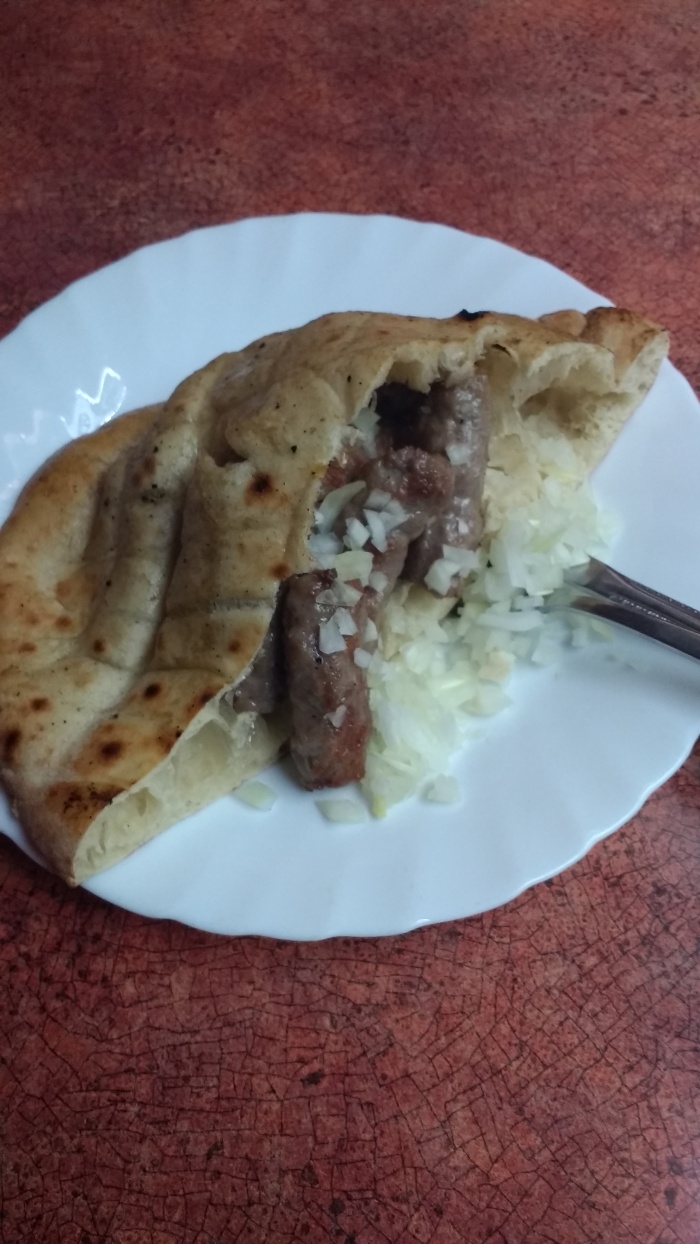
On Ferhadija street past the big cathedral is this small family run cevapi place. It is owned by the father of a young local tour guide named Edin who does superb free daily morning walking tours with the local tour company Meet Bosnia Travel. If you want good and cheap cevapi in a hole in the wall no frills setting this is a good place. For as little as 3KMs (€1.50), you get a plate of small mini cevapi sausages in warm pitta bread and chopped onions.


3. Kod Secka

IMG_20170916_192234_987

This eatery located somewhere in the heart of the Baščarsija district is a solid reference point if you are watching the KMs and have had enough of cevapis and bureks. Kod Secka’s piece de resistance is roast half chicken and potatoes for 5KM (€2.50). It is heavenly. Cheap, tasty and very filling. And a perfect dose of midday rocket fuel for those long walks discovering and unearthing the rich history of Sarajevo.

IMG_0734

Half chicken and potatoes at Kod Secka


4. Inat Kuca

IMG_20170916_190628_985

Inat Kuca restaurant is located in an historic building

This restaurant is located in an old house dating back to 1895 by the main Miljacka river. It serves genuine and tasty traditional Bosnian cuisine. This is a solid restaurant to eat at if you fancy a modest splurge, although compared to similar restaurants in other western countries, the prices are inexpensive.

IMG_20170916_191023_981

“Bosanski lonak”

When I visited, I ordered the “Bosanski lonak”, a delicious traditional Bosnian stew consisting of beef and veal, potatoes, vegetables and spices. It was also beautifully presented in a metal bowl with chopped parsley. For just 10KMs (5 euros) this is a very good deal. Other staples on the menu include the “Sarajevski Sahan” for a few KMs more which is a mix of traditional Bosnian dishes and “Japrak Dolma” which is similar to the Polish dish “Golabki” and consists of minced meat, veg and rice wrapped in cabbage leaves.

IMG_20170916_191447_678

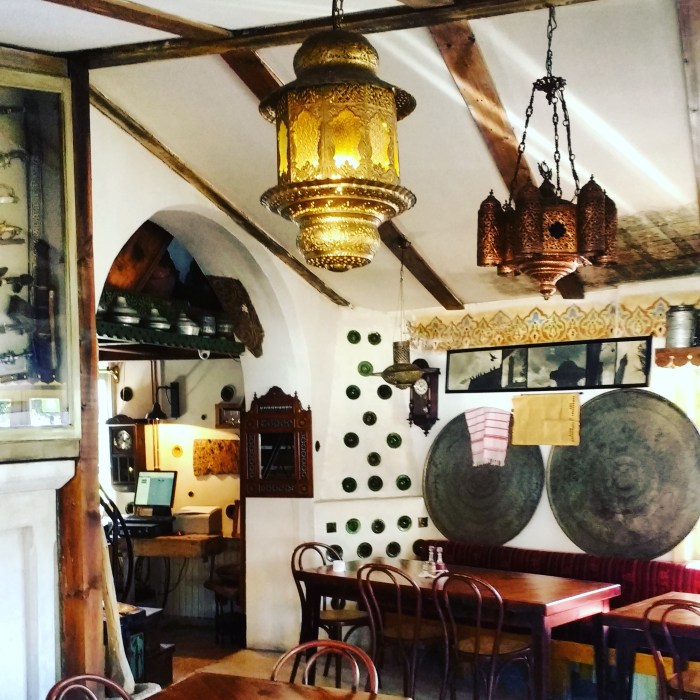
On a blue day it is delightful to sit at a table on the outside terrace facing the river. But inside, the restaurant is aesthetically very tasteful in the old Ottoman era style; beautiful Turkish copper lamps hang from the ceiling and other Ottoman style artefacts and old black and white photographs adorn the walls.


5. Slasticarna Egipat

IMG_20170914_201200_671

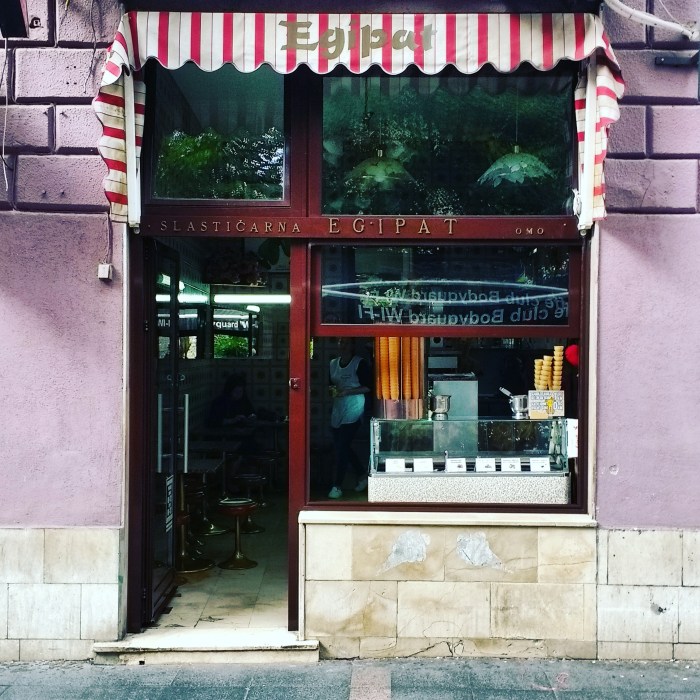
This Macedonian owned family patisserie has been serving customers since 1949

Ice cream parlours and sweet shops are plentiful in the city but not many can match the authenticity, quality, spirit, and even prices of this local ice cream parlour and patisserie run by a Macedonian family. Located on Ferhadija Street like Nune, this sweet treats place has a history dating back to 1949. Entering Egipat is like travelling back in time to former Yugoslavia of the Tito era during the 1960s and 70s. The walls are covered in retro tiles and it is a corner of the city unaffected and little changed by rampant globalisation.

IMG_20170911_205934726

The spirit here is purely local and reminds me of the old school Jewish bagel shops on Brick Lane in the East End of London. And like those bagel shops, the service can sometimes be indifferent and abrupt but we wouldn’t want it any other way.

IMG_20170911_210330035

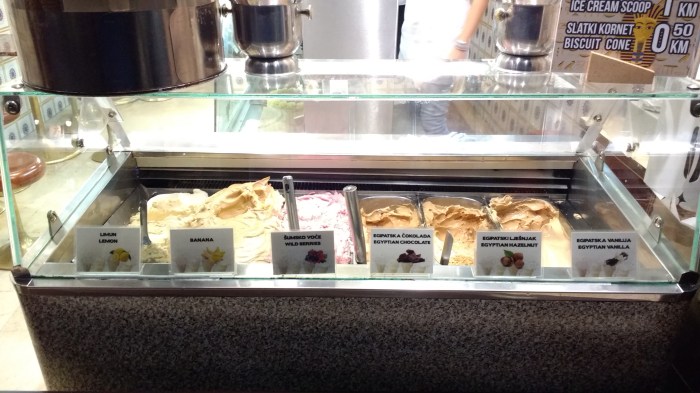
There are six flavours of homemade ice cream. On two occasions I tried the “Egyptian Vanilla” and “Egyptian Chocolate”. Both were excellent and have a flavour and texture that is different to any other kind of ice cream I’ve ever had. But I must warn you the sugar content is off the scales but who cares with ice cream this good. Since tasting their ice cream, I made many repeat visits to sample some of their traditional cakes and other local sweet delights.


Sampita is a very sweet Bosnian white cake, like the French Ile Flotante but much heavier with more texture and flavour and less anaemic; a dangerous sugar bomb. The čokoladni rolat is an irresistibly decadent rich and creamy chocolate roll. I also had some rich and tasty heavy cream and chocolate cake. And they also have the famous traditional Turkish baklava cake, which can be found throughout the country owing to its Ottoman past. A scoop of ice cream like most of the other ice cream parlours of Sarajevo will set you back only 1KM (50 cents) and most of the cakes can be purchased for just half a KM more per slice.


By Nicholas Peart

©All Rights Reserved


Sarajevo History and Wonderings

IMG_20170916_185628_858

Visiting Sarajevo was an enriching and memorable experience. Even though I am a seasoned traveller who has already traversed across a sizeable chunk of this crust, Sarajevo impressed and inspired me. This city gave my accumulated travel experiences another exotic dose of red hot spice. Sarajevo is sometimes referred to as the “Jerusalem of Europe” owing to its rich multi religious and cultural history.

I stayed at a modest but homely and warm family guesthouse located up on a hill in the Bistrik district south of the Miljacka river and only a few minutes walk from the Ottoman era Baščarsija old bazaar district. This historic district was constructed in 1462 by the Ottoman Empire general Isa-beg Ishaković just after the Ottomans arrived. Before they arrived, the biggest settlement then in Sarajevo was a village square called Tornik located today at the junction between Marsala Tita and Relisa Dzemaludina Čauševica streets where the Ali Pasha mosque is situated several blocks west of the Baščarsija district. Ishaković built a mosque named “Careva Džamija” (the Emperor’s Mosque) in 1457, which is the oldest mosque in Sarajevo. The original structure was destroyed by the end of the 15th century before being rebuilt in 1565.

IMG_20170912_225945_504

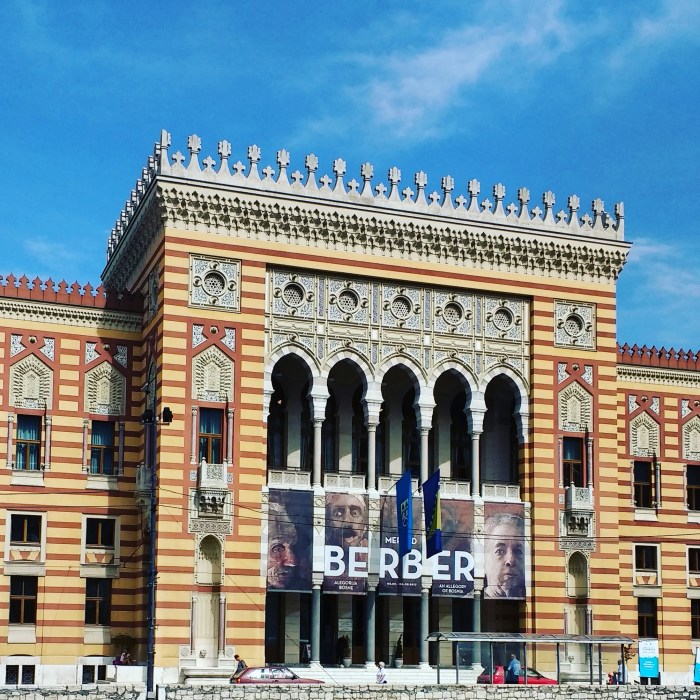
Sarajevo City Hall

Crossing over the Miljacka river and walking past the large Moorish style City Hall building, I commenced my adventure through the old Baščarsija streets. Most of the places along the first street I walked across are small eateries selling bureks; spiral pastry pies filled with potato, meat, cheese, or spinach and even pumpkin. On my first evening in Sarajevo, I took a chance on an authentic looking burek place with a magnificent open coal oven where the bureks and other specialities are cooked in large closed circular pans covered in crushed coals. The bureks here at Buregdžinica Asdž are very good and cheap.

IMG_20170914_204211_765

Buregdžinica Asdž: Great burek eatery in the Baščarsija district 

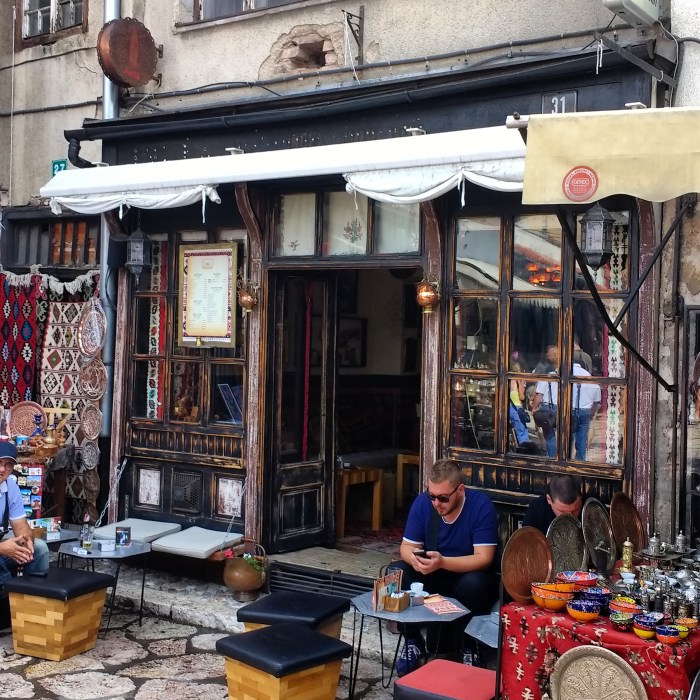
I venture down another smaller street and the oldest street in Baščarsija named Kazandžiluk street, better known as “Coppersmith Street” where small shops sell copper cups, plates, bowls and tankard-like jugs. Walking through this street feels like walking through one of London’s medieval streets around Fleet Street or St Bartholomew’s church with an Arabian tinge. At the end of this street there is an antique wooden coffeehouse where you can drink authentic Bosnian coffee.

IMG_20170912_223935_639

Coppersmith Street: the oldest street in Baščarsija 


IMG_20170912_224223_522

On Coppersmith street


IMG_20170912_225519_706

Wooden coffeehouse on Coppersmith street 

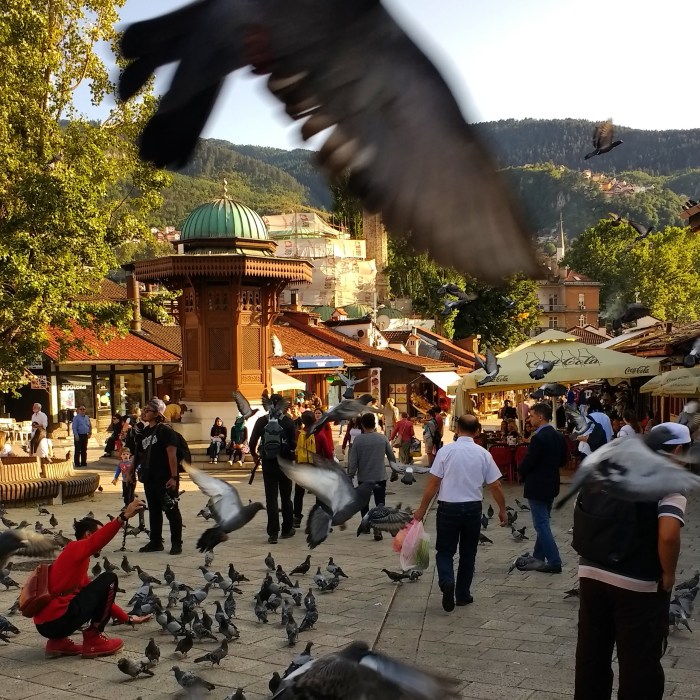
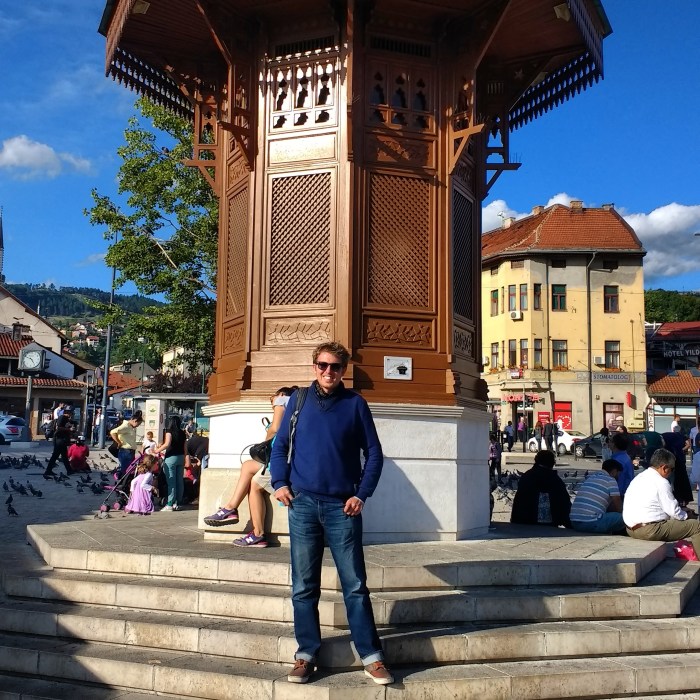
Anyone who visits Baščarsija will unavoidably cross paths with the main square or Pigeon Square as it’s sometimes better known as, because of the large concentration of pigeons at any given moment just like in London’s Trafalgar Square. In the middle of this square is an old Ottoman style wooden fountain called the Sebilj. It was originally built by Mehmed Pasha Kukavica in 1753 and then in 1891, during the Austrian-Hungarian era, it was repositioned by the Austrian architect Alexander Wittek.

IMG_20170914_185348_719

“Pigeon Square”: The main square in Baščarsija 


IMG_20170914_105342_399

By the Sebilj

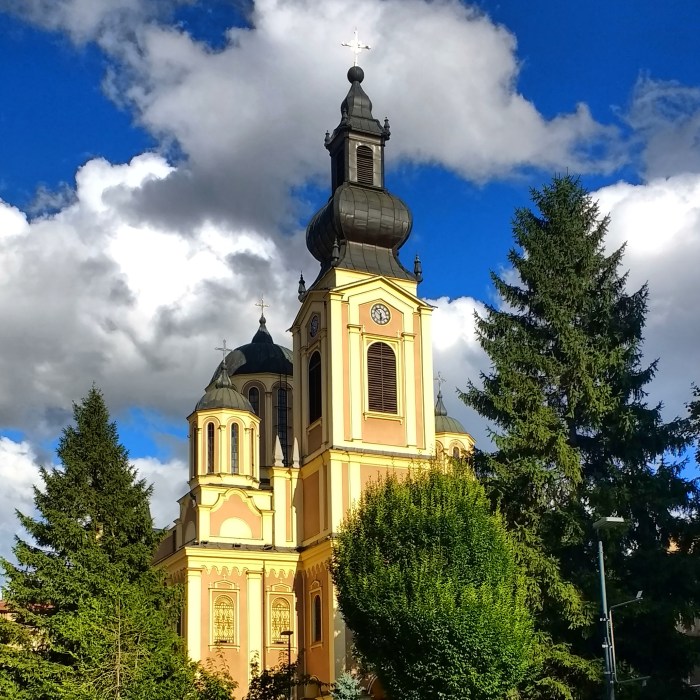
Close to the Sebilj on Mula Mustafe Baseskije street is the old Orthodox Church of the Holy Archangelo Michael and Gabriel. It is a Serbian Orthodox Church and the oldest church in the city dating back to 1539 (although it’s original structure may date back even earlier).

IMG_20170912_223321_308

Old Serbian Orthodox church: The oldest in the city dating back to 1539

An integral part of my experience in Baščarsija was delving into the area’s history associated with Gazi Husrev-beg. Gazi was born in 1480 in Serres, Greece where his father, Ferhad-beg, was a governor. From 1521 until his death twenty years later in 1541, he was the Ottoman governor of Bosnia and had contributed immensely in the establishment of the city of Sarajevo. By the time of his death, Sarajevo had already developed into a thriving and successful trading center at the crossroads between east and west. He had invested most of his fortune (his endowment or ‘waqf’) towards the development of the city and was a great philanthropist and humanist who cared deeply about the welfare of his people.

IMG_20170914_191230_060

Gazi Husrev Beg mosque: built in 1531 and the largest in the country 

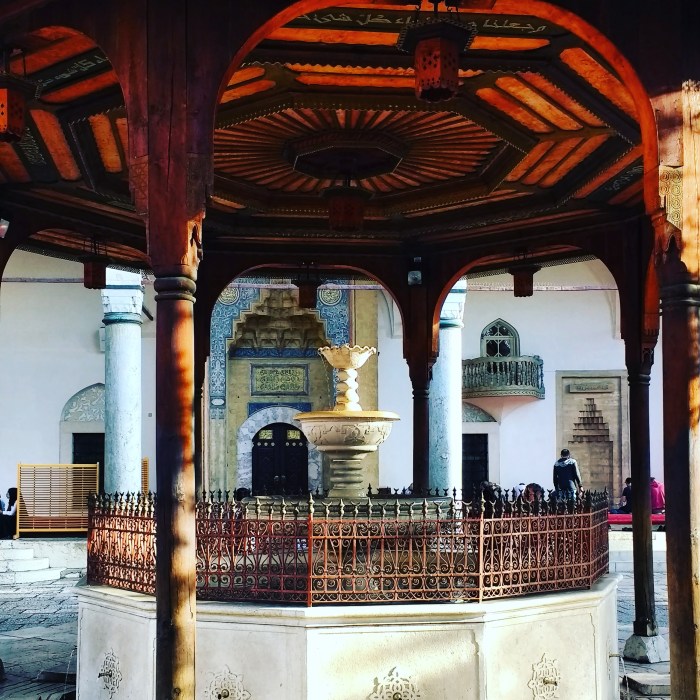
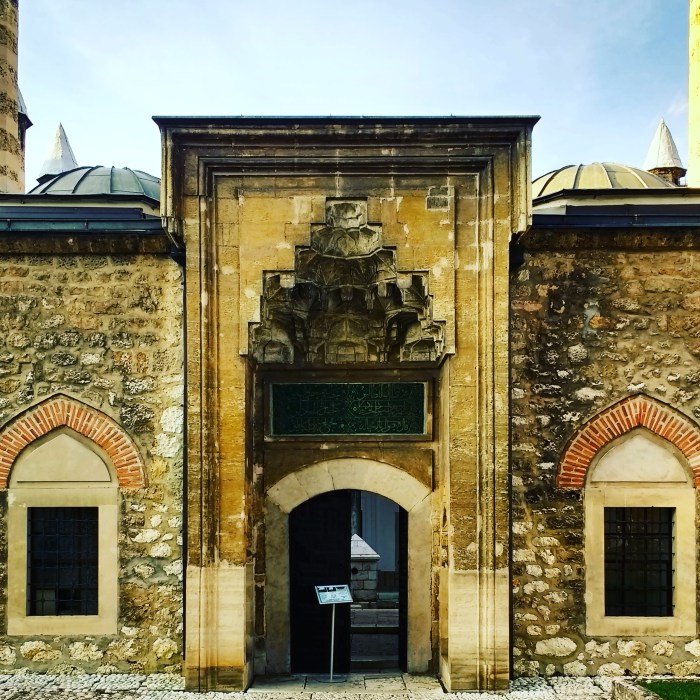
The most notable landmark associated with Husrev beg is the Gazi Husrev beg mosque built in 1531 and located in the heart of Baščarsija. It is the largest mosque in Bosnia and Herzegovina and an outstanding example of Ottoman architecture from that time. Within the mosque compound in the courtyard is an old fountain (‘shadirwan’) similar to the fountain in the main square yet this fountain is over 200 years older dating back to 1530. Situated on the west side of the mosque is the tall stone Sahat Kula clock tower built in the 17th century. It was restored after being damaged in a fire in 1697. The clock shows the lunar time meaning that the day ends at sunset after which a new day begins. Close to the clock tower, there is a water system created by Husrev beg for the city (he also built a public toilet in 1529 which back then was very rare) where the water was transported via ceramic pipes from a wooden aqueduct under the ground. Even today the water system is still in operation and locals (and tourists) continue to come to the fountain to drink the water. I drank from the fountain and I have to say that the water is some of the purest and freshest I’ve ever tasted. Also within the mosque complex is Husrev beg’s mausoleum.

IMG_20170912_230829_607

The Sahat Kula clock tower


IMG_20170914_191451_218

The old ‘Shadirwan’ fountain by the Gazi Husrev Beg mosque dating back to 1530


IMG_20170916_182453_540

The mausoleum of Gazi Husrev Beg


IMG_20170916_184526_891

Drinking from the Gazi Husrev Beg fountain. The water is excellent and comes from the oldest water system in the city dating back to 1529 and engineered by Gazi Husrev Beg

Opposite the mosque is the Ghazi Husrev beg Madrassa (or learning institute) built and established in 1537 for the education of the local population. Husrev beg stated that any money remaining after the madrassa had been built should go towards buying good quality books for the madrassa. Today the collection of those original books is housed in the new modern Gazi Husrev beg library which opened in 2014 and was financed via a $8m grant from Qatar. Within the old madrassa complex is the small Ghazi Husrev beg Museum, which is an excellent place to learn and understand more about him and his unique and generous contribution to the city of Sarajevo.

IMG_20170914_193300_826

By the entrance of the old Gazi Husrev Beg Madrassa which today houses the Gazi Husrev Beg museum 


IMG_20170918_205421_429

Gazi Husrev Beg museum 


IMG_20170918_210358_407

Gazi Husrev Beg library 

Yet the Gazi Husrev Beg journey isn’t over yet. Halfway between the mosque and the Sebilj is the Morića Han which was a ‘caravanserai’ or roadside inn. In its day it was able to accommodate as many as 300 travellers and 70 horses. It was built in 1551, 11 years after Gazi’s death, and funded using his endowment or ‘vakuf’. Since during this time Sarajevo was an important international trading centre, it was important to establish lodging facilities to accommodate travelling traders who travelled long distances via their horses often from other parts of the Ottoman Empire (which around the time the inn had been built had covered all of modern day Turkey and other parts of the Middle East, North Africa and almost all of south Eastern Europe). Today the Morića Han is transformed into a lovely historic courtyard with cafes and a small market bazaar selling textiles and various crafts.

IMG_20170916_185027_927

By the outside of the old Morića Han


IMG_20170914_193658_322

Inside the courtyard of the Morića Han 

Heading towards the western edge of Baščarsija is Gazi Husrev Beg’s Bezistan which is an indoor bazaar. The original structure of the bazaar was likely built around 1540 financed via Gazi’s endowment. During the period of the Ottoman Empire, the shops inside the bazaar traded textiles. Running parallel to the Bezistan is the old goldsmith street (Zlatarska) today known as Gazi Husrev Begova street where goldsmiths and jewellery shops owned by metal workers sold gold and silver jewellery.

IMG_20170916_182955_202

The entrance of Gazi Husrev Beg’s Bezistan 


IMG_20170917_155209_613

Inside Gazi Husrev Beg’s Bezistan


IMG_20170917_160327_441

The old goldsmith street of Baščarsija

The ruins of the original Tašlihan stone inn, constructed around the same time as the Bezistan to accommodate travelling merchant traders like the Morića Han, can be found in the summer garden of the historic Hotel Europe.

IMG_20170917_155827_812

The ruins of the original Tašlihan stone inn

Leaving the Baščarsija and the eastern Ottoman part of the city we literally cross over to the western part of the city over the “East-West: Sarajevo Meeting of Cultures” line.

IMG_20170916_212204_775

The “East-West: Sarajevo Meeting of Cultures” line marking the border between the Ottoman eastern part of the city and the western part of the city  

Our first port of call is the old stone Jewish synagogue built sometime towards the end of the 16th century. Since it’s establishment it was damaged several times before being reconstructed again. The current physical structure of the synagogue dates back to 1813. In 1941 it was raided and occupied by the Nazis and subsequently demolished. The Nazis detained Sarajevo’s remaining Jewish community here before they were taken to concentration camps. After enormous reconstruction, in 1966 the synagogue was turned into the Jewish Museum of Bosnia and Herzegovina.

IMG_20170918_202453_405

The old stone Jewish synagogue. In 1966 it was turned into the Jewish Museum of Bosnia and Herzegovina

Inside the museum, there are various artefacts and fragments of traditional Jewish life in Sarajevo. There are moving and poignant displays and photographs from the time of the Nazi occupation in Sarajevo. Some of the written displays include stories of gifted Jewish teachers and intellectuals in Sarajevo whose lives were cut short by the Nazis. There is one black and white photograph from 1941, when it was a very dangerous time to be a Jew in Sarajevo (as in many other parts of Europe), showing a Jewish mother and her two children walking alongside two Muslim women. The Muslim woman in the right of the photograph is covering the Jewish woman’s Star of David symbol which she is wearing on her left arm.

IMG_20170918_204615_709

Paraphenalia in Sarajevo’s Jewish museum dating back to WW2 when the Nazis occupied Sarajevo and the city’s Jewish population was rounded up and sent to concentration camps. The postcards in the photograph are postcards from the concentration camps 


IMG_20170918_204955_000

Black and white photographs of captured Sarajevo Jews 


IMG_20170918_203831_130

Photograph dating back to 1941 showing a Jewish mother and her two children walking alongside two Muslim women. The Muslim woman on the right of the photograph is covering the Jewish woman’s Star of David symbol which she is wearing on her left arm

The history of the Jewish community in Sarajevo (and the rest of Bosnia and Herzegovina) dates back to 1492, the year when Christopher Columbus discovered the New World, and also the year when the first wave of Jews arrived in Bosnia escaping the Spanish and Portuguese Inquisitions. They were welcomed by the Ottoman Empire ruler of the time, Sultan Bayezid II. In the time when Bosnia and Herzegovina was part of the Ottoman Empire, the Jewish community prospered and were well-treated living peacefully with the Bosnian muslims. They had a large amount of freedom and rights including the right to buy property and land and establish trade in any part of the Ottoman Empire. By 1856, a law was passed within the Empire granting Jews (and other non muslims) full equality. The Jewish community continued to flourish during the subsequent Austrian-Hungarian Empire rule until the beginning of World War One. The rise of Nazism and the Second World War caused many Jews to flee Sarajevo and Europe. By 1940 there were around 14,000 Jews in Bosnia of which 10,000 were in Sarajevo. When former Yugoslavia was invaded by the Nazis in April 1941 most of the remaining Jewish population were deported to Auschwitz or concentration camps in Croatia. After the war, most of the Jewish survivors emigrated to Israel. Today only about 1000 Jews are living in all of Bosnia and Herzegovina. If you have some time, I recommend a visit to the city’s Jewish cemetery located outside of the city. The local tour agency Funky Tours combine a visit to the Sarajevo Tunnel Museum with a visit to the cemetery.

IMG_20170920_181401_177IMG_20170920_175404_100

Photographs from Sarajevo’s Jewish cemetery. You can see the effects of the 1992-5 Bosnian War from the shelling marks on the gravestones 

The western part of the city is full of elegant and ornate buildings dating back to the era of the Austrian-Hungarian empire hand in hand with austere, brutalist architecture from the post WW2 communist Tito years. If you look closely, you may notice many buildings still scarred by intense shelling when Sarajevo was under siege during the Bosnian War from 1992-5. You may also see shelling scars on the streets you walk on. Some of these scars are painted red and known as ‘Sarajevo Roses’ marking the location where civilians died from mortar explosions during the war.

IMG_20170916_111920_605

Architecture dating back to the time of the Austrian-Hungarian empire 


IMG_20170916_112711_678

Brutalist architecture in the city 


IMG_20170914_195632_138

Scars from the 1992-5 Bosnian War


IMG_20170916_102041_722

‘Sarajevo Roses’: red painted street scars from the war marking the locations where civilians died from mortar explosions during the war

On the corner of Obala Kulina Bana street by the main river and Zelenik Beretki street is the Museum of Sarajevo 1878-1918 and the location from where the young Bosnian revolutionary Gavrilo Princip assassinated Archduke Franz Ferdinand who led the Austrian-Hungarian empire. His assassination was the catalyst for the First World War and the collapse of the empire. The museum documents the period of Austrian-Hungarian rule in Sarajevo as well as the assassination featuring photographs of the Archduke with his wife in their car after they were both shot, and original artefacts like the trousers Gavrilo Princip was wearing and the gun he used to assassinate the archduke.

IMG_20170914_194902_827

At the location from where Gavrilo Princip assassinated Archduke Franz Ferdinand


IMG_20170918_201517_069

Inside the Museum of Sarajevo 1878-1918 which houses the trousers Gavrilo Princip was wearing and the gun he used to assassinate the Archduke


IMG_20170918_201831_563

Original photograph of the Archduke with his wife in their car just after they were both shot

Walking back towards Ferhadija street and west, you will eventually come face to face with the Sacred Heart Cathedral of Sarajevo, which is the largest cathedral in Bosnia and Herzegovina dating back to 1884, only a few years after the city came under Austrian-Hungarian rule. Viennese contractor Baron Karl Schwarz along with supervising architect Josip Vancaš designed the cathedral in a neo-Gothic style.

IMG_20170917_162545_706

The Sacred Heart Cathedral of Sarajevo: the largest cathedral in Bosnia and Herzegovina dating back to 1884

Close to the cathedral is the Orthodox Church of the Most Holy Mother of God, which faces Liberation Square. Here you will see locals playing chess like they have all the time in the world; un-restless and un-hurried.

IMG_20170916_181047_958

Orthodox Church of the Most Holy Mother of God


IMG_20170916_181427_860

Chess on Liberation Square

Not far from the square is the Museum of Crimes Against Humanity and Genocide which the documents the 1990s war in Bosnia and Herzegovina. Amongst the many photos documenting this horrific period there is a display of a dug up mass grave where one can see a human skull, bones and miscellaneous scattered personal items. During the war 34,946 civilians went missing in Bosnia and Herzegovina and more than 5,000 locations containing body parts and mass graves have been discovered across the country. Through conventional methods of clothes/items recognition and more advanced DNA analysis, about 23,000 victims have been identified. Yet around 7,000 people as of today are still missing. Elsewhere there is a display of torture methods and devices used on victims during the war. On one wall there are graphic photographs of victims exposing shocking injuries inflicted on various parts of their bodies and photographs of war refugees cramped and lying on the floor of a building in sleeping bags to keep warm. On another wall there is a framed letter from Arnold Schwarzenegger to a Bosnian heavy weights star who lost members of his family in the war. In the letter Arnold tells him, in spite of all the trauma and destruction from the war, to move forward and take care of his mother. He also mentioned enclosing gifts in the letter. As I near the end of the Museum there is a sculpture of a man made from slices of bread by Mensud Kečo dedicated to the victims of the May 27th 1992 bread queue massacre. 26 civilians were killed and over 100 were wounded as they queued for bread on Ferhadija street.

IMG_20170917_163559_353

Mass grave display at the Museum of Crimes Against Humanity and Genocide


IMG_20170917_164007_828

A sculpture of a man made from slices of bread by Mensud Kečo dedicated to the victims of the May 27th 1992 bread queue massacre on Ferhadija street

To gain a good understanding of the Siege of Sarajevo, I embarked on a half day tour with Funky Tours. My guide was a middle aged man named Adnan who experienced and lived through the siege and was injured in his hip by flying shrapnel. With his unique experience he is also a charismatic and engaging guide, and it was riveting to listen to his stories. On this tour we visited the Sarajevo Tunnel located on the outskirts of the city. It was built discreetly by the Bosnian Army to link the neighbourhoods of Butmir and Dobrinja. At the time the entire city was surrounded by the Bosnian Serb army and it was very difficult to escape. Civilians were trapped and the tunnel enabled them to flee and get access to essential humanitarian aid. Today the house whose cellar acted as the entrance to the tunnel has now been transformed into the Sarajevo Tunnel Museum. When we entered the house we walked down the narrow 20 metre length portion of the original tunnel from its entrance. Inside the house there are photographic displays and War artefacts like military uniforms and equipment and also some examples of the humanitarian aid and food staples smuggled via the tunnel.

IMG_20170918_015519_109

By the Sarajevo Tunnel Museum


IMG_20170918_015810_237

Inside the Sarajevo Tunnel

Afterwards, Adnan drove us to the bobsleigh track built for the 1984 Sarajevo Olympics. Eight years later from the start of the Bosnian War, the track was destroyed by the Bosnian Serb Army and also utilised as an artillery position. Today the track is a heavily graffitied relic. One area of the track has been graffitied with the image of a young girl crying wearing a yellow shirt with a flower. She’s holding two signs in each hand. The right sign features the John Lennon and Yoko Ono slogan ‘Give Peace A Chance’ whilst the left sign continues the sentence with ‘For All Kids’.

IMG_20170918_021526_297IMG_20170918_020843_545

Bobsleigh track photographs


IMG_20170918_020305_243

View over Sarajevo 

Close by the track we stopped at the side of a mountain road from where we had an incredible vista of the city of Sarajevo and its surroundings. All of the city is located in a valley surrounded by mountains. As magnificent as the scenery is, the heartbreaking truth is that such as setting made it relatively easy for Bosnian Serb Army troops to almost completely surround and lock the city.


Text and photographs by Nicholas Peart

©All Rights Reserved


Visiting Mokra Gora and Višegrad

IMG_20170907_191723_373

The countryside of Serbia is truly extraordinary. After experiencing Belgrade, I decided to spend a week in the southern Serbian mountain town of Zlatibor. At around a kilometre above sea level, it has a cooler climate and made a welcome change to the melting Satan-hot summer temperatures of Belgrade. It has been said that Zlatibor has some of the cleanest air in all of Europe. Zlatibor is a resort town and is a very popular skiing destination for Serbians in winter. For a week I had my own mini studio-cube apartment at the top level of a warm family home on the outskirts of town.

Zlatibor is also a launchpad from which to visit the region’s surrounding areas of which there are many gems. However without your own vehicle it can be challenging to visit these places. Fortunately I met a very interesting and knowledgeable young man named Bogdan who has his own small tour business. It was already the beginning of September when I arrived in Zlatibor and by then much of the peak August crowds had left meaning the town wasn’t over crowded and finding/extending accommodation was never a problem.


Mokra Gora

One day I embarked on a day tour with Bogdan and a small group of Serbian tourists to the nearby region of Mokra Gora close to the Bosnian border. Mokra Gora is an authentic and traditional slice of the Balkan country with some magnificent vistas. For the first leg of our Mokra Gora excursion, Bogdan drove us from Zlatibor to Mokra Gora railway station, from where we would travel on an old school train on the short but memorable Sargon Eight narrow-gauge railway line. This line was originally built in 1921 just after the First World War. It took four years to build and is over 15km long. The construction of the line was increasingly gruelling and often life threatening. 3,000 – 5,000 workers were involved in its construction and 200 died. As well as laying down the track, 22 tunnels and 5 bridges were built to make way for the line. The longest tunnel has a length of 1669 metres.

IMG_20170906_124317_173

By the Ćira train on the Sargon Eight narrow-gauge railway line

Rather tragically, not long after the railway line was completed, it became abandoned and defunct. It was only in 1999 when it re-opened as a tourist attraction. The classic and vintage narrow gauge train is known as the “Ćira” train. Being on this train brings back happy childhood memories of riding the famous Bluebell Railway train in East Sussex. The spirit of Thomas the Tank Engine throbs. All that is missing is Ringo Starr. I can imagine him being the conductor of that train in another life, taking ample swigs from a cheap bottle of plum rakija in the colder winter months whilst entertaining passengers with off-beat anecdotes via the tannoy.

IMG_20170906_121447_712

Mokra Gora

The landscape and views throughout the train journey are sublime. It is a true joy to ride on this train and simple stare and marvel at the fertile green mountain scenery. All that hard graft to build the railway line was not all in vain. The first station we stop at is called the Ninth Kilometre. It is so-called since there are nine kilometres between the station and the Bosnian border. Then we stop at Jatare Station. Here I take a short hike up a small rocky hill with a young Serbian couple from Belgrade for some lovely vistas. Jatare used to be a water station and resting place and is also known by the fact that not one ticket was ever sold at the station.

IMG_20170906_124656_212

In Jatare with some Serbian friends

We make a few more stops to admire the country scenery before returning to Mokra Gora station where we are reunited with Bogdan. From here we travel to a nearby small village called Bela Voda, which is well known for its natural spring with healing water. The water is known to cure and treat skin diseases. What is also unique about the water here is it is highly alkaline with a pH of 11.5 and is ranked as 5th in the world in terms of its pH level. In addition to treating skin diseases, the water can be drunk in small doses and can cure stomach ulcers and gastritis. It is good for digestion and is also known as ‘eye water’ since it can treat eyelid inflammation.

IMG_20170904_131838946

Bela Voda

Bela Voda is a paradise of a place with an attractive cherry-red stone church by the water stream, which augments the beauty and etherealness of this special village. I fill my empty bottle with some of this water from the well. Nearby there are wooden huts that are available to rent. I think to myself how delightful it would be to spend a long summer here completely forgetting any notions of time and space.

IMG_20170904_153221402

Drvengrad

From Bela Voda, Bogdan drives us to a hillside village not far from Mokra Gora railway station called Drvengrad. This completely wooden village was built by the Serbian filmmaker Emir Kusturica for his 2004 film Life Is A Miracle. It’s a unique, brilliant and unusual place with small streets and squares named after famous filmmakers, writers, visionaries, revolutionaries, sports-stars etc. I’ve written a separate article on the wonders of this magical place in another article which can be viewed here.


Višegrad

Early in the morning the next day, I meet up again with Bogdan for another tour this time visiting the historical Bosnian town of Višegrad. Višegrad is famous for its landmark Ottoman-era Mehmed Paša Sokolović Bridge, which is a UNESCO world heritage site and was the bridge immortalised in the Nobel prize winning writer Ivo Andrić’s novel The Bridge On The Drina. It is also the site of another village complex built by Kusturica called Andrićgrad after Ivo. Unlike Drvengrad, this village is completely made from stone and there is a statue of Andrić.

IMG_20170907_180212_247

Dobrun monastery

Before crossing the Bosnian border, we make a stop at the old monastery of Dobrun, which was constructed in 1343 by Duke Pribil and his sons Stefan and Peter. Originally all of the interior of the monastery was decorated with frescoes. Today, just a fraction of those original frescoes survive. Fortunately the one of Tsar Dušan with his wife Jelena and their son Uros still remains. Tsar Dušan, who was also known as Dušan the Mighty (born in 1308 – died on 20 December 1355), was the King of Serbia from 8 September 1331 and the Emperor of the Serbs and Greeks from 16th April 1346 until his death in 1355. This was the golden age of Serbia and at the time of his death, the Serbian Empire included most of modern day Greece, Albania and large swathes of former Yugoslavia.

IMG_20170907_182332_396

14th century fresco of Tsar Dušan with his wife Jelena and their son Uros inside the monastery 

Unfortunately since the era of Tsar Dušan, the monastery was under attack on several occasions. The first attack came in 1393 when the Ottoman Turks occupied Bosnia. Yet it faced the greatest destruction during the Second World War when it was used by the Germans to store ammunition. On their withdrawal in 1945 at the end of the war, they blew up the monastery. It was restored the following year. In spite of the monastery’s turbulent history, it is a handsome and immaculate building in beautiful surroundings. The decoration of the front facade of the monastery is a work of art.

Afterwards we cross the border and head to Višegrad. In 1454 Višegrad was conquered by the Ottoman Empire headed by Osman Pasha. The town remained under the empire for over four centuries until 1878 when the Austro-Hungarian Empire controlled Bosnia and Herzegovina. More recently, the town suffered greatly during the Bosnian War from 1992-5. Much of the town was bombarded by JNA (Yugoslavian National Army) troops and many houses were destroyed and an estimated 3,000 Bosniaks were killed.

IMG_20170907_191723_373

The landmark Ottoman-era Mehmed Paša Sokolović Bridge in Višegrad

Most of the arches of the famous bridge were badly damaged (and some even completely destroyed) during both world wars. The bridge was also the scene for the killing of hundreds of Bosniaks by Bosnian Serb forces during the Bosnian War.

IMG_20170908_234426_162

In Andrićgrad

Filmmaker Emir Kusturica’s nearby village complex, Andrićgrad (also referred to as Kamengrad or ‘Stonetown’), officially opened on 28th June 2014 to mark the 100th year anniversary of the assassination of Archduke Franz Ferdinand by the young Bosnian revolutionary, Gavrilo Princip. When you enter the complex and walk along the Main Street with cafes, you may notice two large rectangular mosaic murals by the Multiplex Dolly Bell cinema. The first one features Gavrilo Princip with other members of the Young Bosnian movement who wanted to end Austrian-Hungarian rule in Bosnia by assassinating the Archduke. This led to the start of the First World War. In the other mural a group of men featuring Kusturica appear to be engaged in a ‘tug of war’. In a way this mural is a homage to the perseverance and resilience in realising Kusturica’s vision of Andrićgrad. Looking at the mural more closely, you may notice the Serbian tennis star Novak Djokovic in the background.

IMG_20170909_213542_777

Mural of Gavrilo Princip and members of the Young Bosnian movement 


IMG_20170909_212015_197

Mural of Kusturica (with Milorad Dodik, president of the Republika Srpska) and Novak Djokovic in the background 

The town’s style is a mix of Ottoman, Byzantine, Renaissance and Classical periods of architecture which reflect the history of Višegrad. There are statues of Ivo Andric, scientist and visionary Nikola Tesla and Petar II Petrović-Njegoš, who was a Prince-Bishop of Montenegro as well as an important poet and philosopher who’s works are seen as some of the most significant in Montenegrin and Serbian literature. In addition to his literary talents, Njegoš is seen as one of the fathers of the modern Montenegrin state and Kingdom of Montenegro, and for his struggles with the Ottoman Empire as he tried to expand Montenegro’s territory. His poem Gorski Vijenak (The Mountain Wreath) is considered a classic and it became the Montenegrin national epic. It had a big influence on Gavrilo Princip, who knew it off by heart. The poem is significant for many Serbians as its a reminder for them of their solidarity with Montenegro against the Ottoman Empire.

IMG_20170909_211536_267

Statue of the writer Ivo Andrić whom Andrićgrad is named after


IMG_20170909_210830_111

Statue of Petar II Petrović-Njegoš by the Crkva Svetog Cara Lazara orthodox church

Aside from the bridge and Andricgrad, Višegrad is a small but interesting city to explore on foot. If you have the time, walk along the bridge to the other side of the river. From there you can take a walk up one of the hills along a heavily debris laden path. From the top you have an incredible birds eye view over Višegrad.

On the way back down, keep on walking along the other side of the river and very soon you will stumble upon the childhood home of Ivo Andrić. It is a crimson-pink house, but it’s not possible to enter since it is a private residence.

IMG_20170908_231734_974

The childhood home of Ivo Andrić in Višegrad

Just before I left Višegrad for Zlatibor, I was at a small cafe close to the bridge where I had an exceedingly good slice of baklava cake. Oh boy it was so good. If I could remember the name of the place I would tell you, but alas I can’t.


By Nicholas Peart 

©All Rights Reserved


References

Wikipedia

-srbvoz.rs

-panacomp.net

-“The Town That Emir Kusturica Built” : excellent article by Peter Aspden in the Financial Times, where he writes extensively about Andrićgrad and also features an interview with Emir Kusturica