A Weekend In Hull

Hull Marina

Over the last several days I’ve been slowly travelling from Glasgow back towards London. One of the highlights of this trip has been the weekend I spent in the town of Kingston upon Hull on the mouth of the river Humber. In the past I never thought much about Hull and any previous notions I had of the town were unfavourable and extracted from the media. Noel Gallagher only added petrol to all the lazy stereotypes by branding Hull ‘a f***ing shithole’ at one of his gigs earlier this year. Ground-breaking statement Noel. Last year Hull was made the official UK City Of Culture. I’d also heard numerous stories about artists moving to the town. In the wake of all this it was only natural that if I ever had the opportunity, I should one day go and visit the Hull. With hindsight I am glad I made that decision.

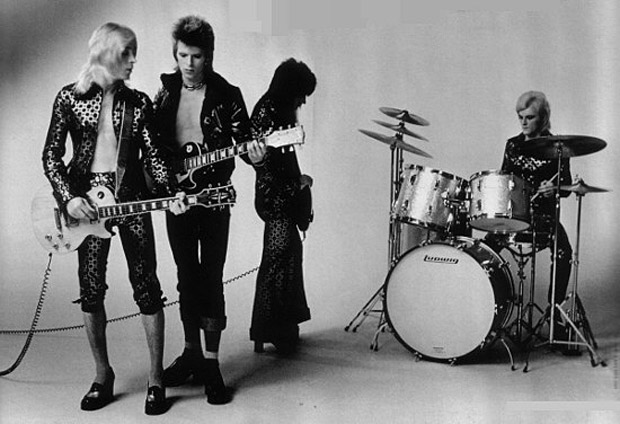
The grand and historic station of Hull was my first taste of the city. My first links with Hull were via its musical history. The members of David Bowie’s backing band during his Ziggy Stardust days, the Spiders From Mars, were from Hull. The guitarist from that band, Mick Ronson, was a key Bowie collaborator and played a paramount role in shaping the sound of some of Bowie’s most important records. He was also a gifted producer. He produced one of Morrissey’s best solo albums, Your Arsenal, from 1992. During that time he developed cancer and sadly passed away a year later. The Beautiful South and Everything But The Girl are two other bands hailing from Hull. Yet its the counterculture history of Hull, which is of great interest to me centred around two founding members of the experimental 1970s group Throbbing Gristle; Genesis P-Orridge and Cosey Fanni Tutti. Cosey recently published her autobiography, Art Sex Music, which is a riveting and fascinating read. What’s more, an insightful slice of the history of Hull is featured in the book from the times of her upbringing through to the late 1960s when she first met Genesis until the early 1970s when they left Hull for London. During this time they were squatting in a disused industrial building in Hull living an unconventional life outside of mainstream society and setting up what would later manifest into the pre Throbbing Gristle avant-garde performance art collective, COUM Transmissions.


DB spiders

David Bowie with his Spiders From Mars backing band


COUM Transmissions

COUM Transmissions 


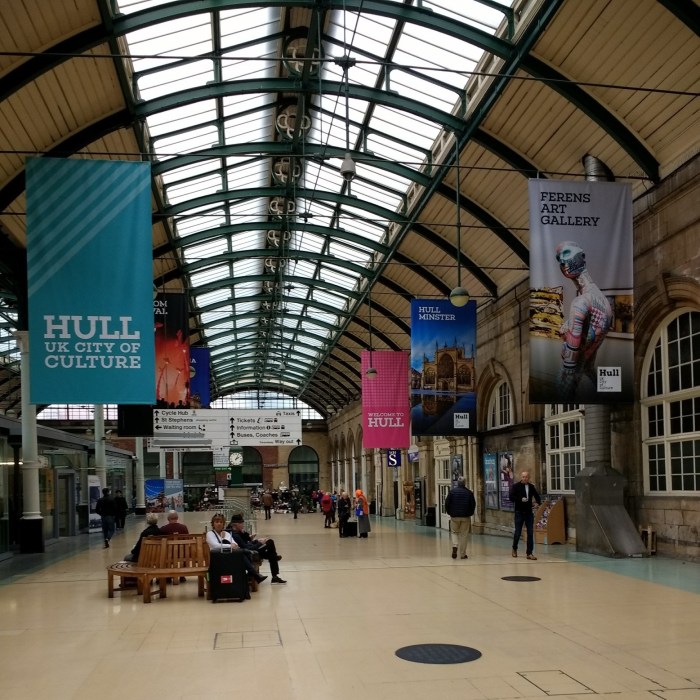
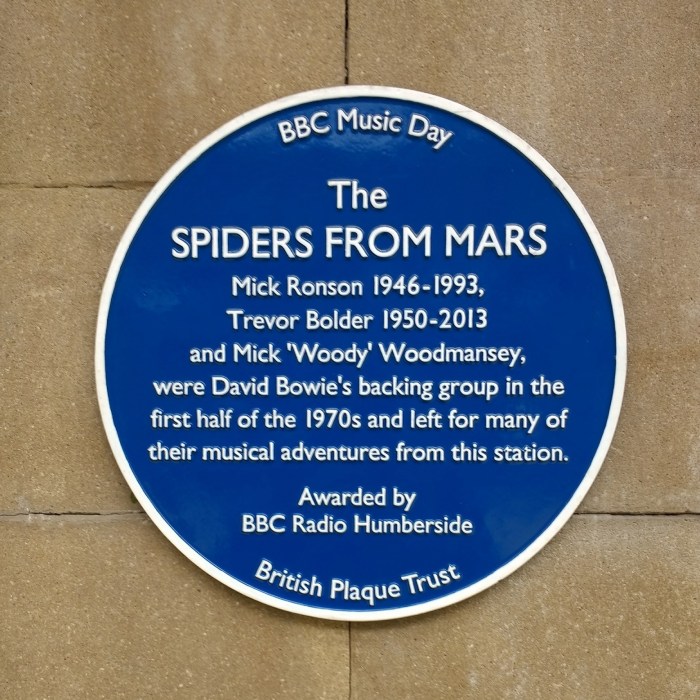
When I arrived at the train station, there were numerous landmarks and tributes to the town’s history including a statue of the poet Philip Larkin who lived in Hull for many hears and a blue plaque dedicated to the Spiders From Mars. There were also numerous banners promoting the city’s UK City Of Culture status.


IMG_20181005_140459206-1560x2080

Hull train station 


IMG_20181005_140351077-1560x2080

Blue plaque commemorating the members of David Bowie’s backing band from the early 1970s, The Spiders From Mars, who hailed from Hull


From the train station, I took a local bus to my accommodation outside of the city centre. My accommodation for the weekend was a family home full of character located on one of Hull’s notable avenues; wide leafy streets in a conservation area of handsome Victorian and Edwardian style houses. The interior of the house had many works of art and lots of original features. It was a real treat to stay here. My hosts were kind-hearted, cultured and generous, and took great care of me during my stay.


IMG_20181005_180436903-1560x2080

Westbourne Avenue 


After settling in my room, I took a stroll towards the town centre. I walked the length of Westbourne Avenue, were I was staying, marvelling at all the houses. One of the houses had a small blue plaque stating that one of the main crew and survivors of the Titanic had lived there. Another blue plaque was dedicated to a poet or playwright. As I walked along Princes Avenue I encountered many Kurdish restaurants. I later learn that Hull is home to a sizable number of Kurds from Northern Iraq. The main high street is deserted. In fact there is not much life in the centre of town. At one point I enter a Weatherspoons bar situated in a grand Georgian building. It is one of the few bars in town that has at least a modicum of life. I find a table and order an IPA beer and a Veggie burger, before deciding to call it a night and return to my accommodation.

The next day I wake up early and walk back to the centre of town. On the way I make an early lunch stop at one of the numerous Kurdish restaurants. For only a fiver I am served a substantial tray of shredded strips of meat and cheap with a pile of salad and two large freshly baked disks of warm pitta bread along with an ayran yogurt drink, a traditional tea and a bottle of water. Similar establishments in London districts such as Stoke Newington, Dalston or Harringay don’t hold a candle. Gilbert and George would love this place. I just wish I could remember the name. But I’ll find it next time I am in Hull.

In town, I visit the Ferens Art Gallery, located in a Neo-Classical Grade II listed building. It has a modest but notable collection of art. Highlights include a painting by the Spanish Renaissance master Jusepe de Ribera, a painting featuring a ship entering Humber Dock after a long voyage from Calcutta by the 19th century Hull painter John Ward, and a group of more contemporary works including a couple of Leon Kossoff paintings, a Nan Goldin photograph and an imposing statue of a naked pot-bellied man holding a long fishing rod like spear by the Australian sculptor Ron Muerck.


IMG_20181006_143512176-1560x2080

Sculpture by the Australian contemporary artist Ron Muerck in the Ferens Art Gallery


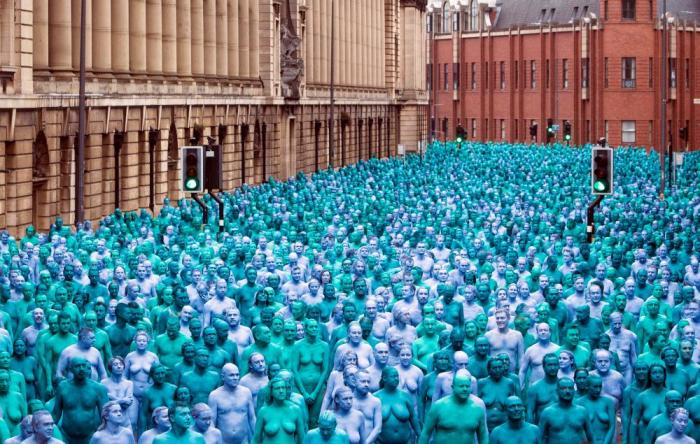
Yet perhaps the most memorable works on display are the photographs by the American artist Spencer Tunick entitled Sea Of Hull from the summer of 2015. This was a monumental work which took place in Hull and featured over 3,200 naked participants painted blue; the biggest ever naked photo shoot in the UK. The event generated a lot of publicity and some argue that it was an important springboard for Hull being granted its prestigious UK City Of Culture title two years later in 2017.


Spencer Tunick

‘Sea Of Hull’ by the American photographer Spencer Tunick


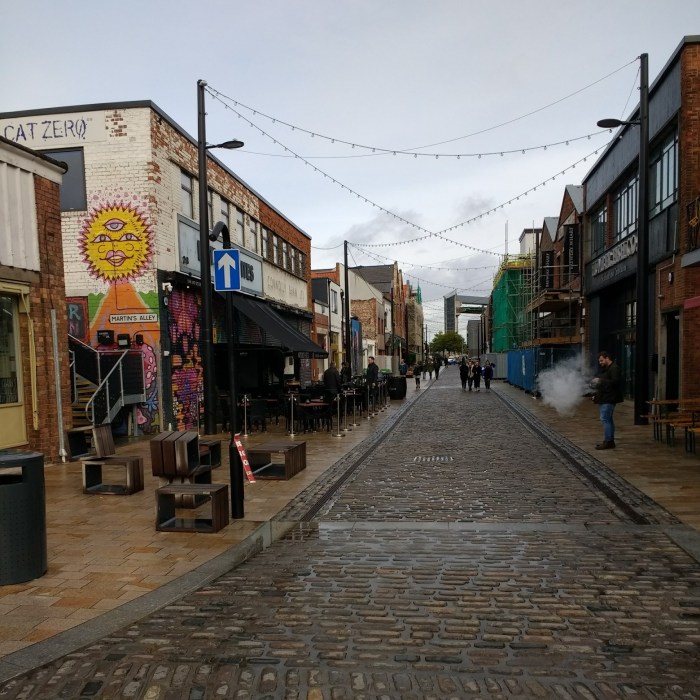
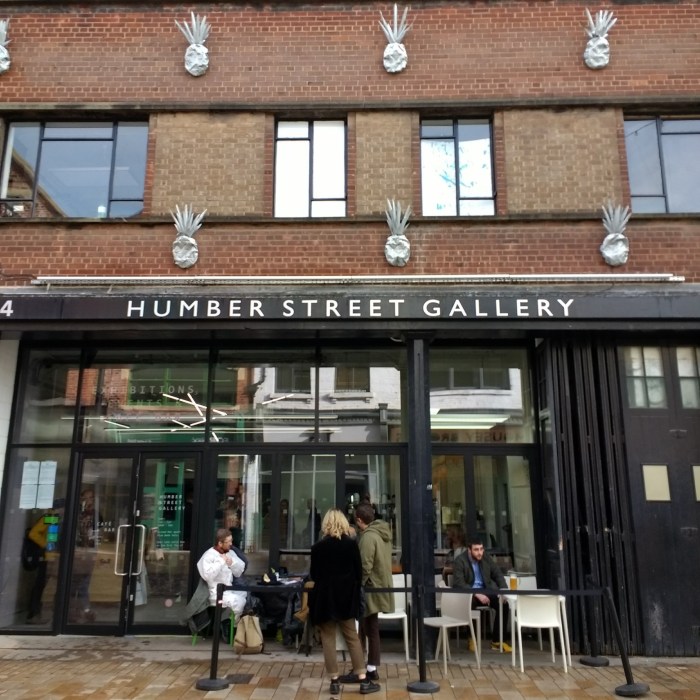
I then walk to the old town and along the Hull Marina before approaching the Fruit Market district, reminiscent of a micro Shoreditch. Its principle street, Humber street, features chic arty boutiques and pop up art spaces. One of the town’s core art spaces and an integral part of the contemporary art scene of Hull, the Humber Street Gallery, is located here. It is set over three levels including a rooftop terrace. When I visited a performance art event was in the process of being set up.


IMG_20181006_150924949-1560x2080

The Fruit Market district 


IMG_20181006_152259864-1560x2080

The Humber Street Gallery 


From the Fruit Market I strolled towards the Hull Minster; an enormous parish church and the largest in the country. It is a masterpiece of ornate architecture dating back to 1300. It is just as impressive inside; a loving work of art. It is a delight exploring the interior of this church. At one point I sit down on a wooden seat at the back of the church and a full service commences. It is a hypnotic experience and I take it all in for some time falling into an almost deep meditation; carried away just as much by my surroundings as the service itself.


IMG_20181006_160400870_HDR-1560x2080

The Hull Minster 


IMG_20181006_161049519-1560x2080

Inside the Hull Minster 


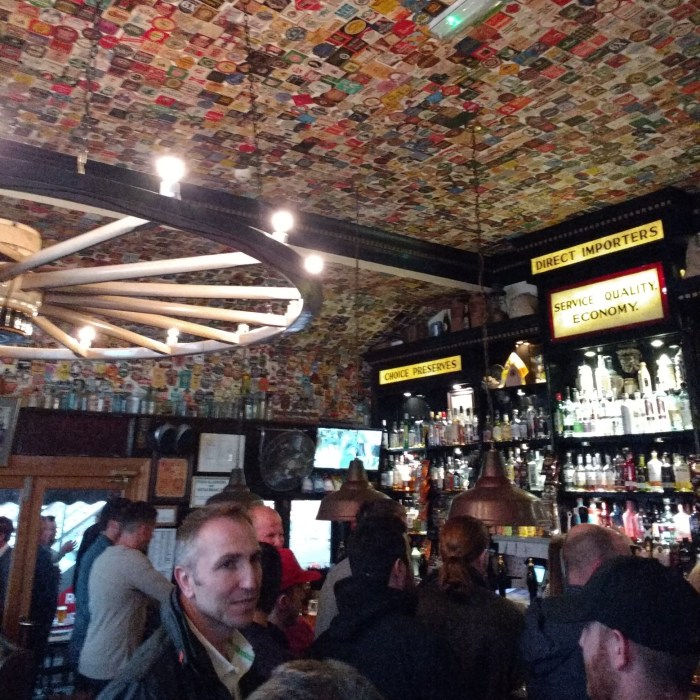
Next I amble around the attractive old town of Hull to find the Lion and Key pub, which was recommended to me by my hosts. It’s a good choice. An old school tavern with tasteful aesthetics and character located on the old High Street. All the ceilings of the pub are covered in beermats and its a popular place. I am lucky to have found a corner to sit down. On tap are the usual well known lagers and ales plus a few locally brewed ales. I go for a half of one of the latter. There are a number of traditional taverns dotted around the old town.


IMG_20181006_171551965-1560x2080

Inside The Lion and Key pub 


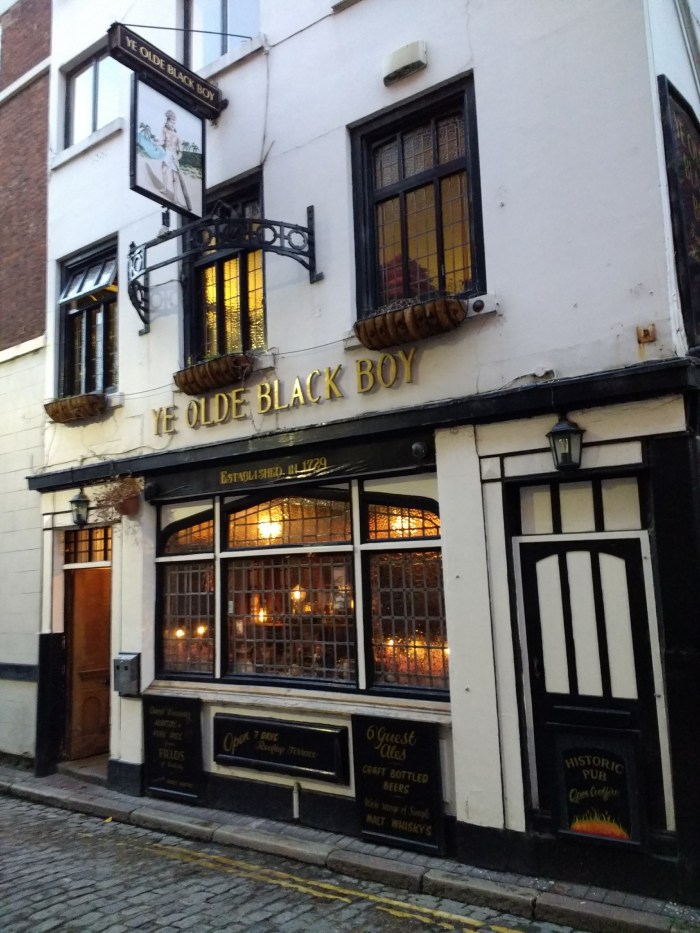
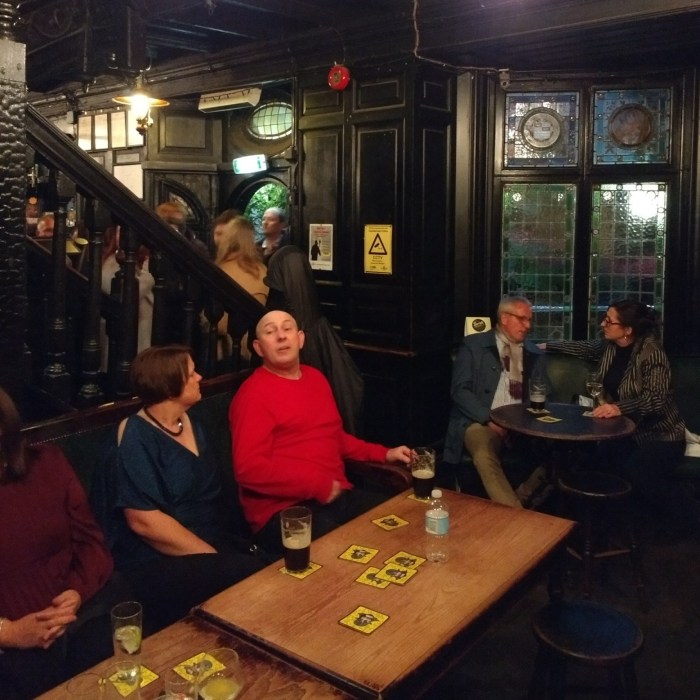
My next destination is one of the jewels of Hull; the Ye Olde Black Boy pub dating back to 1779. This is the kind of place I came to Hull for. The outside and interior is untouched. Surprisingly, there are less people there than at the Lion and Key and I have no trouble finding somewhere to sit. I have a pint of some nondescript ale. For me it’s not about sourcing the best craft beers and everything about finding and being somewhere authentic.


IMG_20181006_183401974-1560x2080

The Ye Olde Black Boy pub 


A few blocks away in the old town, I pay The George Hotel pub a visit; another classic old pub located via a narrow alley way, similar in some ways to the historic Ye Olde Mitre pub in Holborn, London. This tavern is pulsating with life. Like the last pub I am perhaps the only outsider in the building. I order a half of a delicious stout and crash here for a while.


IMG_20181006_184651806-1560x2080

Inside The George Hotel pub  


After my jaunt visiting some of the old pubs of Hull, I head back towards my accommodation via one of the local city buses. En route I make a stop to visit the Hull Fair, which has been in full swing since the start of the weekend. It is a huge event and the biggest fair in Europe. The main thoroughfare is bursting with people and its sometimes a struggle to make any movements.


IMG_20181006_204209087-1560x2080

Hull Fair 


It is also louder than a Motorhead concert. A myriad of piercing sounds and bright flashing lights thunder at me from all directions. If I were on acid, it would be the worst trip imaginable. It is a fascinating experience and sight though. The lyrics of The Smiths song Rusholme Ruffians whirl around my head, ‘the last night at the fair, by the big wheel generator, a boy is stabbed and his money is grabbed, and the air hangs heavy like a dulling wine’. Yet I don’t sense any menacing danger. Just an overwhelming overload of sensations. I am not tempted to hop on any of the rides nor am I swayed by the fluorescent coloured Slush Puppy like beverages. After some time I decide to walk back to my accommodation located not so far away from the site.

On Sunday morning, I order and pack all my things. My host Ruth kindly allows me to leave my luggage at her home so I can have another day to explore Hull before heading to my next destination. I take the local bus into the centre of town. Around the modern part of town I find a chippy and have a brunch consisting of battered haddock, chips and mushy peas with a can of Cherry Coke. It goes down a treat.

On the edge of the old town and opposite the Ferens Art Gallery is the town’s Maritime museum, located in a lovely historic Grade II listed building. The museum contains information, artefacts, paintings and documents related to the maritime history of the town. One of the most visible objects in the collection is the entire skeletal structure of a North Atlantic Right Whale, which was killed off Long Island, New York in 1907. Nearby is a large cabinet containing a collection of whale teeth and tusks including a few of the sword-like tusks found on narwhales in the Arctic.


IMG_20181007_125136315-1560x2080

Whale teeth and tusks inside the Maritime museum


One of the most important, if not the most important, figures to come from Hull is the English politician and anti-slavery campaigner William Wilberforce. His drive to abolish slavery led to the Slavery Abolition Act in 1833, which ended slavery within the British Empire paving the way for other Empires and nations to follow suit. There is a tall and prominent column monument entitled the Wilberforce Monument dedicated to him in town identical to the famous Nelson’s Column in Trafalgar Square, London.


IMG_20181007_134216212-1560x2080

William Wilberforce monument 


Located in the Museums Quarter of the old town is the Wilberforce House where he was born on 24th August 1759. The house is now a museum dedicated not only to his life and work, but also to the history of slavery. It is a real education and an eye opener to the inhumanities, injustices and brutality of the slave trade. In the outside Wilberforce House Gardens there is a white marble statue of the man himself.


Hull photo WW house

Entrance to the Wilberforce House Museum 


My time in Hull subsequently comes to a close. I go for an aimless stroll by the River Hull before taking a bus back to my accommodation to pick up my luggage and then take another bus to the train station where I await my train to Leeds.


By Nicholas Peart

(c)All Rights Reserved 


*All photographs are my own except the main article photograph at the top of the article and the photographs featuring The Spiders From Mars and COUM Transmissions


Visiting Jonestown: Site Of One Of The Biggest Mass Suicides In Recorded History

Jonestown massacre 2

The small village of Jonestown is located in a remote corner of the South American country of Guyana. This was also the location of the People’s Temple cult organisation founded in California and led by Jim Jones. On November 18th 1978, a mass suicide took place where a total of 918 members died. On the 3rd March 2014, I visited Jonestown and recorded my trip and thoughts in a diary I kept throughout my journey across Latin America, Africa and Europe entitled, ‘Travel Journal Of A Lost Soul’. 


3rd March 2014

Today was a solid hi-octane day. I must have experienced at least three such days like this on this trip. There was my refusal to travel from San Cristobal de las Casas to Panajachal by shuttle bus opting instead for an odyssey involving countless chicken buses and never-ending bus stops. Then there was the ten hour speedboat trip from Carti to Carpugana. There may as well have been a hole in the boat with the amount of water that got through. And did I already mention the road from Lethem to Georgetown?

I woke up this morning at 4.45am. I was on and off last night. I can’t remember the last time I had to rise at such an hour. My taxi was scheduled to arrive at my guesthouse at 5.45am. I waited patiently outside. After over ten minutes there was still no sign of it. Fortunately, the guesthouse owner was awake and made another call. A taxi swiftly arrived and I arrived at Georgetown’s Ogle airport with more time than I expected before my plane left for the town of Mabaruma. The plane was made of cards. Some screws were missing and the upholstery on the plane seats was collapsing. I thought to myself if I am ever going to die young it might just happen within the next hour. Was I tempting fate with my visit to Jonestown?

Despite my initial anxiety, the journey went OK with minimal turbulence. When I arrived in Mabaruma my original plan was to spend the day here before taking a boat to Port Kaituma in the mid-late afternoon. I think I saw all there was to see in Mabaruma in less time than a Ramones song. I saw a school. Then another school. Then a rusty disused tractor followed by a Seventh Day Adventist church and an abandoned smashed up saloon car. I was told that there would be a boat leaving for Port Kaituma at 9.30am. Furthermore, it was the only one until the next day. I hurried into the colectivo going to the port like someone trying to outrun a tsunami.


DSCN3766

Not much going down in Mabaruma 

Arriving in quite possibly the filthiest and most dilapidated ‘port’ I’d ever witnessed in my life, I am introduced to the young captain who tells me the fare will be 6,000 Guyanese dollars ($30). It is only an hour journey and I develop a paranoia (which may or may not be justified) that he’s giving me the Gringo rate. My anger combined with the impossible heat and humidity and depressed location send me on an epic internal rage where I start cursing my surroundings. Seeing all the mountains of trash in the already despoiled and poisoned dock waters makes my veins explode. I think to myself if God ever wanted to send me to hell, he’d kick my ass all the way here at the drop of a stone. As my mind slowly cooled and I develop the gift of perspective, I realise the boat fare is a small price to pay just to leave.

On departing, the captain revs the boat to full power. I grip on to all my things for dear life. We are going at supersonic speed against the river current and I feel as if I am sitting on the wing of a jet in motion. I keep my head down at all times with my mind on the prize of arriving in Port Kaituma. The full force of the air is enough to tear my head off.


DSCN3788

The dock of Port Kaituma; an environmental catastrophe 

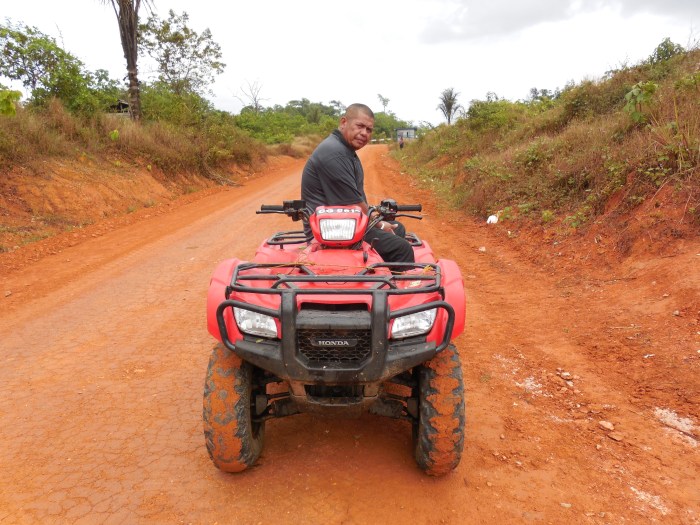
When I finally arrive in the dock of Port Kaituma, I am greeted by a heap of floating plastic bottles, empty crisp packets and oil spillages. This is bad, but it doesn’t compare to Marabuma dock, which was a disgrace. Port Kaituma is small and over compact. Everything seems to be hanging on a thread here. I do my best to avoid the mud of the numerous dirt paths. I envisage all sleeping options in this town to be fleabags. But I get lucky when I stumble upon an Indian-run guesthouse with comfortable air conditioned rooms (AC here is a damn pre-requisite). After I’ve registered, I ask the Indian lady about visiting Jonestown, located just a few miles away. She tells me that she knows of someone who may be able to take me there. A few minutes later at the entrance of the guesthouse I am greeted by a burley Amerindian man named Wesley. He is a man of some stranding as the Head of Social Security Services in the local government of Port Kaituma. For a reasonable fee he offers to drive and accompany me to Jonestown from the guesthouse and back on his red quadbike. He tells me other modes of transportation are out of the question in order to access the site.


DSCN3819

My guide Wesley on his demolition machine. I clung to the back grills 

I sit on the metal bar grid on the side of the quadbike. The dirt road between Port Kaituma and Jonestown is not fit for any vehicle save for the hardiest of trucks and 4x4s. Every time we go over the multitude of dirt road bumps my poor behind gets bashed more and more into a coma. The palms of my hands are raw from perpetually holding onto the metal bars. The last place I want to spend long stretches of my life is in a Port Kaituma hospital. I would rather drink the poisoned laced punch like the other poor fuckers of the People’s Temple. Even though the journey lasts less than an hour it feels more painful than just about any other journey I’ve undertaken in my life. Fortunately, the road becomes smoother and very soon we approach the entrance with the infamous sign, ‘Welcome To The Peoples Temple Jonestown’. Driving past the sign and into the bush off the main road, we frequently have to battle stubborn overgrowth. Wesley tells me that for a long time nobody came to visit the site. He says that just a few years ago, the path was clear and unaffected by overgrown vegetation. At many intervals, my head, arms and legs are duffed up by an abundance of thorns and twisted vines. One of the vines is so stubborn it nearly yanks me off the bike.


DSCN3795

At the entrance to the People’s Temple in Jonestown 

Soon we arrive at the sight of a tall white memorial plaque dedicated to all the victims of the massacre. Over 900 bodies were strewn all around the complex on that fateful day in November 1978. What makes this visit even more poignant was listening to the last seven minutes of the ‘Death Tapes’ on YouTube. Amongst all the background sounds of young children crying and sombre music, Jim Jones is telling all the mothers to ‘stop this nonsense’ along with ‘you are getting the kids all excited’. This is followed by his immortal words; ‘we are committing an act of revolutionary suicide against this inhumane cruel world.’


DSCN3816

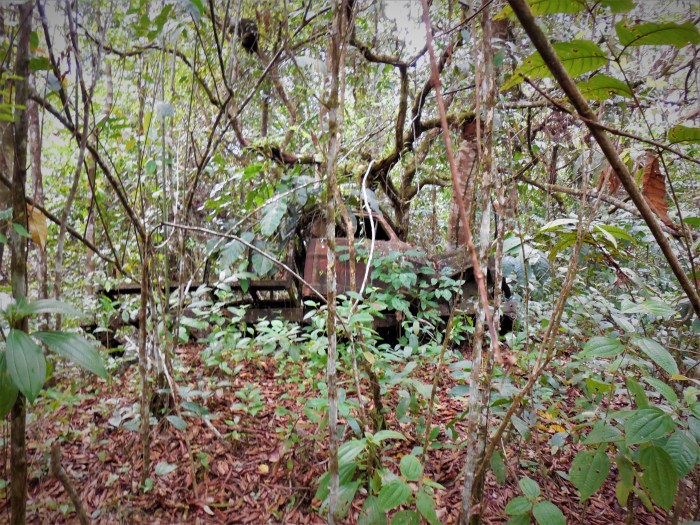
Jim Jones’ truck camouflaged by vegetation and decay


DSCN3817

A defunct generator once belonging to the People’s Temple

We walk more into the bush where numerous artefacts from that time are discovered such as a generator, a wheel and Jones’ truck, all rusted and decayed. After the mass suicides, many things were looted and only very few relics of that time remain. I ponder over the setting. The uber – remoteness of this location. Even though Guyana for many will always be associated with the tragic events which took place here, this site reminds me of a place long forgotten and neglected. Despite its messy, barbaric and tyrannical history there is something very peaceful about this place. Perhaps this is the eternal calm and stillness after the apocalyptic storm. Jim Jones, though his name and legend live on, is dead as Dillinger. Thus, there is also a peculiar sense of safety here, like it will never again be tainted by evil and bad times. I stop and remain silent here for several minutes just listening to the sounds of the jungle. I record this stillness in the shape of a few short video clips.


jonestown massacre 3

Jim Jones; leader of the People’s Temple


Jonestown massacre 1

Aftermath of the mass suicide from November 1978

On the journey back to town it rains heavily. I am happy when I return to my room and equally happy that I have my flight booked to return to Georgetown early next morning. There is load reggae music playing on the floor below. Yet I am so battered and broken that my body simply shuts down until my mobile phone alarm goes off the next day.


By Nicholas Peart

©All Rights Reserved

SEE NAPLES AND DIE: Wanderings In Italy’s Most Colourful City

naples-1842509_1280

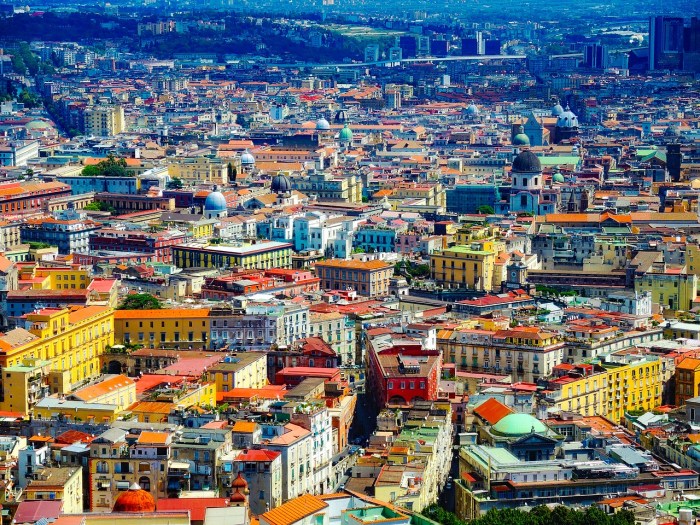
I’d been looking forward to re-visiting the city of Naples for a long time. The last time I was there was very briefly with my family almost 20 years ago in the late 1990s on the way to the Amalfi coast. The thing that I remember most from that trip was not the beautifully pristine holiday brochure perfect Amalfi coast itself. Rather what I remember most vividly from that trip was Naples train station and the streets surrounding it. Seedy, dishevelled, dirty, loud and downright dicey are some of the adjectives that spring to my mind when I look back on it now. I remember walking through the station and trying to break away from my family to read a guitar magazine on one of the vendor stands. My dad immediately pulled me back towards the family and gave me a stern look as if to say, ‘Don’t even think about wondering around here by yourself’. For my parents were on a mission to get the hell out of this station as fast as it was humanly possible like trying to escape from a building about to collapse.

From the holy Umbrian town of Assisi located in the very heart of Italy, I board a discount Flixbus, which via Rome will take me to Napoli. Six hours later I arrive in the bus station. We approach the bus terminal along a road going through a neglected part of the city. The buildings are dilapidated and lathed with aggressive graffiti. Hardly anybody is walking the streets. When I exit the bus, I make my way towards Garibaldi metro station bypassing the train station. On my way to the metro line I walk through a modern shopping mall. My initial impressions this time of the area are more sanguine as much of the filth and grime I witnessed at the train station all those years ago appears surprisingly absent. I am quite disappointed.

I take the metro to Toledo station. When I exit the station onto Via Toledo I arrive on a busy pedestrian thoroughfare. My accommodation is located a few streets away from the station. From Via Toledo I walk through one of the adjacent side streets. This area is also known as the Spanish Quarter. I haven’t been to this part of the city before. The side streets I trudge off the main boulevard is like walking through a tightly connected open neighbourhood where everybody appears to knows one another. Tall crumbling buildings. Endless washing lines. Cheap hole-in-the-wall pizzerias. Buzzing scooters. Madonna and Bambini shrines. People laughing. People shouting. People arguing. What more could I want? This is my place. I am in heaven here.

IMG_20180408_153826571

My temporary neighbourhood in the heart of the Spanish Quarter

My accommodation is located in one of those buildings on the first floor. My room is humongous. It could almost count for a studio flat with a tiny balcony overlooking one of the narrow streets. I rest for a while but soon develop impatient feet and an uncontrollable urge to dive head first into this unruly soup enfolding me. The Spanish Quarter of Naples is like a PG certificate Parharganj retaining all the positive attributes of Delhi’s notorious tourist ghetto district. Thankfully the air quality is better here and there are no aggressive hawkers relentlessly on my trail. When I venture back out I hit a nearby pizzeria and order a margherita pizza to take away for only 3 euros. It is cooked in an enormous dome shaped stone oven. On the counter there is a photograph of Diego Maradona. I already like this place.

IMG_20180408_192331775

My local pizzeria where a traditional Margharita pizza done Napoli style will only set you back a few euros

A few minutes later my pizza is bunged into a takeaway box served to me piping hot. I walk with it back onto via Toledo and try to find somewhere to sit down. I spot a side street with a row of granite seats. Unfortunately, its occupied by shifty looking folk so I keep searching. Finally, on Piazza della Carita I find a spot to sit down. I fold my pizza in half before I munch away at it. The taste is different to other pizzas I’ve eaten across Italy. I notice that the dough is chewier. The ingredients also taste fresher and the basil topping is the cherry on the Napoli cake. I wolf it down like an uncouth savage. If I were eating this thing on one of the park benches by the Houses of Parliament I would have most certainly got some funny looks. But here in downtown Napoli nobody gives a toss.

IMG_20180412_185209970

Piazza della Carita off Via Toledo 

Being a Sunday the Via Toledo is full of local families and couples wondering on their evening passegiatta. I walk past an old Baroque church where a gaggle of Bukowski bums are strewn across the steps. Close to the piazza is a small open-air market selling everything from candies and literature classics in Italian to handbags, purses and religious paraphernalia. Further down the via Toledo a vender is selling plastic swords which glow in multi colours. Towards the end of the street there is a large opulent neo-classical style shopping mall called Galeria Umberto. Its very similar to Leadenhall market in the City of London. All the time, I see and hear scooters and motorbikes on every street I walk down whether it’s a main boulevard or some dingy narrow alleyway. The last time I encountered as many scooters and motorbikes was when I was in Hanoi five years ago.

IMG_20180408_191031539

Via Toledo

On the way back to my guesthouse I search for a small alimentari to buy a large bottle of water. I have little success. Whenever I do find a place that’s open its either an ice cream parlour or tourist eatery, which sells small bottles of water for about two euros a pop. I finally get rewarded down a small alleyway corner close to my guesthouse. There in a small Bangladeshi owned grocery shop where I locate a large two litre bottle of water for just one euro.

The next day I head over to Toledo metro station to take a train over to Garibaldi where the central train station of Napoli is located. I wanted to relive my experience from 20 years ago. When I arrive at the station its almost unrecognisable to the one I have those flashbacks of all those years ago. I am surprised to discover a rather modern and funky contemporary looking station redesigned by some hip architect du jour. And with security camaras! Wow!! And there was me thinking I was going to get a taste of Caracas. Even the main piazza Garibaldi outside has some trendy structure around it to make it look all modern and up with the times. I am kind of reminded of the old port area of Marseille which has a modern and hip structure to clean up the rough and tumble image of the city. But you can only fool people so much. Head down any of the narrow streets directly adjacent to it and it’s the same as it ever was. And, fortunately, this is true for Napoli. I head down one of these streets and in almost no time I arrive at a run-down piazza where there’s a small unkempt market of African vendors selling unfolded rags of second-hand clothes. What I was hoping to find is finally here. It’s thankfully midday. At night I would think twice about walking around this part of town. Even the wayward wonderer that is I has at least a modicum of common sense.

IMG_20180409_104628512

Market stalls near Piazza Garibaldi

By this rough and tumble piazza, there is a small castle like façade marking the gateway to the Quartiere Pendino. This part of the city is arguably the most busted and down at heel. Yet it’s a tantalising area to explore. I develop mental images of the La Goute d’Or district in Paris nestled within the triangle of Barbes Rouchechouart, Chateau Rouge and La Chapelle metro stations.

IMG_20180409_105345970IMG_20180409_105509324IMG_20180409_105813023IMG_20180409_105824665

Photos from the Quartiere Pendino

As well as people from different parts of Africa there’s a huge south Asian community. I spot a handful of Napoli Indian Bangla eateries. There are many outside fruit and vegetable vendors where a kilo of lemons or tomatoes can be picked up at rock bottom prices. Yet it’s the site of the seafood vendors that tickle my imagination. It is raw sight with no refined presentation. Freshly caught seafood – bosh – in white plastic water filled containers or on large crushed ice slopes ready to be bought. Here one could be mistaken for being in one of the gritty streets of Victorian London or Canaletto era Venice. Sacks of muscles, clams and mountains of prawns and mini squids are all waiting for overworked chefs to transform into a sumptuous linguini alla vongole dish.

IMG_20180409_110119949

A fish stall in the Quartiere Pendino

Leaving the Quartiere Pendino district en route towards Via Dei Tribunali in the centro historico district I spot a pizzeria and order a Capriccioso pizza – the full monty. It doesn’t disappoint, just like the pizza I had last night at my local in the Spanish quarter. Via Dei Tribanali is the heart of the historic centre of Naples. Its less off the beaten piste than Quartiere Pendino but it’s also a true slice of raw Napoli nonetheless. There are many old churches around here. My first stop here is the Quardreria e Cappella del Pio Monte della Misericordia.
IMG_20180409_135938225

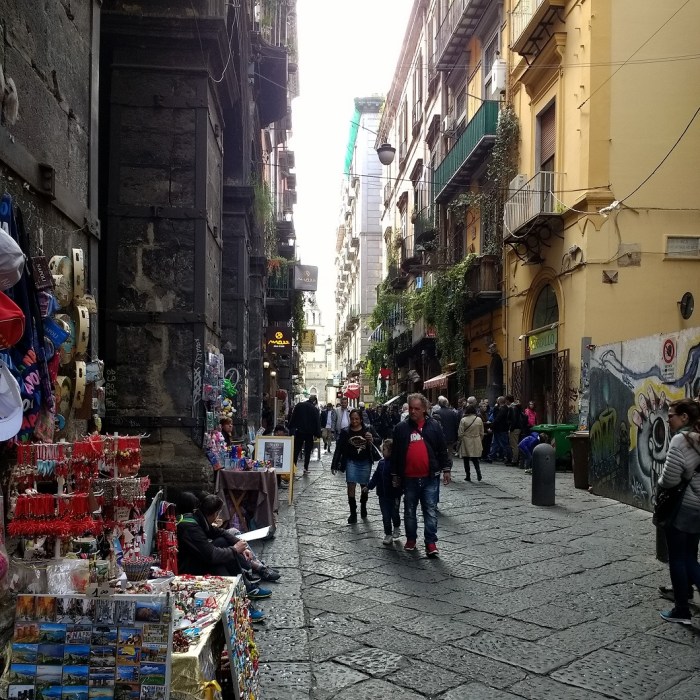
On Via Dei Tribunali in the historic centre 

Inside the chapel at the main alter is an enormous oil painting by Caravaggio entitled Le Opere di Misericordia. There are also paintings by other Baroque era Italian artists such as Luca Giordano, Battistello and Fabrizio Santafede. Giordano’s Deposizione painting features Christ being….. Sadly it is difficult to fully scrutinize Caravaggio’s painting. It is located too far away and the electric light around it obscures parts of the painting.

IMG_20180409_130138008

Caravaggio (1571 – 1610) – Le Opera di Misericordia

The 7 euro entry fee is worth it though since the price also includes entry to a separate Pinacoteca art gallery on the grounds of the Pio Monte della Misericordia. There are several paintings on display by the 18th century Italian painter Francesco De Mura. He is a very skilled realist painter from the same tradition of Caravaggio who came before him. There is humanity and emotion exuding from his paintings, most notably his Cristo alla Colonna (1760) and San Paolo Eremita che adora la Croce (1760) paintings. Yet its not on the same visceral scale.

C.Fracanzano - Miracolo di un indemoniato

Cesare Fracanzano (1605-52) – Miracolo di in indemoniato

The 17th century Baroque painter Cesare Fracanzano’s Miracolo di un indemoniato painting gets closer to core of what made Caravaggio such a powerful painter of the human condition. In another corner of the pinacoteca are a number of donated works of art by a group of international contemporary artists. One of the leading figures of the Italian Arte Porvera movement, Jannis Kounellis, is featured as are two other important Italian artists of the Transavangardia movement of the late 70s/early 80s; Francesco Clemente and Sandro Chia. The 1970s conceptual artist Joseph Kosuth is in there as is the Austrian sculptor and conceptual artist Franz West. Anish Kapoor has a recent work from 2011 appearing on initial glance to be formed from bee’s wax or caramel but is most likely to be resin solution.

IMG_20180409_133015147

Francesco De Mura (1696 -1782) – Portrait from 1735

Back in the main area of the Pinacoteca, I find another painting by Francesco De Mura, which stops me in my tracks from 1735 of a portrait of a voluptuous female aristocrat. She radiates unhappiness, boredom and repression. There’s a feistiness inside of her which is wanting to explode, yet it will remain trapped. I think of the French painter Ingres’s Madame Moitessier portrait, which he made over a century later. Both exude a kind of Junoesque beauty and both look bored, yet Ingres’s subject appears less intense.

IMG_20180409_133325407

Jusepe de Ribera (1591 – 1652) – Portrait of St Antonio Abate 

A portrait of St Antonio Abate by the Baroque Spanish master Jusepe de Ribera is in the collection. The portrait has an acute Caravaggio style realism and humanism to it. The old man’s face, beard, eyes and left hand is painted unadulteratedly in all their detail. There are no embellishments or mannerisms. Caravaggio’s chiaroscuro technique is executed very skilfully too.

IMG_20180409_133523887

Giovanni Baglione – Sepoltura di Cristo

One of the highlights of the Pinacoteca’s collection come’s towards the end of my visit via a painting by Caravaggio contemporary Giovanni Baglione entitled Sepoltura di Cristo. In this painting Christ is painted in a seductive homo-erotic way. Muscular with toned olive skin, almost fully naked with an angelic face. A body and face so beautiful it’s impossible not to be moved by this painting. The people around him are full of sorrow too. It is a modern and human painting and the faces of the other figures look so contemporary they could be walking the streets this minute.

IMG_20180409_143048162

Piazza Bellini

Back on Via Dei Trubunali I walk towards Piazza Bellini. There are several vendors selling all kinds of miscellaneous knick-knacks and souvenirs. Lots of Diego Maradona related items. In Napoli he almost has the same status as the patron city saint himself San Genarro – more on him in a bit. In the 80s Maradona played for Napoli and so he has a special place in the city’s heart. At another stand I spot a column of toilet paper rolls with the faces of politicians on each sheet. The Italian politicians Berlusconi, Renzi, Salvino and De Maio make the cut as do Trump, May, Macron, Merkal, Putin and Kim Jong Un.

IMG_20180409_160630620

From one of the many of the souvenir stalls in the historic centre 

Piazza Bellini, located at the end of Via Dei Tribunali, features a statue of the 19th century Italian opera composer Vicenzo Bellini whom the piazza is named after. His statue is defaced with graffiti. By the piazza there are some vendors selling second-hand books. I spot several art books priced from just a euro yet all the text is in Italian. Nevertheless I locate a large series of A3 size booklets featuring large high quality colour photographs of works by different old master artists of the past. Corregio, Mantenga, Hugo Van der Goes, Parmagiano, Carpaccio and many more are here. Nearby I visit a couple of bric-a-brac shops selling random objects and artefacts such as figures of St Francis of Assisi, period cabinets, lamps and porcelain crockery. In one corner I spot a figure of an old saint or vagrant dressed in rags carrying a rusted metal tin.

IMG_20180409_143937561

In a small antiques/bric a brac shop by Piazza Bellini

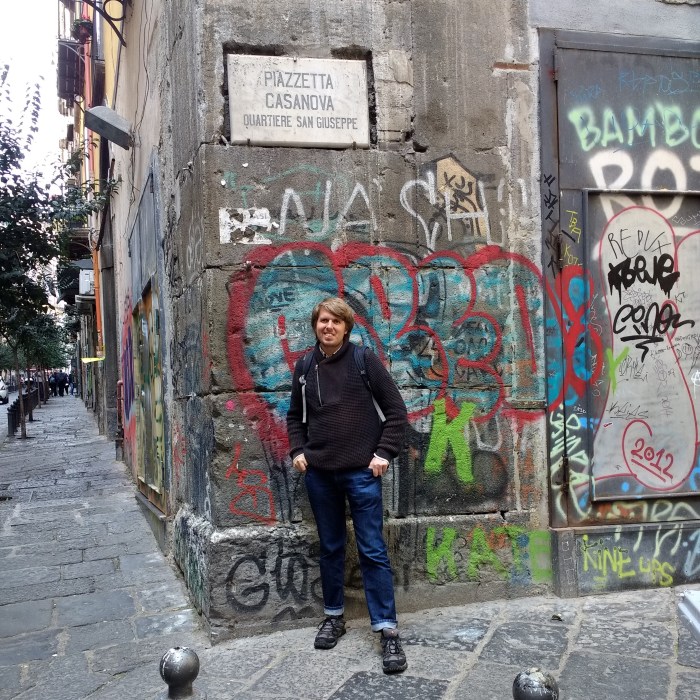
Most of the walls of the city are covered in graffiti and political and propaganda posters. I spot one small poster with the following slogan, ‘Napoli Non Si Vende!’ (Napoli’s not for sale). I walk aimlessly along the graffitied streets of the San Giuseppe quarter in an almost delirious state.
IMG_20180409_150701945

Yours truly at Piazzeta Casanova near the historic centre 

When I do get off my cloud I make my way to Naples’ Duomo or main cathedral. It is an outstanding and impressive Gothic cathedral dating back to the early 13th century. Yet I’ve come to see the smaller basilica of Santa Restituta located adjacent to the main Duomo. It is also the oldest building in Naples dating back to 324 AD when it was constructed by Constantine. Inside there is a small baptistery with relics and mosaics going back to 5th century and early Christian times after Antiquity and the fall of the Roman Empire.

IMG_20180409_163725977

The Santa Restituta basilica – the oldest building in Naples dating back to 324 AD
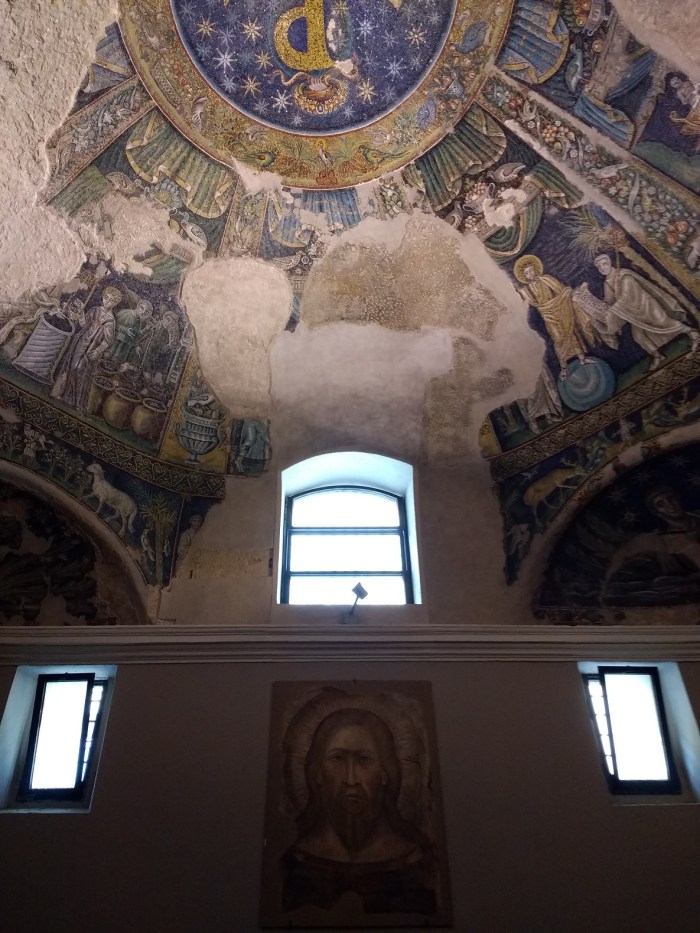
 

IMG_20180409_163256107

Inside the baptistery of the Basilica containing mosaics and relics dating as far back as the 5th century AD 

When I return to the Duomo I enter the Royal Chapel of the Treasure of St Januarius or San Genarro, dedicated to the patron saint of Naples himself. He is somewhat of a legendary figure who died in 305 AD. When his body was transferred to the cathedral two glass vials containing his dried blood liquefied. They are kept in a silver reliquary behind the alter. This ‘miracle’ has continued to repeat itself at least three times a year (on the first Saturday in May and on September 19th and December 16th). The liquefaction during a special mass on those days. To many San Gennaro is viewed as the saviour and protector of Naples and if the blood doesn’t liquefy on those auspicious dates, then catastrophic events are supposed to besiege the city.
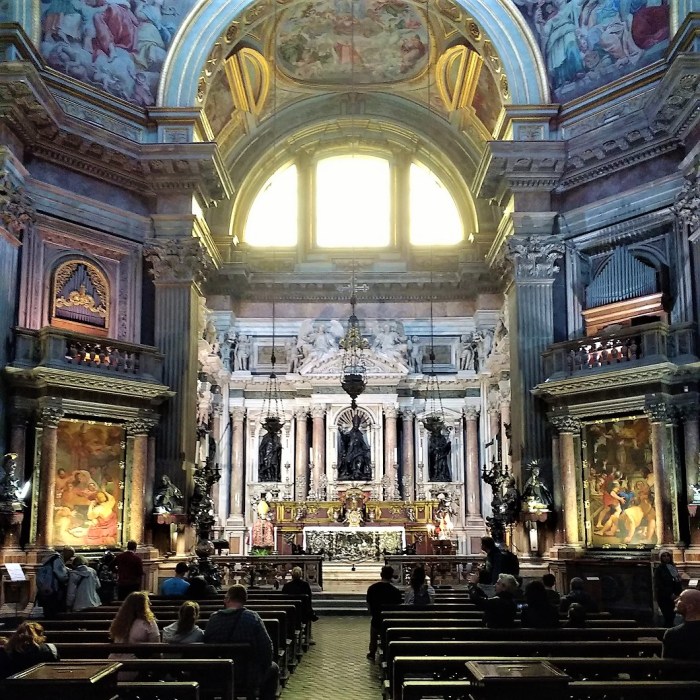
IMG_20180409_164624437

The Royal Chapel of the Treasure of San Genarro

The following day I walk to the end of Via Toledo on to Piazza Dante lined with an ornate, albeit crumbling, crescent of attractive Baroque era architecture as well as a prominent white statue of the great poet himself. It is a seedy area and by the statue there’s a banner advertising an organised demonstration of free health care for everyone.

IMG_20180409_171622754

Piazza Dante

I re-enter the historic centre of Naples simply meandering and walking dreamily along the main thoroughfares and side streets. On one of the streets in this part of town, Via San Gregorio Armeno, I feel like I am walking through a corner of the old medina of Fez in Morocco even if its just for a fleeting moment. In this part of town I visit the classically Baroque church San Gregorio Armeno, which contains frescos by the Neapolitan Baroque era artist Luca Giordano. Inside it is a truly luxurious church with ornate and opulent walls, arches and ceilings. The Giordano frescoes crown it all.
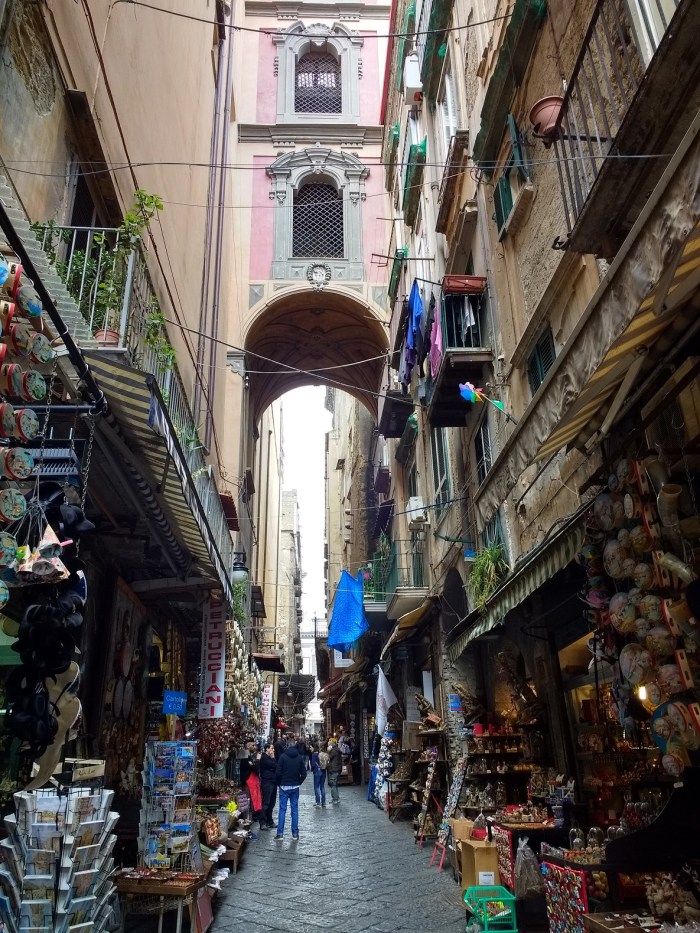
IMG_20180410_130604069_HDR

Via San Gregorio Armeno


IMG_20180410_112141812

The Baroque style San Gregorio Armeno church with frescoes by Luca Giordano

I walk away from the historic centre and onto Via Forcella. This is classic unkempt Napoli where one can find outdoor vendors selling groceries for a fraction of the cost of those at established supermarkets and alimentaris. The concentration of tourists from the area around the historic centre has declined here and all that can be found are local Neapolitans going about their daily life. As I wonder through this part of town I look for a cheap and authentic pizzeria. By chance I stumble upon L’Antica Pizzeria ‘Da Michele’.

IMG_20180410_113502978

Life goes on around Via Forcella 

Little did I know that this place is something of an institution and is heaving with locals and tourists who make the effort to get here. Originally established in 1870 this pizzeria specializes in one pizza and one pizza only; La Margherita. 4 euros will get you a ‘normal’ sized pizza. 4.50 a medium sized one and 5 a large one. The boys are hard at work at the back working like the most overworked Amazon worker on a hardcore treadmill. The difference here being that they live and breath the work. Its popularity means that this place is no secret and photographs adorn the walls of the proprietors with Italian politicians Matteo Renzi and Luigi De Maio as well as a photo of Julia Roberts eating at the establishment. I don’t fancy the long wait to eat inside so I order a pizza to go. I find a bench to sit nearby to it. Most of the pizza is covered in a thick film of olive oil. I let some of it drip onto the pavement so it doesn’t get on my clothes. The pizza is heavenly. It is so delicate it melts in my mouth. Moreover, all the ingredients taste and feel fresh and not processed. The best margherita pizza I have ever had period.

IMG_20180410_115836037

Outside pizzeria ‘Da Michele’ – an institution in Naples


IMG_20180410_120916617

The best margherita pizza I have ever had 

I revisit the historic centre for an idle wonder and decide to walk towards Piazza Garibaldi. I walk along the main boulevard Corso Umberto I via Piazza Bovio and Piazza Nicola Amore. Continuing on from Piazza Nicola Amore and getting nearer to Piazza Garibaldi, I walk past the dinghy side streets I became familiar with from yesterday morning. The kind of streets where Caravaggio would be fighting and quarrelling with those who had the temerity to rub him up the wrong way. Jim Morrison chose to crash in Paris, but he would have felt in his place on those streets. As would have the great precocious French poet Arthur Rimbaud. Their hatred of stultified, vacuous petit bourgeois society would have made this place a paradise for them. There’s something of the Petit Socco district of Tangiers here. When I reach the central station of Naples I decide to purchase a ticket to the ancient Greek civilisation of Paestum for the next day.

I conclude my time in Napoli with a visit to two of the most well-known sites in the city, the Museo Nazionale di Capodimonte and the National Archaeological museum. Even if you have just a passing interest in art and art history through the ages, they both contain a very rich collection of important and landmark paintings, sculptures and artefacts. One of the highlights are the works from the Farnese Collection, especially the classical sculptures in the National Archaeological museum. The Capodimonte museum is located in a grand red stately home like building on the outskirts of the city centre in a park on top of a hill with some awesome vistas over the city. The building is in fact called the Palazzo Reale di Capodimonte, which was once the royal residence of the Bourbon King Charles III. It dates back to 1738 and is today home to one of the best collections of art in Italy. I walk all the way to the museum. It is a long walk but sometimes I like to take a long walk through a city to discover corners of unexpected delights and nuances. Even when I travel from one part of the city to another by public transport to reach my desired destinations, I often feel that I miss things on the way. The process of the journey is sometimes just as important as the destination itself.

IMG_20180412_125608545_HDR

The Museo Nazionale di Capodimonte

The Museo Nazionale di Capodimonte has a huge collection of Renaissance era paintings (including paintings by Simone Martini, Masaccio, Mantegna, Botticelli, Bellini, Correggio and Titian) as well as many paintings by Baroque and Napoli masters. Of those works, Artemisia Gentileschi’s Judith Slaying Holofernis (1612-13) and Caravaggio’s The Flagellation Of Christ are two distinct highlights.

Caravaggio_-_La_Flagellazione_di_Cristo

Caravaggio (1571 – 1610) – The Flagellation Of Christ

Caravaggio is well known for his brutal and gritty realism and knack for visceral and raw emotion in his work, but this painting is one of his strongest works if not his best. It’s a modern painting too. The two sinister and intimidating looking figures to the left and right of Jesus look like they could have been plucked from the set of The Football Factory.

Artemisia Gentileschi is unique for her time, since she was a female artist during an age when it was difficult to be accepted and validated. The Italian art historian Roberto Longhi called Gentileschi, ‘the only woman in Italy who ever knew about painting, coloring, drawing, and other fundamentals’. She was part of a generation of painters that came after Caravaggio and were inspired by his works. Her Judith Slaying Holofernis painting is disturbingly graphic and full of gore; the sword is halfway through Holofernis’s neck and the bed sheets are covered in blood. It’s realism and the chiaroscuro technique may be influenced by Caravaggio, yet not even Caravaggio’s most brutal paintings such as the ones featuring the severed heads of Goliath and John The Baptist reach this threshold of vivid violence.

a.gentileschi capodimonte

Artemisia Gentileschi (1593 – 1656) – Judith Slaying Holofernis (1612-13)

In this painting it is the woman who has the power over the man. Judith takes revenge on Holofernis for raping her. Today Holofernis could represent the disgraced Hollywood film producer Harvey Weinstein and Judith the sum of all the women accusing him of sexual assault. All their cathartic rage and pain is channelled and processed into the sword hacking away at the head of their tormentor. The museum also has a good selection of modern and contemporary art works. There’s a huge black relief installation by the Italian artist Alberto Burri as well as a room containing a work by Jannis Kounellis featuring an assortment of large terracotta vases. Elsewhere there are works by other important post WW2 Italian artists such as Giulio Paolini, Mario Merz, Michelangelo Pistoletto, Gino de Dominicis, and Mimmo Jodice.
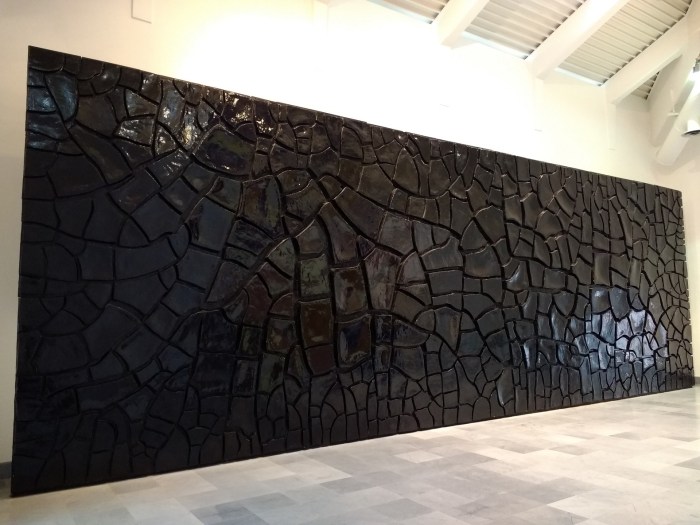
IMG_20180412_170409834

Alberto Burri (1915 – 95) – Grande Cretto Nero (1978)


IMG_20180412_165812131

Jannis Kounellis (1936 – 2007) – Untitled (1989)

The National Archaeological museum is a vast sanctuary of classical artefacts. Some of tremendous significance. There is a sizable collection of Egyptian artefacts, Roman mosaics and many of erotic art artefacts from the Roman period. Of all the erotic art in the museum, the frescos and the sculpture of Pan having sexual intercourse with a goat are the most outstanding.

IMG_20180413_132922812

IMG_20180413_133004758_LL

IMG_20180413_132947300

Erotic frescos from the Roman period at the National Archaeological Museum 


IMG_20180413_133833496

Erotic sculpture of Pan and a goat from the NAM 

Yet the most important part of the museum is arguably the classical sculptures from the Farnese collection. Many of the sculptures in this collection are Roman era copies of original sculptures made during the Classical Greek period.

IMG_20180413_125605434

Venus Kallipygos sculpture at the NAM


IMG_20180413_121318353

Artemis of Ephesus sculpture at the NAM

Of those works the refined and elegant Venus Kallipygos sculpture, the mixed-material  Artemis of Ephesus (an oddity of a sculpture for its time not sticking to the standard rules of classical sculpture) and the giant Farnese Bull are three highlights.

Farnese Bull

The Farnese Bull sculpture at the NAM

The Farnese Bull is unique since it’s the largest piece of classical sculpture ever discovered. Yet what is interesting is that when the work was first discovered, all the pieces of the sculpture were fragmented, and it was only through extensive restoration that it was all re-connected back to its original form – quite a feat.

oscar and bosie in naples 2

Oscar Wilde and Bosie in Naples in 1897

Vedi Napoli e poi Muori indeed. It has been one hell of a banquet lapping up this raw pearl of a city. So much so I feel like I can die with a smile on my face. On my last evening in Naples, as I surf the net on my laptop, curiosity leads me to the great playwright, writer, poet and wit Oscar Wilde. I discover a few grainy black and white photograph from 1897 of Oscar with his on-off friend and lover, the poet Lord Alfred ‘Bosie’ Douglas, in this city. Having spent two years in prison on charges of homosexuality (this was Victorian Britain) brought to the fore by Bosie’s father, the Marquess of Queensbury, Oscar turns his back on Blighty. With his reputation in tatters he heads south. It is in Naples where he settles with Bosie for the latter part of 1897 before moving to Paris where he would remain until his death in 1900.


By Nicholas Peart

(c)All Rights Reserved 


Exploring The Contemporary Art Scene Of Athens

emst ATHENS

For most of November 2017 I was based in Athens. During my time here I delved into the history of Athens and Greece via all the sites and museums in this city. Yet I endeavoured to set aside ample time to visit many of Athens’ contemporary art galleries. The city has a very healthy art scene. In spite of the economic and social problems facing the country and the lack of funding some artist spaces may be experiencing, there is a veritable buzz here. A number of international artists have moved to the city attracted by this buzz and more affordable rents. As Berlin (long popular with artists for its cheap rents and artistic spirit and history) has become less affordable, some artists have already been looking to other cities across Europe to base themselves in. Athens is one of those cities, seen as a compelling cultural alternative to Berlin. So much so that in 2017 the Documenta art event held in the German city of Kassel every 5 years, was also held in Athens. As a city with over 2,500 years of history and the landmark Akropolis site beaming across the landscape, that can’t be a bad thing to blossom the imagination.

The Exarcheia district

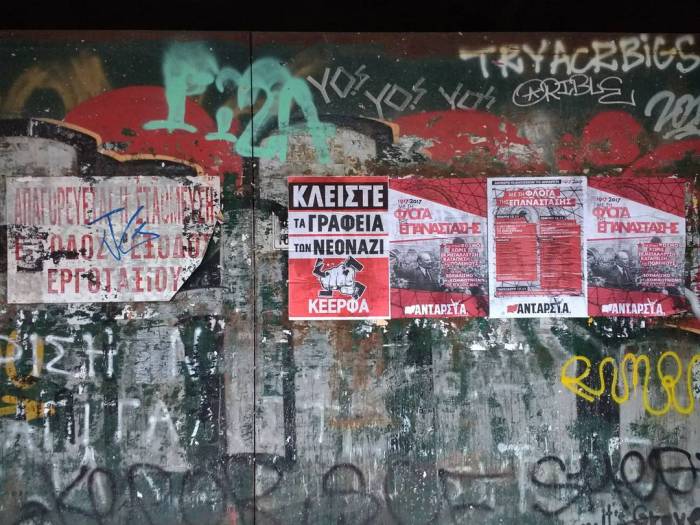
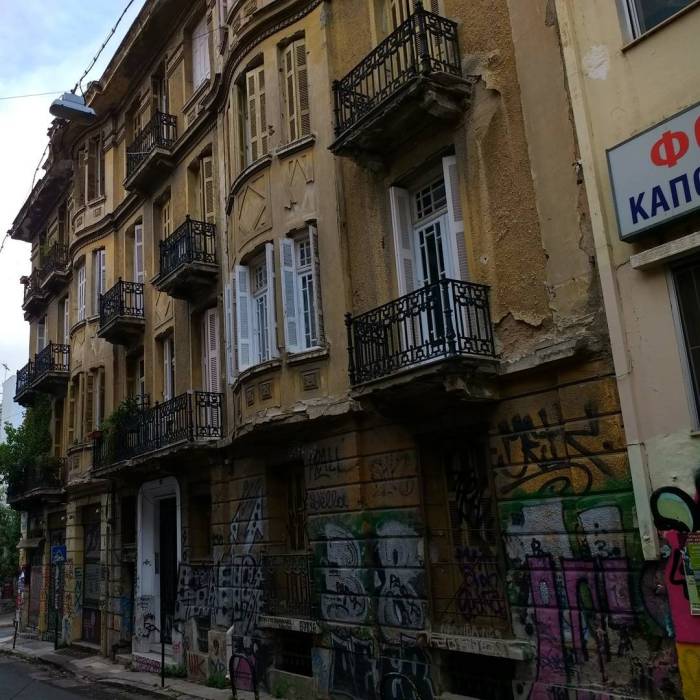
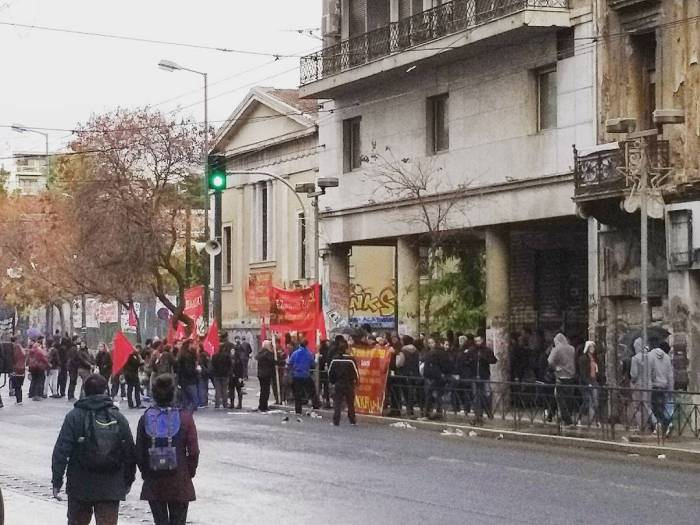
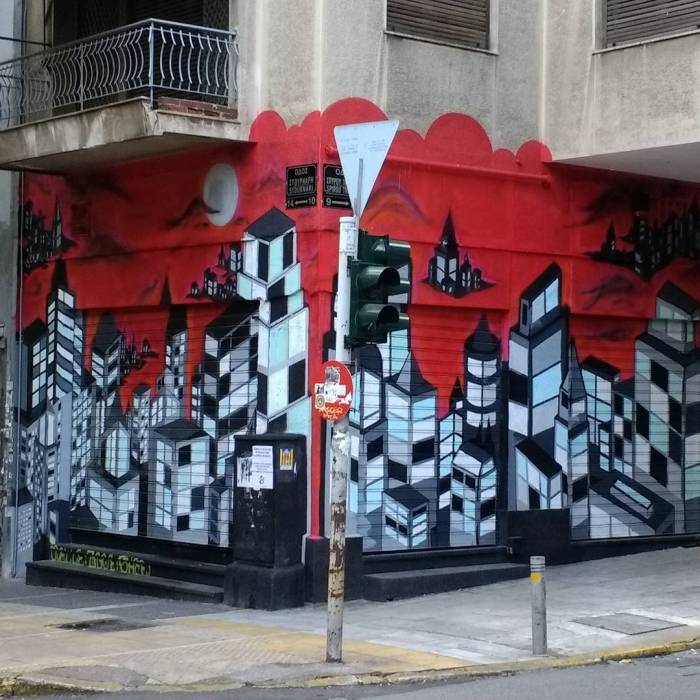
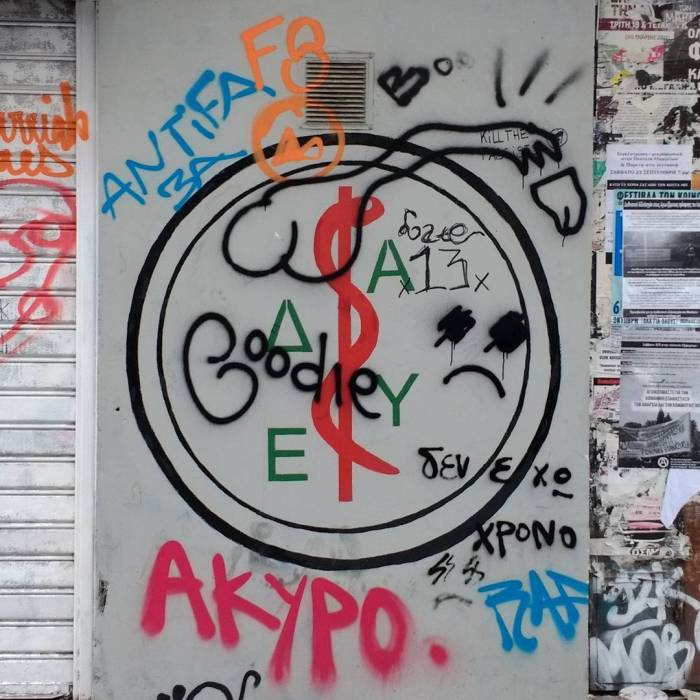
For a strong taste of alternative Athens, the Exarcheia district is the place to be. This is a raw and unsanitised part of the city. Its streets are caked in graffiti and there’s a heavy anarchist spirit in the air. The scars of the country’s economic problems are very noticeable as you walk the streets. Frequent demonstrations take place here and often without warning. I’ve written a separate post about this district with several photos.

nicholas_peart_1983_4___Bbha9svDNLi___

Mural of a homeless person in Athens’ Exarcheia district 

EMST National Museum of Contemporary Art

emst ATHENS

Athens’ National Museum of Contemporary Art (EMST) opened its doors in the hip Koukaki neighbourhood only two years ago, after a plethora of legal and political difficulties. When I visited it was only partially open. It was not possible to access the museum’s permanent collection of art works, which was a great shame. Hopefully that will be possible soon. On a positive note, I viewed two impressive temporary exhibitions. The first of those was a photography exhibition of contemporary Greek artists entitled What We Found After You Left, which was made in response to a related film, Tripoli Cancelled, by the film maker Naeem Moheiaeman about his father being stranded in Athens’ now defunct Elinikon Airport for nine days without a passport in 1977. The recent photographs created in response are taken in Elinikon Airport, which shut down in 2001. The airport is now a crumbling disused relic. In the photographs one can sense desolation, wilderness and decay. A true feeling of distressing alienation, which is what Moheiaeman’s father experienced during his ordeal. A re-visit to a traumatic period of time made even more poignant by the airport’s neglected and forlorn state.

nicholas_peart_1983_3___BbU3elqDFs3___

Photograph by Christos Kanakis from the What We Found After You Left exhibition at EMST 

The second exhibition, Chinese Xieyl, located on the bottom floor of the museum features a selection of works from the collection of the National Art Museum of China in Beijing as part of a collaboration with EMST. It is a brilliant exhibition and an excellent sampler of important painting and sculpture works from China during the 20th century.

nicholas_peart_1983_5___BbU78eoDq4x___

‘Miners’ by Li Shinan (1940-) from the Chinese Xieyl exhibition at EMST 

State of Concept 

nicholas_peart_1983_1___BbjPqI9jazw___

State of Concept is a not for profit space also located in the Koukaki neighbourhood not far from EMST. It was founded in 2013 by the art critic and curator Iliana Fokianaki and is an integral component of Athens’ contemporary art scene. I visited on the opening night of a solo show by the Czech artist Zbynek Baladran entitled Difficulties To Describe The Truth. On display are short films and installation works by the artist. Through his work he explores the very notions of what is often passed of as truth. This is especially pertinent in this current politically tense climate of fake news, information wars and cheap noisy rhetoric masquerading as facts. Through this deluge of corrupted information, especially in the digital world of limitless over-saturated free content, getting to the real truth and facts is mired with obstacles.  It’s less challenging to remain tranquilised with easy truths.

nicholas_peart_1983_3___BbjPqI9jazw___

Contingent Propositions (2015-17) by Zbynek Baladran from his solo show at State Of Concept  

In addition to this exhibition, in the lower level of the gallery there was another separate solo exhibition by the Russian artist Anton Vidokle comprising of a trilogy of his films entitled Immortality for all: A film trilogy on Russian Cosmism. Cosmism was a movement, which developed in Russia in the late 19th century, before the 1917 October Revolution, by the Russian philosopher Nikolai Fedorov (1829-1903), who was a champion of life extension, human immortality and transhumanism. He even believed in the resurrection of the dead. As wild as all this may have sounded back then (and even today), current emerging technologies, especially Artificial Intelligence, more than 100 years later are working towards these realisations. In fact the Life Extension industry is poised to be huge in the future. Google have a department called Calico which is focused on life extension and one of the leading visionaries in this field, Dr Aubrey de Grey, has a not-for-profit foundation called SENS, which is completely dedicated to life extension and anti-ageing. The futurist and inventor Ray Kurzweil has gone on record to state that the Singularity (the event when AI will be on par with human intelligence and when both will merge) will occur in 2045. Both Tolstoy and Dostoyevsky were influenced by Fedorov’s writings. Russian Cosmism was a transformative movement striving to transcend art and philosophy by creating a new world. A world where one is universal and not cemented to one planet – where one is fully connected to the universal cosmos and astral metaphysical world; free from micro societal constraints and mores.

nicholas_peart_1983_9___Bb1MLk7jy5T___

Still from the film Immortality for All: A film trilogy on Russian Cosmism by Anton Vidokle 

The Breeder Gallery

nicholas_peart_1983_6___BcAt36MDnsZ___

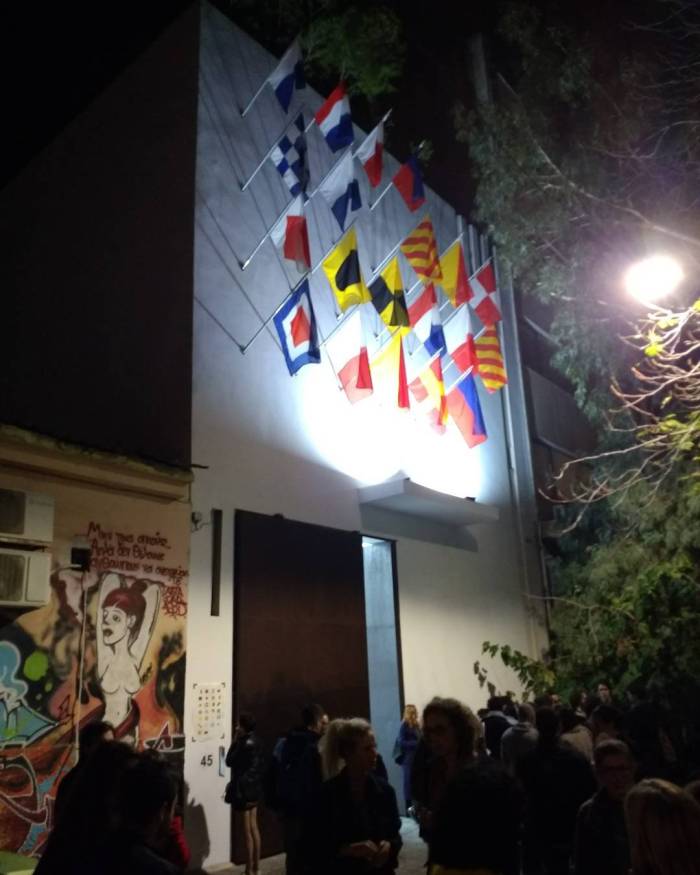
Located in the Metaxourgio district the Breeder Gallery is one of the city’s most cutting edge art spaces. It is a large multi story gallery. I visited one evening at an opening featuring three separate exhibitions. The first of these exhibitions, In Search Of Happiness, by the local art collective Arbit City was made up of an installation of flags on the outside front façade of the gallery.

nicholas_peart_1983_1___BcAvKpiD3W____

In Search Of Happiness – flag installation by Arbit City at the Breeder Gallery

The ground floor and lower level of the gallery featured the second exhibition, a minimalist solo exhibition entitled Nearly Inaudible Breathing by the Portuguese artist Joana Escoval. Yet it was the third exhibition on the upper floors that was the highlight; a group exhibition featuring emerging Greek artists called Athens And Its Periphery In Regards To Contemporary Painting curated by Hugo Wheeler, a young independent British curator who recently moved to Athens from London. For me this show was one of the most vital shows I witnessed during my time in the city with works by local artists projecting the zeitgeist of Athens as a developing and increasingly important and exciting global art city and hub attracting artists from around the world just as Berlin has been doing over the last several years.

nicholas_peart_1983_2___BcAt36MDnsZ___

Work by Orestis Lazouras as part of the ‘Athens And Its Periphery In Regards To Contemporary Painting’ group exhibition at the Breeder Gallery 

Ileana Tounta Contemporary Art Center

The Ileana Tounta Contemporary Art Center is a large warehouse space over two floors dating back to 1988. It has hosted many important exhibitions in the city. During my visit I attended the opening night of a new exhibition, Integral II, the second part of a two exhibitions themed around not just the current political and economic situation enfolding Greece, but also the situation throughout the world. In the first room I enter I am greeted by a giant installation created by the well known Greek born artist Jannis Kounellis who was one of the main figures of the Arte Povera movement in the 1960s and 1970s in Italy. The installation features a large square industrial steel plate resting on one of its edges surrounded by burlap sacks containing charcoal. In the background to the right of the installation are a series of paintings by George Stamatakis and to the left is a tall vertical relief by Socrates Fatouros comprising of bitumen sheets and elastic liquid membrane.

nicholas_peart_1983_1___Bb-gciKD3od___

Works by Jannis Kournelis, George Stamatakis and Socrates Fatouros at the Ileana Tounta Contemporary Art Center

The exhibition continued upstairs featuring another smaller work by Kournelis as well as more works by contemporary Greek artists. Of those works it is George Lappas’s Traveller (2013) work, which stands out. It is a great red sculpture made of iron and red felt. The ‘headless/dislocated’ traveller reflects Lappas’s own experiences as an eternal refugee.

nicholas_peart_1983_1___Bb-hk8Ij37x___

Traveller (2013) by George Lappas 

Gagosian Gallery (Athens Branch)

The Gagosian Gallery is probably the largest art gallery empire in the world. The Athens branch is quite modest in size spread over just a few rooms on one floor in a building in Athens’ Kolonaki district. On my visit there was a solo exhibition by the American artist Sally Mann entitled Remembered Light: Cy Twombly In Lexington of black and white and colour photographs of the late Cy Twombly’s studio taken from 1999 to 2012.

nicholas_peart_1983_6___Bb1MLk7jy5T___

Remembered Light, Untitled (Flamingo Profile) (2012) by Sally Mann

Twombly was a friend and mentor of Mann’s. They both grew up in the US state of Virginia. The photographs of his studio featuring miscellaneous objects, art works, paint marks on the studio floor and walls, and light and shadow tones perpetuate his memory and spirit. Cy Twombly may be gone in body, but his energy continues to radiate strongly as if he never really left.

Touring the art galleries in Athens’ Kolonaki district

The Kolonaki district in Athens where the Gagosian gallery is based is conveniently home to the greatest concentration of art galleries in the city. Of course it is impossible to visit every single gallery (although I almost did succeed!) but I did visit a good number. My first port of call was Gallery 7 and a solo exhibition of realist portrait and figure paintings by the Greek artist Maria Hatziandreou. Her paintings are mature, emotive and atmospheric with a gift for empathy and getting to the emotional core of her subjects. She uses the medium of paint and colour very skilfully to achieve this.

nicholas_peart_1983_4___BbWSiXxDVYK___

Painting by Maria Hatziandreou at Gallery 7

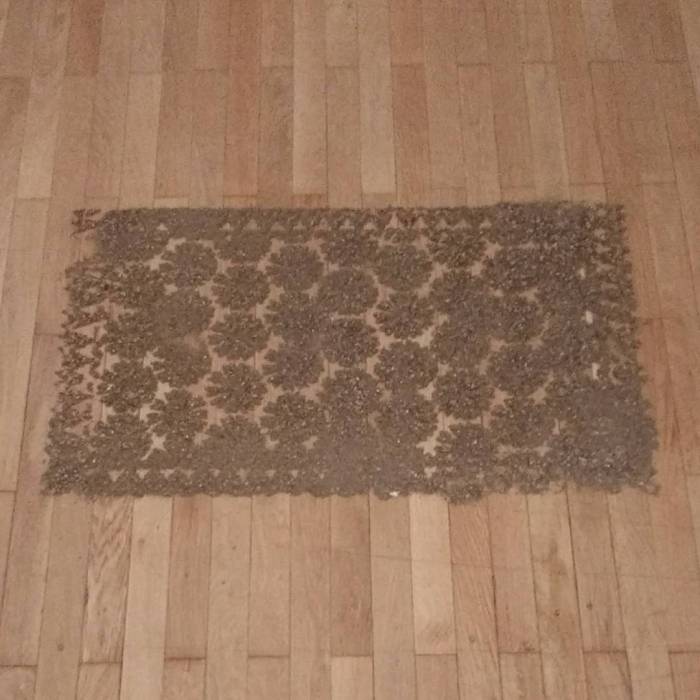
At the Eleftheria Tseliou Gallery there is a group exhibition, Conditions of Production, of mixed media works by emerging international artists. The focus of the exhibition is on materials with meditations on where they stand and how they fit in in the world of contemporary art. Of those works I am particularly drawn to Tina Tahir’s ‘Xenos (welcome mat)’ made of soil.

nicholas_peart_1983_6___BbWQx9WDtfo___

‘Xenos (welcome mat)’ (2016) by Tina Tahir from the Conditions Of Production exhibition at the Eleftheria Tseliou Gallery

The Christina Androulidaki Gallery (CAN) is a small but notable art gallery, which plays a vital role in the city’s contemporary art scene. At the time of my visit I caught a group photography exhibition of young Greek photographers entitled The Sense of an Ending. It is a strong show and the space is perfect for the works on display. Definitely a gallery to follow and keep abreast of the most promising emerging local talent.

nicholas_peart_1983_1___Bb1MLk7jy5T___

Freewheeling (2017) by Dimitris Mylonas from the exhibition The Sense of An Ending at CAN

Afterwards I head to the Kalfayan Galleries space, originally established in 1995, and with a space in Thessaloniki too, focusing on Greek contemporary art. I visited the gallery to catch a solo show called The Cheat by the established Greek artist Antonis Donef. The central part of his exhibition is a large installation work entitled Cheating In Art History comprising of 370 neatly rowed lidless black pens across four black rectangular tables ending at an open book. On closer inspection, the pens contain pieces of text from E.H. Gombrich’s book ‘The Story Of Art’ (which is the open book on the final row) engraved very small scale with a needle. This alludes to the title of the work of memorising parrot-fashion style segments of information rather than fully understanding and absorbing it.

nicholas_peart_1983_3___Bb1MLk7jy5T___

Antonis Donef’s solo exhibition The Cheat at Kalfayan Galleries

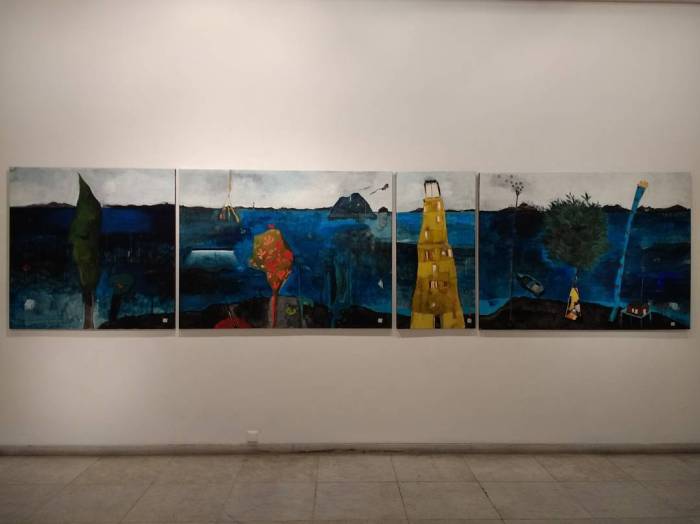
The Zoumboulakis Galleries is one of the oldest galleries in Athens dating back to 1912. Nevertheless it is an important promotor of contemporary art in Athens. When I visited there was a solo exhibition of paintings entitled ‘Future’ by the Greek artist Christos Kechagloglou. His paintings are colourful, childlike and optimistic. His dreamy impressions of landscapes and seascapes invite the viewer on a happy journey of magic colours and limitless imaginary possibilities free from social straitjackets. The artist Paul Klee springs to mind when I focus on Kechagloglou’s paintings.

nicholas_peart_1983_8___Bb1MLk7jy5T___

Painting by the Greek artist Christos Kechagloglou from his solo exhibition ‘Future’ at the Zoumboulakis Galleries

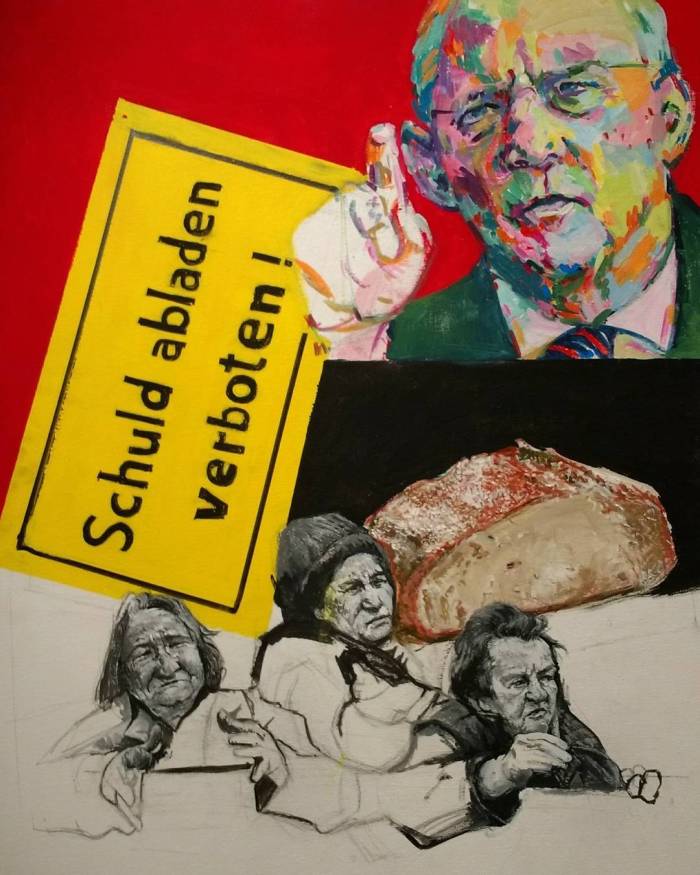
One of the biggest surprises for me though was the two exhibitions I saw at the Astrolavos Dexameni gallery. I stumbled upon this gallery in the Kolonaki district by chance not knowing anything about the gallery beforehand. It is a large space over two floors where I was rewarded with a solo exhibition of polemic paintings by a young Greek artist called Stathis Mavridis and a separate show of atmospheric experimental paintings by a female Greek artist called Iles Xana.

nicholas_peart_1983_1___BbfUai3jsKv___

Painting by Stathis Mavridis at the Astrolavos Dexameni gallery

Stathis Mavridis’s paintings are powerful and very relevant. His painting featuring the former German Federal Minister of Finance, Wolfgang Schauble, and the words ‘Schuld abladen verboten’ (Literally; ‘Guilt unloading prohibited’) is particularly prominent. Schauble’s period as Germany’s finance minister from 2009-17 coincided with the unfolding of the crisis in Greece and in other countries across the Eurozone. Schauble is a very controversial figure in Greece as he is seen by many as responsible for the draconian austerity measures imposed on the country since the crisis first erupted.

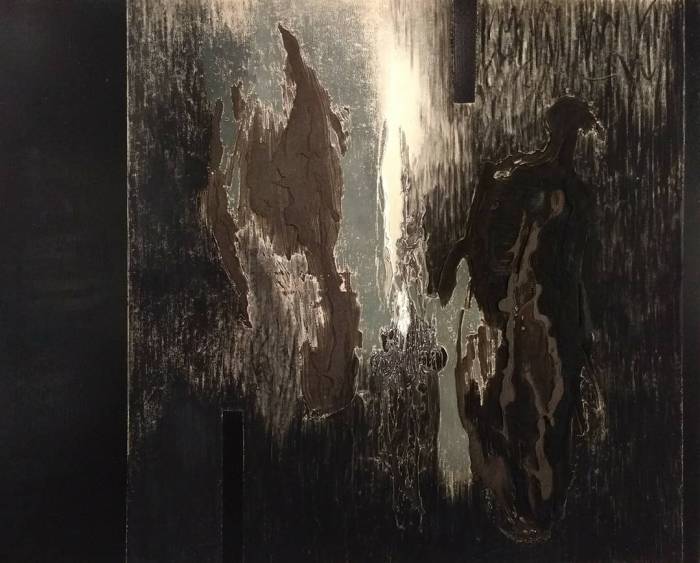
nicholas_peart_1983_1___BbfWCT7jP37___

Painting by Iles Xana at the Astrolavos Dexameni gallery

The separate exhibition of paintings by Iles Xana are a delight. Whilst Madrivis’s paintings are external and time-based, Xana’s paintings are internal and timeless. There are like dream worlds one can float and get lost in. As well as paint she incorporates other materials such as glue to realise her visions

Important contemporary art related places I missed

One important place I really wanted to visit was the DESTE Foundation Center For Contemporary Art. Unfortunately there were no exhibitions on at the centre when I was in Athens, which was a shame as this place is one of the beacons of Athens’ contemporary art scene. The DESTE Foundation For Contemporary Art is a not for profit foundation originally established in Geneva in 1983 by the Greek art collector Dakis Joannou who is one of the most important figures in the world of contemporary art. The exhibition space in Athens is focused on promoting emerging and established contemporary artists.

With much regret, I sadly wasn’t able to visit BERNIER/ELIADES GALLERY, which was founded by Jean Bernier and Marina Eliades in 1977. The gallery is an important and influential promoter of Greek and international contemporary art. When I tried to visit the last exhibition had already ended. I hope to check out this gallery on my next visit to Athens

The Onassis Cultural Center is a leading arts centre located outside of the city centre, which I didn’t get round to visiting. It’s an enormous place though with a wide and diverse program of activities, exhibitions and events.

By Nicholas Peart 

(c)All Rights Reserved
USEFUL LINKS

Exploring the Contemporary Art Scene of Athens

http://athensartmap.net/

Photographs From The District Of Exarcheia In Athens

Exarcheia is an interesting district to explore in the Greek capital. When I was based in Athens for a few weeks in November 2017, I went on a few strolls in this part of the city. It is a slice of alternative Athens. You can call it trendy or hipster, but this is a very raw and unpolished place. This is no Shoreditch or Brooklyn. Demonstrations frequently take place. In fact, when I was there, I witnessed one manifesting by the Polytechnic University entrance with piles of stolen chairs and bits of furniture piled on top of one another. I’ve read about the anarchists who populate this district. They can be found around Exarcheia’s main square. When I passed this square, I saw a bum with an unruly bush of greying curly hair lying on a knackered mattress wrapped up warm (Athens starts to get cold in November) and engrossed in a book. By his side there were several columns of battered paperbacks. I thought to myself, Is this guy some skid row Socrates? There’s a sense of sadness when I walk these streets felt via the consequences of the never ending economic hard times the country is going through. Amongst the abrasive graffiti permeating the streets are some genuine works of art. On one wall someone has created an enormous mural of a homeless person with the words, ‘dedicated to the poor and homeless here and around the globe’. Below is a roll of photographs I took from my explorations here. The best sensors though are natural. One’s eyes, ears and nose will never be able to replace an artificial lens, but these snaps shall suffice…


nicholas_peart_1983_1___Bbha9svDNLi___nicholas_peart_1983_8___Bbha9svDNLi___nicholas_peart_1983_5___BbhdZ64DudI___nicholas_peart_1983_10___BbhdZ64DudI___nicholas_peart_1983_5___Bbha9svDNLi___nicholas_peart_1983_8___BbhdZ64DudI___nicholas_peart_1983_1___BbhdZ64DudI___nicholas_peart_1983_2___Bbha9svDNLi___nicholas_peart_1983_3___Bbha9svDNLi___nicholas_peart_1983_3___BbhdZ64DudI___nicholas_peart_1983_4___Bbha9svDNLi___nicholas_peart_1983_4___BbhdZ64DudI___nicholas_peart_1983_6___BbhdZ64DudI___nicholas_peart_1983_9___BbhdZ64DudI___nicholas_peart_1983_10___Bbha9svDNLi___nicholas_peart_1983_6___Bbha9svDNLi___nicholas_peart_1983_7___Bbha9svDNLi___nicholas_peart_1983_9___Bbha9svDNLi___nicholas_peart_1983_7___BbhdZ64DudI___nicholas_peart_1983_2___BbhdZ64DudI___


Photographs and text by Nicholas Peart

(c)All Rights Reserved

Photographs From Rome’s Testaccio District

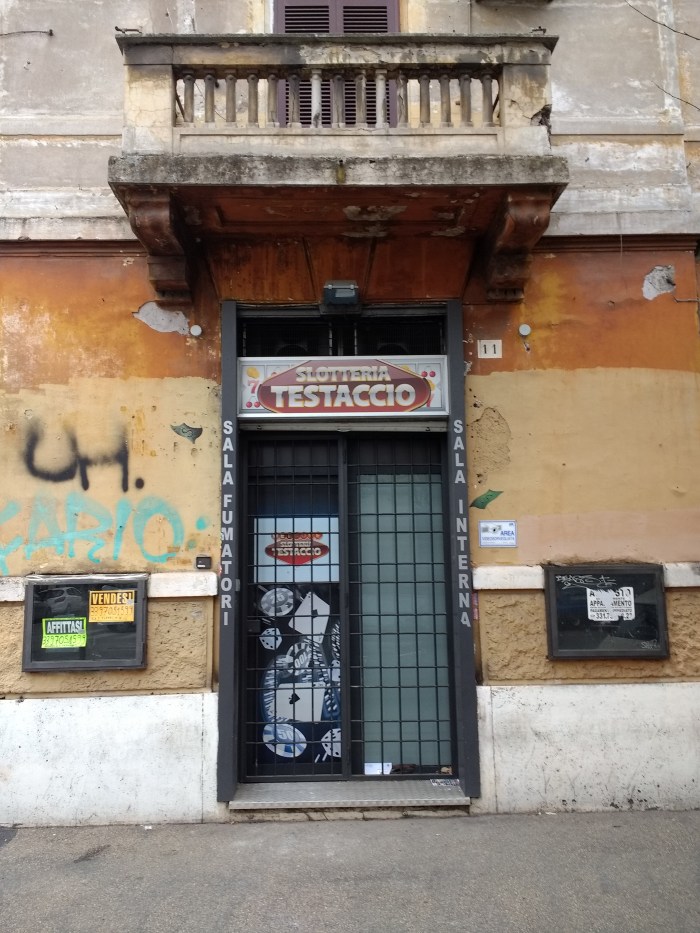
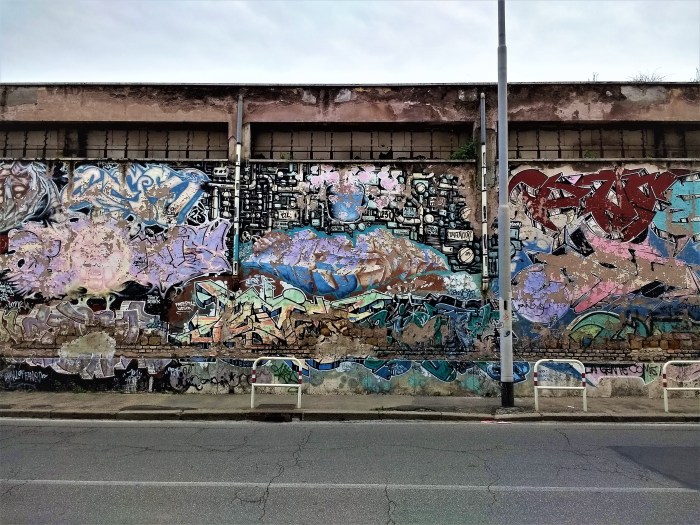
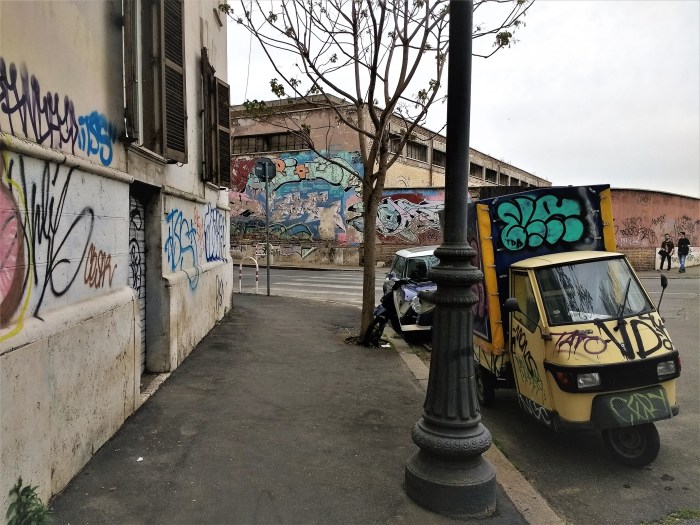
The Testaccio neighbourhood of Rome located by the Tibor river and south of the Coliseum and ruins of ancient Roma is an interesting part of the city to stroll through. For a long time it was traditionally a working-class district. In recent years the area has become gentrified and this shows in some of the trendy eateries and bars as well as the broader mix of residents. Yet unlike some neighbourhoods. which completely lose their original flavour, Testaccio has retained much of its character and this shows in the photographs. The streets are full of grand old multi-story buildings. Graffiti, both artistic and non artistic, can be found in several corners of the neighbourhood.

The main piazza of Testaccio becomes animated over the weekend with families and children playing and kicking footballs around. Old long time residents can also be found shooting the breeze on the piazza benches.

Close to Pyramide metro station on the edge of the district is a prominent Egyptian style pyramid built during the Roman period. And nearby there is a beautiful and tranquil Protestant cemetery where one can find the graves of the English poets Keats and Shelley. I describe this cemetery in another blog post.


IMG_20180414_181914267IMG_20180414_175429284_HDRIMG_20180414_180934697IMG_20180414_180759495IMG_20180414_175826954IMG_20180414_180118696IMG_20180414_180543836IMG_20180414_181749154IMG_20180414_181322599_HDRIMG_20180414_181236969IMG_20180414_182535034IMG_20180414_181511270IMG_20180414_181339140IMG_20180414_182156262IMG_20180414_181540097_HDRIMG_20180414_181602109IMG_20180414_183113914_HDRIMG_20180414_182635649IMG_20180414_182341405IMG_20180414_180858095IMG_20180414_180820634IMG_20180414_183149412


Photographs and text by Nicholas Peart 

(c)All Rights Reserved 


Visiting Rome’s Protestant Cemetery

IMG_20180416_135334777

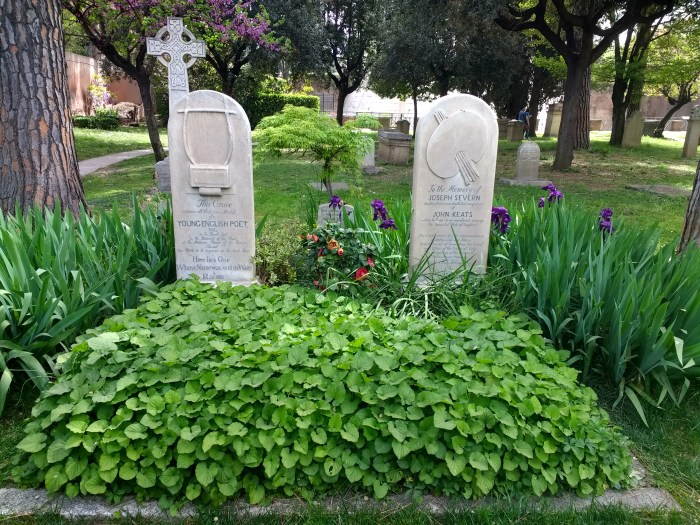
Located in Rome’s Testaccio district is Rome’s Protestant Cemetery where many distinguished figures through the ages are buried. The cemetery is most famous for being the resting place of the English poets John Keats and Percy Bysshe Shelley. Both poets died young. Shelley at 30 and Keats at only 25. Keats died in Rome in 1821 of tuberculosis and is buried next to his friend, the English painter Joseph Severn (who lived 58 years longer dying at the age of 84 in 1879), in the Parte Antica (Old Part) of the cemetery by the prominent Pyramid of Cestius, originally constructed in 18-12 BC as a tomb for Gaius Cestius who was a magistrate and member of the Septemviri Epulonum, one of the great religious corporations of ancient Roman priests.


IMG_20180416_131905442_HDR

The graves of poet John Keats (on the left) and his friend Joseph Severn

Shelley drowned off the Italian Riviera in 1822, just a year after Keats. Even stranger is the fact that a book of Keats poetry was found in his pocket when his body was washed up on the shore. His friends, the poet Lord Byron and the English novelist and traveller Edward John Trelawny, cremated his body on a beach near the Tuscan town of Viareggio. The ashes were then sent to the British consulate in Rome who transferred them to the Protestant Cemetery. Shelley’s grave is located in the Zona Vecchia (Old Area) part of the cemetery in the row at the very back. His epitath reads, ‘Nothing of him that doth fade, But doth suffer a sea=change, In to something rich and strange’


IMG_20180416_132840240

The grave of the 19th century English Romantic poet Percy Bysshe Shelley

Directly facing Shelley’s grave is the small grave of the American Beat era poet Gregory Corso who died in 2001. His epitath reads, Spirit is life, it flows thru the death of me, endlessly like a river, unafraid of becoming the sea.


IMG_20180416_133717048_HDR

The Grave of the American beat poet Gregory Corso 

Elsewhere in the cemetery are the tombs of the grandson of the poet William Wordsworth and the only son of the German writer and poet Goethe. The cemetery contains the grave of the uncle of Edvard Munch, Peter Andreas Munch, who was a historian. One can also find the graves of the 20th century Italian poets Dario Belleza and Amelia Rosselli. One of the principle artists of the Italian post-WW2 Arte Povera art movement, Jannis Kounellis, was buried here last year. The graves of the 19th century English sculptors, John Gibson and Richard James Wyatt, who were both students of the Italian sculptor Antonio Canova, are both located in this cemetery.


IMG_20180416_134315185

The tomb of the 19th century English sculptor John Gibson

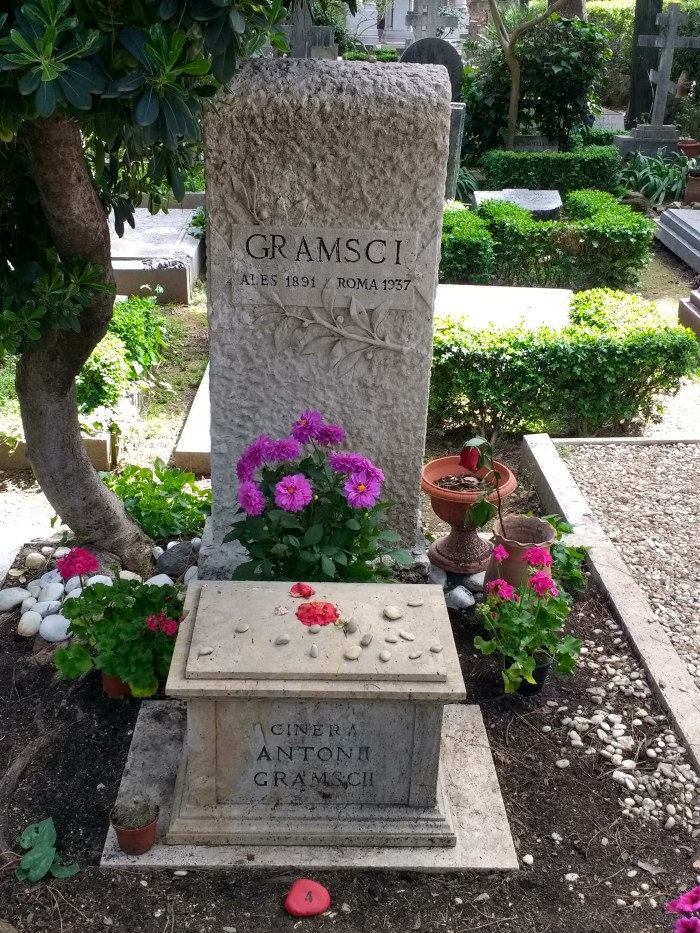
The grave of the Italian philosopher and one of the founders of the Communist Party Of Italy, Antonio Gramsci, can be found here. He was imprisoned in 1926 during Benito Mussolini’s Fascist regime. Whilst in prison he wrote the seminal Prison Notebooks between 1929-35, which were inspired by Marxist theory and by the writings of figures such as Niccolo Machiavelli and Vilfredo Pareto. In 1935 he was released from prison due to deteriorating health and died two years later in 1937.


IMG_20180416_135929819_HDR

The grave of the Italian Marxist philosopher and Communist Party of Italy founder Antonio Gramsci 

One of the most prominent graves in the cemetery is that of the Italian surgeon and humanist Giovanni Ceccarini, which reigns majestically in full Neo-Classical opulence and glory.


IMG_20180416_140108383

The lavish neo-classical tomb of the Italian surgeon and humanist Giovanni Cecarrini

Visiting this cemetery is definitely worth the trip. Especially on a sunny and cloudless day. It is one of the most beautiful and peaceful cemeteries I have ever visited. Some cemeteries can be a sombre and oppressive experience but not this one. Moreover, it is not an overvisited place like many of Rome’s other landmarks. There is no fee for visiting but at least a 3 euro donation is recommended in order to maintain the cemetery.


By Nicholas Peart

(c)All Rights Reserved
THE KOSOVO DIARIES (Part One) – PEJA, DEČANI and PRISTINA

Day One: Mon 25th September 2017
Travelling to Peja

Yesterday I arrived in the provincial Montenegrin mountain town of Berane at 7pm. 12 hours earlier I departed the town of Mostar in Bosnia and Herzegovina for the city of Podgorica, the capital of Montenegro. I get into Pod’, or Titograd as it used to be called at 1.30pm. My connecting bus to Berane departs in two hours. Perhaps I am mistaken but Podgorica is not a pretty place. Knackered Communist era living blocks surround the bus station and even the bus station itself has barely changed since about 1974. I think Titograd is a more fitting name.

I find a modern pizzeria restaurant about 100 metres outside of the bus station from where I take the opportunity to use the bathroom (immaculately clean I could eat my capriccioso pizza off the ceramic floor – yet the lights go off when I am already doing the business) and the free wi-fi to book my accommodation in Berane, and have a good meal that isn’t crisps and chocolate bars. The waiters speak flawless English.

For the duration of the Pod-Berane bus trip, we journey through the Montenegrin countryside; an authentic and unspoilt slice of rural Balkans. When I arrive in Berane the sun is already setting and I realise I have already traversed through most of Montenegro in less than a day. It’s not a big country.

21984960_892098227621441_4633771887019687936_n

The Montenegrin mountain town of Berane

Berane is not the kind of place you would want to be anchored to for too long; especially if you are young and alive. Not much goes down here and it reminds me of a scoop of time-forgotten Brexitville unceremoniously dumped in the middle of the countryside. There is a bus to the Kosovan town of Peja leaving the following day at 11am. Apart from the hotel receptionist where I am staying, absolutely nobody speaks English in this town. I know perhaps ten words of Serb-Croat with a few more Polski words to boot but that only gets one so far. I soon learn that the 11am bus is delayed by 40 minutes. That’s quite a delay but I refuse to leave this one horse station for fear that I will miss the bus. I constantly keep my eagle eye peeled for the bus. When it arrives it’s one of those retro Communist era buses from about 1981; a far cry from gap yarr Euro Rail travelling. I am the only tourist on the bus. Most of the passengers are Kosovan/Albanian.

When we arrive in Peja three hours later, it is raining hard. I have no map of this city of functioning wi-fi on my phone. I wait at the bus station for the rain to soften. I realise I’ll be waiting a long time. Foolishly, I have no umbrella (I lost my last one somewhere on the Paris metro, I think) and I decide to brave it. As I walk along the main road towards what I think will be the centre of town, I am soon rewarded by the sight of a modern Diner style restaurant. They have wi-fi, much to my delight. Not only that, there’s a decent menu and a front display of delicious deserts; many of which I remember from the historic family run patisserie in Sarajevo called Egipat. A filling plate of shredded chicken kebab with chips, salad, and a generous slice of tiramisu for dessert all comes to just €3.50.

nicholas_peart_1983___BZiU5alDVIZ___

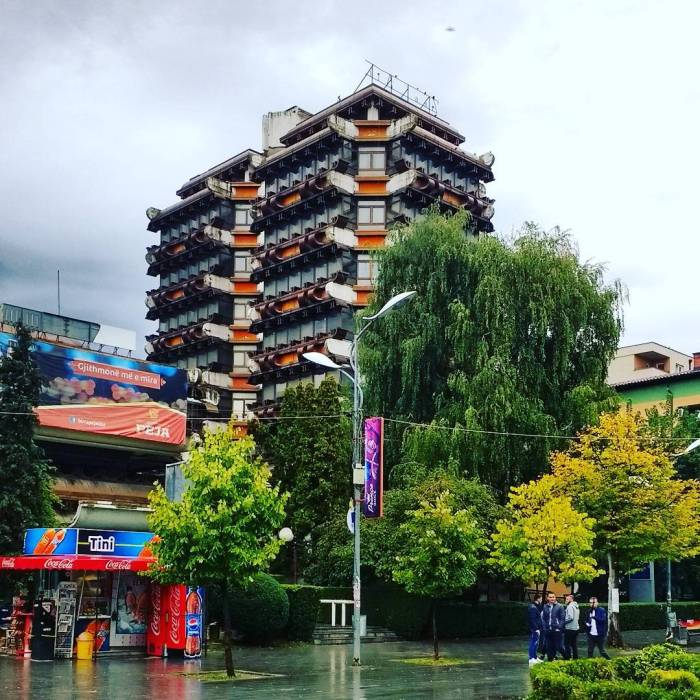
Peja town

I continue walking up the main road. I soon approach a pedestrian square, where a large mid to high range hotel, Hotel Dukagjini, is located, but I am on the lookout for the more modest Hotel Peja. Close to me is an airline travel agency. I enter in the hope that someone there may know the whereabouts the hotel. The attractive and courteous young woman at the desk greets me in perfect English. She isn’t sure where exactly it’s located but she kindly offers to call the hotel and the owner duly meets me at the agency. A stocky white-haired man, perhaps in his late sixties or seventies, arrives and together we walk to the hotel. The hotel is only a couple of blocks away directly facing an enormous future-retro eyesore of a building; like something concocted by the architect of the Barbican tower blocks on acid laced Kool Aid. It is unique in it’s ugliness; the No Retreat No Surrender of global architectural monuments. My hotel is nothing noteworthy but perfectly fine for a couple of nights.

nicholas_peart_1983___BZeKOJbDWIP___

Eyesore or work of art?

I spend the remainder of the rain drenched afternoon and early evening mildly exploring what I can of this city within relatively close proximity to my hotel. In no time I discover a small bazaar like street named “William Wolker” street. William Walker, not to be confused with the clumsy failed wannabe 19th century American conquistador, was the head of the Kosovo Verification Mission, which was a peacekeeping mission established to put an end to the Kosovo War of the late 1990s. Former president Bill Clinton and former US general Wesley Clark also each have a street named after them. As does Tony Blair. Many people view Blair as a “war criminal” owing to his involvement in the 2003 Iraq war, but not the people of Kosovo. Here he is regarded very highly and some families who survived the Kosovo War even went as far as calling their sons ‘Tonibler’. The side of WW street is decorated with a maze of tangled black electricity wires, like its trying the outdo the legendary dishevelled mess of wires found in most of the narrow old bazaar alley ways of Old Delhi, but no matter how hard it may try it will never come close.

nicholas_peart_1983___BZiMtB8D43l___

In Kosovo Tony Blair is held in very high regard

My meanderings soon lead me to the Peja Arts Gallery featuring a solo exhibition of beautiful paintings by the local Kosovo artist Isa Alimusaj. Sadly the gallery appears to be closed even though all the lights inside are blazing. As much as I want to enter, I cannot find anybody who is in charge. Next to the gallery is a library called the ‘Azem Shkreli” library. I wonder if Azem is related to the controversial American-Albanian multimillionaire “Pharma bro” businessman Martin Shkreli? Although I later discover that Shkreli is quite a common Albanian surname. Not far from my hotel by the river is a statue of Mother Theresa, who was originally from Albania. And nearby is a memorial to four soldiers who died during the Kosovo War. In the evening the temperature plummets. I buy a bottle of water and some pears and retire to my room at the Hotel Peja.

Day Two: Tuesday 26th September 2017
Visiting the Patriachate of Peć and Visoki Dečani monasteries

21911065_273615596375837_4854419565494403072_n

The old Ottoman era bazaar of Peja

Early in the morning I leave my hotel room and walk to the main square where I find a tourist information office. It is staffed by a woman who speaks excellent English. She provides me with a map and highlights all the places I want to visit. My first destination is the city’s old bazaar; like a miniature version of the Baščarsija bazaar in Sarajevo. Walking through the bazaar I try to locate somewhere where I can have breakfast. Ordinarily I skip breakfast, but not this morning. I am so hungry I could burn down cities in return for a large plate of čevapi. I follow my nose, towards the source of the pungent smells radiating from the town’s burek and čevapi eateries. I am led to a čevapi joint called Oebaptore Meti. And what a good call that was. The Cevapi here is as good as it gets in the Balkans. Not only that. I also receive a generous side of salad and grilled vegetables. And all for €2.50. The overpriced pretentious bistros of Paris can do one. The food here is divine. I think Anthony Bourdain would concur.

nicholas_peart_1983___BZiLDhUjwGU___

The best cevapi in Peja

Belly overstuffed and belt loosened, I revisit the Peja Arts Gallery containing all those magical paintings by Isa Alimusaj. Initially I come to the conclusion that the gallery must be closed, but after giving the retro gallery entrance door a firm push, to my delight, I stumble inside. The paintings of Alimusaj are magnificent. Wow! What a privilege it is to discover such a brilliant and gifted artist in the unlikeliest of settings. Those paintings don’t deserve to be hidden in some remote and hard to reach corner of Eastern Europe. They should be on the walls of the Royal Academy of Art. I could reference some well known artists when I look at his paintings; Klimt, Dali, Munch and Bosch perhaps. But the truth is they are like no other artist. Alimusaj is in a league of his own.

nicholas_peart_1983___BZiJTQhjqEq___

Paintings by local Kosovan artist Isa Alimusaj at the Peja Arts Gallery

Feeling lifted by seeing such magnificent art, I make the 2-3km walk towards the Patriachate of Pec monastery. As I walk further out of town, I see houses and buildings that were scarred from the war of the late 1990s; destroyed areas covered with newer bricks next to older bricks. The scenery on the walk is beautiful. Even with the sky heavy with low nimbostratus clouds, the mountain countryside sparkles. The entrance to the path leading to the monastery is guarded by NATO’s Kosovo Force (KFOR). At the entrance I show my passport. A group of other visitors soon arrive. A young Englishman called Jack from somewhere in Essex stands out like a whirlwind. He has beautiful long blond curly hair like a youthful Robert Plant and is clad in neo-dandy/hipster ware with shades of his Essex soul brother Russell Brand. He’s with his travelling companion who is an older reserved American who looks like an academic scholar on early Native American history. I get talking with the dude from Essex. They both arrived at the entrance in a battered Mercedes taxi. ‘The taxi geezer charged us 15 euros from the bus station to here. I think he charged us too much’. I think so too. Then apropos of nothing, he points to his reserved travelling companion and blurts out, ‘E’s a West Ham fan too!!’ And here I was thinking, perhaps naively, that I was going to have a quiet uninterrupted trip to this monastery, in a hard to reach little travelled part of Eastern Europe, where I’d have it all to myself. How wrong was I. I like Jack though and he seems to be having a thoroughly great time travelling and seeing awesome things and not allowing himself to be trapped in some depressing-ass road to nowhere job in Basildon or someplace around his neck of the woods.

nicholas_peart_1983___BZiQmpEjp26___

The Patriarchate of Pec monastery 

The Orthodox Serbian monastery dating back to the late 13th century is a jewel painting in red-terracotta. Yet it becomes even more spectacular when I enter. What immediately impresses me are the frescos covering all the walls and ceilings; rich, luxurious and brilliant. Its hard to comprehend how after over seven centuries they are still so alive. The extraordinary skill of them is up there with the very best of the early Italian Renaissance painters. I am particularly spellbound by a specific ceiling fresco, which, through centuries of decay, has morphed into a composition that makes even Goya’s most dystopian works look tame. This fresco appears like its engulfed in Mother Nature’s foulest weather and Tesla’s coil violently erupting. I stay at the monastery for a while, marvelling at the frescos before walking back to town.

nicholas_peart_1983___BZiSgeEj8A-___

nicholas_peart_1983___BZiRZkEjOPP___

13th century frescos from the monastery 

As I reach Pec town I head towards the bus station to visit another monastery called the Visoki Decani monastery located outside of the town of Decani, which is situated between Pjac and the town of Gjakove. When I arrive at the bus station I have half an hour to kill before my Decani bound bus leaves Peja. So I walk across the main road to a bar and on a whim I order a large cold bottle of Peja beer for only one Euro. Time marches on as I begin to feel the initial effects of tipsiness. Before I know it I have just five minutes remaining. I am no barfly but I drain the remainder of my bottle of beer in a way that would have made Oliver Reed proud. When I get on the bus I indicate to the driver that I want to get off at Decani specifically to see the monastery. Nobody speaks passable English on the bus, but I think the driver gets the message. Forty minutes later as we appear to approach what looks like my destination, the driver signals for me to disembark and points to a road that will lead to the monastery. Decani town seems down at heel and depressed and I don’t think the war was kind to this town. There are memorials to soldiers who died in the war and about ten minutes away on the road back to Pec there is a massive, and I mean gigantic, cemetery, where many citizens who died during the war are buried.

I walk for almost 30 minutes along a quiet country road with lush forests and mountain scenery before I approach the beginning of the entrance to the monastery. This monastery has much more security than the Patriarchate of Pec monastery; its almost as if you are going to a Royal Family wedding. I hand over my passport and rucksack at the entrance before entering the compound. It is a handsome white monastery dating back to 1327 during the reign of the Serbian King Stefan Decanski who was the father of King Dusan who ruled Serbia during the golden age of the Serbian Empire. Yet the monastery has a turbulent history becoming the target of many attacks and attempted attacks. Since the Kosovo war, the monastery has been extremely vulnerable to attacks including an incident on 30th March 2007 when suspected Kosovan Albanian insurgents threw hand grenades at the monastery. Fortunately, not much damage was created. This is one of the reasons why the monastery is under constant tight security.

nicholas_peart_1983___BZjxX4Tn3LB___

By the Decani monastery

Like the Patriarchate, the Decani monastery is decorated with monumental frescos. When I enter a procession is already in full swing. The main area of the monastery is exquisite with a sky-high ceiling, elaborate frescos and many tall candles on a suspended chandelier, which one of the orthodox monks would put out one by one with a long metal candle snuffer stick.

nicholas_peart_1983___BZjynHDnhKv___

Inside the Decani monastery 

It has been an awesome and active day today. I am exhausted by the time I return to my room at the Hotel Peja.

Day Three: Tuesday 27th September 2017
Travelling from Peja to Pristina

At midday I check out of my hotel room. The young woman who is in charge arranges a taxi to come and collect me to take me to the bus station from where I will take a bus to the Kosovan capital of Pristina. She is very kind and speaks excellent English. Last night she made me a complimentary mint tea. She tells me that a taxi to the station should not exceed one Euro. I ask her, out of interest, how much a taxi should cost from the station to the Patriarchate monastery? She tells me two euros. I mention my Essex friend paying 15 euros. She looks at me as if he jumped out of a plane without a parachute. As I go to my taxi she insists that I don’t pay more than three euros for a cab from Pristina bus station to the location of my accommodation over there.

The taxi driver is a stocky middle age Kosovan-Albanian with a severe crop. He doesn’t speak a lick of English, but he can speak some German having lived in Germany for 18 months as a refuge during the war. I communicate with him in my fractured German.

nicholas_peart_1983___BZiVXSzjgaZ___

Inside Peja bus terminal 

At the bus station I locate my knackered old school Pristina bound bus. I nod in and out of consciousness for the duration of the journey. As we approach the outskirts of Pristina my first impressions are not full of joy. Arriving at the rundown bus terminal I begin to feel that the city centre, and more importantly my guesthouse, is no stone’s throw away. I haven’t the faintest notion where I am in relation to the city centre. With no map to guide me and no SIM card in my phone it is going to be challenging. My hopes lift when I get talking with a young man at the information desk in the terminal who speaks reasonable English. He gives me the password for the terminal wi-fi and finally I can take advantage of good ol’ Google Maps. I have already mapped out my journey from the bus station to my accommodation. When I approach two outside taxi drivers they both want at least ten euros to take me to my accommodation which is more than triple what I was advised to pay by the young woman back at Hotel Peja. I walk on. Even with the assistance of Google Maps, I am obstructed by a loud and aggressive dual carriageway with no infrastructure to cross it. No way am I going to cross this death-trap with vehicles driving at out of sight speeds. I swiftly come to the realisation that paying ten euros for a taxi may not be such a bad idea after all. So I approach another taxi driver. This one speaks no English. Nevertheless I show him the address of my accommodation. After looking at the scrap of paper with the address for what seems like an age, he brusquely says, ‘OK!’. When I press him on the taxi fare, he grunts in German, ‘Drei, vier Euro’. Fuckin’ A. Lets go.

Everything goes swimmingly until we approach the district of the city where my accommodation is supposed to be located. It is situated on the edge of a hill overlooking the city centre. After driving aimlessly across multiple narrow streets, the taxi driver stops at a small convenience store to ask for directions to my place. A middle age woman with red curly hair appears. She speaks refreshingly good English and advises me to go to an Italian restaurant located further down the street, which may be able to better assist me. When I tell her that I am from England, she almost gets down on her knees repeatedly telling me, ‘I love England! The war was so terrible and you defended us!’ The taxi driver then proceeds to drop me off at the Italian restaurant, continually apologising in German for his navigation blunders. I tell him not to worry and get out of the cab. At the Italian restaurant, I find a waiter who speaks excellent English yet he has no idea regarding the whereabouts of my accommodation. Happily though he allows me to use the wi-fi in the restaurant. I call my host via WhatsApp telling him where I am. He duly arrives in a black BMW X5 looking like the ring leader of a human trafficking gang. I am absolutely petrified of him. On arrival at the location of my accommodation it appears that I got more than what I expected. Not only do I have my own private room, I have my own mini apartment all to myself with a breath-taking view over Pristina. As I take it all in, he ominously barks, ‘Pay!’. I have a look inside my wallet and discover that I only have six euros. I ask him whether I can pay later? He’s not happy with my response. ‘Ok come with me I drive you to cash machine’. And so I put back on my shoes just as I took them off and we had to his black mafia mobile. He drives me to some BNP Paribas cash machine located outside of the city. As I attempt to withdraw 100 euros, the bank tells me there will be a flat five euro withdrawal fee. So I double my withdrawal amount to 200 euros. When I pay him he becomes less intimidating. The hard as nails Lennie McLean façade morphs into soft as butter Dr Phil. He offers to drive me all the way to the centre of the city.

22069766_272601449913147_8573444292700274688_n

Pristina at night

My impressions of Pristina become more positive the closer I get to the centre. My quest to find a tourist information centre and a map fails miserably. On a positive note, I ask two random young guys for directions to a city centre based hostel where my chances of finding a city map are high. They are both wonderfully friendly and speak fluent English. At Hostel Hun, located on the forth floor of a building, I meet a young hostel worker who speaks perfect English. He gives me a map of the city. I am not a fan of dormitories, but this hostel is quiet, clean and appears well run. I make a reservation for one night in the six-bed dormitory room for my third night in Pristina.

Afterwards I walk to a nearby diner where I order a combo of chicken and beef kebab meat with chips and salad. I haven’t eaten all day. I am still peckish after finishing my meal and so I order a sandwich with small hamburger-like patties and salad. Then I head back towards my mini apartment. On the way I pause at a modern café/bar and order a slice of the Three Milks cake. It is delicious. Later I amble up the hill back to my pad.

By Nicholas Peart

(c)All Rights Reserved 

Photographs From Mostar

I visited the town of Mostar in Bosnia and Herzegovina during my two month long Balkans trip back in September 2017. The town is one of the highlights of the country and is easily accessible from either Sarajevo or the historic Croatian town of Dubrovnik. I took the train from Sarajevo, which I highly recommend. On most bus journeys its not uncommon to hear the latest chart music playing on the speakers. Instead during this two hour train journey I was treated to a non stop 60s and 70s rock n roll extravaganza of Thin Lizzy, Free, Deep Purple, Credence Clearwater Revival, The Rolling Stones and lots more classic music from that era.

Mostar is well known for its famous Ottoman era landmark bridge in the old part of town. During the Bosnian war in the 1990s the bridge was completely destroyed as was much of the town. In fact if you take a good walk around Mostar you will see many remnants of bombed out and dilapidated buildings from that awful time. The current bridge is a beautiful and meticulous reconstruction of the original bridge.

There’s a popular restaurant in the old part of town close to the bridge called Sadrvan, which serves delicious and inexpensive traditional Bosnian cuisine. Look out for the Mostarian Sahan (a traditional local mixed hot pot) and the Duvec (a rich vegetable stew).

This is a pleasant and charming old historical town in a beautiful setting. Most places are walking distance away and you can easily spend 2-3 leisurely days here. Away from the main tourist drag there are some good bakeries selling cheap and tasty pastries.  The best thing to do here is to walk and explore the streets and side streets. Lots of interesting nooks and crannies can be unearthed. Below I am sharing with you all some of my photographs from this interesting slice of the Balkans…

21980328_682601675243390_5797842993582964736_n

21689042_287204848431086_4031590272092602368_n

21980962_117815588886711_6986500468633501696_n

21910072_2114720135417683_6114904149457895424_n

21879493_1845667795744456_2948873529812058112_n

21911429_514433475588526_2837874352064561152_n

21879681_104991570225090_8804041189901729792_n

21911079_1620588721331953_2263239918639644672_n

21910916_1865312173782882_3448435246322679808_n

21879788_117570678954264_8893532614539870208_n

21878896_1169497499818990_2435692403286343680_n

21909200_132688007359728_6240875411400556544_n

21980283_298692230611489_7557218802417532928_n

21879196_128025467786670_4554843543604035584_n

21909503_1700780453327448_5383545788171288576_n (1)

Photographs and text by Nicholas Peart

(c)All Rights Reserved

Art in Albania and Kosovo

Albania is not a country that frequently pops on many people’s European travel itinerary. Its way off the Euro Rail grid and it’s one of a small bunch of European countries that isn’t yet a member of the European Union. But this small country located at the bottom west corner of the Western Balkans is a rewarding, authentic and educational experience.

My first taste of Albania was in fact via the newly independent country of Kosovo, which became independent in 2008. In Kosovo at least 90% of the population is Albanian. From the small Montenegrin mountain town of Berane, I boarded a battered bus to the Kosovan town of Peja. I didn’t expect to encounter any significant art of note in this town, but I was delightfully surprised. On a late afternoon stroll through the town, I stumbled upon the Peja Arts Gallery; a large ground floor space with a number of striking paintings by the artist Isa Alimusaj.

nicholas_peart_1983___BZiJTQhjqEq___

Isa Alimusaj solo exhibition at the Peja Arts Gallery

Alimusaj is a notable Kosovan artist who has exhibited his work extensively in the Kosovo region since the 1970s with occasional exhibitions in Serbia, Albania, Macedonia and even Poland. His paintings are vivid and hallucionary dreamscapes; plains of raw and visceral emotions. I could namecheck Munch, Dali or Bosch, but Alimusaj’s style is his own. His perceptions, vision and created worlds are only his and no one else’s. I look at these monumental paintings and think what a hit they would be exhibited in a top-notch gallery in London, New York or Paris. It’s a crime that they are hidden from most of the world.

nicholas_peart_1983___BZg8HjGD-Wm___

Isa Alimusaj

On my second day in Peja, I chance upon an art studio close to the old Ottoman style Bazaar of the town. Little did I know that the studio in fact was Alimusaj’s. Stacks of his sublime paintings were crammed on top of one another in a small room. Alimusaj himself was in a smaller adjacent room painting. When he recognised me I tried to strike up a conversation. He didn’t speak any English only Albanian and some German. In my substandard German I complemented him on his paintings and told him how much I loved his current exhibition.

A few kilometres outside of Peja town is a beautiful old terracotta-red Serbian Orthodox monastery called the Patriachate of Pec. The jewels of this monastery are the painted 13th century frescoes inside. Even after all this time, the paintings are very potent and alive. I am particularly transfixed on a faded ceiling fresco where the areas of deterioration accidently create a powerful and apocalyptic effect in the blue sky; as if Nikola Tesla entered the scene with his earth shattering Tesla coil. It is unwittingly modern.

nicholas_peart_1983___BZiRZkEjOPP___

13th century fresco from the Patriarchate of Pec monastery

In the Kosovan capital of Pristina, I visit the National Gallery of Kosovo. Opposite the gallery is the National Library of Kosovo; an off the scales futurist-retro style juggernaut of a building so out of sight it makes Antoni Gaudi’s architectural designs look like a row of non-descript Barratt homes. The library was designed in 1982, when Kosovo and most of its neighbouring countries where all once part of former Yugoslavia, by the Croatian architect Andrija Mutnjakovic.

nicholas_peart_1983___BZo5t0rjp4a___~2

National Library of Kosovo

At the National Gallery there was a solo exhibition on display entitled ‘Groan’ by the artist Zake Prelvukaj. Prelvukaj is a mixed-media artist. There are experimental paintings, photography and video installations on display. Her paintings are expressive, introspective and primal with elements of tribal art from sub Saharan Africa. On the top level floor of the gallery, there are two video pieces by Prelvukaj; one of which entitled Blood-Feud-Vengeance features the artist with her hands covered in blood.

nicholas_peart_1983___BZtXvn-j0ST___

Works by Zake Prelvukaj at the Kosova National Art Gallery

From Kosovo I make my first trip to Albania to the northern town Shkodra, where the Marubi National Museum Of Photography is located. This museum has more than 500,000 photographs in its collection with the oldest dating back to 1858 when the first photographs were documented in Albania. The origins of the museum can be traced back to the painter and photographer Pietro Marubi who was from the northern Italian city of Piacenza. He emigrated to Shkodra in the early 1850s where he founded, Foto Marubi, using old camaras he’d brought with him, which utilized the wet plate collodian process to develop photographs. This was the most technically advanced way of developing images back then having only recently been invented in 1851 by the British inventor and photographer Frederick Scott Archer. The legacy of Marubi’s studio and landmark photography collection was protected and enhanced by the innovative and distinguished Albanian photographer Kel Kodheli (who later changed his surname to Marubi) who first began work at Marubi’s studio in 1885 at the age of 15. Kel inherited the Marubi studio after Pietro’s death in 1903 and was responsible for expanding the collection of photographs in the studio by collecting photographs from established Albanian photographers of the time as well as photographs by lesser known photographers documenting Albanian culture as well as Albanian urban and countrylife. The enormous photography collection as well as the museum’s reputation as the most important museum for photography in Albania is all thanks to him.

nicholas_peart_1983___BaE8IUdjGyx___

Pietro Marubi Jak Bjanku

The most interesting photographs in the collection of the museum for me are the experimental photographs employing collage and cut and paste techniques. Some of these are by Pietro Marubi himself from the 19th century and look very avant-garde; almost Dadaist before the movement was invented.

On my second trip to Albania later in the year in December, I spend time in the capital city of Tirana as well as the old Ottoman towns of Gjirokaster and Berat. In Berat, I visited the Onufri Museum in the old Christian neighbourhood of Kala surrounded by castle walls and located on the top of a hill with an amazing view over Berat. The museum is located within the grounds of the neighbourhood’s largest church, Church of the Dormition of St Mary, which contains a magnificent gilded iconostasis from the 19th century.

IMG_20171201_103510533

Iconostasis from the Church of the Dormation of St Mary in Berat

Onufri was a 16th century Orthodox icon painter and Archpriest of the Albanian town of Elbasan. He is one of the most significant figures associated with Albania’s history of art and the most important icon painter of a group of icon painters working in Albania during the 16th century who wanted to revive the sacred religious icon painting of the past, which flourished before the era of the Ottoman Empire. The collection of works in the Onufri museum are by Albanian Iconographical painters between the 16th and 20th centuries and includes original works by Onufri himself.

IMG_20171201_111507667

An original 16th century wooden icon painting by Onufri

When I eventually reached Tirana, I wanted to tap into the city’s contemporary art scene. During the long reign of the Albanian dictator Enver Hoxha, who ruled the country from 1944 until his death in 1985 Albania was similar to North Korea today; a pariah country completely cut off from the rest of the world. Albanian citizens were not permitted to ever leave the country and those who, against all odds, managed to escape could not return. It was only after the fall of Communism in the early 1990s that the country was finally liberated after decades of isolation.

IMG_20171205_120912694_HDR

View over Sheshi Skenderbej (Skanderbeg Square) in central Tirana

One of the most notable Albanian artists of the 20th century is Edi Hila who was born in Shkodra in 1944. He graduated from the Higher Institute of Arts in Tirana in 1967. Yet with the inescapable and stultifying backdrop of the Enver Hoxha regime it was challenging to shine and fully develop as an artist. In 1974 the regime found him guilty of ‘foreign influences’ in his work. It is precisely because of such a strict and authoritarian regime that no art scene could blossom in the country. Albania’s contemporary art scene only began to develop from the early 1990s and even since then it took time, because the country was isolated for so long and no ‘foreign influences’ could seep through. Today in this digital age of hyperconnectivity it’s a different story but back then all forms of international media and communication were suppressed. Nevertheless, some of the pre1990s works of Hila are one of the best representations of a meaningful and enlightened documentation of some of the art produced in Albania during the Communist era.

Since the early 1990s a new generation of contemporary Albanian artists slowly emerged with the artists Adrian Paci and Anri Sala being the most internationally recognized. Adrian Paci was born in Shkodra in 1969. He studied at the Arts Academy of Tirana where he trained as a realist painter. Then towards the late 1990s he emigrated with his family to Italy escaping a period of political unrest which was breaking out across the country. He is currently based in Milan where he lives and works. Paci is a mixed media artist whose whole oeuvre of work comprises of videos, installations, paintings, sculptures and photography. Yet he is best known for his videos, which he began to make around the time he left Albania for Italy. Back in the first half 2013 an important retrospective of his work entitled Lives In Transit was held at the Jeu de Paume experimental art space in Paris and travelled to other cities around the world. Interestingly, I was in fact present at the space in April of that year where another exhibition was also taking place in the same space involving my friend, the Philippine artist David Medalla. At the time I wasn’t familiar with Paci and sadly didn’t properly investigate his show, but I remember a clip from his powerful 2007 film Centro di Permanenza Temporanea, which took place in an airport with a scene featuring a still of a large concentration of people on a solitary unconnected air-stair. Watching this film again there is a strong sense of tension, uncertainty and anxiety in the video; a meditation on the meaning and, perhaps, also futility of life. Who are we? Why are we here? Where are we going to? Delving into the depths of these existential themes and questions is uncomfortable. Maybe since most of us are not trained to be mindful of this and prefer to escape and ‘keep busy’ in our cultivated roles.

Adrian Paci Permanenza

Adrian Paci Centro di Permanenza Temporanea (2007)

Anri Sala was born in Tirana in 1974. He completed his studies at the Arts Academy of Tirana in 1996 before moving to Paris where he continued his studies at the National School of Decorative Arts and after at the National Studio of Contemporary Arts. Sala, like Paci, is best known as a video artist and began to fully harness this medium in his work around the same time as Paci in the late 1990s. He made his first video work in 1997 entitled Interview – Finding the Words. The 25 minute film features footage of a black and white video Sala found of his mother speaking at a youth movement of the Socialist Party in the 1970s. There is no sound in the original film so Sala tried to restore the missing speech in the film via the aid of a deaf-mute lipreader. When he plays the film to his mother with the reconstructed speech she is embarrassed with her language yet doesn’t distance herself from her socialist beliefs or associating herself with a political movement. The Albanian art writer and critic Stefan Capaliku explains how Sala, ‘enters between the (lost) voice and the (found) figure of his mother, someone who has lived both during communism and political pluralism. He interferes via the reconstruction of lost time, connecting two antagonistic moments.’

Subsequent films made by Sali include, Byrek (2000), which is a 24 minute video showing a traditional Balkan dish, byrek, being made with the recipe written in Albanian on the middle of the screen and Time After Time (2003). His film Give Me The Colours (Dammi i colori) was exhibited at the Tate Modern in London and in 2011, he had a high profile solo exhibition at the Serpentine Galleries.

A.Sala - Byrek

Anri Sala Byrek (2000)

Whilst in Tirana I tried to locate some of the art spaces in the city which play an essential role in the city’s art scene. Unhappily I didn’t have much luck. On first impressions it seemed that I had perhaps overestimated the possibility of a thriving creative hub in the city. One place I very much wanted to visit, the Tirana Institute of Contemporary Art (T.I.C.A) was no longer in operation when I visited Tirana in December of last year. Considering that T.I.C.A, founded in 2002, was the first center for contemporary art in Tirana and has played a leading role in developing contemporary art in Albania, this was not a good sign. Another art space The Tirana Arts Lab appeared to be in operation and when I visited its webpage an exhibition was taking place, but it seemed to be permanently closed whenever I tried to enter. I later learnt that the owners were away in Germany. Furthermore, I had no luck in finding the Tirana Ekspress cultural centre.

IMG_20171205_133305905

The National Art Gallery of Albania

Yet my stay in Tirana was by no means fruitless. The National Art Gallery of Albania was all in working operation. Situated by the entrance to the museum is a modern white grid installation entitled The Cloud Pavilion designed by Sou Fujimoto. There are over 5000 works of art in the collection. Inside there is a modest room on the ground floor with paintings of portraits and street scenes from the first half of the 20th century. On the next level there are more, larger paintings which are historical and political in subject matter. Surprisingly when I was visiting, there was a large temporary exhibition by Grayson Perry featuring a series of tapestries inspired by the 18th century British artist William Hogarth’s series of works, ‘A Rake’s Progress’.

IMG_20171205_133138301_HDR

Sou Fujimoto The Cloud Pavilion

In addition to the Perry exhibition was another temporary in the museum by an Albanian, Kosovo based, artist called Zeni Ballazhi with a body of work across a range of different media. One work features a gilded framed photograph of the skull of an ox with a crown on its head. In another corner of the exhibition is a video projector projecting distorted footage of a human skull x-ray. Elsewhere is a room full of newspapers with a lone car tyre. Ballazhi’s art constantly questions who we are and our relationship with the world. He explains his art as follows; ‘Through artistic creation I seek to rebuild human soul unity, to replenish that soul with energy and tension, in order to transform my relationship with the world. Art addresses the need to introduce all living elements to the world, to enable them to communicate amongst each other, without privileges or hierarchy’.

IMG_20171206_153619630

Zeni Ballazhi The smile of a fake life (2014)

From the National Art Gallery I walk towards the trendy Blloku district located south of the Lana River. On the way I walk past the iconic ‘Pyramid of Tirana’. It once served as the mausoleum for Enver Hoxha until 1991. Today it is derelict and neglected. Ample amounts of graffiti can be found and you can sometimes witness young locals playing on top of the structure.

IMG_20171206_155618699_HDR

Pyramid of Tirana

In the Blloku district, I visit a small commercial art gallery called the Kalo Gallery featuring a solo photography exhibition entitled North Korea’s Choreography of Happiness by a Tirana based photographer called Alfred Diebold. The exhibition comprises of photographs Diebold took when he visited North Korea. His photographs offer a fascinating glimpse into a country, virtually off limits to almost all outsiders. The only way to visit this country is as part of a guided tour and even in such a situation one is under immense scrutiny. In spite of these restrictions and limitations, Diebold captures North Korean society debased from some of the propaganda around the country. For example, one photograph shows a group of three locals having a picnic in some park with a greater variety of food than one would expect reading about from such a part of the world. In the photograph I see chicken, bread, apples and some salads too, as opposed to say Oliver Twist style gruel slop.

IMG_20171207_163951552

Photograph taken by Alfred Diebold whilst in North Korea

On the same street is another gallery called the Fab Gallery featuring a solo exhibition by Ardian Isufi entitled Flower Power. The highlight works in this small exhibition space are the large triptych paintings with themes of nature and destruction using bold and lavish amounts of blue, purple and red.

IMG_20171207_172249547

Ardian Isufi The Garden Of Permanent Instability (2016)

The highlight, however, of my time investigating Tirana’s scene involved a meeting the curator and gallery owner Valentina Koca who is a very important figure in the Albanian contemporary art scene and a tireless promoter of promising Albanian contemporary artists via her gallery space, Zeta. Since it was established just over ten years ago, it has played an integral and crucial role in showcasing the works of some of the most gifted Albanian artists. The history of the gallery and all its exhibitions are documented in a handsome hardback book, ‘Zeta: 2007-16’, published in 2016. Nineteen Albanian artists are represented in the book. Albanian modern artist Edi Hila, whom I mentioned earlier, is featured. In fact he has already exhibited three times at the gallery. In the book there are colour photographs of four paintings by Hila; two of which are from 1975. His water colour from that year, Under the Sacks, reminds me of the artist Marc Chagall sharing his loose, surreal and introspective qualities. Each show by Hila at Zeta was curated by Zef Paci, who is an art history professor at the Tirana Academy of Art. One afternoon I met Zef along with Valentina for coffee and tea at a local café in the city. We spoke at length about the history of Albanian art as well as the current art scene in Tirana and the future of the city and Albania in general.

IMG_20180223_213957112

Edi Hila Under The Sacks (1975)

Other Albanian artists in the Zeta book who’s works intrigue me include Albana Shoshi, Enkelejd Zonja and Ervin Berxolli. Shoshi’s painting At The Sea (2008) comprises of a large Albanian family on the beach with two towels suspended from the parasol; of which one represents the flag of the European Union and the other the flag of Albania. On one hand this is a typical painting of an Albanian family on the beach. Yet this is also a political painting too. Albania is not a member of the European Union yet it shares a border with a country that is, Greece. Furthermore, when this painting was created in 2008, the cracks and struggles that the European Union is currently grappling with, had yet to come to the fore.

IMG_20180223_214432075

Albana Shoshi At The Sea (2008)

Enkelejd Zonja is a mixed media artist yet its his hyper realist paintings, which interest me. One of these paintings, In Your Vein (2011), is inspired and influenced by a painting by the Italian master Caravaggio depicting the former Albanian dictator Enver Hoxha pulling up his shirt and vest to expose his right nipple whilst simultaneously grabbing the hand of a member of the public, as if it is imitating a pistol with one finger piercing a deep wound in his torso. It is a painting of high drama and very human with each subject painted in a sensitive and realistic way with no exaggerated mannerism. The three subjects in the painting next to Enver are representations of the so called ‘common man’ and are each painted in a style, which donates to the painting a strong sense of gritty realism; this is the aspect of the painting, which shines for me and I am reminded of another painting by Caravaggio; his 1601 painting Supper At Emmaus in the London National Gallery capturing Jesus with two of his disciples who are both depicted very acutely in all their hardcore material poverty and humanism. The man with his hand under Enver’s grip is dressed in dirty, well-worn and little washed cloths; he could be a factory worker, builder or metal welder perhaps. The older man to his right with his head hunched down appears down and out and downtrodden with a face revealing someone who’s ridden through the heavy grime and rough ride of life and has subsequently been severely conditioned and affected by his experiences.

IMG_20180223_214348373

Enkelejd Zonja In Your Vein (2011)

Ervin Berxolli is also a mixed media artist and in the book there are two photographs of prints on wood entitled From The Cycle Icons (2014). In these works I am reminded of seminal experimental black and white photographs I witnessed in the collection of the Marubi museum in Shkodra. The distortions, various marks and manipulations augment the metaphysical qualities of the works and small discerning nuances morph into something more pronounced and take on a greater role. They become haunting and hard to forgot.

IMG_20180223_214206743

Ervin Berxolli From The Cycle Icons (2014)

There is more to Tirana than what at first meets the eye, but through perseverance and an unyielding curiosity the city and its secrets will slowly be revealed.


By Nicholas Peart

©All Rights Reserved


REFERENCES

Articles

frieze.com/article/mother-country
frieze.com/article/article/adrian-paci
frieze.com/article/article/anri-sala

Books

Stefan Capaliku – On Albanian Contemporary Art (2014)

Zeta 2007 – 2016 (2016)