Touring The Oldest Pubs Of London

Following on from my tour of the pubs of Glasgow back in October, I thought I’d share with you all my experiences of touring some of the oldest pubs of London. Some of these pubs go back to the times of medieval London before the Great Fire Of London of 1666. The history of London is fascinating in itself and some of these old pubs or taverns project a strong energy and spirit of what London must have been like all those years ago.


Ye Olde Mitre

image

This notorious pub, hidden down Ely Court in the Farringdon area, was first established in 1546. The bottom floor of the pub by the bar is full of hanging old beer mugs from the ceiling and historic photographs and pictures. The pub or tavern was originally built for the servants of the Palace of the Bishops of Ely from Cambridgeshire. The pub and palace were later destroyed in 1772. The pub in its current structure dates back to that year.


image

Inside Ye Olde Mitre

I prefer to come here for a pint during the afternoon when it is quieter and there are less punters. My favourite part of the pub is upstairs where there are many old pictures of historical figures like Mary Queen of Scots. When I was there with my sister back in August, we were the only people there. During the evening, especially on a Friday night, the pub becomes uncomfortably overcrowded and loud. The pub is currently owned by Fullers brewery and does a decent selection of beers and ales. When I was there I had an Oakham Green Devil IPA ale. A sterling choice but at 6% this stuff can make you weak in the knees quicker than you think.
 

image

St Etheldreda’s Church

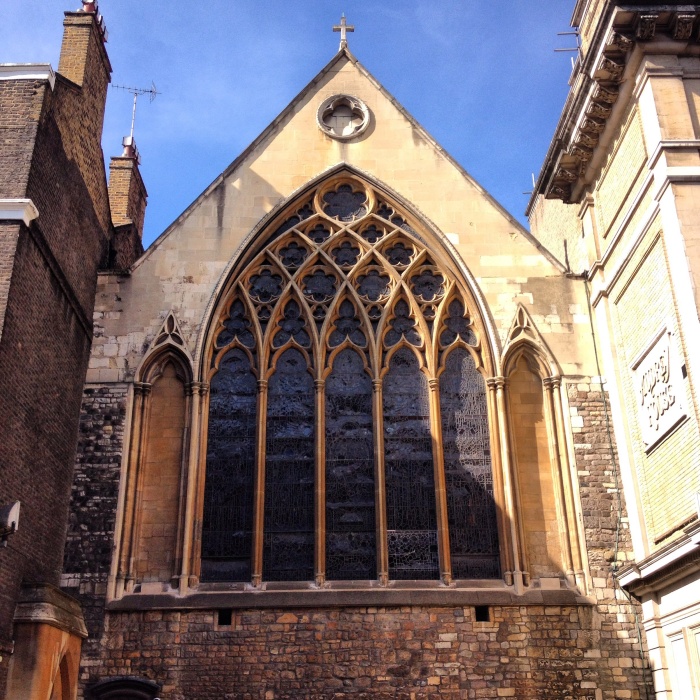
If you have some free time, try to visit the atmospheric St Etheldreda’s Church which is the oldest Catholic Church in England built in 1291.


Ye Olde Cheshire Cheese

image

Number two of the Ye Oldes, this legendary pub, located on Fleet Street, was first established one year after the Great Fire Of London in 1667. What immediately strikes me about this pub is its heavy, wooden Old London austerity, rawness and darkness. You could have a thousand suns beaming down on this pub and inside it would still be darker than the blackest of hearses. This is not a place to go to for natural vitamin D therapy but if you want to experience the ghosts and grime of a time long gone, this is a great find.


image


Many literary figures including Mark Twain, Sir Arthur Conan Doyle, P.G Woodhouse and Dr. Samuel Johnson are all said to have been locals of this pub. Charles Dickens was also a regular of this pub and the atmospheric and ‘gloomy old London’ energy of the pub must have provided him with an abundance of inspiration for his writing.


image

Downstairs at Ye Olde Cheshire Cheese

Here this pub is at times a curious mix of one timer global smartphone-glued tourists and hardcore spit and polish long timer locals who’ve been drinking at this pub longer than I’ve been on this planet. My favourite part of the pub to sit is either in the small room where the bar is by the main back entrance or downstairs below the ground floor. It’s in these areas where I feel the spirit of the pub the most.


The Seven Stars

image

The Seven Stars is a special pub in London. Not only is it one of London’s oldest boozers first established in 1602, it also has the rare distinction of having survived the Great Fire of 1666. Fortunately none of the owners throughout the pub’s history have been shortsighted enough to redesign the pub in any shape or form and so it remains exactly as it was when it first opened its doors in the early 17th Century. Furthermore, it is one of the very few remaining independent old pubs in London.


img_0282

Inside the Seven Stars

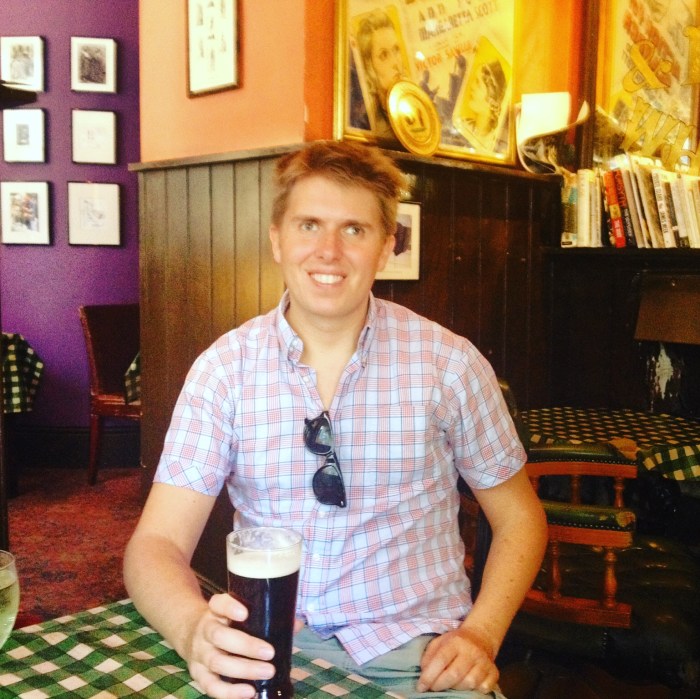
Since the pub survived the Great Fire and owing to the fact that it has hardly changed since its original beginnings, it offers a veritable taste of a typical medieval London tavern. A part of me would probably die if this place was ever turned into, god help me, a ‘gastropub’. What’s more, this pub has a decent selection of ales. When I was there with my sister, I had a pint of the dark Roadside Adnam ale which was very good.
 

img_0283

Yours Truly at the Seven Stars with a pint of Adnam ale

It is located by the Royal Courts of Justice and London School of Economics meaning that it is often frequented by LSE students and barristers who take their clients here for a celebratory drink.


The Cittie Of Yorke
image

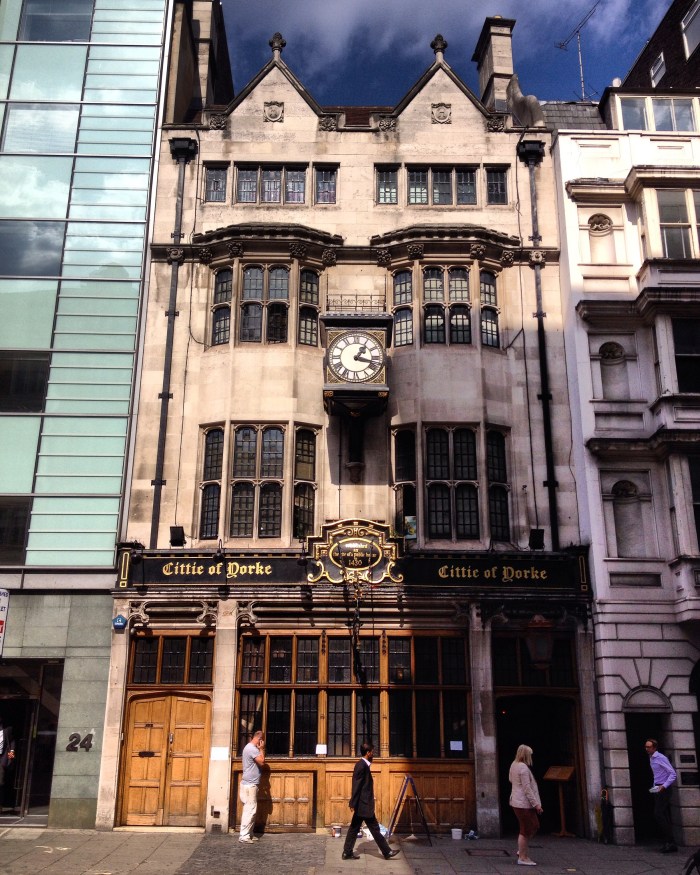
The Cittie Of Yorke is an outstanding old pub located in Holborn. It is a Samual Smith owned pub but is probably one of the most atmospheric pubs I’ve ever had the pleasure of visiting. The on site history of the pub goes back all the way to an impressive 1430 even if much of the current building is a rebuilding from the 1920s.


image

Inside the Cittie Of Yorke

The main bar area is situated in an awesomely atmospheric hall with high wooden beam ceilings, low suspending globe like lights and a series of big wooden beer barrels above the bar. More than many other pubs I’ve frequented, it is here where I could really imagine myself in a crowded, noisy and messy old London tavern. People would be dressed in rags or in immaculate suits, coats and top hats. I could imagine the former like being straight out of a painting by the 17th century Dutch painter Adriaan van Ostade who was a great painter of the Dutch underclass who spent there time in tavern like places getting drunk and merry and disorderly; tankards clinking, loud voices singing and a multiple of instruments ringing.


image


The legendary Welsh poet Dylan Thomas who was a great lover of pubs, wrote an impromptu ode to this pub when it was called the Henneky’s Long Bar. Aside from the main bar, there are some equally atmospheric rooms with dark wood furnishings, leather coaches, tall old windows and paintings.


The Hoop and Grapes

image

The Hoop and Grapes located on Aldgate High Street was originally built in 1593 and is one of the few existing relics of medieval London to have escaped the 1666 Great Fire. This current pub dates back to 1721 and is currently owned by the Nicholson Brewery. In spite of its unique history and all the old furnishings and photographs on the wall, this is quite an ordinary commercial pedestrian pub playing standard mainstream chart music. Unlike Ye Olde Cheshire Cheese, the original spirit of this place is hard to find.


The Anchor

image

This pub located on the South Bank has a very impressive history. This was William Shakespeare’s local and the pub from where the great London diarist, Samual Pepys, watched the Great Fire Of London. The genesis of this pub was a tavern reported to be 800 years old and this would make this place one of the oldest pub establishments in the city even if the pub had been destroyed during the Fire and subsequently remodelled a few times since then. The Anchor was recently refurbished in 2008.

Despite the epic and awesome history of the place and even the fact that the old decor remains, albeit with a slick facelift, it is quite an ordinary commercial pub serving the usual fare of alcoholic drinks and pub grub. Still it’s location on the South Bank can’t be beat and on a pure blue summer day, this is a good place to go.


The George Inn
image

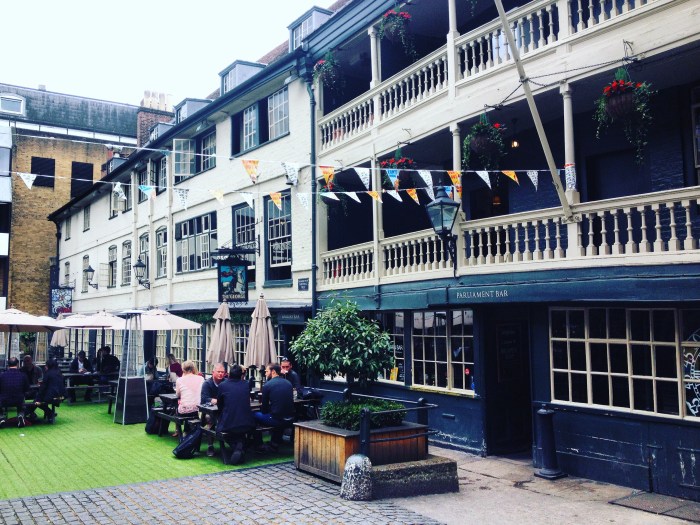
Located close to Borough Market and short distance walk from the Anchor, the George Inn is a gem of a pub and unlike the Anchor has retained much of its original character and charm. The George is a former coaching Inn dating back to 1542 and the current building dates back to 1676 after the original Inn was destroyed in a fire. The pub has also had a distinguished set of people who came here to drink. Most notably William Shakespeare and Charles Dickens. The latter mentioned The George in his novel Little Dorrit.

When I came here I had a pint of the locally brewed George Inn ale which I highly recommend. This is an outstanding pub and would be my personal choice over the Anchor if you happen to be in SE1.


The Prospect Of Whitby

image

The Prospect, located in Wapping, is one of the oldest pubs of London and the oldest riverside tavern of London dating back to 1520. It is also one of the best pubs I have ever had the pleasure of visiting. It was originally called The Pelican, which was later renamed The Devils Tavern and then later The Prospect of Whitby in the 18th Century. Back in those early days most of Wapping’s residents worked by the river as fishermen, sailors, and boat and sail makers. In addition to this, Wapping also had its fair share of pirates, thieves and smugglers.

image

Many famous people frequented the Prospect. ‘Hanging Judge Jeffries’ was a regular here. Throughout history it has been claimed that he would tuck into his lunch on the balcony of the pub whilst watching the hangings at a place then known as the Execution Dock. It was here where the notorious pirate Captain Kidd was executed in 1701. Then there was the 17th century London diarist Samuel Pepys who was a regular here during his stint as a clerk for the Navy and later Secretary to the Admiralty.

After the end of World War Two during the 1950s and 1960s, Wapping like many other parts of East London was in decline. However the pub was still doing brisk business and one of the pub’s rooms upstairs was a restaurant which was popular with many celebrities of that time including Richard Burton, Kirk Douglas, Frank Sinatra, Mohammed Ali and Princess Margaret.

image

One of the rooms in the pub upstairs was at one point in history used for boxing matches. Some of the earliest international matches happened between sea workers from around the world. As well as boxing matches, cock fighting matches also too place in this particular room.

image

I came here with a couple of friends one summers day back in September. We spent most of our time here on the outside riverside patio of the pub enjoying our pints and the beautiful weather. When we were not outside we were exploring the interior of the pub, it’s multiple rooms with old shipping memorabilia and paintings, portraits, photographs and records of all the distinguished people who crossed paths with this mighty place.


The Mayflower

image

From Wapping my friends and I take the Overground line one stop south of the river to nearby Rotherhithe. It is here that we visit the historic Mayflower pub. This pub was originally established in 1550 and then rebuilt in 1780 as the Spread Eagle and Crown before being renamed The Mayflower in 1957 after the Mayflower ship which took the Pilgrim Father’s from Rotherhithe to America in 1620.


image

Inside the Mayflower

The pub is atheistically a very tasteful pub with lots of old shipping related pictures and artefacts on the walls and around the pub. In a way it is the perfect vintage pub and it’s cosiness and warm vibe increase its attractiveness. It is best to come here when it isn’t crowded. When we came here there was a massive entourage of people celebrating something and we couldn’t move anywhere. But when it isn’t busy this pub is a delight. The riverside terrace is also one of the best in London.


The Angel
image

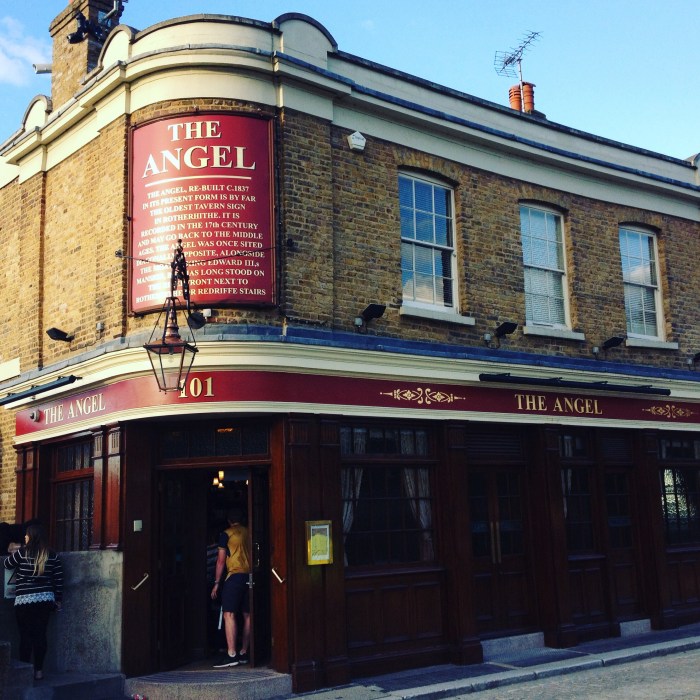
Also in Rotherhithe is the Angel pub. For me it is not as attractive or interesting as the Mayflower. The interior reminds me more of a tough East London boozer where the Kray brothers or one of the older EastEnders actors or Lennie McLean would call their local. Nevertheless, this Samuel Smiths pub is a good no nonsense boozer and has a long history. It was originally a 15th century tavern established by the monks of Bermondsey Priory. It is mentioned in Samuel Pepys diary as a place where he drank.


The Grapes

image

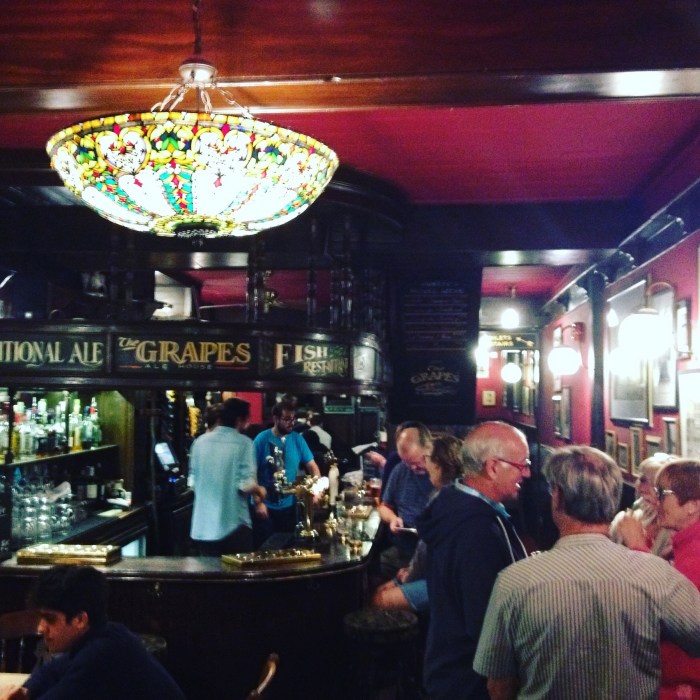
This unique riverside Limehouse pub has a history going back to 1583. The current building of the pub has a history dating back to the 1720s and was originally a raw working class riverside tavern serving predominantly the dockers of the Limehouse Basin. Regarding notable figures, our faithful friend Samuel Pepys makes an appearance here. His diary mentions trips to lime kilns at the jetty right by the Grapes.
 

image

Inside The Grapes

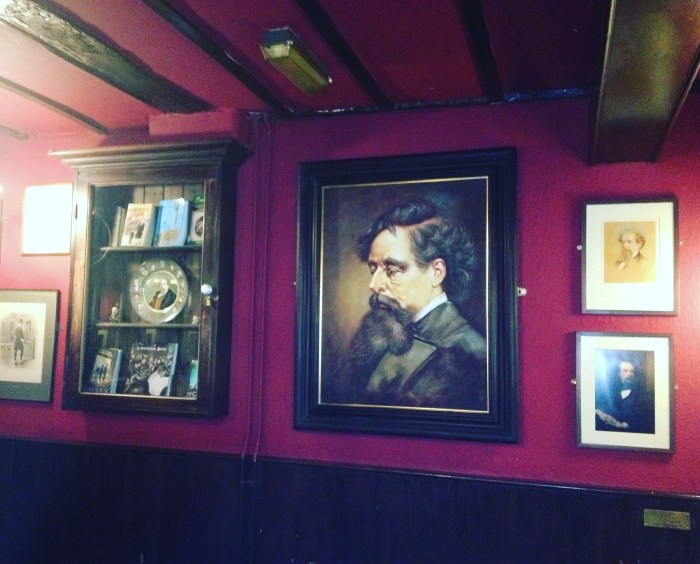
The pub also appears in the Charles Dickens book Our Mutual Friend. The back of the pub is full of Dickens related paraphanelia including a large portrait painting of him.
 

image

Portrait of Charles Dickens inside The Grapes

I like this pub. The interior and decor hasn’t been messed with and as a result it retains its original character and spirit.


Spaniards Inn
image

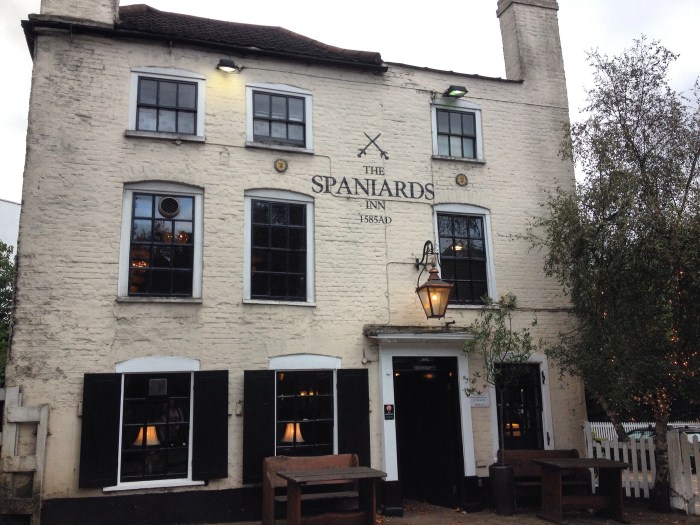
One day earlier this year I met a friend of mine in Hampstead. After a long walk in the beautiful Hampstead Health park, we visited this gem of a pub nearby. This attractive pub is one of London’s oldest pubs dating back to 1585 and is a great pub to visit full of original character and charm. There is also a large outdoor sitting area which is perfect for warm Spring and Summer days. This pub has a distinguished literary heritage. Dickens mentioned the pub in his book The Pickwick Papers and the poet Keats wrote Ode To A Nightingale here.


The Olde Wine Shades

image

Although more of an ancient wine bar than a pub, this place in the City of London nevertheless merits a mention more for its history and the fact that it is, like the Seven Stars pub in Holborn, a rare example of pre 1666 medieval London. It was one of the few buildings of that year to escape the Great Fire. Historical importance aside, I was quite disappointed to discover that it is nothing more than a mediocre overpriced wine bar. I would come here for a curious peep but I would rather pick the Seven Stars or the Prospect over this place any day of the week.


Text and photographs by Nicholas Peart

2nd December 2016

(All Rights Reserved)
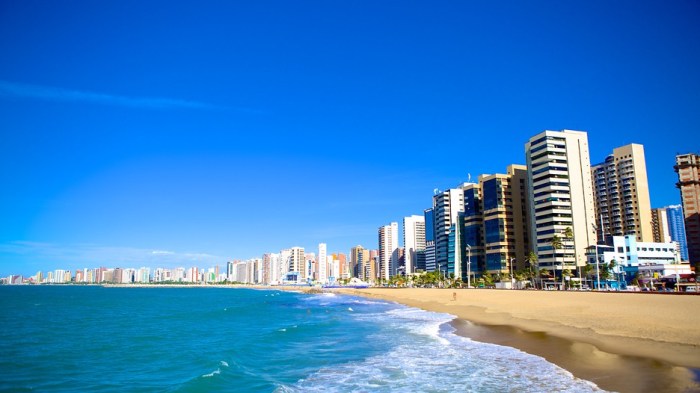
Dicing With Danger In Fortaleza

img_0398

Fortaleza: Not all a beach


The following article is an excerpt taken from my 2013-14 travel diary ‘Travel Journal Of A Lost Soul’


29th March 2014

Today the aeroplane crashed into the mountain. What happened today was perhaps the most frightening and dangerous position I ever found myself in so far in all my travelling life. Getting mugged on the streets of Caracas five years ago was small beer compared to this.

In the morning I took a local ômnibus to Fortaleza’s international airport to buy my plane ticket to the Cape Verde islands and also to have some clarity over a few Cape Verdean related immigration queries. I was also carrying my rucksack containing my iPad so that I could take advantage of the wireless internet in the airport. When I arrived at the airport, the TACV (local Cape Verde airline company) desk for flights to Cape Verde was closed. There was nothing I could do so I took an ômnibus from the airport to the city centre of Fortaleza. I had planned to take some photos and make some short films discreetly. So far tudo bem. I take my photos and films, have two cups of agua de coco, and explore a large portion of the city untroubled.

Later in the afternoon I look for an ômnibus going to the suburb of Iracema where my guesthouse is located. A big tough ol’ fat lady weighing at least 300 pounds tries to guide me to my bus. After some time she becomes very aggressive and starts demanding money. I board a random ômnibus about to depart and she gets on it too and begins to lunge at me. Immediately she grabs at my shirt and trouser pants and tries to punch me several times WWE style. I naturally cry for help but unbelievably no one on the bus comes to my rescue. At this moment I am absolutely terrified and in a panic I empty my wallet containing 15 Reis. She snatches the 15 Reis out of my hand and demands that I give her more money. When I am unable to give her more money, she rips my fake pair of Ray Bans off my face and crunches them up to debris in one of her enormous hands like a crusher at a scrap metal plant. Right now she’s a combination of Medusa and Big Mama Thornton on crack. Five policemen enter the bus. Three of them try to restrain her. My Brazilian Portuguese is maybe only half a step up from standard Gringo level and most of the time I barely decipher what she’s saying as it jets out of her mouth at 90 times the speed of sound. Only a little later does it become clear that she tried to unscrupulously frame me by claiming that I bought cocaine from her. And not only that…that I refused to pay for it! Even if this house of cards allegation were true, by admitting that you are a drug dealer surely creates ramifications for yourself, does it not? The police officers turn me and my rucksack upside down in pursuit of the smallest nano particle of blow. When they eventually realise that I am in possession of no drugs let alone cocaine, they simply bark something at this rare disgrace and let her go. The pathetic absence of justice and incompetence on the part of the local police, whilst it didn’t surprise me, left me feeling vulnerable, insecure and full of fear. Yet in their defence they did do one caring thing for me by driving me back to my pousada on Rua Dom Manuel in Iracema.

I am still trembling from this rare hi-octane episode of barbery that I spend the rest of the day and night in my room. I only venture out once in the early evening to buy bottled water and have a simple dinner at one of the adjacent restaurants.

When I finally manage to calm down, I discard my emotions and purchase my flight ticket to the city of Praia in the Cape Verde islands off the west coast of Africa. Tomorrow morning I vow to exit this city and go to the small and tranquil beach village of Canoa Quebrada.


By Nicholas Peart

(All rights reserved)

image source: http://www.expedia.com

Blazing To Panama City In Time For New Years Eve

img_0396

Panama City at night


The following article is an excerpt taken from my 2013-14 travel diary ‘Travel Journal Of A Lost Soul’


28th December 2013

I am sitting in the armchair in the corner of my spartan guesthouse room in the city of San José, Costa Rica. In front of me is a picture of Aung San Suu Kyi on the wall with the words, ‘ the only real prison is fear, and the only real freedom is freedom from fear’. Last night in my uber tired and messed up state I really pondered over these words. Now after at least seven hours of sleep, my body and mind are calmer and I am able to look at things more rationally.

My bus arrived in San José from the town of Estelí in Nicaragua at 11.30pm last night. It was originally scheduled to arrive at 8pm. I waited in Estelí for over two hours before the Tica Bus finally arrived.

This afternoon I purchased my bus ticket to the Panamanian city of David for tomorrow. From there I’ll continue on to Panama City.


29th December 2013

Today the pressure was high. I am now in my hotel room in David as I write this. I am falling apart from relentless travelling. Tomorrow will most likely be another eight hour journey as I make my way to Panama City.

The bus from San José to David was rather basic. At the Panamanian border, the officials demanded that I provide proof of onward travel out of Panama. This came quite unexpectedly. I certainly didn’t have a flight ticket out of Panama. There was one way I could get out of this. If I could show the officials a bank statement with funds of over $500, then they would stamp my passport and let me through. Fortunately there was a small ramshackle internet café nearby. I logged onto my bank account on this very dodgy computer with half the letters missing on the keyboard. Thankfully the connection was quite fast. My current account showed funds of less than £100. So I transferred £400 from my savings account onto my current account before printing off a statement of my newly topped up current account. I diligently sign off and revisit my bank account page to make sure I definitely WAS signed off. Interestingly, when I finally did present the statement to the officials they barely gave it a glance before my stamping my passport with a Panama entry stamp.

Here in my basic hotel room in David, it’s either too hot or too cold. There is an old AC unit with missing dials meaning I am unable to modify the Arctic temperature whenever I turn on the unit. In hindsight a room with just a simple fan would’ve been better but the crippling humidity in this part of the world makes me game for AC.

There is a noisy bar directly adjacent to my room. It’s 1am and the party is still going. Perhaps I should’ve anchored myself in San Marcos La Laguna instead of embarking on this batshit insane voyage.


30th December 2013

I woke at 9am. I don’t know how I feel. I feel numb. At one point in the night I woke up and thought I was in an unheated room in Puno. I turned off the AC and went back to sleep. I can’t see myself arriving in Panama City at a sensible time now.

I travel on a surprisingly comfortable and luxurious bus from David to Panama City. For $15 it was incredibly cheap for what it was worth. When I arrived at the bus terminal, I took a shared taxi to the Casco Viejo district. The taxista drove like a devil across the different highway intersections of the city to get to my destination. As we approached the outskirts of the Casco Viejo I almost forgot how rundown certain parts are. The section with all the tourist hotels and hostels is the more spruced up and nicer part. When I arrived at the big Santa Ana plaza I tried to find the cheap hotel I stayed at when I was last in this city some years back. After a few minutes of surveying the different corners of the plaza I finally found it; Hotel Caracas. Even though it feels like a tropical borstal, I remember when I last stayed here I had a basic but clean and spotless room with a fan for $10 a night. I asked to see a room. The first room I was shown looked nothing like the room I stayed at before. There were exposed live wires, marks on the walls and doors. Hell, even the bed sheets were a mess. The state of the shower looked like the aftermath of someone who’d blown their brains out with a shotgun during a game of Russian Roulette after an intense cocaine binge. The last time I’d seen a room as uniquely disgusting as this one was when I was in Beira, Mozambique. I kindly ask if I could see another room? I think we must have gone through about six rooms before finally settling on one for just one night – like choosing between six different formations of shit to eat. I choose the only one which had a window not facing an external wall. Yet when I did open the window it was directly facing onto an enormous heap of trash on the pavement of one of the more down at heel streets; a cocktail of death, decay and Kurt Schwitters. Yet even in my bombed out state of mind, there is something strangely fascinating about all this. I mentioned death but these streets are full of life. A raw and unsanitized liveliness. Isn’t this what I am always looking for? Well, now it’s there if I want it.

This evening I went to a hole in the wall bar right next to my hotel. I was the only Gringo there. I started as a barfly and pretty soon I was dancing salsa in my very rudimentary way with some enormous butterball of a lady from the Dominican Republic. I thought about staying out longer but I want to have some energy for tomorrow. For the next two nights I’ll be staying at the notorious backpacker hostel, Luna’s Castle.


31st December 2013

I slept erratically last night. This hotel room is like something out of a William S Burroughs book. I was woken up at 7.30 am by an insanely loud rubbish collection vehicle. Not even the V8 engine of the AC unit in my room could drown out this Earth shattering noise from outside.

After transferring all my things from Hotel Caracas to Luna’s Castle, I took a taxi to Albrook Airport to sort out my onward travel to Colombia. Although Panama borders Colombia, neither countries are connected by road. The PanAmerican higher abruptly ceases at some point between Panama City and the border. All that separates these two countries is an impenetrable stretch of jungle called The Darien Gap. Some courageous souls have successfully navigated it yet the risks far outweigh the rewards and for the handful of travellers who crossed it successfully many more have perished. There are at least three feasible ways to get to Colombia from Panama. One is to fly from Panama City to any major Colombian city. The second is to take a 4/5 day boat trip via the San Blas islands and the third option is to take a small domestic plane from Panama City to a small isolated Panamanian village called Puerto Obaldía on the Panama/Colombia border from where it is possible to catch a motorboat to the Colombian village of Carpuganá. From there you take another motorboat towards the city of Turbo which has land connections to other parts of Colombia. I embarked on the third option on my last trip across Latin America.

When I arrived at Albrook airport and enquire about purchasing a ticket to Puerto Obaldia departing in six days time, I was told that all flights to Puerto Obaldia were booked solid for the next three weeks. I was truly disappointed at this discovery. On the other hand, it was a tad shortsighted of me to have left the booking so late, especially since the plane is tiny and the fact there are not many flights. Yet three weeks is a staggering amount of time to wait until the next available flight and I for one am not going to languish in Panama City for that duration of time. I refuse to do the 4/5 day sailboat trip. Everybody seems to be doing that trip and I can already foresee a lot of problems and boredom from doing such a trip. With the third and second options ruled out, the next logical step seemed to be a direct flight from Panama City to the Colombian cities of Cartagena or Medellín. I was shocked to discover that the cheapest flight going was $350. That is a ridiculous sum of money for a one hour flight. Fortunately I soon discovered one more way to get to Colombia. A kind local lady who worked at Luna’s Castle hostel explain it all to me. It involved travelling in a 4×4 vehicle from the city to a small coastal town called Cartí. From Cartí I would then travel by speedboat for something crazy like 9-10 hours to Puerto Obaldía and finally Carpuganá. Like a concentration camp version of the third option.

As I write this from my hostel dormitory, I am now only two hours away from the New Year and the rumba is already in full swing. I will raise my last bottle of Balboa beer of the year towards much luck for the remainder of my trip and that I finally do manage to get to West Africa from Brazil – whether by boat, plane etc – it doesn’t matter.


1st January 2014

Last night the party at the hostel was enourmous. I was thrashing the rum and cokes. The party went on until sunset. I passed out at around 4am. Today has been a coma’d day. I spent most of it inside the hostel. Around mid afternoon I went for a stroll on Avenida Central off the Casco Viejo. Amongst the rare silence today on New Years Day, I got talking with an old Panamanian lady who, surrounded by masses of pigeons, sold bags of pigeon food. I bought a bag and suddenly became swarmed by dozens of them every time I threw a handful of grains on the floor. Most of the restaurants were closed bar a small low lighted budget Chinese restaurant where I had a very ordinary meal of fried rice and chicken. There are many Chinese here in Panama City and most of the ones I encounter (although certainly not all) are reserved and indifferent.

Since yesterday afternoon I befriended a middle aged Turkish/German man. He speaks almost no English but speaks Spanish very well having travelled in Latin America for a considerable amount of time. Although he is very intelligent and head and shoulders more interesting to talk to than many of the other guests staying at the hostel, he is also very intense and unstable. He is the kind of person that would burn down cities if things didn’t go his way. As a consequence I feel a little uneasy around him. It’s quite interesting how sometimes the most alive and riveting people are also the most unhinged. I often rage against mediocrity and dull people but for the most part I cherish stability. I don’t want my life to be a nonstop proverbial rollercoaster ride. I don’t want it. I would rather have a boring and stable life rather than a life full of tension. Oh boy, what am I talking about? If only I could become more aware of all my glaring contradictions.


By Nicholas Peart

(All rights reserved)
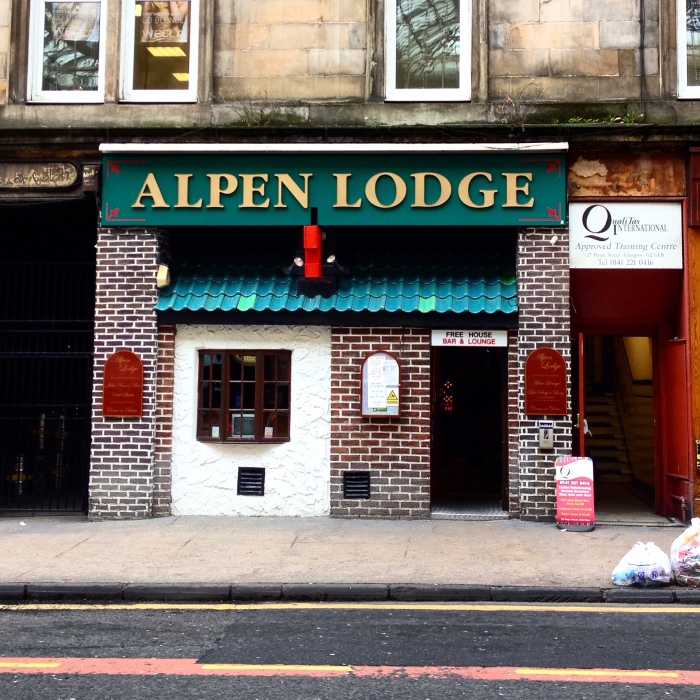
image source: http://www.pinterest.com


Fear And Loathing In Guatemala City

img_0393

Guatemala City: only the strongest motherf***ers survive


The following article is an excerpt taken from my 2013-14 travel diary ‘Travel Journal Of A Lost Soul’


December 13th 2013

I woke up feeling heavy, hot and nervous. As I was surfing the internet on my iPad in my small guesthouse room in the pretty Guatemalan tourist town of Antigua, I had a change of heart. It was almost 10am and I had an hour before check out. On a whim I decided to go to Guatemala City. I wanted to check out a few of the contemporary art galleries and spaces dotted around the city. The most important ones are Proyectos Ultravioletas (which is supposed to be the hub of the Guatemalan contemporary art scene) and NuMu (which currently has a retrospective of the work of the celebrated and fearless Guatemalan performance artist Regina José Galindo).

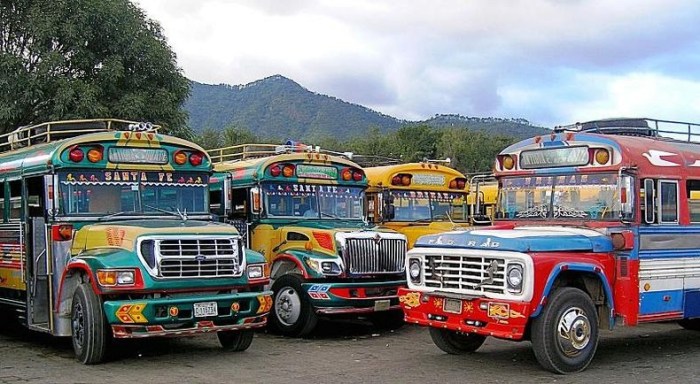
So this afternoon I dragged myself and my things to the ramshackle chicken bus terminal behind the mercado principal. Oh yes, I was all for the hard life again. For nine Guatemalan Quetzales a green and orange psychedelic chicken bus would whisk me all the way to the Zona 3 district of the city. The bus journey was quite an eventful 90 minutes. I held onto the iron bars tightly for every abrupt swerve on the mountain highway. At one interval, we were all serenaded by a flamboyant and lively duo in face paint. They were a stellar act and I gave them a few of my Quetzales.

Arriving in the Zona 3 district of the city was like landing in some out of bounds skid row district of Los Angeles. If a shifty hoody type approached me now he’d most likely square me up and say, ‘Come here again and I’ll kill you’. There was not a chance in hell I was going to consider walking even half a block in this part of town on my own. Fortunately I was accosted by a taxista as soon as I disembarked from the bus. He wanted 50 Quetzales which I thought was a tad on the steep side considering that the central Zona 1 district I wanted to go to bordered this district. We agreed on 40. I told him I wanted to go to the Hotel Fénix. He knew where it was. As I looked out of the window for the duration of the ride, I realised how grateful I was to be inside. I felt happy to shortly be arriving at my destination. Only there was one problem. It appeared that the Hotel Fénix did not exist any more. This is now Murphy’s Law tripping me down a long flight of stairs. Ok, think man. I have a glut of other contacts from the Kindle version of my Lonely Planet Guide to Central America on my iPad, but I’d rather not brandish it in front of the taxista. Yet I remember reading something on the internet recently about another hotel close by called Hotel Spring. The taxista was adamant to take me to some place I’d never heard of many blocks away from the centre. I held very firm with him and told him I wanted to go to the Hotel Spring. I even offered to pay him the original price of 50 Quetzales just to not argue with him and get this all done and dusted.

I arrive at the Hotel Spring, located in a an old decrepit colonial building with quite a spectacular internal courtyard. The rooms however are basic and more costly than anywhere else in the country. Guate (as many refer to this city) is probably the second most unsafe city I’ve ever visited after Caracas in Venezuela. The former central business district of Johannesburg comes a firm third place. I am a total dipstick for shunning beautiful and serene Antigua for this. Yet on the other hand, sometimes I need a drop of danger and tension in my life.

After checking into my room, I go for a mid afternoon stroll on Sexta Avenida, which is the main pedestrian drag in the centre of the city. Leave that drag and you are back in Mogadishu. A Guatemalan lady approaches me speaking fluent American English. Yet what she tells me isn’t pretty. She relays many a horror story involving deportation from the USA, rape, and being physically abused by her violent partner. She lost her papers and can’t return to California. Now she has no money and sleeps on the streets. She even points to the place where she sleeps behind an old building. Whether her stories were true or not, I give her all the coins I have in my right pocket.

Many of the restaurants on Sexta Avenida are a little pricy. The global fast food joints are always a last resort. After a while I find a nondescript hole in the wall place where I ate the worst and blandest meal on my trip so far of burnt chicken and macaroni cheese. I was a fool to eat it. Afterwards, I visited a large shopping centre called Centro Capital. Once inside, beauty parlours and arcades dominate. Yet my main reason for coming was to visit the Proyectos Ultravioletas art space. Unfortunately it was closed when I arrived. I later got chatting with a friendly security guard who told me he lived in the city of Washington for eight years. Judging by the ability of his English, I imagined he always stayed in one familiar community. His English was so substandard (not that my Spanish is faultless) I lost patience and spoke with him in his language. Observing him more, he looks like a member of a Calabrian mafia family.

Just as darkness was about to fall, I duly returned to my hotel room. At night I feel trapped and now I have a great urge to leave this city. Visiting this city just to see a few esoteric contemporary art spaces, regardless of how interesting they may be is simply not worth the heartache, back and brain damage. Wherever I go I will always be a Gringo. No matter how fluent my Spanish is or how much I assimilate myself into the culture and make friends, I will always be a Gringo. Later in the evening I chat with my sister Caroline via Skype and we speak for almost an hour. I subsequently felt glad and happy since for most of the day I was heading south with the realisation of the colossal error I made in coming here coupled with the even greater realisation of just how much of a grade A shithole this city really is. A mug is me.

 
14th December 2013

Last night I stayed all night in my hotel since as soon as I go outside I feel like an endangered species. The morning when I woke up and took a look in the mirror (the narcissistic fool that I am) I felt like I’d added 40 years to my age since yesterday. I got hardly any sleep last night. Some of the people in this hotel are rich in stupidity and insensitivity. There was constant noise. Loud talking and drunken laughter all night. A veritable frathouse. This unpleasant experience has scrapped all my plans to explore the galleries and visit the lovely couple I met in San Pedro Laguna. I now will pay whatever it costs to get out of this stew and move to my next destination. I feel like a sleep starved sack of shit. I have no energy and I am furious about last night. Yet I have to say that these last 18 hours since I touched down in Guate have given me a magnificent glimpse of Hell.

I took a walk through the streets of central Guate to find a bus company with transport to the Guatemala/Honduras border. As I walked I bumped into a middle aged Guatemalan man named Héctor. He spoke to me in very good and clean American English telling me that he lived in California until 1985. He knew of a couple of bus companies with transport to the border. We walked many blocks through the city. The city is a shambles and completely off limits and impossible to navigate if you are and look like a Gringo; depressing, dilapidated and out of date homogenous grey concrete blocks, lethal potholes, and second to none air pollution (most of which appears in generous portions of big black smoke from the many clapped out overworked chicken buses ploughing the busy city streets). Even during the day I can’t relax and I am on my guard to the maximum degree. It is not just the very real possibility of someone jumping on me without warning. Crossing the streets here is an art which requires some serious and seasoned skill and concentration.

During most of our walk through the city I let Héctor do most of the talking. He told me he was a teacher and earned 1600 Quetzales per month paid fortnightly. Today he was going to go to the rural village of Quiche to visit his parents and sisters. We visited two bus companies many blocks apart. Both had transport in some shape or form to the Honduran border but to get the bus I had to take a taxi to the North Terminal wherever the hell it was. On our walk back towards my hotel we both agreed to have a drink at a cafeteria close to the hotel. Once inside I ordered an orange juice. Héctor told me he didn’t have much money. I offered to buy him a drink. Instead he asked me whether I would give him some money? He asked for 100 Quetzales. I asked him what he needed the money for? He told me to buy meat to take with him to his parents village. I suggested we go to a meat vendor together and I would purchase what I thought was a reasonable amount at the local rates. He refused and demanded that I give him the money. I was a little disappointed by his behaviour. Immediately his tone changed and I didn’t feel comfortable around him. Then apropos of nothing, he got up, shouted something in rapid Spanish about the Guatemalan civil war and stormed out of the cafeteria. For about five minutes I felt very shaken. Moreover, I was tired and depressed. The site of Guate, even under a pristine brilliant blue sky, further exacerbated my depression. On a whim I returned to my hotel, grabbed all my things and got a taxi to Zona 3 to catch a chicken bus back to Antigua.

There was heavy traffic on the road back to Antigua. Some time later during the bus journey, a Christian Gringo missionary got on the bus at some random location. In haste, he began approaching random locals on the bus in fluent Spanish to get them to come along to his meetings and church services. He later approached me. I was in a foul mood yet I allowed him to ask me the following…

Was I going to spend a long time in Antigua?
No

Where are you going to after Antigua?
Have you heard of Lao Tzu pal?

No
He was a very wise Chinese sage. He once said that if you want to make God laugh, you tell him your plans and that includes where I am going to next.

Oh. But how long are you travelling for?
Don’t make God laugh

Where do you live?
England

Could we come to England to visit you in your home?
You gotta be fucking joking mate

I immediately retracted what I said. This is what Guate living does to gentle sensitive souls. I apologised profusely for my obnoxious behaviour. I kindly declined and told him I needed to rest. He was surprisingly good natured and moved on to the next random person on the bus.

When we finally arrived in Antigua, I returned to my old guesthouse like I’d just returned from an epic expedition through the DRC. The dueña told me that my old room was still available. I rejoice to the heavens. I spent most of the afternoon at the Toko Bar run by a wonderful Dutch/Indonesian guy called Eduardo. This place makes Antigua for me. It has been one of the highlights of my trip. Not just the delicious and generous portions of tasty Indonesian and global dishes, but the vibes, Eduardo’s stories and all the different and random people I keep meeting. Antigua is quite seductive in this respect even if it is very far from a slice of the ‘real’ Guatemala (whatever that means). These last two days have been a rough and gruelling fill of the real Guatemala so I am more than happy to recover in Antigua. In the evening I had plans to go to the Rainbow Café but after all I’d been through I had to pass.


By Nicholas Peart

(All rights reserved)
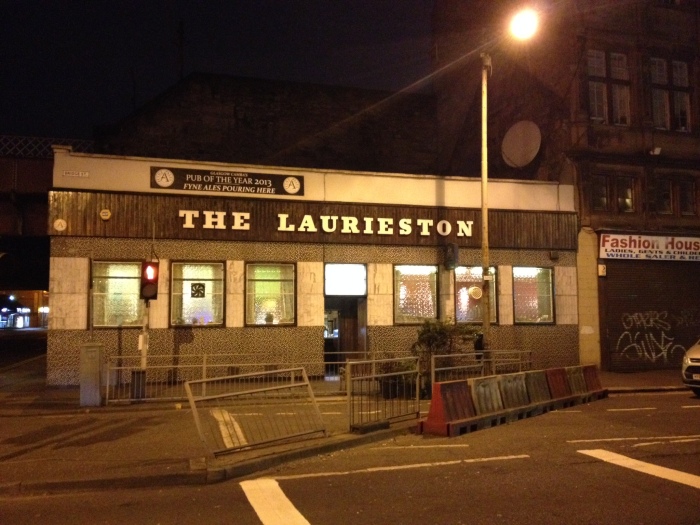
image source: https://www.porternovelli.com

Travelling From San Cristóbal De Las Casas To Panajachel The Hard Way

img_3647

You know you are in Guatemala when you stumble upon one of these badboys 


The following article is an excerpt taken from my 2013-14 travel diary ‘Travel Journal Of A Lost Soul’


29th November 2013

I am now in the Guatemalan lakeside tourist town of Panajachel. The word “epic” would be an understatement to describe today. Hindsight is indeed a wonderful thing and I would have made my day a lot less painful if I’d just swallowed my intrepid pride and taken the tourist shuttle bus. Instead I decided to inflict fifty shades of mayhem onto myself and opt for the hard, irrational and masochistic way. Either way I had to wake up super early this morning; 5.15am.

The first leg of the journey from San Cristóbal de Las Casas in the southern Mexican state of Chiapas was perfectly fine on a comfortable and modern Marcopolo bus. Three hours after departing San Cristóbal, we arrive at the Mexico-Guatemala border. I exit the bus, cross the road and receive my Mexican exit stamp from the small immigration office. There is a line of taxis outside all waiting to take me to the Guatemalan side; 10 Mexican pesos shared or 40 solo. Since I quickly figure out that nobody is going to be joining me anytime soon, I fork out the full 40 pesos just so I can press on and leave this godforsaken place. Once on the Guatemalan side, I promptly receive my Guatemalan entry stamp and change whatever remaining Mexican pesos I have into Guatemalan quetzals without paying too much attention to maths and exchange rates. Then I hop on a rickshaw-like vehicle to take me to the bus station (if you can call it that!). And here I am having traded swanky modern Marcopolo buses for the ubiquitous, dilapidated and hair raising chicken buses which plough the roads of the most down at heel parts of Central America. When their first life as perfectly innocent USA school buses expires, their next life is less gentle on the thug life streets of Tegucigalpa. I am bundled onto a brightly coloured and ornate chicken bus heading to the city of Huehuetenango. I feel blessed to have reasonable space for my legs. Two is comfortable where I am sitting. But after only a few stops, that number doubles to four. Yet I look on the bright side; one of the advantages of being squashed like a dead skunk on the side of the bus is that whenever the bus is turning on the narrow, long and winding highland roads, I am not forever sliding form one side of the bus to the other.

We arrive at the Huehuetenango bus terminal a few hours later. This terminal has all the classic trimmings of a crazy, dishelved and chaotic bus terminal in any third world city. This is raw. I am not in Mexico anymore. Mexico may be poor but I never once in all my time in Mexico witnessed a bus terminal as dirty and rundown as this one. I have some spare time to eat a very basic lunch of well done beef strips, rice and beans. Gourmet food this most certainly ain’t, but I hadn’t eaten all day until now. I have been to Huehue before on my last trip through Latin America a few years back, but I have no reason to stop there this time. An old dilapidated Mercedes “Pullman” bus (this one is two steps up from a chicken bus) with tyres so illegally smooth will take me to Panajachel – apparently. Even though I have my own seat, the upholstery is all crumpled up, loose and looks like it hasn’t been cleaned since I was five.

The bus journey goes well, until I ask the cobredor (bus conductor) what time we will be arriving at Panajachel? He replies that we went past it 40 minutes ago. This is not a directly Panajachel bound bus and will be going Guatemala City (the last place on Earth I would want to arrive at night). It’s already dark and I am so pissed off at this revelation. The cobredor then tells me that in five minutes he’ll drop me off at a stop from where I’ll be able to catch a bus to Panajachel. I think it myself thank god I have at least a foothold on the Spanish language otherwise I’d really be in a veritable no-mans land. When I get dropped off, I am literally dropped off on the side of a very busy highway. It’s dark, it’s cold, the highway lacks illumination and the night sky is downing in fog. There are enormous trucks going at impossible speeds. And I have to cross this death trap to get onto the other side. My heart is beating so fast I feel like it is going to explode from my body like a high pressure jet of water from a burst pipe. I honestly haven’t a clue where the fuck I am and I begin to feel a tremendous longing to be back home with my family. By some grace of god I manage to cross the road with all my things unscathed. Once on my side there is little tienda (convenience shop) and a small bay for on-coming buses to stop. I get chatting with some three toothed viejo (old dude) on the side of the road. He re-assures me that a bus will be coming soon. Seguro? (Are you sure man?). I give him a moneda (coin). His mood duly lifts and this time he is super seguro that every little thing is gonna be alright.

And soon a bus doth come along and I am bundled in with all my crap. Alas I don’t think this one will be going directly to Panajachel. I am so depressed I think I need a shot of mezcal and a band of impeccably dressed Mariachi musicians to console me. The driver drops me off at a busy crossroad from where I am briskly transfered onto another chicken bus. Maybe this one will be the last one? I am sitting on the floor at the back of the bus swerving like a lunatic as the bus driver takes to the narrow winding descending country roads Formula One style with Spanish language power ballads turned up full blast. He seems to be in a race with another chicken bus in a never ending game of ¿quien es más macho? I am not religious but I make the sign of the cross. Thirty minutes later I am bundled off this bus at a stop where there are about six other chicken buses. I am told that the one at the end of the line is going to Panajachel and, seguro, this will be the last one. I make a dash with my things towards it like it’s some holy chariot of good fortune. Once inside the bus, I look out the window and, through the bus lights, notice a sign which says, ‘Panajachal 8kms’. I will be so low if this bus doesn’t go the full eight kilometres. No matter how reckless the bus driver may be, I rejoice when this bus finally stops right at the side of the beginning of the tourist drag of Calle Santander in Panajachal town. Even though it is a little chilly, it is nowhere near the Lapland temperatures of San Cristóbal. I find a hotel and go to sleep.


By Nicholas Peart

(All rights reserved)

image source:  www.amusingplanet.com

Is Now A Good Time To Buy Gold?

IMG_0384.JPG


This is something I’ve been thinking about a lot these last few months. Looking at all the current global events including the upcoming US elections and the sense that the world is becoming increasingly unhinged, could gold (and by extension other precious metals such as silver) be a good place to put some of your savings/hard earned cash into?

Gold has traditionally been the place to put your money into during times of global unrest. Out of all the world currencies, the US dollar is often seen as the main currency. If you live in a country where the local currency is notoriously unstable, it is often seen as a smart idea to have any cash savings in US dollars. Especially since, unlike other major currencies such as the Euro or British Pound, the US dollar is accepted absolutely everywhere. Yet what happens when even the US dollar becomes unstable? This is where gold comes in.

All paper currencies, whether you have US dollars or Zambian Kwacha, are all just that; paper currencies. Furthermore, if the government wanted to, it could print more and more of its currency thus increasing the money supply and triggering inflation which reduces the value of a country’s currency against other currencies. Unlike paper money, gold is highly prized for its scarcity.

Gold can be seen more as a security to protect your money as opposed to making money. Of course if you buy gold at $1,300 an ounce and the price a few months later is $1,600, you would have made a nice profit if you ever decided to convert some of your gold back into cash (and conversely, if the gold price went down to $1000 and you needed cash you would be selling your gold at a loss).

There are also of course digital currencies out there with Bitcoin being the the most well known, established and traded of all the global digital currencies. Even if digital currencies may be seen as the future of money especially with the Bitcoin (which was once the pariah of the financial world) becoming increasingly accepted and recognised as a legitimate global currency, this is a world where my expertise is limited. I am also scared by the high chance of wild fluctuations and the whole intangibility of it all. Gold just seems less complicated. It is a precious tangible metal with a limited supply and that is all I need to know.

Looking at the gold price chart of the last twenty years, gold has already had a hell of a run going from a low of just $252 an ounce in 1999 to a high of $1889 an ounce in 2011. The current gold price as I write this article is $1307 an ounce; still several multiples of its 1999 low yet a good chunk lower than its 2011 high. Some say that the gold price could surpass its 2011 high and breach the $2000 an ounce mark if the world really did begin to tilt off its axis and spin in some crazy time signature. Yet predicting the future price of gold is a fool’s game. What I can say with ‘certainty’ though is that during times of ‘uncertainty’, gold is a good thing to have.


How To Purchase Gold

Gold can be purchased physically in the forms of established gold coins and gold bars. It can be good to personally own some bits of physical gold and keep them in a safety box (or dig a deep hole somewhere in your garden to hide and store them – just make sure you don’t forget where you put them!). On the other hand having lots of physical gold in the house can create a feeling of insecurity. If you are lucky enough to have a big gold pile, it would be best to keep it in a robust security vault by an established and reputable firm. Below I am listing some useful contacts…

Apmex based in Oklahoma, USA, is the world’s largest online retailer of precious metals selling more than 10,000 gold, silver, platinum and palladium products in the form of bars, coins, bullion, rare collectible editions etc.

BullionByPost based in Birmingham, UK is the UKs largest online gold dealer and a good contact to have if you are a UK resident.

For Australian residents, The Perth Mint is a good contact.

Other established global gold/precious metals dealers include the Canadian company Kitco and the Indian company RiddiSiddhi Bullion Limited.

The London based company BullionVault is an online peer to peer gold and silver bullion exchange. Since its founding in 2005, the company has been very successful. This is also a great place to trade gold and silver if you don’t have much money at your disposal since there is no minimum amount of gold or silver you can trade. BullionVault charges a flat 0.5% – 0.05% fee per trade depending on the amount of gold or silver you buy or sell. The other additional costs are the annual fees for storing and insuring the gold and silver you purchase which are 0.12% (0.01% per month – $4 minimum) of the value of your gold and 0.48% (0.04% per month – $8 minimum) of the value of your silver


By Nicholas Peart

5th November 2016

(All rights reserved)


image source: http://www.therealasset.co.uk 

Art And Living In The Digital World

img_0382


This is an essay I wrote towards the end of 2014 about being an artist and living in the context of our digital world. I have made a few changes since then but the general gist of the essay remains the same.


Today art can be split into two categories; “Pre-Internet” and “Post-Internet” art.

All the important and influential art movements are all of the Pre-Internet age. It seems to me that in this current Post-Internet age, there are no real lasting and meaningful art movements. There are of course many interesting artists today creating challenging and original works of art via digital media and who are very much in tune with the zeitgeist and more power to them. Yet there is something I long for which I feel is missing. And this is not strictly limited to artists and art. This applies to (and perhaps to a much greater degree) general living.

Before the internet the main media sources were television/video, the telephone, the radio and the printing press. The internet is all this and much much more. It enables us access to diverse and limitless quantities of information. In order to source information before the internet, most people went to libraries and even these institutions were no guarantee that you would find the specific information you were looking for. But with the internet almost all kinds of information can be accessed without having to travel to libraries or even spend valuable time and money employing people to find certain bits of information. Access to information has been truly democratised (assuming everyone has an internet connection) since the development and growth of the World Wide Web.

Today we have a whole plethora of internet related social media sites such as Facebook, Twitter, Instagram, YouTube etc. to communicate/express ourselves through. Before the internet, the only possible ways to communicate with one another apart from face to face, were via the telephone, fax, telegram or via mail (in the form of letter writing which save for a few dedicated souls is well and truly six feet underground as an art). The channels of far flung communication were limited. People were more in the woods with regards to what was happening globally.
People did not lose themselves or devote much of their time to living in “electronic virtual reality”. People actually spent much time reading books, spending their free time outside, having real relationships (we still have real relationships but these are decreasing and I believe in the wake of “hyper-immersive 3D virtual reality” more and more people will be cutting themselves off and almost be living at least half of their entire existence in this new type of virtual world. More and more people will even cease having sexual relationships since the stimulated virtual way will feel even better than the real thing).

Via the array of social media sites there are many different groups that artists join. Too many groups. A humongous vertigo-inducing fragmentation of different groups. In the context of today’s world, everything changes faster than before. This is a faster world. News travels faster. There is less mystery. Life is documented more than ever before. Through the internet, everyone can now express themselves. There are more artists today than before. Art or being an artist is not something that is taboo or contentious anymore. Things that may have been considered ‘renegade’ or less accepted in the past such as being an artist, a musician or traveling around the world are now accepted and quite conventional. To travel around the world for a year as part of a ‘gap year’ is now the done thing.

I think that to be a true artist (a most overused weird) in this current digital age is to leave no traces; no evidence of art or living. To disappear and be an eternal apparition.

Often I don’t have the guts or the humility to leave no traces. There is something intricately hardwired in me about having to ‘be somebody’. Yet as the great Indian sage Juddi Krishnamurti once said, ‘the moment we want to be someone we are no longer free’


By Nicholas Peart

Originally written on 27th December 2014

(All rights reserved)


Image source: http://www.blouinartinfo.com

My Favourite Paintings In The Louvre

img_0345

The Louvre *


The Louvre museum in Paris has one of the most impressive collections of paintings by European Old Masters in the world. Perhaps the only museum to really rival it in this field is the Prado in Madrid (the Rijksmuseum in Amsterdam, the National Gallery in London and the Metropolitan Museum of Art in New York are a few close contenders). But not only does it house an impressive collection of paintings and sculptures from that age, it also has a substantial collection of Egyptian, Greek, Roman, Islamic and other World artefacts through the ages.

In this post I am listing my favourite paintings from the enormous collection of paintings on display by Old French, Italian, Flemish and Spanish Masters


image

Nicolas Poussin (1594 – 1665) – Saint John Baptising The People (1634-5) 

Many art writers and historians argue that Poussin was the first great French painter who changed the face of art in France and blazed a trail for all French artists who came after him. The art scene in France during his time was very staid (yet in a state of transition finally moving away from the traditional apprenticeship methods of working) and for this reason he spent most of his life in Rome. The American author Micheal Kimmelman goes as far as saying that Poussin was, ”the springboard for the greatest French artists from David to Matisse”


image

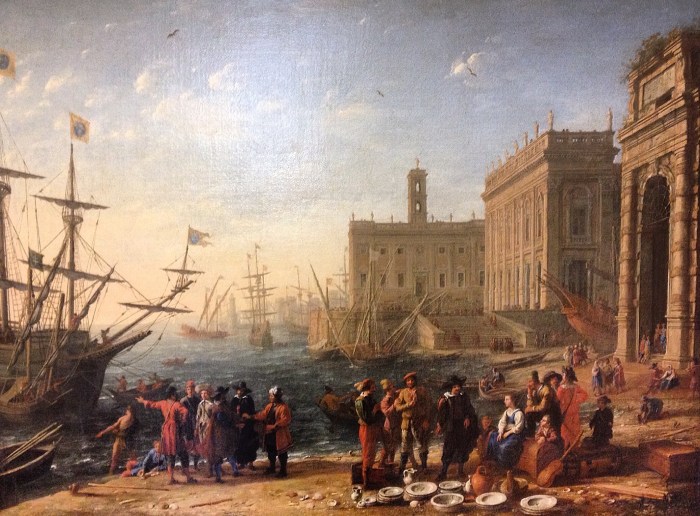
Claude Lorrain (1600 or 1604/5 – 1682) – Port With Capitol (1636)

Claude was another great French painter who like Poussin spent most of his life in Italy. He was also a prominent landscape painter. As can be seen in the port painting, the landscape was the dominant subject. At the time, making the landscape the dominant feature of a painting as opposed to actual figures/subjects was seen as groundbreaking. Claude’s paintings were an enourmous influence on the dramatic abstract-like landscape paintings of the revolutionary British painter J.M.W.Turner.


image

Adolphe-Joseph Monticelli (1824 – 1886) – The Diner 

Monticelli was a very individual painter with his own unique style. What is even more amazing is how ahead of his time he was regarding his unusual style. Like the other great French painter, Eugene Delacroix (whose oil sketches Monticelli highly admired), he predated the Impressionists by many years.


image

Herman Naiwincx (1623-1670) – Baptism Of The Ethiopian Eunuch 


image

Alexandre-Gabriel Decamps (1803-1860) –  A Begger Counting His Money (1833) 


img_0349

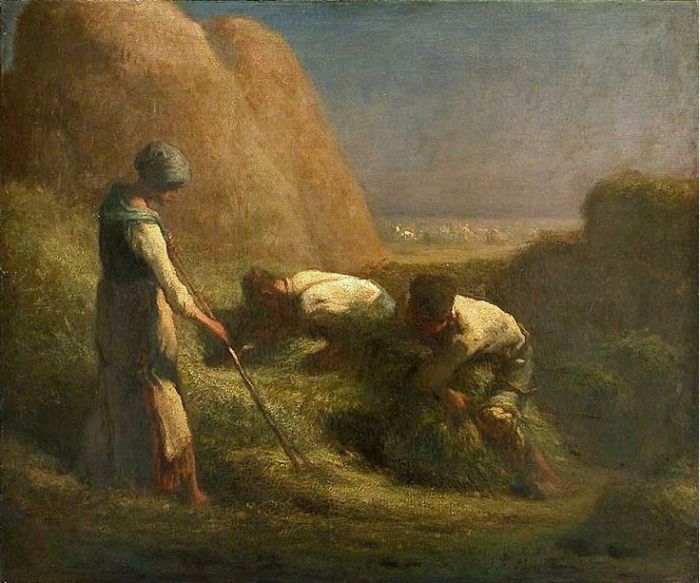
Jean-François Millet (1814-1875) – The Hay Trussers (1850-51)

Millet was a huge influence on Vincent Van Gogh and this painting, as well as being a landmark work of art, perfectly encapsulates what Van Gogh first set out to achieve when he established himself as an artist. Van Gogh had a strong desire to paint the rural folk and their way of life as can be seen in his early paintings such as The Potato Eaters and many of his early sketches.


image

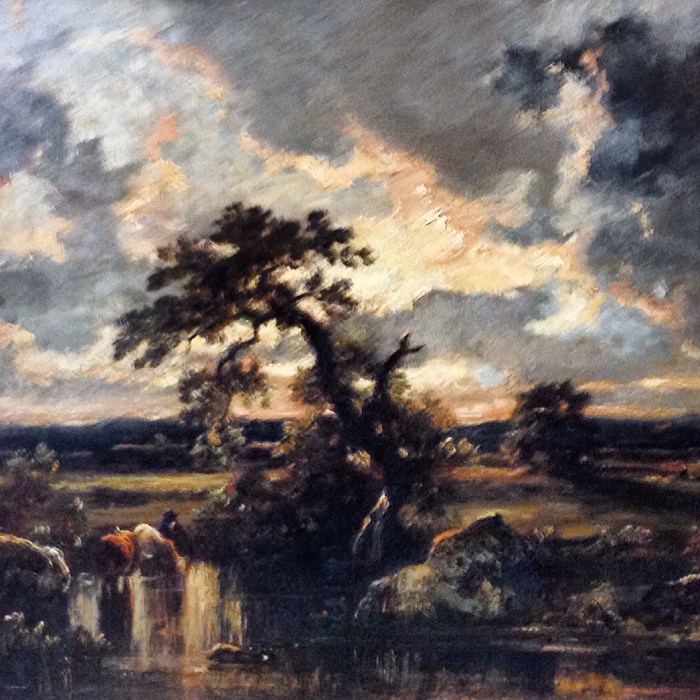
Jules Dupré (1811-1889) – Sunset After A Storm (1851)


image

Eugène Delacroix (1798-1863) – Pietà (1837)

This is a gem of a painting by the great French painter Eugene Delacroix. What is amazing about this painting is, stylistically, how loose and free it is and one could argue that it is a strong example of proto-Impressionism since it predates the movement by four decades (give or take a few years). Furthermore, Delacroix was an enormous influence on that generation of artists. In fact many argue that he planted the seed for the Impressionist movement.


image

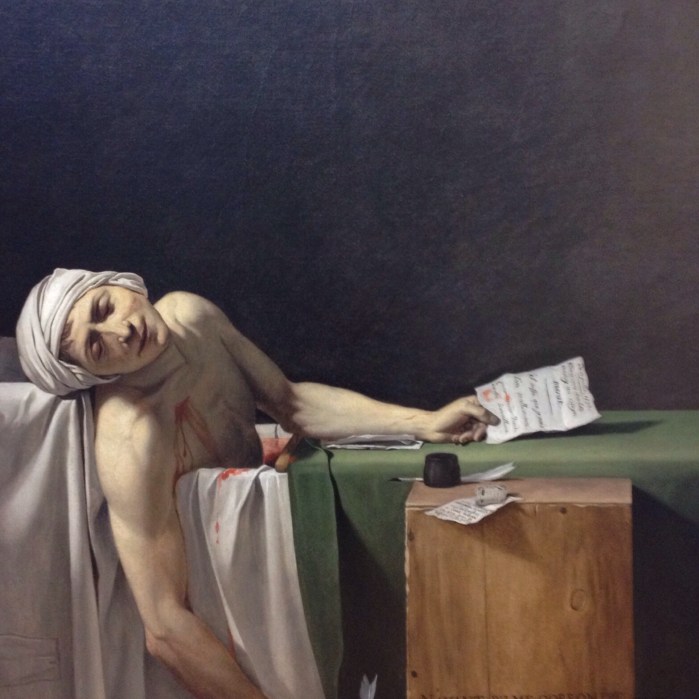
Jaques-Louis David (1748-1825) – Death Of Maret (1794)

This painting is of the murdered leader of the French Revolution, Jean-Paul Marat, and is one of the most iconic images of its time.


image

Jean-Honoré Fragonard (1732-1806) – Rinaldo In The Gardens Of Armida


image

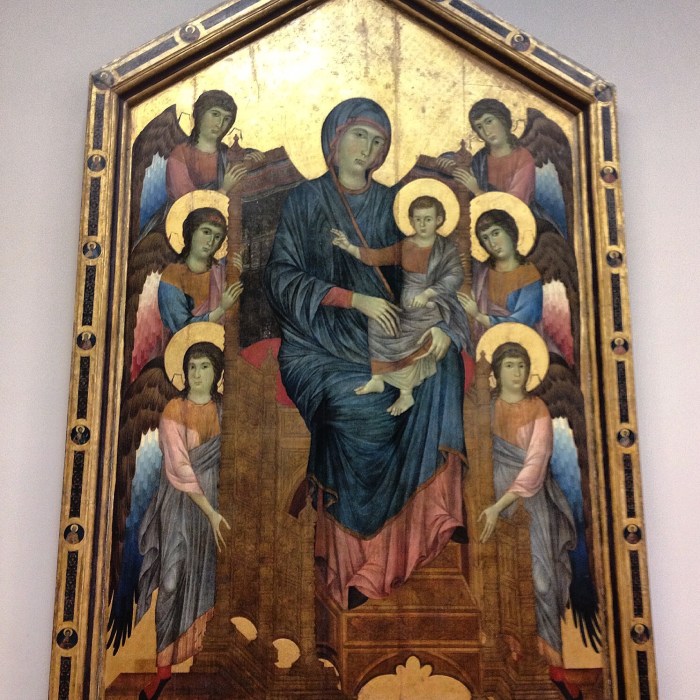
Cimabue (1240-1302) – The Madonna And Child In Majesty Surrounded By Angels

Cimabue was a revolutionary artist. Arguably the first of the major early Italian Renaissance artists and the first artist to break away from the traditional Italo-Byzantine style art of the time. The above painting is one of his series of famous Maestà paintings.


image

Giotto di Bondone (1266/67 – 1337) – The Crucifixion

Giotto was a student of Cimabue and along with him a major artist of the early Italian Renaissance movement.


image

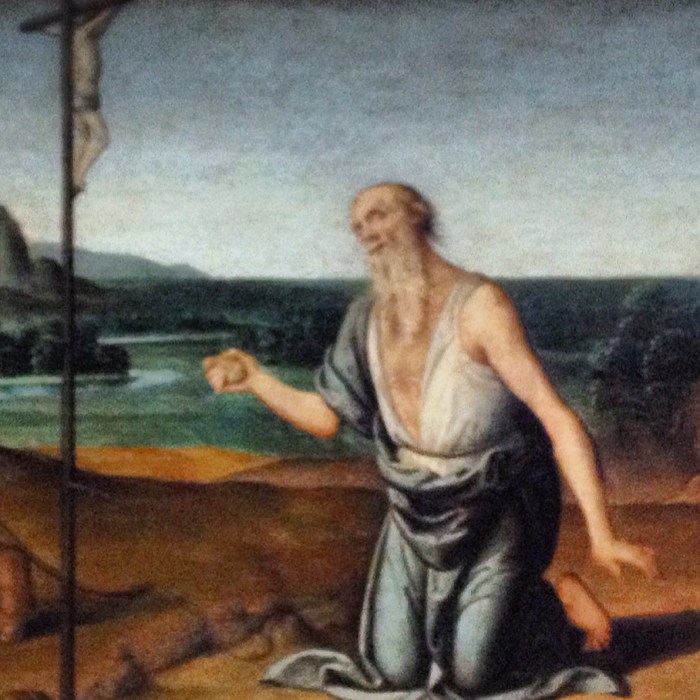
Lo Spagna (d. 1529) – St Jerome In The Desert (1531)


image

Antonio Campi (1522-87) – The Mystery Of The Passion Of Christ


img_0350

Bartholomé Esteban Murillo (1617-82) – The Young Begger (1645-50)

This painting, for me, is striking for it’s gritty realism and social context. It was painted towards the end of Spain’s Siglo d’Oro (Golden Age) around the middle part of the 17th century when Spain had an enormous global empire. But what is clear is that, as evident by the acute poverty in the painting, it wasn’t a Golden Age for everyone. Much of Spain’s wealth accumulated from its former colonies was squandered on wars and in spite of its global clout at the time, the Spanish Crown filed for bankruptcy several times.


By Nicholas Peart

26th October 2016

(All rights reserved)

*image source: symmetrymagazine.org

Touring The Local Pubs Of Glasgow

Earlier this month I visited and stayed with a couple of friends of mine in Glasgow. I had an absolutely stellar time over there. Yet one integral aspect of what made my time in Glasgow truly memorable was visiting some of the city’s local boozers. In this article I will be selecting some of these pubs which I particularly enjoyed.


Kelly’s Bar

img_3556


This pub is a proper authentic Irish boozer located off Polokshaws Road south of the city centre and an important part of Glasgow’s traditional and historic Irish community. My friends both took me there on my first night in Glasgow after we had a delicious vegetarian Indian feast at nearby Ranjits Kitchen. As we all ordered pints of Tenants a stocky Irish lad was playing songs on his acoustic guitar. Many of the songs were traditional Irish songs with a smattering of pro IRA ditties thrown in for good measure. You can take it or leave it, I suppose. But I like this pub. Not many outsiders venture here. There is nothing ostentatiously hip or pretentious about this place and if you want a cheap pre or post curry pint, you could do far worse than rock up here. Most of the time the pub is refreshingly devoid of big crowds except when Celtic are playing.


Saracen’s Head

img_3557


The Saracen’s Head, or ‘Sarries Head’ as its better known to locals, is a notorious Glasgow pub directly opposite the Barras market and very close to the Barrowlands concert venue. As I was ordering our drinks, I was mulling over whether to order a separate glass of the infamous Glasgow brew called Buckfast Tonic wine. The guy serving me was three parts Billy Connolly and two parts Gregor Fisher. He gave me a strong look to break my indecision and said, ‘ya cannoe gorra Glasgow and no av a wee bita Buckfast lad’. It seemed I had no other choice in the matter.


img_3559

At the Saracen’s Head pub with my Tenants and Buckfast


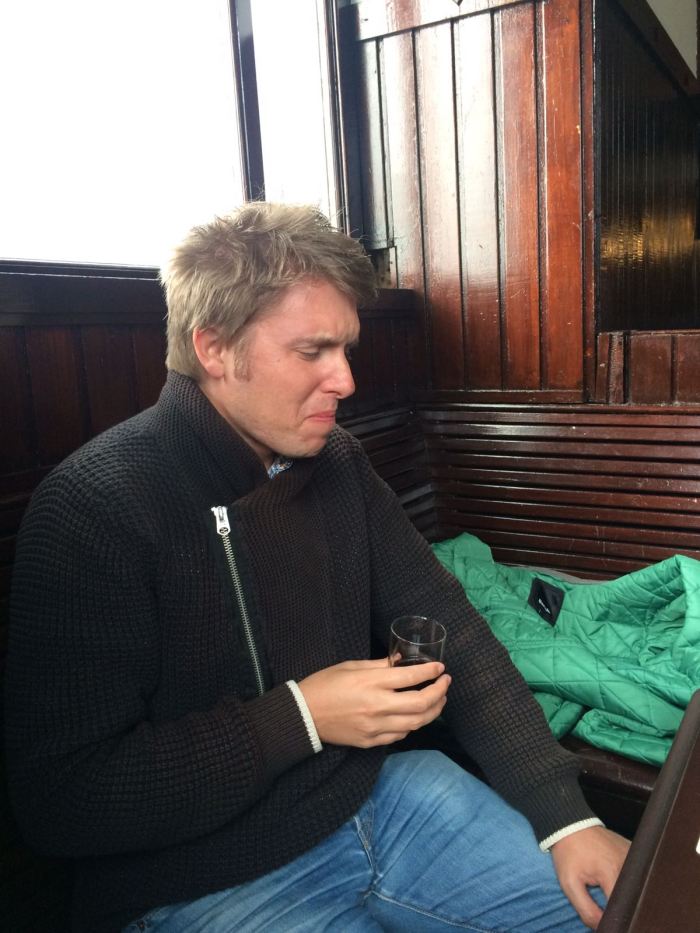
My friends and I found a corner of the pub to sit down. There I was with my Tenants in one glass and deep crimson Happy Shopper cassis in the other. I approached the Buckfast like it was a glass of black mamba venom. This toxic liquor was absolutely vile. I badly needed a kale, kiwi, cucumber – you get the picture – one of those uber healthy raw juices to cleanse by desecrated internal body after this legendary assault.


img_3278

Not feeling the Buckfast


The Star Bar

img_3551


The Star Bar is located on the corner of Pollockshaws and Eglinton streets. On the surface this is an unassuming and nondescript place. But once you open the doors and enter you are immediately catapulted into a genuine and uncorrupted slice of Glasgow. All the Rab C Nesbit stereotypes are pungent here. Yet this place exudes warmth. My principle reason for coming here was to sample their 3 course meal for only £3! I have never heard of anywhere else offering such deal. I loved the sound of it and I thought it would be rude not to resist.


img_3552

I couldn’t say no


The landlord was monumentally friendly to an outsider like myself and even offered me a free half pint of Carling as I was about to order my drink. A salt of the earth person with a heart of gold. I was very touched. My starter came in the form of canned minestrone soup. I could handle it, almost.


img_3553

Course One: Canned minestrone soup


Then for my main I received a Scots pie with fat green beans and boiled potatoes. This was by far the most ‘wholesome’ part of the three course meal even if the pie and mince inside was about as processed as processed pies got but you would have to be a real wolly to complain considering the price. And besides, I would be dead offended to be served anything remotely representing ‘gourmet’ quality here.


img_3554

Course Two: Scots pie with potatoes and green beans


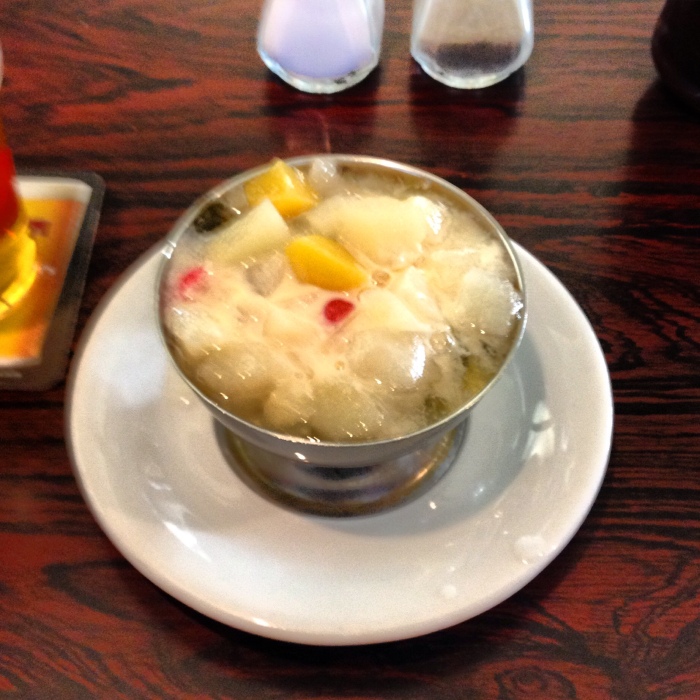
Finally for dessert (or ‘sweetie’ as the landlord called it) I was served green jelly, tinned fruit and cream in a small tin cup. This was more challenging. I could handle the fruit but not the rest.


img_3555

Course Three: Green jelly, canned fruit and cream


The Brazen Head

img_3345


Further up Pollockshaws road and past the Star is the Brazen Head. I was expecting a gritty, rough and tumble affair judging by some of the online reviews I’d read. The Sunday Times even wrote an article on it entitled ‘Inside the Gorbals hardest pub’. Yet I was unexpectedly surprised to discover a rather pleasant and friendly Celtic Irish pub. On the other hand it was verging on dead when I was there save for two or three long timers. Perhaps I should go there when the football is on to give this place a more realistic assessment? I found a corner at the far end of the pub nestled amongst a galaxy of Celtic memorabilia. The widescreen plasma TV was on mute as I quietly drank my pint of Guinness.


The Alpen Lodge

img_3547


Around central Glasgow station are a number of down and out local boozers which are unlikely to ever make an appearance in a Lonely Planet guidebook. The Alpen Lodge is one of those places. Here it is semi packed yet everyone mostly keeps themselves to themselves. There is absolutely nothing remarkable about this pub but if you want to visit an authentic Glasgow boozer, albeit uncomfortably voyeuristically, you can do far worse. After a while I just wanted to get the hell out of here. Out of all the pubs I had visited in Glasgow, it was here where I felt the most self conscious. Yet as I drank my pint of Tenants in haste, I discovered a very enlightened poem on the wall next to me entitled Smiling which began…

‘Smiling is infectious,
you catch it like the flu,
When someone smiled at me today,
I started smiling too…’

I read the entire poem and immediately felt more relaxed and at ease. I savoured the remainder of my pint.


The Laurieston

img_3271


Saving the best til last, The Laurieston is the granddaddy of all the pubs I’ve mentioned. An institution and a unique and untouchable gem of Glasgow. What a place! On the outside it could be mistaken for a typical council estate drinking den. This pub is similar to the Star Bar in some ways. Both places exude legendary Glaswegian warmth and are as authentic as pubs get. Yet whereas the Star Bar projected a fatigued and rather downbeat vibe, here the energy is infectious. What’s more, all kinds of people come here; long timers, football fans, students, local trendies and even a smattering of tourists like myself. It was on the awesome recommendation of my Glasgow based friends that I first became aware of this place. This pub has been in the family for decades who, amazingly, have so far resisted any offers to sell the place. The family who own the Laurie are very proud of their pub and I feel a change in ownership could potentially dent a great part of what makes this pub truly special.


img_3267

Inside the Laurieston 1


img_3268

Inside the Laurieston 2


img_3269

At the Laurie sipping my pint of Guinness


As my friends and I sip our pints, I venture over to the jukebox which is free. There is a large selection of songs much of which are from old 60s, 70s and ‘Now That’s What I call Music’ compilations. I select Blondie, Thin Lizzy, The Troggs and Status Quo before I return to my friends and my pint of the black stuff.


By Nicholas Peart

26th October 2016

(All rights reserved)

My Favourite Things To Do In Liverpool

img_0370

Liverpool waterfront*


Liverpool is a great city to visit. There are simply tons of things to do here to occupy you for at least several days. I was in Liverpool for only a few days and I still feel like I would like to go back and visit certain places I didn’t get the chance to visit this time around. However I did do some internet research before coming to Liverpool and already had a few specific places in mind which I wanted to visit. There are all the obvious sites such as all the Beatles related landmarks (which I could not possibly shun especially since I myself am a huge fan of their music). There are also some world class art museums such as the Tate Liverpool and the Walker Gallery – sadly I didn’t have enough time to visit the latter although I hope to visit it on another trip to Liverpool. If I do return to Liverpool I would like to explore more of the city’s local arts and music scene. There is a building on the waterfront, right by the Tate Liverpool, which houses the Liverpool Maritime museum and the Slavery museum – both definitely worth a visit to gain a better understanding of the city’s history. Like Glasgow further north, the shipping industry flourished in Liverpool during the 19th century and brought incredible prosperity to the city. At one point Liverpool was wealthier than London. Evidence of this past wealth can be seen in many of the architecturally beautiful buildings dotted around the city as well as the rows of handsome Georgian houses on many of the city’s streets.

Below I am featuring certain sites and places in Liverpool which I particularly enjoyed.


Beatles Landmarks

img_0372

Those Fabulous Four**


For me my favourite Beatles related thing to do is to visit the houses where John Lennon and Paul McCartney grew up. There are some agencies which offer tours but in reality you can visit independently. However if you want to go inside John Lennon’s house that can only be done via the tours offered by the National Trust. Both houses are located several kilometres outside of the city centre in the suburb of Allerton. I decided to check out Macca’s childhood gaff first but before I did I thought it would be rude if I didn’t break the journey in Penny Lane which is located en route via the 86 bus from the centre. The Penny Lane street sign is completely defaced just like the Abbey Road sign at St Johns Wood in London. I ask a passerby to take a photo of me next to it. Listening to the music of the Beatles and my second favourite band from Liverpool, the La’s, I develop many romantic notions in my head of the city some of which I can’t explain in words. Penny Lane is quite an ordinary street yet it’s thrust and propelled into a dauntingly significant part of history because of that song.


img_3477

The Beatles song Penny Lane was named after this street


I get back on the 86 bus before disembarking at the junction of Mather Avenue and Forthlin Road. The latter street is where Paul McCartney’s childhood home is located. Macca’s house is very modest and nondescript. Now I am sure he can easily afford to buy up the whole street and still barely make a dent on his vast fortune. There is no one else on the street but myself until a few moments later a mammoth tour group arrives all descending on Paul’s humble childhood abode.


img_3482

The childhood home of Paul McCartney


John Lennon’s house is located about 20 mins away off Menlove Avenue. To get there I walk via the Allerton Golf club. I am using Google Maps on my iPhone and try to utilise the shortest route possible. Lennon’s childhood home is larger than Macca’s with its own front drive. A blue plaque adorns the front of the house. There is the option to enter the house if you do one of the National Trust tours yet I feel there is nothing more I need to gain. I would rather spend that time losing myself in his amazing music.


img_3492

Outside John Lennon’s childhood home


I return to the city centre from where I take another bus north east of the city to the suburb of West Durby. It is here on a leafy and seemingly affluent street with some lovely villa-like properties where the Casbah Coffee Club was once located. It was established by Mona Best (the mother of Pete Best, the original Beatles drummer who was unceremoniously fired from the band just before they hit the big time) in the celler of their substantial family home in a beautiful rural setting to provide a space for local bands to play and socialise.


img_3497

The Casbah Club was located in the celler of the pre Ringo drummer, Pete Best’s, family’s home


The club was established in August 1959. It was here where the Beatles, then known as the Quarrymen, played their first gig. This was before they would regularly play at the legendary Cavern club in the centre of town which at the time was only putting on Jazz.


img_3507

Outside the famous Cavern Club which was the epicentre of the early 1960s Merseybeat scene in Liverpool where the Beatles regularly played before they hit the big time

 
Chinatown and St Luke’s Church

image

The famous Chinatown Arch


Liverpool’s Chinatown is the oldest Chinatown in Europe. I’ve already touched upon this historical part of Liverpool in a separate post which can be viewed here. The roots of Liverpool’s Chinese community date back to the 1860s with the establishment of the Blue Funnel Shipping Line by Alfred Holt and Company which employed many Chinese seamen who came all the way from Shanghai. The original Chinatown was established around Cleveland Square close to the docks. When that entire area was bombed during the Second World War, a new Chinatown was established on Nelson Street and surrounding streets where it continues to flourish today.


img_3527

St Luke’s church


At the intersection of Berry and Renshaw streets which marks the unofficial beginning of Chinatown is a bombed out church called St Luke’s, which was destroyed during the Second World War. This church reminds me of St Dunstans to the East in the City Of London close to Tower of London.


img_3535

St Luke’s church today resembles more an ancient negleted ruin as a result of heavy bombing during World War Two

 
The Ye Cracke and Dispensary pubs

img_3524

The Ye Cracke pub


The Ye Cracke pub is a great old fashioned pub on Rice Street off Hope Street, close to the Philharmonic Hall. This place is crammed full of early pre Beatles history. John Lennon’s uncle was a regular here as was John himself and his girlfriend Cynthia when they were both at art school in the 1950s. I love this pub. When I stopped by one mid afternoon there was just a mere smattering of punters and I had a whole wing of the pub to myself. I ordered a pint of Thwaites for only a couple of quid. In my corner Beatles related artwork by local junior artists adorned the walls.


img_3520

Inside Ye Cracke. Notice both the black and white photos on top left corner which feature a young pre Beatles John Lennon from the 1950s. John was a regular here.


img_3536

At the top of the photo is a very early back and white Beatles photo when Pete Best was still in the band


In front of me was a turquoise portrait of John Lennon by a local artist. In the portrait, John’s face appears tired and washed up; like he’s been on crystal meths for two weeks. In the entrance there are a few black and whites photos featuring a young John Lennon in the 1950s plus one of the very early Beatles line up when Pete Best was still in the band.


img_3539

The Dispensary pub


The Dispensary pub is a cracker. A proper place with all the original features, warts, shit stains and all. Something of a rarity today. And boy do they do amazing ales. Have a pint of the Plum Porters. It is one of the best and tastiest ales I’ve ever had. The songs Hush, Mr Tamborine Man and Tiger Feet seem to be on continuous repeat on the jukebox. Being here I feel like I’m in the Newcastle pub Michael Caine enters at the beginning of Get Carter where he asks for a pint of bitter ‘in a thin glass’. On various online forums there is a lot of talk about the pub’s notorious ‘volatile’ landlord, ‘Crazy Dave’. Immediately I think of the low budget 1993 US film Red starring legendary hard man Lawrence Tierney as the cantankerous and unstable landlord of some dive bar in Philadelphia. In the film he gets periodically prank called and every time ends up losing his shit at the offender down the phone. I was at the Dispensary two times and on both occasions Dave was present. In the wake of reading all the online stories about him, I felt a perverse temptation to add to the existing chain of Crazy Dave agro and order a Smirnoff Ice with a straw but I chicken out. Astonishingly, on my second visit Dave recognises me and greets me with an unusually cordial ‘alright mate’. Yet examining him further, he looks like the sort of person who wants to keep his place local and wouldn’t hesitate to crush a Shoreditch trendy like a butterfly on a wheel if they rubbed him up the wrong way. This is a place where Trip Advisor reviews mean jack shit. The Dispensary ain’t The Old Blue Last, that’s for sure


Breakfast at Shiraz Café

img_3545

Full English breakfast at Shiraz café


Come to Shiraz, located on Williamson square, for breakfast (or lunch) and order the Full English Breakfast for £5.50. This is one hearty and powerful Full English. My only complaint about it is the black pudding ring which at times feels like you are chewing on a cooled melted ice hockey pick. Yet apart from that the breakfast is top here and great value. All stripes come to Shiraz. This is an institution and an invaluable reference point if you are ever hungry and don’t want to break the bank. The Full English aside, Shiraz also does good size portions of cheap no nonsense comfort fare dishes like Chilli Con Carne, casseroles, lasagna etc. On one of my many trips here I ordered a half roast chicken with a mountain of fries, rice and salad for a little under £6. The vegetarian Mediterranean breakfast is a healthier alternative to the full English but before you order it request that they don’t put so much sauce over the feta salad which on its own is perfectly fine. A good local cafe/restaurant which I highly recommend.

 
Zanzibar club

img_0373

The Zanzibar club***


Whilst in Liverpool I wanted to find a good non pretentious live indie/rock music venue similar to the Camden Barfly in London or the now defunct CBGBs in New York. There is no shortage of live music venues in Liverpool yet I hand picked this venue because of its focus on unsigned indie/rock bands and also it’s history especially regarding the city’s local music scene during the last 15-20 years. During the early 1960s the Cavern Club on Mathew Street was the epicentre of the emerging Merseybeat music scene with the Beatles it’s most successful band. Then later towards the end of the 1970s during the whole punk and new wave movements the nearby club Eric’s also on Matthew Street was the centre of that scene where local bands of that time such as Echo And The Bunnymen, The Teardrop Explodes and The Mighty Wah emerged from. The Zanzibar club located on Seel Street, which has a number of trendy bars and clubs, has been an integral part of the local Liverpool music scene for close to 20 years. Two key Liverpool bands, The Coral and The Zutons, used to gig here regularly when they were still relatively unknown. Noel Gallagher also once played a solo gig here in 2003. I came one Saturday night when four local unsigned bands were playing. I managed to catch two. Neither band was particularly original nor did they ooze much charisma or play a set that was truly memorable. On the other hand the first band where the members were around the 19-20 mark played a good tight set. Perhaps with time their musical influences will expand and they may start making some very adventurous and challenging music. It is incredibly hard and gruelling work being in a band in these digital post internet days (unless you are the Rolling Stones), especially with the collapse of much of the music industry. In a way I think local bands should be supported now more than ever before. Most bands essentially do their best whether I am a fan or not.


By Nicholas Peart

 20th October 2016

(All rights reserved)


*Image source: http://www.wikipedia.com

**Image source: http://www.bilboard.com

***Image source: http://www.mycityvenue.com