Who Moved My Cheese? Dealing With Change

image

Who Moved My Cheese? by Dr Spencer Johnson is a fantastic little book, originally released almost 20 years ago, about how one can successfully deal with change. The story features four characters; two mice called Sniff and Scurry and two little people named Hem and Haw. The mice represent the simple parts of ourselves and Hem and Haw the complex parts. Sniff ‘sniffs’ out changes early and Scurry ‘scurries’ into action. Hem blocks and fears change and as a result remains stagnant whereas Haw is more open and willing to adapt to change as he sees change leading to something better. Haw is prepared to ‘move with the cheese’ whilst Hem perpetually moans ‘who moved my cheese?’.

For Haw it’s not just about acquiring more cheese. He is just as excited by the journey, challenge and adventure of finding it. So even if he failed in his quest to find more cheese, the buzz of trying to find more is more satisfying than simply complaining about having no cheese left whilst feeling trapped and always remaining at the same station without ever moving.

Initially, I assumed the book to be more of a manual to achieve success professionally. A book for businesses. But it is much more than that. The story is timeless and up there with the greats like The Prophet and Aesop’s Fables.

In my life I have played the roles of all of these characters. Yet it has been the character of Hem who I’ve played the most. Those times of fear, procrastination, denial and sabotaging my happiness, which have affected my life. These emotions have always anchored me to the same station and very soon I become trapped. And even when there’s cheese remaining, it’s taste is different and it’s just not satisfying anymore. Clawing at this remaining cheese doesn’t pump my heart or nourish my soul or spice up my life.

Sometimes I want to ask ‘who put this brain inside of me?’ Some may sniff (no pun intended!) at the brain of a mouse and how it lacks the complexity of a human brain but precisely! It deals in simplicity and basic instincts and doesn’t have any of this crazy emotional baggage which wrecks havoc on our lives. Their skills to move on and adapt are more advanced than ours. They don’t waste time unnecessarily overanalysing things.

Expanding on this short story, is it enough to settle on finding just any cheese station? It is one thing setting off and finding more cheese, but more specifically, are you after a particular kind of cheese? Cheese is a metaphor for all kinds of things. This could be money, a certain possession, a fulfilling job, a certain type of partner, a new experience, excellent health, happiness, inner peace etc. – it can be anything you want.

What is my cheese? Perhaps for me the best type of cheese is the one called Self-Discovery or Self-Knowledge. The more I get to know myself the more of this cheese gets accumulated. Even if at times the journey is painful, as I navigate the maze to find more of this type of cheese, I invariably get hopelessly lost, demoralised and insecure that I will never find more of this Self-Knowledge cheese on the less travelled roads of the maze. It is much easier and less painful to search through the more accessible routes of the maze of life and look for more ordinary cheese. A station containing enormous slabs of mass produced mild bland cheddar may be enough for some and there is nothing wrong with that – each to their own. But what a thing it would be to find a cheese station containing some of the rarest, most exotic and tastiest cheeses. Rich and irresistibly creamy and tangy flavoured French and Italian cheeses for example.

Yet the paths of the maze to reach the stations containing these cheeses can be emotionally treacherous and many have lost their heads and their minds, and simply given up. The roads on this maze are not well paved and well lit 10 lane highways where one can idly cruise and be off their guard. Oh no sir! If only!! These roads are more like narrow hazardous Himalayan passes at least 5000 metres above sea level where just one minor slip could be fatal. It is challenging and demands full concentration but what a buzz to travel on those roads! Once you’ve travelled on those roads travelling on all other roads is a piece of old piss. In fact, after having successfully navigated those roads, travelling on those well lit 10 lane highways becomes an insufferably dull experience. You then almost become allergic to Hem!! Hem is fearful of change but you become fearful of ever ending up like Hem. You begin to embrace change like most people walk through their front door.

This is an indispensable book. Short, concise, to the point and it may even change your life and your ways of thinking for the better.


by Nicholas Peart

2nd June 2016

(All rights reserved)
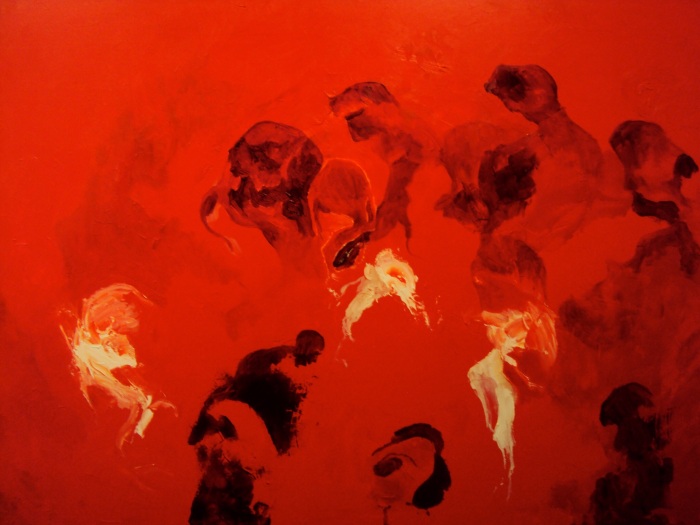
 

Spiritual Coding and Self Discovery: An Exploration Of My Paintings

image

Magma Matter Execution (2012) by Nicholas Peart


I am often asked by people to explain my paintings. ‘What are they about?’ is a common question. For a long time I found it difficult to translate the meaning of my paintings into words since the process is very personal and involves deep introspection. When people did ask the question I invariably gave them the reply, ‘My feelings. I paint my feelings’. This is one of the most succinct and sincere ways of explaining the meaning of my paintings yet I often felt that such a response just didn’t wash with some people.

All of my inspiration comes from within; through journeys into the deep chambers of my eternal, spiritual and immortal being. This is the part of me that is really me. The truth. In Hinduism and Buddhism this part of the self is known as atman. Yet often I feel very separated from this as I am immersed in the external environment of this life; a player on a stage where much of the cast has been programmed to be increasingly separated from their true being.

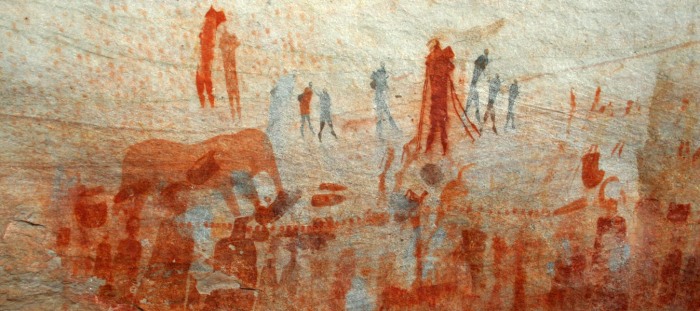
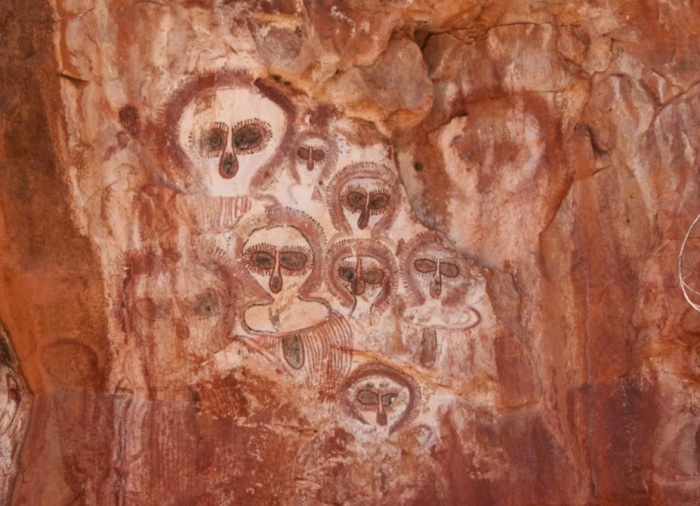
When I am immersed in the deep meditative process of painting, I feel increasingly connected with my true eternal being. It almost feels like it’s not me painting but my spirit. In my most inspired and transcendental moments of the painting process it is my eternal spirit which guides me. In these moments there is no chasm between my conscious and my unconscious. Being in this state makes me think of some of the earliest prehistoric civilisations. Back then, the world was a much less complex and complicated place to the one it is today. Especially the time before words. I think of the San rock art paintings found across parts of Southern Africa and Aboriginal rock art paintings from Australia. The San people of Southern Africa and the Aboriginal people of Australia fascinate me greatly since their culture goes back tens of thousands of years. But what’s more, their culture is profoundly spiritual and this can be seen clearly in their art; their oneness with the world and nature, and their high levels of awareness. In many ways it’s their lives and methods of working which inspire me just as much as the work itself, because of their deep spirituality.


san-rock-art-cederberg-south-africa

San rock art – Cederberg, South Africa


One thing that the San and Aboriginal people have in common is that much of their land is vast desert. For many people such a terrain is inhospitable and lonely; especially if one is very separated from themselves. In this state of being such a person would very quickly find the desert intolerable and isolating. It’s almost like the desert richly rewards those who are spiritually connected (and by extension at one with it) and makes life a living hell for those who are detached from their eternal soul. With a higher state of consciousness the desert begins to truly reveal itself. In a sense my paintings are like deserts, which only become alive as one becomes more connected with themselves. And this is sometimes a great problem I encounter as to some people my paintings appear quite alien and foreign to them. I fully expect this and it does not offend me when people openly tell me that they don’t understand them. My paintings are interactions with the spiritual world and these interactions take place during the painting process. One could then argue that in order to get to the core of my work it would be essential to observe me as I paint. You can do this and you can even do this without me being aware of being observed. But to really understand the processes would involve fully connecting with all levels of my consciousness.


image

Wadjina Aboriginal rock art – Kimberly, Australia


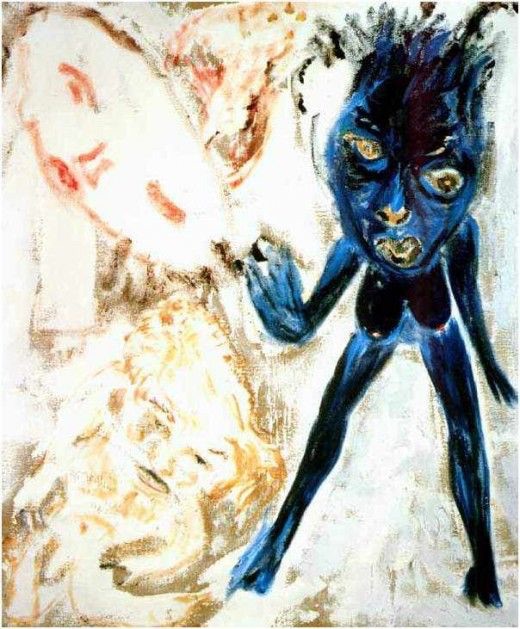
I find that the paintings of the American artist Don Van Vleit (better known as Captain Beefheart) have much in common with the art of those early prehistoric civilisations. What’s also interesting is that when Van Vleit retired from making music and dedicated himself fully to painting in the early 1980s, he lived in a remote part of Northern California. And by immersing oneself in his work one can see the deep connection. Like the San and Aboriginal people, his true spiritual home was in nature. The place where his true being could glow white hot. Take him out of this environment and plop him in a studio in New York, London or Berlin, he would be like a flower without water.


image

                                        Crepe And Black Lamps (1986) by Don Van Vliet


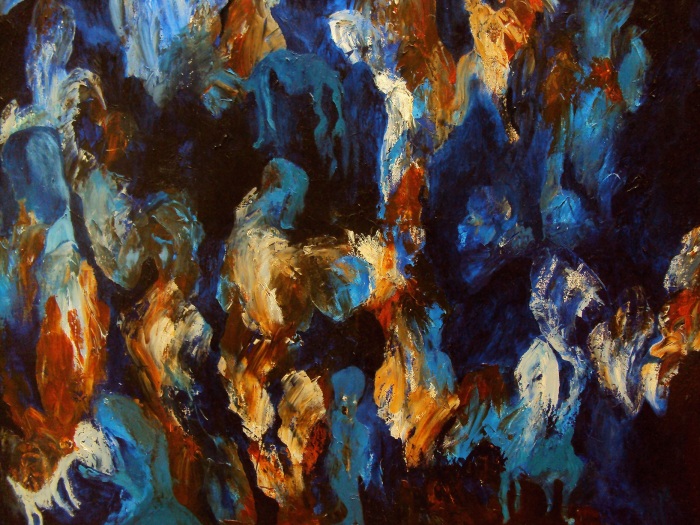
I like to call my painting technique Spiritual Coding. In the digital world in which we currently live the word coding is used a lot. This of course refers to computer programming. A language for this age. And when I look at my paintings I am also using my own language. A language created through interacting with my ‘inner being’ and this I call Spiritual Coding. My paintings are in many ways remnants of this. Tangible photographs almost of my eternal spirit. Although they don’t capture the processes of my work they are residue formations of intense spiritual journeying and internal searching.


image

A Winter In Crowland (2008) by Nicholas Peart


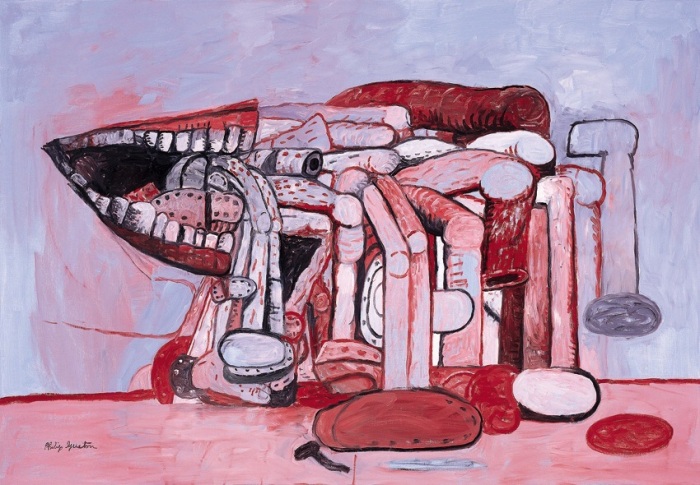
Remaining on the subject of Spiritual Coding, symbols are important in my paintings. The American artist Philip Guston created his own unique symbols, language and world. Even if his world was very bleak and one of hardcore isolation. A dystopian spirituality. But through connecting with his paintings one can see that he embraced this insurmountable at-sea pain and isolation. Works offering no hope or salvation. For the majority of people (including myself) such a level of alienation would be intolerable and very difficult to embrace and accept. But it’s amazing how secure Guston seems to be in this vacuum. And that’s what makes his paintings very striking, visceral and distinct. They are pure undiluted archives of raw pain. I think of Van Gogh and how, even though he was often in the grip of profound sadness and anxiety, he produced some of the most beautiful paintings of all time. Yet Guston’s paintings are anything but beautiful. He was not looking to turn pain into beauty. He was more interested in turning pain into more pain. The painter Francis Bacon is the closest artist to Guston in this respect. Merciless insatiable masochists. Perhaps there is absolutely nothing of the spiritual in Guston’s work and he was always an enigma to himself but his comfort in the most acute thresholds of pain and loneliness is epic.


image

Painter’s Form II (1978) by Philip Guston


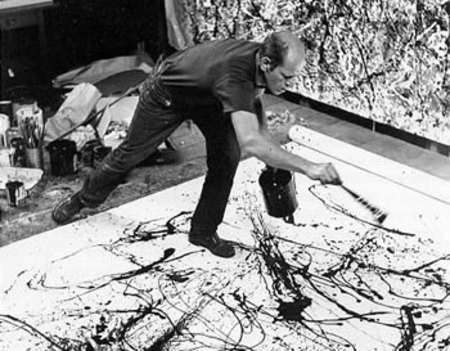
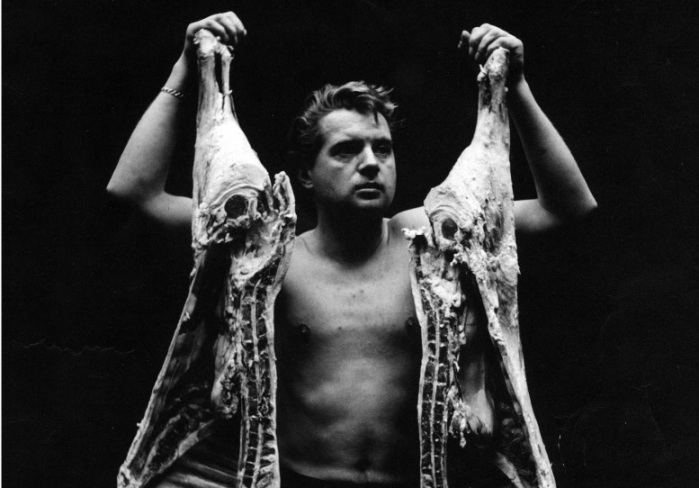
Luck and chance play enormous roles in my paintings. My soul brothers here are the painters Jackson Pollock and Francis Bacon. And like them I never make sketches or engage in preliminary studies. And why would I? After all this is completely against my way of working and, more significantly, my raison d’ĂȘtre. I can’t plan what I am going to paint. If luck and chance weren’t integral parts of the painting process, I don’t think I would ever paint. Uncertainty is extremely important.


image

                                                                           Jackson Pollock 


The work of both Jackson Pollock and Francis Bacon have their own unique and idiosyncratic qualities yet what unites them is their spontaneity. But there’s a more important quality which unites them and that is their energy. Wild, untamed, animal energy. Free of even the most minute inhibition. The primal way Pollock dripped paint and the ferocious and feral way Bacon attacked the canvas. Almost like a serial axe murderer taking a swing at his next victim. I can relate to this (not the axe murderer) since in much of my work when I first apply paint to the canvas either with a brush or a palate knife I literally lunge at it and let my inner self do the work. And sometimes I get so exhausted by the end of this process I need to rest.


image

                                                                            Francis Bacon


I am still on my journey of self discovery. And as explained earlier in the text, I am just as conditioned and influenced by my external environment as any other being yet when I am painting I am far away from this external environment since painting enables me to get closer to the truth; of myself and the world


by Nicholas Peart

23rd May 2016

(All rights reserved)


My work can be found by visiting my website; http://www.nicholaspeart.com

Clover Cafe: Like Being In A Monet Painting

image

Clover Cafe


Clover Cafe is a gem of a place set in pure nature. It is one of those places which feels very special and has a certain spiritual energy where words would be insufficient to describe it. It is situated by a beautiful lake with a small wooden bridge. Seeing this one could almost be mistaken for being in Giverny where Monet created many of his most significant and iconic paintings. I have had many happy times over there and it has enriched my time spent in Plettenberg Bay, South Africa.

It is run by Werner and his brother Christo who do an absolutely stellar job in making Clover the special and unique place that it is. What’s more they have a small team of very friendly and charismatic staff who make sure that everyone is happy and having a lekker (South African slang for good/cool) time.

Everyday they have a different menu of delicious and creative meals made from fresh organic ingredients. They have excellent meat and fish meals as well as a decent selection of healthy vegetarian options. Their pizzas are especially good. And the prices are very reasonable considering the quality of the food.

Sundays are a great time to head over to Clover where one can see and hear excellent and authentic local live music played with real heart and soul. And when it’s a glorious blue day than it becomes truly magical. Clover has so much potential to be not just a great restaurant and live music venue but an important hub where people come to be inspired and make great things happen.

by Nicholas Peart

May 15th 2016

(All rights reserved)
Bocca Dolce Cafe: Sensational Vegan Food In A Paradisiacal Setting

image

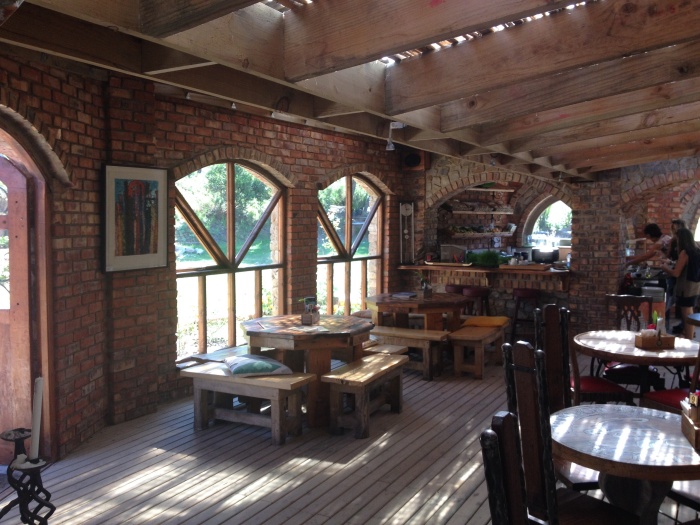
The interior of the Bocca Dolce Cafe


The Bocca Dolce Cafe is a paradise of a place situated in the beautiful Quarry Lake Estate around the Wittedrift area close to Plettenberg Bay and planted firmly on the lush and infamous Garden Route in South Africa. The heavenly location alone is enough to warrant a visit. I am also told that they have excellent coffee, which I completely believe judging by what I’ve seen on my few forays over there. Sadly for me, I am not a coffee drinker.


image

The beautiful surroundings


But for me it’s not about the beautiful location (yet it’s certainly a bonus) or the excellent coffee. My primary reason for visiting (and returning) is the divine, delicious and generous weekend vegan buffet they serve up every Saturday and Sunday from 1pm. I suppose one could split this abundant and tasty vegan buffet into three categories; Salads, Mains and Desserts.

The salads alone are a meal in itself with about 10-12 different selections to choose from. The selections change each time yet my personal favourites are the curried potato salad, the chick pea salad, the beetroot salad, the spinach, broccoli and bean concoction and, last but not least, the sublime humus. With such a selection I often run the risk of not leaving any space for the mains or desserts.


image

My plate loaded up with some delicious salad selections


Now for the mains. The highlights for me are the vegan lasaña and the vegan curry. Both are excellent and very tasty. There is also a table loaded with a grand selection of different and exotic vegan snacks. I particularly love the vegan satay kebabs.


image

Delicious and exotic vegan snacks


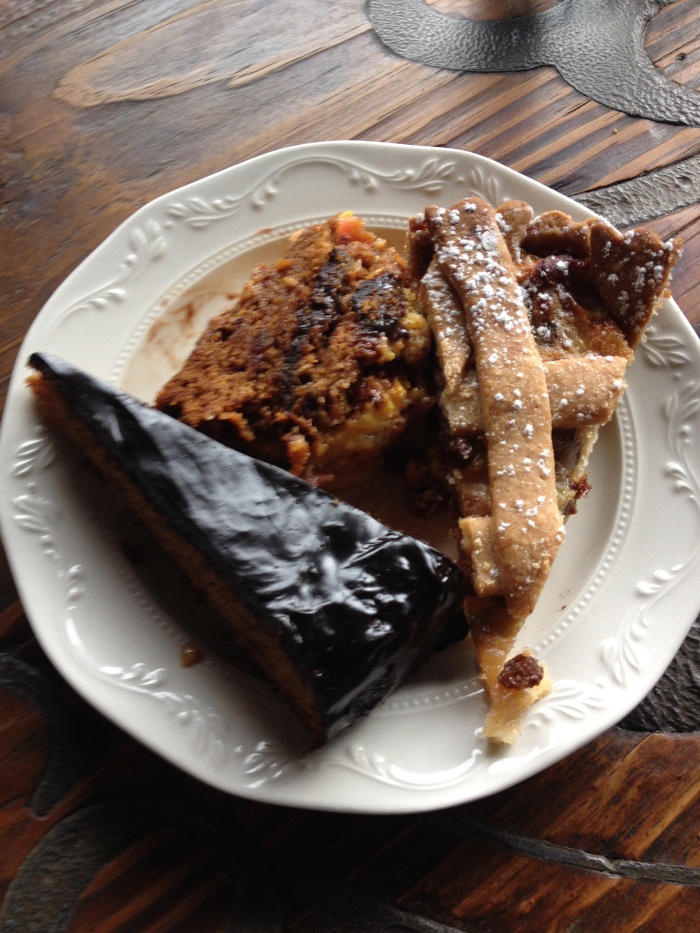
Finally the deserts. It would be a crime not to leave any space for those (easily done). Like the salads, the dessert selections change each time. On my last visit I got very lucky with the desserts to the point they became the highlight of the buffet that day. That day some of the dessert selections included a sensational vegan trifle, a very rich and delicious vegan chocolate and date cake, and a good no-nonsense vegan apple crumble. I have a weakness for trifle and I was very impressed with the textures, flavours and even creaminess of it all made a la vegan.


image

Exquisite vegan desserts


If you can’t make the weekend buffet the salad buffet is available on the weekdays.

The Bocca Dolce Cafe is a special place. The exceptional food notwithstanding, it offers a unique and unforgettable experience. The place is a real labour of love designed and created very tastefully with beautiful furniture and artworks on the wall by local artists. I highly recommend dropping by if you are in the area.

by Nicholas Peart

16th May 2016

(All rights reserved)

Virtual Reality: Further From The Source

A hundred years ago people had much more time than choice (and even only 20 years ago just before the rapid rise of the Internet). Radio was a new thing. TV wasn’t invented yet and video and the Internet were still some time off. What ‘entertainment’ distractions were there? The theatre (yes people used to go to the theatre in droves), books, newspapers, various sport and outdoor activities, musical instruments, poker, chess, backgammon, to name but a few.

With the invention of TV eventually video emerged as a major medium and would kill the radio star – or at least significantly reduce the major market share it had in the market for all global mass media communications outlets. Then it was the Internet which would upstage and threaten the video star.

With Virtual Reality one can potentially travel without moving and leaving their fixed space. Travelling Without Moving, to quote the title of an album by the pop star Jamiroquai which was released 20 years ago (what foresight Jay!). Taking into account the level of instant gratification which VR could bring combined with the Internet and the increasing sophistication of Artificial Intelligence, one could potentially satisfy all their wildest sensual wants, needs and desires without ever leaving their bedroom.


Jamiroquai – Virtual Insanity


Of course the virtual world is nothing new. Any time spent surfing the Internet especially through social interaction via the many social media sites available is time spent in the virtual world (and as is any fantasy experience such as getting lost in a good book). Yet this is still a 2D virtual experience. You are fixed to it but not completely immersed in it. VR has the potential to change all that. The 3D experience it offers is still very limited but with time the potential for further development is enormous. Yet perhaps it will never be a viable substitute to real life experiences? At least I hope not. I for one would rather still travel around different parts of the world the hard way, preferably overload via clapped out public transportation. But what if sometime in the future when every nook and cranny of the world becomes connected to the Internet, travelling virtually becomes a real possibility? Google Maps has already done a sterling job in shrinking the world and making it easier to navigate than ever before. Two of the original pioneers of globalisation, the Portuguese explorers Bartholomeu Dias and Vasco Da Gama, would be astonished with this progress.

image

The 15th century Portuguese explorer Bartholomeu Dias


But if VR could provide even higher degrees of sensations than those experienced through real life experiences than it has a serious future. One area of pleasure that springs to mind is sex. I can with complete certainty see the growth of the virtual sex industry growing exponentially via VR as its main vehicle. And with synchronisation from additional growing technologies like haptic technology (which enables one to feel something virtually without actually physically touching it) than the potential for experiences and sensations even more intense than the real thing is very high. Yet this idea both scares and disconcerts me. This is one of the ugly sides of VR which seems unavoidable. Sex sells and there will be some people becoming obscenely wealthy through this.


The Digital Love Industry documentary


But what disconcerts me the most with VR technology is the further separation and isolation it will bring on its users. It will become so addictive and immersive, that there is a real possibility people will be living almost 100% of their days awake (un-awake spiritually) virtually. I would guess that currently many people spend at least 50% of their days awake virtually via the internet and social media sites.

What the Internet has achieved is an increased fragmentation and separation of global society (even though it has, ironically, provided the tools for greater connectivity with one another than ever before). VR has the potential to speed up this fragmentation. In spite of the rise of the net, there are still ‘hubs’ where people meet. And cities, towns and villages where people live. Communities (although decreasing) still exist. Yet if everybody were to live all of their daily lives (including their professional lives) via 3D virtual reality (and have all their provisions delivered by super fast drones), one could live anywhere in the world with an internet connection. The very concept of cities, towns and villages could blur (a wild and demented prediction but what if this occurred?).

VR could mean a future where people almost only communicate and socialise virtually. I think Facebook knows this hence their purchase of the VR company Oculus VR two years ago, which may prove to be a very shrewd move. Communicating via Facebook is still a 2D virtual experience but with the additional VR vehicle of the Oculus Rift device, this 2D experience is transformed into a 3D one. And how many Facebook users currently are there?

image


Oculus Rift VR device


What implications would this increased disconnection from the real world have? Could there come a time when real life socialising dramatically decreases? People meeting one another face to face less? People not having real and meaningful relationships anymore? People not going to cafes, bars, pubs or clubs anymore like they used to? The rise and development of the Internet has already had a catastrophic impact on physical high street retail outlets (through the rise of e-commerce giants like Amazon), that could VR be the final (or penultimate) nail in the coffin for the high street? Could most leisure activities like nights out to pubs and clubs, social meet-ups in coffee shops, holidays abroad and travelling to exotic places, going to gigs and festivals, day trips to theme parks etc, almost disappear if VR really takes off? Such a scenario depresses me. I hope I am talking rubbish and none of these situations occur.


image

Back to nature


Yet the real world is always there. No one is forcing me to be deeply sucked into VR. I can take it or leave it. The Internet and the fast pace of globalisation has already succeeded in making the world a smaller place but the world becomes a larger place again if one is prepared to free themselves from these digital shackles for just a moment.

by Nicholas Peart

13th May 2016

(All rights reserved)

The Curve

The Curve is an innovative and groundbreaking concept by Nicholas Lovell. His excellent book The Curve (2014) explains how one can survive and be succesful in what they do in the context of the current Digital Age where many things are free. This is especially true if you are a creative person such as a musician or a writer struggling to make ends meet in a world saturated with Free Content.

The video below is a presentation by Lovell where he explains the Curve model and the significance and relevance of it today…


Nicholas Lovell explains The Curve


The Curve is split into three parts;

  1. Use Free to find an audience
  2. Use Technology to be able to talk to your audience again
  3. Use Technology to understand what your audience wants


The model of The Curve focuses on two groups of people; Freeloaders and Superfans. Freeloaders make up the bulk of your potential audience. They want something for nothing but that doesn’t mean that they should be ignored or treated with contempt. On the contrary, they should be viewed as ‘potential converts’ rather than unscrupulous pirates. They may not always remain Freeloaders and may at some point down the line spend some money on your products and services.

Then you have your Superfans which represent a small fraction of your audience (perhaps 10%). They are the most important part of your audience since they are the ones who love what you do so much that they are prepared to spend serious money on your products and services. This is the part of your audience you should care for the most since it is through them you’ll be making the bulk of your revenues.

To further explain how the Curve model can be applied today lets take the example of a band trying to raise funds to make their next album. The fundraising sites KickStarter and Crowdfunding really take the Curve model to their bosom. A potential Curve model the band can use could be as follows;

1. FREE : Free download of new album.

2. $2-5: Live clips of the making of the album streamed directly from the studio

3. $10: CD copy of the album

4.$30: Vinyl copy of the album limited to 5000 copies

5.$50: Red coloured vinyl copy of the album limited to 1000 copies

6.$100: White coloured vinyl copy of the album limited to 500 copies

7.$250: Gold coloured vinyl copy of the album in a luxury box-set with booklet limited to 100 copies

8.$2000: Private acoustic gig anywhere – the buyer pays for all transportation. One hour slot. 10 slots

9.$5000: Private electric gig anywhere – the buyer pays for all transportation. One hour slot. 10 slots

10. $10,000: Private electric gig anywhere where the band play NAKED – the buyer pays for all transportation. One hour slot. 5 slots.


This is just a rough model I drafted up which is far from perfect (and maybe some of the prices need some reconsideration – hehe) yet the most important thing is that it very much embraces a ‘Curve’ model. The old way of making money through selling ‘units’ of your album at the same price worked perfectly well in the pre-Internet age but sadly not today.

by Nicholas Peart

14th May 2016

(All rights reserved)


You can download a free e-book by Nicholas Lovell entitled ’10 Ways To Make Money In A Free World’ by clicking on the following link…


Or you can buy The Curve by Nicholas Lovell by clicking on the link below…


Want Your Children To Survive The Future? Send Them To Art School

I am presenting you all with one of the most illuminating and forward thinking articles I’ve ever read entitled ‘Want Your Children To Survive The Future? Send Them To Art School’. The author of this article, Dustin Timbrook, talks about a ‘Post-Work’ world (which many economists and futurists are predicting) where most jobs become obsolete due to automation from growing technologies such as Artificial Intelligence, 3D Printing and Robotics. But what is even more interesting, and very much the heart of this article, is that when this does occur, then our creativity will be all that is left. Yet it is interesting how in today’s world the ‘Arts’ are becoming an increasingly maligned sector. Art schools are currently in danger of becoming exclusively the preserve of people who can afford to pursue an ‘arts career’ and more and more focus is put on STEM subjects. In the context of today’s world this is understandable and there will be an ever increasing demand for computer programmers and website developers (‘coding’ is the current buzzword) and workers in growing technology sectors. But what happens when there comes a time when we are just not needed any more for any jobs? I often think of the inventor and futurist Ray Kurzweil’s Singularity prediction for 2045 when Artificial Intelligence will become on par (and subsequently more and more advanced) with human intelligence (our logical intelligence)? Suddenly we will all have lots of time on our hands (yippee!!!) and be able to put all our energies into things that interest us and that we are passionate about. It will be our creativity which will be king in this new world.

Being an artist has always been viewed as an ‘unstable career choice’. In a way, to quote Picasso, every child is born an artist. Every child is born with an innate sense of curiosity and wonder. To quote Timbrook (from a TED Talk he did in 2015), every child is ‘born weird’. But the problem is that traditionally (and today) this ‘weirdness’ and curiosity would be stifled and suppressed by the child’s parents who were (understandably) fearful of their children becoming outsiders or ‘drop outs’. By moulding them more in sync with the mores of current society, they would lose all their unique qualities and go on to do jobs they had little to no interest in doing. A recipe for a repressed and unhappy life. Yet by allowing a child’s ‘weirdness’ and sense of wonder, curiosity and creativity to flourish you are enabling a child to develop not only unique skills and traits, but gifts it will one day be able to present and share with the world and even contribute to making the world a better and happier place to live in.

Just underneath Timbrook’s article, I am also enclosing a You Tube video of his excellent TED Talk, which continues on the themes covered in his article.

by Nicholas Peart

8th May 2016

(All rights reserved)


Want Your Children To Survive The Future? Send Them To Art School   by Dustin Timbrook

http://www.rocketcitymom.com/want-children-survive-future-send-art-school/


Creativity Is Not A Gift – TED Talk by Dustin Timbrook


All Aboard The Santos Express

I’ve been spending the last few days of a cheeky little trip around the Western Cape in South Africa in the coastal town of Mossel Bay. A big draw for visiting Mossel Bay is its history. Evidence of Middle Stone Age people occupation some 170,000 to 40,000 years ago can be found at the nearby Pinnacle Point caves, and the Portuguese explorer Bartholomeu Dias rocked up here in 1488 christening the place Aguado de SĂŁo Bras before the Dutch came and renamed it Mossel Bay.


image

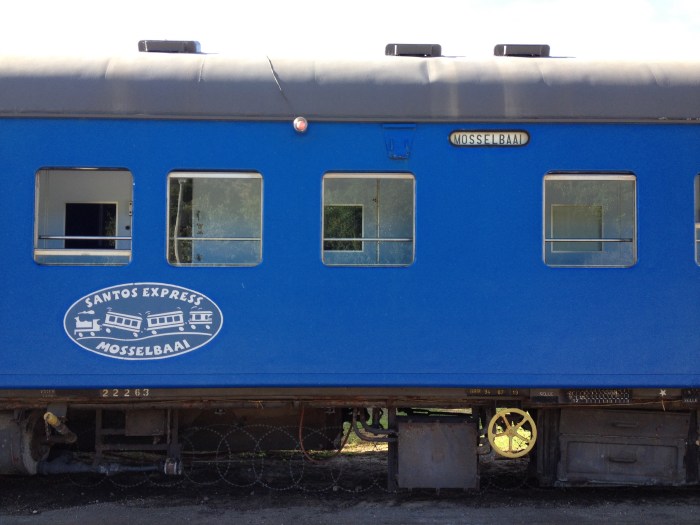
The Santos Express Train Lodge, Mossel Bay, South Africa


But it’s fascinating history was not the highlight for me. For me it was my choice of accommodation one night in a converted defunct train called the Santos Express Train Lodge. I don’t think I’ve ever stayed in such a setting like this in all my vast traveling life. All the compartments in each carriage are converted into bedroom cubicles. Two toilets and a shower compartment were also incorporated into the carriage I was staying in. My room was uber poky with a small single mattress but how I relished it all! It was a snug, warm and very rich experience. If only this thing moved. Through the Gobi desert in Mongolia across the endless Sahara and vast expanse of Patagonia. I have a high capacity for dreaming and unlimited fantasy. All the rooms overlook the Indian Ocean and this only augments my imagination and the good feeling about the place. It’s such a unique experience that I think I’ll return one day to Mossel Bay for at least a week and book myself for the duration of that time into one of the rooms on the Santos Express. I could spend all day in my compartment reading, writing poetry and staring out of the window and day dreaming.


image

Inside my room on the Santos Express


A great lover of trains, the American travel writer Paul Theroux would fall in love with the Santos Express Train Lodge. And so would the criminally underrated English singer songwriter Robyn Hitchcock who once wrote an album (and song) entitled I Often Dream Of Trains. I know that if he ever touched down here he would spend the rest of his days on the Santos Express.

Also, if you do happen to drop by Mossel Bay, I highly recommend that you have breakfast, lunch or dinner (or all three) at the Sea Gypsy Cafe. It is a very cool little place with friendly staff and the food is hearty, delicious, no-nonsense and very good value. The hake and chips is stellar. And if you ever come here for breakfast, I highly recommend (providing you are non vegetarian) the Pirates Breakfast. A gut busting feast comprising of a 150g lump of steak, wors (South African style sausages), bacon, 2 eggs, tomato, mushroom, toast and chips. It makes all my past Full English indulgences woefully lightweight.


by Nicholas Peart

2nd May 2016, Mossel Bay


(All rights reserved)

The Death Of David Bowie, The Future and 3D Printing

This is a piece I wrote on January 12th 2016, a couple of days after David Bowie died

I’ve been thinking about nothing but David Bowie these last couple of days. So many of his songs are playing in my head; Sound and Vision and Heroes being the most popular. Heroes always makes me pause and be deeply pensive. There’s something majestic and timeless about that song. Like millions of others around the world I am saddened and shocked by his early death. I had no idea he was so unwell even though I was a little suspicious that something was not right regarding his sporadic movements over the last decade. Another clue that perhaps all was not well was from watching the video to the 2013 song Where Are We Now? from his penultimate album The Next Day. It’s a beautiful, haunting and deeply reflective song. More importantly, it seems to me like he’s seriously questioning his own mortality. When I initially saw the video to that song I could see real pain in his face and I began to feel very sad for him.

In my selfish state of mind I was hoping that he would tour again but I can now kiss that option goodbye. I remember one day back in 2003 pondering on whether to see him live at Wembley Arena. The Dandy Warhols were confirmed as his support band. That day I was at the Stargreen ticket office on Argyll Street in Oxford Circus and the lady at the desk told me they still had tickets left for the show but I foolishly declined on the grounds that I thought the ÂŁ65 ticket price was too high. As the years went by and I got more deeply into Bowie’s music the desire to see him live increased exponentially but that was never to be as, after a heart attack in 2004, he retreated into splendid isolation with his beautiful wife Iman and the rest of his family. I have seen his compadre Iggy Pop live many times (and I even saw his other soul brother Lou Reed live once but he was dreadful and in a foul mood that day, which was a huge disappointment for me) and as special as Iggy will always be to me, I still regret not taking that unique opportunity to see David live. But life goes on man.

Taking a slight tangent, I often wonder what kind of people the people born today and in the last few years will grow up to be? I don’t know what the world is going to be like in 2020 let alone in 2030 or 2050. I humbly predict that by 2100 there will be no purely organic/biological human life still standing. I think by then all humans will be at least trans-human (half human/half machine). If the inventor and futurist Ray Kurzweil’s 2045 prediction for ‘The Singularity’ comes true then by 2050 artificial intelligence will be on par if not far more advanced than human intelligence. The question now is will this advanced level of AI further benefit our lives? Perhaps we can augment our bodies with AI technology in order to be compatible with AI itself as far as logical/mechanical intelligence is concerned? Or will it have dystopian consequences and wipe us all out? Some prominent figures such as the scientist Stephan Hawking and Tesla founder Elon Musk have already publicly expressed much concern that a situation like the latter may very well happen and Musk has even gone as far as to spend a large chunk of his vast fortune on AI research.

By the beginning of the 2020s I predict that 3D printing will slowly start to become mainstream. Currently 3D printing machines are the preserve of scientists and a smattering of ‘geeks’, innovators and early adapters. It is also still rather expensive to acquire a 3D printer but with time costs will decrease and the technology will only get more advanced. I think 3D printing will be the biggest thing to shape our lives since the Internet. 3D printing now is what the Internet was back in 1994/5. Give it time.

Now back to the subject of David Bowie, there is an interview he did with Jeremy Paxman in 2000. At one point in the interview they were talking about the Internet and what it meant back then. Paxman seemed to have little belief in the power of the Internet and stated that he thought it was just a ‘tool’ whereas David disagreed and saw it as potentially a much bigger and larger force (both good and bad) to what it currently was. In fact, Bowie was one of the first major artists to utilise the Internet as a platform for his music when it had just become mainstream back in 1997. Now let’s fast forward to 2016. The Internet plays an enormous role in our lives. It has also disrupted many industries in the process. The one that really springs to mind is the music industry. Many will remember the Napster saga involving members of Metallica back in 1999 but how many back then could have foreseen the colossal impact that illegal downloading would have on an entire industry worth billions of dollars? For many creative people; especially writers, musicians and digital photographers, this is now the age of Free Content. Yet what the Internet has enabled is an instant connectivity and strong social networking facility with an enormous and growing number of people around the globe, which was not possible before.


David Bowie talks about the Internet with Jeremy Paxman (2000)


Back to 3D printing. The main casualty of this emerging technology is going to be the mass manufacturing industry. “Made In China” will become a thing of the past as every household becomes a factory. Big mass manufacturing businesses like IKEA will either have to adapt in the face of this growing technology or potentially face serious challenges to their current business modal. I believe that the next 5-15 years are going to be very interesting.

For more information on this I highly recommend that you purchase a copy of The Curve by Nicholas Lovell. It is a riveting and incredibly insightful and enlightening book which is very ahead of its time. Furthermore, it is an indispensable book to have with many helpful and practical solutions if you are a creative person struggling to make a living in a world of free content.


by Nicholas Peart

12th January 2016
London


(All rights reserved)