REVIEW: Don Van Vliet “Standing On One Hand”

This is the moment I’ve been waiting for; the chance to finally see in the flesh the paintings of Don Van Vliet, better known as Captain Beefheart. I’ve been a fan of the music of Captain Beefheart for over 20 years. He was a one off with an incredibly singular vision and a style that was completely his own, without competition. And this is what attracted me to him; I’d never heard anything like him before. 

Through discovering and immersing myself in his music I soon also learnt about his paintings. Quite often when great musicians also produce (or in most cases “dabble in”) paintings, sculptures, etc, their works tend to fall short next to their songs. Bob Dylan is one of the greatest songwriters of all time; a timeless poet and a genius with words. Yet when I look at his drawings, I don’t detect anything special. They are far from bad drawings, but they don’t match his power as a towering wordsmith. David Bowie is another example. Even though he had an impressive and deep understanding of art, his paintings pale next to his magnificent body of music. 

What makes the Captain different is that his paintings are on par if not even better than his magical and highly distinct music. They are not divorced or different from his music. All together, along with his own unique and idiosyncratic being, they are a total work of art. Projecting the same rhythms, grooves and off beat time signatures that I hear on Trout Mask Replica. And this is why I love his paintings. When he stopped making music in the early 1980s, he devoted himself fully to painting. 

Looking at the paintings on display at the Michael Werner gallery in London, created in the 1980s and 1990s, one can conclude that his own vision, code and core never deserted him. When I focus and meditate on his paintings, I unearth so much. I see animal, human and other organism spirits of the infinite and asymmetric world. I also see a multitude of symbols each with their own irregular shapes and DNA. In the painting, Crow Dance A Panther, I see a celestial dog-like creature in a state of drifting metamorphosis with a raven head and an object in the form of a chair forming from its mouth in a weightless state of perpetual cosmic motion. The paint marks and elements don’t seem random. They each all have their own connection and balance in the composition. Paint is often applied thickly. The heavy white impasto marks have a physicality resembling frozen smoke and other forms of invisible moving matter; as if the paintings are always moving beyond their earthly boundaries.

The large painting, China Pig, has elements in it that remind me of some of the earliest cave art paintings found in South Africa and Australia. At the bottom of the painting painted in yellow is an extraterrestrial-like supernatural animal creation, a lively golden eagle bunny type of creature, riding on top of what appears to resemble a warthog or the Captain’s china pig! Elsewhere in the painting are pools of energy in non-stop flux; semi-buried faces, the dead, the living, the living dead, dynamic bodies and spirits, a myriad of colliding landslide landscapes; remnants of our dreams and nightmares without any filters. The golden eagle bunny keeps riding on its china pig through all these forever changes. 

The adjacent Feather Times a Feather painting appears to be on the same wavelength as China Pig and the next destination. The horizon and world of that painting is where the golden eagle bunny on its china pig feel like they should be heading towards. It’s the next stop in their no-return voyage. Feather Times a Feather is the Captain’s very own Garden Of Earthly Delights; hues of pink, yellow, orange, blue and green all representing symbols, cosmic fragments and morphing spirits, dominate the vacuum above and appear, perhaps deceptively, relatively gentle and calm. Below this area in the painting things are more unsettling. A distressed face bent below an ominous black crow symbol. An awakening crimson warrior to the right shows no mercy. In the far bottom left corner is a stagnant but ecstatically demented grey evil space cadet scarecrow figure – like a highly toxic deep sea creature. This painting is a veritable tripped out minefield. Pleasure and decay traps mingle hand in hand. 

In the painting Red Cloud Monkey, there are three towering mountain-like beings cunningly statuesque, but not too dissimilar to active volcanoes, they can erupt without warning. Meanwhile a frantic red figure features like a nimble devil, restless and insecure, in the bottom of the painting. In the night next to the volcanic trio, the figure is doomed. The Captain channels and strengthens this energy by his gift of creating bold hunks of space and discordant brush strokes. The black, yellow and green empty quarters are applied to the canvas furiously. Their primitive physicality is palpable. 

The other paintings that draw me in are the ones that have an afterlife kind of eternal calm; albeit a collapsing and destructive calm. I see this is the paintings, The Drazy Hoops #2, and Luxury Rack.  In the former painting, I see an extinct and dead frozen-in-amber type of creature with prominent and luminous yellow and purple gases forming from it’s behind well after it’s long gone. The yellow paint is applied generously to the canvas making it appear like it’s in constant motion. One can almost smell and taste these noxious gases. In Luxury Rack there is a beaming plankton type of silence. The Captain knows where to find the gold in the trenches of the deepest oceans. He doesn’t need a submarine. There’s no need for him to embark on some intrepid physical adventure or to travel to Mars. For it’s all present and well illuminated in his limitless and fertile mind. 

By Nicholas Peart

11th January 2024

(c)All Rights Reserved

Image: Don Van Vliet Feather Times A Feather 1987

Don Van Vliet: Standing On One Hand is on display at the Michael Werner Gallery London until 17th February 2024.

Spiritual Coding and Self Discovery: An Exploration Of My Paintings

image

Magma Matter Execution (2012) by Nicholas Peart


I am often asked by people to explain my paintings. ‘What are they about?’ is a common question. For a long time I found it difficult to translate the meaning of my paintings into words since the process is very personal and involves deep introspection. When people did ask the question I invariably gave them the reply, ‘My feelings. I paint my feelings’. This is one of the most succinct and sincere ways of explaining the meaning of my paintings yet I often felt that such a response just didn’t wash with some people.

All of my inspiration comes from within; through journeys into the deep chambers of my eternal, spiritual and immortal being. This is the part of me that is really me. The truth. In Hinduism and Buddhism this part of the self is known as atman. Yet often I feel very separated from this as I am immersed in the external environment of this life; a player on a stage where much of the cast has been programmed to be increasingly separated from their true being.

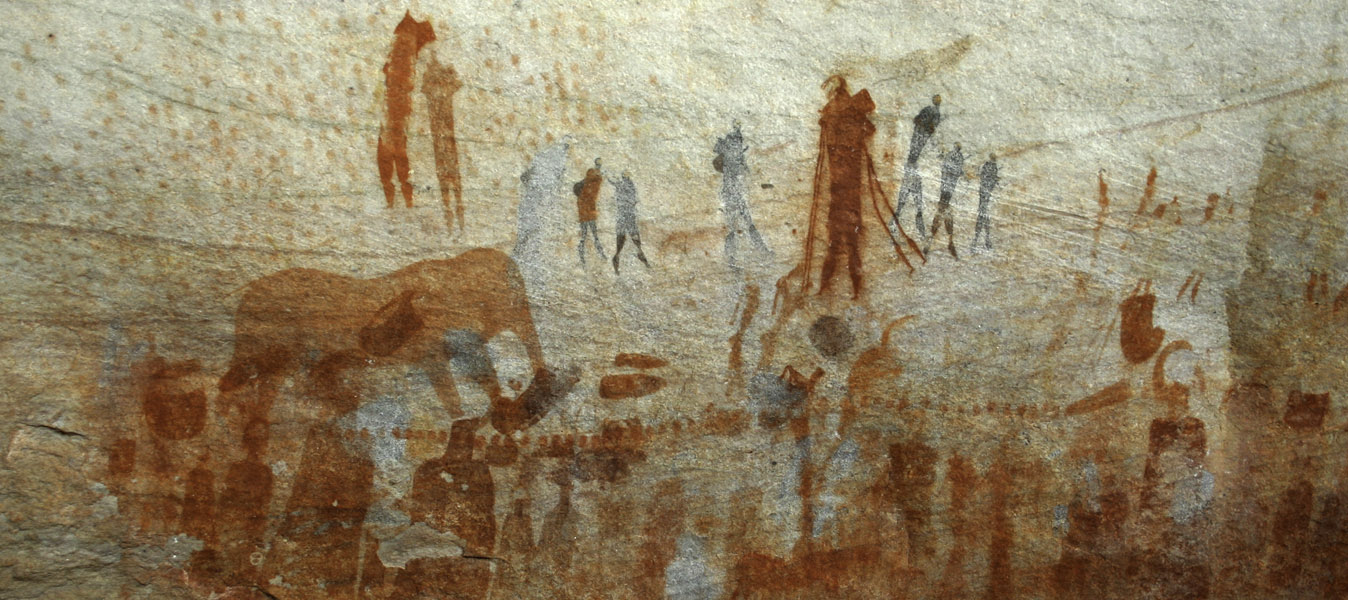
When I am immersed in the deep meditative process of painting, I feel increasingly connected with my true eternal being. It almost feels like it’s not me painting but my spirit. In my most inspired and transcendental moments of the painting process it is my eternal spirit which guides me. In these moments there is no chasm between my conscious and my unconscious. Being in this state makes me think of some of the earliest prehistoric civilisations. Back then, the world was a much less complex and complicated place to the one it is today. Especially the time before words. I think of the San rock art paintings found across parts of Southern Africa and Aboriginal rock art paintings from Australia. The San people of Southern Africa and the Aboriginal people of Australia fascinate me greatly since their culture goes back tens of thousands of years. But what’s more, their culture is profoundly spiritual and this can be seen clearly in their art; their oneness with the world and nature, and their high levels of awareness. In many ways it’s their lives and methods of working which inspire me just as much as the work itself, because of their deep spirituality.


san-rock-art-cederberg-south-africa

San rock art – Cederberg, South Africa


One thing that the San and Aboriginal people have in common is that much of their land is vast desert. For many people such a terrain is inhospitable and lonely; especially if one is very separated from themselves. In this state of being such a person would very quickly find the desert intolerable and isolating. It’s almost like the desert richly rewards those who are spiritually connected (and by extension at one with it) and makes life a living hell for those who are detached from their eternal soul. With a higher state of consciousness the desert begins to truly reveal itself. In a sense my paintings are like deserts, which only become alive as one becomes more connected with themselves. And this is sometimes a great problem I encounter as to some people my paintings appear quite alien and foreign to them. I fully expect this and it does not offend me when people openly tell me that they don’t understand them. My paintings are interactions with the spiritual world and these interactions take place during the painting process. One could then argue that in order to get to the core of my work it would be essential to observe me as I paint. You can do this and you can even do this without me being aware of being observed. But to really understand the processes would involve fully connecting with all levels of my consciousness.


image

Wadjina Aboriginal rock art – Kimberly, Australia


I find that the paintings of the American artist Don Van Vleit (better known as Captain Beefheart) have much in common with the art of those early prehistoric civilisations. What’s also interesting is that when Van Vleit retired from making music and dedicated himself fully to painting in the early 1980s, he lived in a remote part of Northern California. And by immersing oneself in his work one can see the deep connection. Like the San and Aboriginal people, his true spiritual home was in nature. The place where his true being could glow white hot. Take him out of this environment and plop him in a studio in New York, London or Berlin, he would be like a flower without water.


image

                                        Crepe And Black Lamps (1986) by Don Van Vliet


I like to call my painting technique Spiritual Coding. In the digital world in which we currently live the word coding is used a lot. This of course refers to computer programming. A language for this age. And when I look at my paintings I am also using my own language. A language created through interacting with my ‘inner being’ and this I call Spiritual Coding. My paintings are in many ways remnants of this. Tangible photographs almost of my eternal spirit. Although they don’t capture the processes of my work they are residue formations of intense spiritual journeying and internal searching.


image

A Winter In Crowland (2008) by Nicholas Peart


Remaining on the subject of Spiritual Coding, symbols are important in my paintings. The American artist Philip Guston created his own unique symbols, language and world. Even if his world was very bleak and one of hardcore isolation. A dystopian spirituality. But through connecting with his paintings one can see that he embraced this insurmountable at-sea pain and isolation. Works offering no hope or salvation. For the majority of people (including myself) such a level of alienation would be intolerable and very difficult to embrace and accept. But it’s amazing how secure Guston seems to be in this vacuum. And that’s what makes his paintings very striking, visceral and distinct. They are pure undiluted archives of raw pain. I think of Van Gogh and how, even though he was often in the grip of profound sadness and anxiety, he produced some of the most beautiful paintings of all time. Yet Guston’s paintings are anything but beautiful. He was not looking to turn pain into beauty. He was more interested in turning pain into more pain. The painter Francis Bacon is the closest artist to Guston in this respect. Merciless insatiable masochists. Perhaps there is absolutely nothing of the spiritual in Guston’s work and he was always an enigma to himself but his comfort in the most acute thresholds of pain and loneliness is epic.


image

Painter’s Form II (1978) by Philip Guston


Luck and chance play enormous roles in my paintings. My soul brothers here are the painters Jackson Pollock and Francis Bacon. And like them I never make sketches or engage in preliminary studies. And why would I? After all this is completely against my way of working and, more significantly, my raison d’être. I can’t plan what I am going to paint. If luck and chance weren’t integral parts of the painting process, I don’t think I would ever paint. Uncertainty is extremely important.


image

                                                                           Jackson Pollock 


The work of both Jackson Pollock and Francis Bacon have their own unique and idiosyncratic qualities yet what unites them is their spontaneity. But there’s a more important quality which unites them and that is their energy. Wild, untamed, animal energy. Free of even the most minute inhibition. The primal way Pollock dripped paint and the ferocious and feral way Bacon attacked the canvas. Almost like a serial axe murderer taking a swing at his next victim. I can relate to this (not the axe murderer) since in much of my work when I first apply paint to the canvas either with a brush or a palate knife I literally lunge at it and let my inner self do the work. And sometimes I get so exhausted by the end of this process I need to rest.


image

                                                                            Francis Bacon


I am still on my journey of self discovery. And as explained earlier in the text, I am just as conditioned and influenced by my external environment as any other being yet when I am painting I am far away from this external environment since painting enables me to get closer to the truth; of myself and the world


by Nicholas Peart

23rd May 2016

(All rights reserved)


My work can be found by visiting my website; http://www.nicholaspeart.com