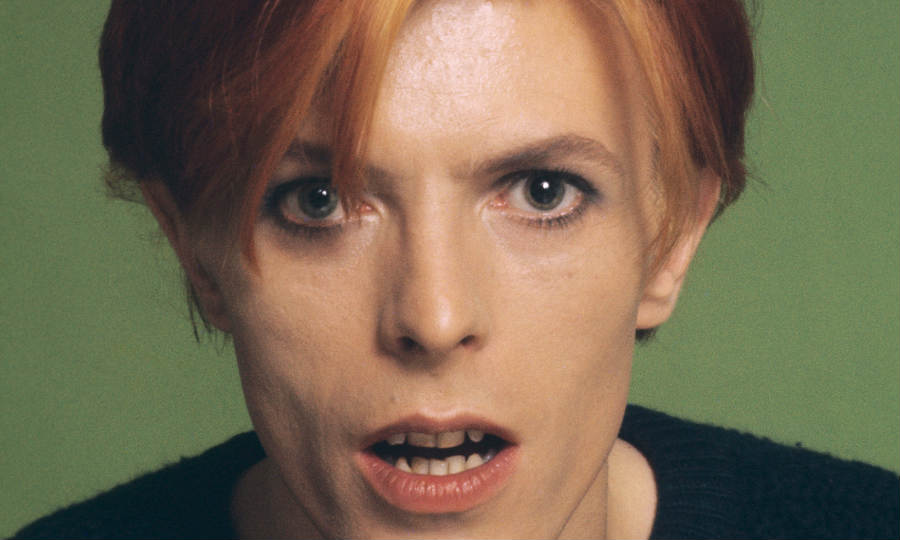
DAVID BOWIE: A Reflection And Tribute

Today marks the 10th anniversary since David Bowie passed away. I still remember that day clearly. I was in South Africa watching the news on the TV and seeing the wealth of tributes. It was a shock. He kept everything very private. In fact, I was thinking of him just a few months before he died and I was wondering when he would, if ever, decide to go on tour again? His last world tour was more than a decade before that point and I foolishly turned down the chance to see him play at Wembley Arena back in 2003. 2003-4 would be the last time he properly toured and save for a few sporadic and brief live appearances, he would never tour again. 

Just a couple of days after he died on January 12th 2016, I wrote a piece entitled, “The Death Of David Bowie, The Future And 3D Printing”. This would also be my very first blog post for my newly established blog website that was originally called The Slider.  In this post I not only reflect just on David himself, but also the wider context of the future and new and emerging technological developments. For example, I talk about the concept of The Singularity and the inventor and futurist Ray Kurzweil’s prediction that in 2045 artificial intelligence will surpass human intelligence. Back then the topic of AI was not on everybody’s lips like it is today.

And what has all this got to do with David Bowie, you may ask? For me, it is all very relevant when I think of him. Aside from being a great artist who changed the face of pop music and expanded the parameters regarding the possibilities of what being a mainstream pop artist can be, he also had remarkable prescience. As well as embracing and harassing change (as opposed to fighting it), he had a unique ability to see far into the future and had a pioneering spirit. A great example of this is his interview with Jeremy Paxman from 1999. Back then we were still in its early days of the evolution of the internet. There was a lot of excitement and hype over the internet. Naturally, there were believers and sceptics. The doubting Thomases saw the internet as just a fad whereas the believers saw the net’s huge potential. Bowie was definitely in the latter camp, but he wasn’t a blind and blinkered believer. He was one of the first artists to release his own music online and he saw the great possibilities of the internet and how it would shape our lives. Yet he could also foresee the negative impacts it would have on humanity. In the interview, Paxman remarks that the internet is “just a tool”, although I suspect he may have been playing devil’s advocate and trying to gauge Bowie’s response.

It is a popular theory to say that Bowie planned his death all along and that he checked out at the perfect time before the whole world turned to custard. It is a compelling theory, but I don’t buy it. I don’t buy it, because I firmly believe that Bowie loved life for all its ups and downs. Yes, he may have been highly secretive about his illness and meticulously planned his final album, but if he had the chance he would have given anything to live longer on this planet. In fact, I recall reading somewhere after he died that one of the things that made him the most sad about knowing that he was going to go so soon was knowing that he wouldn’t be around to see his young daughter grow. Moreover, I also seem to remember reading a tweet by his son Duncan, a few years after his death, where he said that if only David had not smoked so much throughout most of his life there would have been a good chance he would still be around. So no, I am not one of those folk who thinks that he “died at the right time”. 

On the day he passed away and the days after his death, I watched people who grew up with Bowie as far back as those Ziggy Stardust days being absolutely heartbroken; as if they had lost a beloved soulmate. I was very shocked and saddened when he died. I love his music and spent a lot of time listening to his records. However, I did not grow up with his music from the early days of his career. It was the Ziggy Stardust period that was the tipping point and that finally turned him into a star after several years of struggling and false dawns. Those veteran fans remember when Bowie appeared on Top Of The Pops in the early 70s playing his song Starman with a blue guitar. For them, it was like witnessing some exotic and androgynous extra-terrestrial being. In those days long before the internet, social media and hyperconnectivity, witnessing this on the TV was exciting and a blast of colour in a colourless world. Throughout most of the 70s Bowie was firing on all cylinders creatively and almost every album he released during this period was excellent. He took risks and never rested on his laurels like some of his glam rock contemporaries and he knew when the time was right to wrap up the Ziggy phase of his music career. 

Sometimes I ask myself, if Bowie were starting out today would he strive to make it as a pop star or even go into the arts full stop? Personally, I feel that he was more than just a pop star and he didn’t have all his huevos in one basket. I think one of the most important things to deduce about him, as I already explained earlier, is that he had a pioneering spirit. He embraced change and new and emerging landscapes. He was terminally curious and open minded. When Bowie’s career first really took off in the early 70s, the music industry was still growing and there was still a lot of low hanging fruit in terms of creative musical experimentation and what could be achieved. Even though there were wild and unconventional musicians that existed before Bowie first emerged, one could argue that Bowie was the first mainstream pop star who created the template for all future popstars regarding what they could be. Thus in the same way that The Beatles were probably the most influential band of all time, it would not be unreasonable to argue that David Bowie was the most influential pop star of all time. 

By Nicholas Peart

10th January 2026

©All Rights Reserved  

The Death Of David Bowie, The Future and 3D Printing

This is a piece I wrote on January 12th 2016, a couple of days after David Bowie died

I’ve been thinking about nothing but David Bowie these last couple of days. So many of his songs are playing in my head; Sound and Vision and Heroes being the most popular. Heroes always makes me pause and be deeply pensive. There’s something majestic and timeless about that song. Like millions of others around the world I am saddened and shocked by his early death. I had no idea he was so unwell even though I was a little suspicious that something was not right regarding his sporadic movements over the last decade. Another clue that perhaps all was not well was from watching the video to the 2013 song Where Are We Now? from his penultimate album The Next Day. It’s a beautiful, haunting and deeply reflective song. More importantly, it seems to me like he’s seriously questioning his own mortality. When I initially saw the video to that song I could see real pain in his face and I began to feel very sad for him.

In my selfish state of mind I was hoping that he would tour again but I can now kiss that option goodbye. I remember one day back in 2003 pondering on whether to see him live at Wembley Arena. The Dandy Warhols were confirmed as his support band. That day I was at the Stargreen ticket office on Argyll Street in Oxford Circus and the lady at the desk told me they still had tickets left for the show but I foolishly declined on the grounds that I thought the £65 ticket price was too high. As the years went by and I got more deeply into Bowie’s music the desire to see him live increased exponentially but that was never to be as, after a heart attack in 2004, he retreated into splendid isolation with his beautiful wife Iman and the rest of his family. I have seen his compadre Iggy Pop live many times (and I even saw his other soul brother Lou Reed live once but he was dreadful and in a foul mood that day, which was a huge disappointment for me) and as special as Iggy will always be to me, I still regret not taking that unique opportunity to see David live. But life goes on man.

Taking a slight tangent, I often wonder what kind of people the people born today and in the last few years will grow up to be? I don’t know what the world is going to be like in 2020 let alone in 2030 or 2050. I humbly predict that by 2100 there will be no purely organic/biological human life still standing. I think by then all humans will be at least trans-human (half human/half machine). If the inventor and futurist Ray Kurzweil’s 2045 prediction for ‘The Singularity’ comes true then by 2050 artificial intelligence will be on par if not far more advanced than human intelligence. The question now is will this advanced level of AI further benefit our lives? Perhaps we can augment our bodies with AI technology in order to be compatible with AI itself as far as logical/mechanical intelligence is concerned? Or will it have dystopian consequences and wipe us all out? Some prominent figures such as the scientist Stephan Hawking and Tesla founder Elon Musk have already publicly expressed much concern that a situation like the latter may very well happen and Musk has even gone as far as to spend a large chunk of his vast fortune on AI research.

By the beginning of the 2020s I predict that 3D printing will slowly start to become mainstream. Currently 3D printing machines are the preserve of scientists and a smattering of ‘geeks’, innovators and early adapters. It is also still rather expensive to acquire a 3D printer but with time costs will decrease and the technology will only get more advanced. I think 3D printing will be the biggest thing to shape our lives since the Internet. 3D printing now is what the Internet was back in 1994/5. Give it time.

Now back to the subject of David Bowie, there is an interview he did with Jeremy Paxman in 2000. At one point in the interview they were talking about the Internet and what it meant back then. Paxman seemed to have little belief in the power of the Internet and stated that he thought it was just a ‘tool’ whereas David disagreed and saw it as potentially a much bigger and larger force (both good and bad) to what it currently was. In fact, Bowie was one of the first major artists to utilise the Internet as a platform for his music when it had just become mainstream back in 1997. Now let’s fast forward to 2016. The Internet plays an enormous role in our lives. It has also disrupted many industries in the process. The one that really springs to mind is the music industry. Many will remember the Napster saga involving members of Metallica back in 1999 but how many back then could have foreseen the colossal impact that illegal downloading would have on an entire industry worth billions of dollars? For many creative people; especially writers, musicians and digital photographers, this is now the age of Free Content. Yet what the Internet has enabled is an instant connectivity and strong social networking facility with an enormous and growing number of people around the globe, which was not possible before.


David Bowie talks about the Internet with Jeremy Paxman (2000)


Back to 3D printing. The main casualty of this emerging technology is going to be the mass manufacturing industry. “Made In China” will become a thing of the past as every household becomes a factory. Big mass manufacturing businesses like IKEA will either have to adapt in the face of this growing technology or potentially face serious challenges to their current business modal. I believe that the next 5-15 years are going to be very interesting.

For more information on this I highly recommend that you purchase a copy of The Curve by Nicholas Lovell. It is a riveting and incredibly insightful and enlightening book which is very ahead of its time. Furthermore, it is an indispensable book to have with many helpful and practical solutions if you are a creative person struggling to make a living in a world of free content.


by Nicholas Peart

12th January 2016
London


(All rights reserved)