
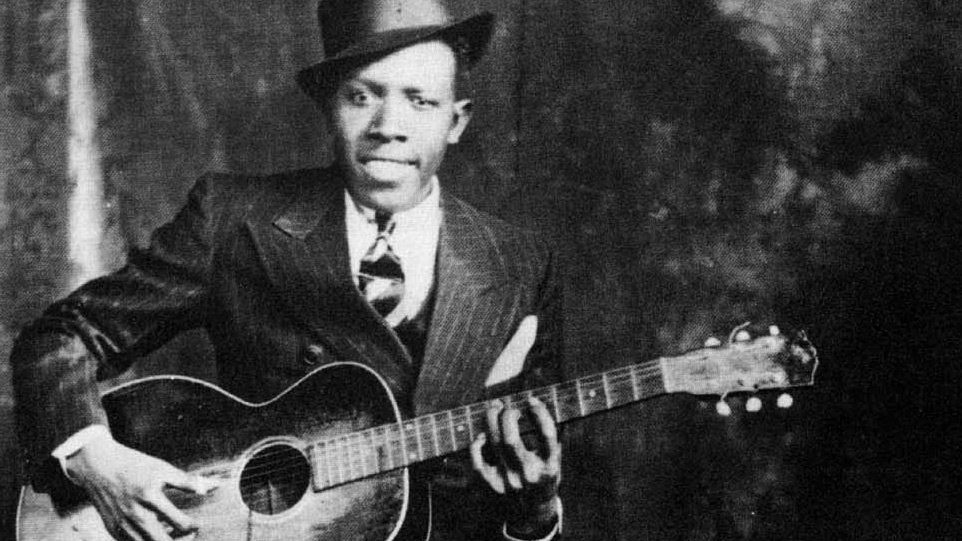
By far the most well known of the great Mississippi Delta bluesmen is Robert Johnson. The Paganini of the Blues. The one who was said to have sold his soul to the devil in return for being able to play like no one else. He was truly a one off and isn’t called the King of the Delta Blues for nothing. I first listened to a compilation of his meagre recordings when I was 19 and I was blown away by them; by the magic and the mystic of these rudimentary and raw records as much as by his guitar skills. When Keith Richards from the Rolling Stones first heard one of his songs in the very early 1960s while living in a cold flat with fellow bandmate Brian Jones (before the Stones hit the big time), he famously asked who the other guitar player was? That’s how off the wall his guitar playing was.
Only two photographs survive and certainly no video footage of the man himself, although there are some who claim that there exists a very rare 30 second film footage of him. If anybody wants to know more about the man, especially from those who knew him, I highly recommend trying to track down a copy of the fascinating 1991 documentary produced by the musician John Hammond called The Search For Robert Johnson, which contains interview footage from his former lovers and some of his contemporary Mississippi bluesmen like Johnny Shins and David ‘Honeyboy’ Edwards. The latter is particularly instrumental in the Robert Johnson story especially since he happened to be there on that fateful night when Robert was poisoned by the partner of one of the women he was sleeping around with. His whiskey was laced with strychnine and he died a slow and painful death. Eyewitnesses at the scene including Honeyboy recalled that he was in so much pain he was howling like a dog all night. Raw Wild West stuff. It is difficult to imagine one of Mumfords & Sons getting into such a pickle.
Unlike Robert, Honeyboy went on to live a very long life. He died in 2010 at the age of 95. I was fortunate enough to have watched and met the man on two occasions. Firstly at an Irish Centre in Leeds in 2007 and secondly at the 100 Club in central London in 2008. Within the paradigm of the great original Delta bluesmen he is no Van Gogh or Gaugain like Robert or Son House, but he is a solid, special and integral component of that red hot time. When I watched Honeyboy in 2007, he was 92, but no slouch. When he was not sliding away on the expensive Martin guitar he was playing, he was knocking back bottles of Becks.

Yours truly with David ‘Honeyboy’ Edwards in 2007
But let’s go back to the roots of that great time of those original Delta blues axemen. Where did it all start? Many blues aficionados point to Charley Patton as the grandfather of that whole original Mississippi Delta blues scene. Patton was born in Hinds County, Mississippi in 1891 (although some claim he could’ve been born as early as 1881). When Charley was a young boy his family moved to the Dockery Plantation cotton farm in the wilder northern part of the Mississippi Delta looking for better work opportunities. While his parents almost broke their backs working on the farm, ol’ Charley boy didn’t care too much for all that gruelling cotton picking. Instead, he dedicated his time to developing the Delta blues and becoming one kick ass guitar player. If he’d have tried to please his parents instead, a great void would have remained. Shit, if everybody tried to please their folks there would be little to no inspiration to draw from and a tremendous cultural poverty would prevail.

Charley Patton
Charley already lived like a rock n roll animal decades before the likes of Jim Morrison. He lived the quintessential hard drinking, hard livin’ rough and tumble life. A serial womaniser too, he married and had affairs about as many times as most people walk into their living rooms to crash on the sofa after a hard day at the office. If you look at the only photo of him that seems to exist, it is not the face of a man you could comfortably introduce to your mum and dad. You don’t need to be a psychic or know anything about the man’s personal history by looking at that photo to deduce that he was one ‘don’t fuck with me’ son of a gun. It also appears that he was an interesting mix of African American and Cherokee (or possibly even Mexican) heritage, which was unusual as most of the Mississippi bluesmen of that time were African American.
Within the whirlwind of his brief 40 years on this planet, he was popular and he played at many parties and events for both a black and white audience. He performed frequently at Dockery Plantation farm where he developed his own style. Even though Patton today is widely seen as the father of the Delta Blues he was highly influenced and tutored by a local musician called Henry Sloan who was one of the very early proto Delta bluesman. He was born in Mississippi in 1870 and died in 1948 leaving behind no recordings. Perhaps one could deduce that what the 13th century Italian artist Cimabue was to the development of the Italian Renaissance, Sloan was to the development of the Mississippi Delta blues. And in the context of the Italian Renaissance, Patton could be compared to Cimabue’s most gifted student Giotto.
As Patton performed at Dockery and other local plantations he got to know the legendary bluesman Willie Brown (more on him later). Patton also knew several younger bluesmen like Robert Johnson, Tommy Johnson and Howlin’ Wolf and just as Henry Sloan taught him, he mentored those younger Turks of the Mississippi Delta Blues. Patton was quite a versatile player and could play old hillbilly and country songs as well as traditional ballads and other styles. He was like a living jukebox who had a natural knack for whacking out almost anything from his battered six string machine. That may also explain why he was such a big draw at various events. He could play his own raw and authentic style of deep blues yet at the same time he could also give the people what they wanted.
My own introduction to Patton came when I was 20. Having spent most of the previous year obsessed with Robert Johnson, I naturally investigated further, checking out other great blues artists. Via a secondhand four CD compilation of miscellaneous blues performers which I purchased from Notting Hill Tape and Exchange for three quid, I discovered the Patton song High Sheriff Blues. I later checked out his other songs, but it was this particular song, which made a big impression on me. His deep gravelly whisky soaked voice hypnotised me. It was so unpolished, almost, dare I say, verging on rank. This was not the voice of an angel. This was the voice of a fucking criminal. If he came back from the dead to perform that song on the X Factor show, he would never have made the stage. He would’ve already been arrested and given a good hiding by one of the burley security guards at the entrance.
Willie Brown was a friend of Charley’s. Yet beyond this friendship he is one of the most mysterious of the early Delta bluesmen as well as one of the most influential. He is mentioned by Robert Johnson in his famous song Cross Road Blues in the line, ‘my friend Willie Brown’. I myself know very little about the man, but I am fascinated by his myth and legend in the history of the Mississippi Delta Blues. I see him more as a Henry Sloan figure, yet unlike Sloan who left behind no recordings, Brown did cut six songs for Paramount Records in 1930, which were released as three separate records on shellac 78rpm discs. Of those three records, only the Paramount 13090 two sided recording “M & O Blues” / “Future Blues” is known to have survived of which only three copies of that record are declared to be in existence (making it one of the rarest records in the entire history of recorded music). The other recordings are rumoured to have been destroyed in a fire. Alan Lomax, the son of the groundbreaking father and son field recording John and Alan Lomax duo, claims to have recorded that same Willie Brown in Arkansas back in 1942. Yet some dispute as to whether the recording he cut for Lomax, “Make Me a Pallet on the Floor”, was actually by that same Willie Brown who cut those early records for Paramount 12 years previously.
What is important though is Brown’s association with Patton, Johnson and the other legendary bluesman Son House. Willie Brown and Son House were very close. They were both born at the turn of the 20th century, both were musical partners who each cut recordings for Paramount (along with Patton) in 1930, and, more importantly, both musicians influenced Robert Johnson. Yet it was Son House, more than Brown, who was probably the biggest influence on Robert.
Eddie James “Son” House Jr was born in 1902 in a small Mississippi hamlet called Lyon situated to the north of Clarksdale, a town deeply rooted in the history of the Delta Blues. It was the birthplace of Willie Brown and John Lee Hooker. 1950’s Rock n Roll pioneer Ike Turner and the legendary early soul singer Sam Cooke also came from Clarksdale as well as numerous other musicians.
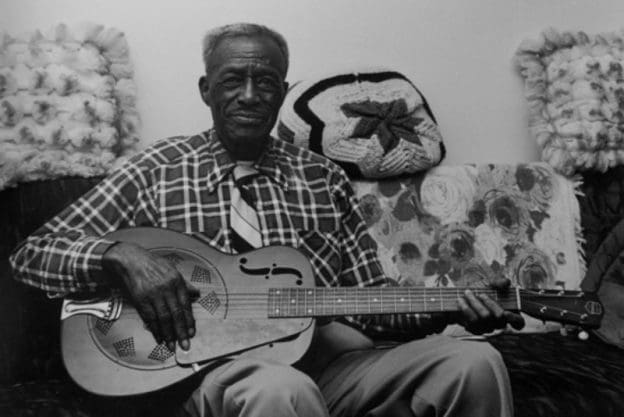
Son House
The interesting thing about Son House was that in his early years he hated the blues and was passionate about religion instead. He found that the blues, being the music of the devil and all that, went against his religious beliefs. At the age of 15 he was living in New Orleans and had started to preach sermons. He also married when he was 19 to an older woman called Carrie Martin. They then moved to Carrie’s hometown of Centreville in Louisiana where her father owned a farm. Most of Son House’s time over there was spent with her father working on his farm. It was grilling work under a swampy Deep South sky and after a couple of years, feeling he was being taken advantage of, he split from Centreville leaving behind Carrie, her father and his farm. House remembered of that time, ”I left her hanging on the gatepost, with her father tellin’ me to come back so we could plow some more.”
House, like his blues brother Charley, hated farm work and most forms of manual labour. He found a way out of it by accepting a position as a paid pastor, initially in the Baptist Church and then later in the Colored Methodist Episcopal Church. However during this period he began drinking and womanising. This conflicted greatly with his role as a pastor (no shit!!) and he eventually left the church.
In 1927, when Son House was 25, he threw himself into the Devil’s music he’d long tried to suppress. He began frequenting and playing at local Mississippi juke joints. Juke joints were rough and raw wooden, shack-like barrelhouse dens where music, dancing, drinking and gambling occurred. They were places where cotton plantation workers and other menial labourers could relax and wind down after a hard day’s work. These juke joints, scattered around the Mississippi Delta, were instrumental in the development of the Mississippi Delta Blues. It was at these juke joints that the younger generation of blues musicians like Robert Johnson, Howlin’ Wolf and Muddy Waters would watch Son House and his buddies Willie Brown and Charley Patton perform. Muddy Waters, just as much as Johnson, idolised Son House and he would try to go to almost every juke joint where House was playing.
One night when House was playing at a local juke joint around 1927/8, someone in the crowd brandished a pistol and went on a shooting spree. One of the bullets hit House in the leg. Son House swiftly reacted with his own weapon and shot the man dead on the spot. House was sentenced to 15 years at the Mississippi State Penitentiary. He served only two years of his sentence. His early release was the result of the intervention of an influential high ranking white plantation owner whom his family worked for. After his release, he left Clarksdale and caught a train to the small Mississippi town of Lula, 16 miles north of Clarksdale. Here he hooked up with fellow outcast Charley Patton who had already been kicked off Dockery Plantation, I imagine, for probably spending too much time creating one helluva racket on his six string machine, drinking and chasing women and not enough time being a good diligent cotton picker. Patton was with his partner in crime Willie Brown who by then had both developed quite a reputation on the local Mississippi blues juke joint circuit. All three of them would eventually play together and go on to cut records for Paramount.
This brings us now to Robert Johnson. The most legendary and famous of all the Delta bluesmen. For a long time the little I’d actually read and discovered about his life was either via the scant liner notes in the copies of his recordings I purchased and via well trodden anecdotes. There is so much mythology around the man. This is only fuelled by the fact that aside from the few recordings he left behind and just two confirmed photographs, almost all other information extracted about him has come from people who were associated and close to him. It doesn’t help that he died in 1938, before the second world war and at a time when mass media communications were far less developed than what they are today.
Recently though, I discovered a book called Escaping The Delta: Robert Johnson And The Invention Of The Blues by Elijah Wald. This is probably one of the best books out there on Robert Johnson that does a commendable job on hacking through the dense thickets of myths around his life and getting to some of the more mundane facts. Chapter 6 of Wald’s book, A Life Remembered, contains a lot of this information. Robert Johnson was an illegitimate child born in a small Mississippi town called Hazlehurst (about 30 miles from the capital, Jackson) on May 8th 1911 (although this date may be incorrect). His biological mother was married to a man called Charles Dodds who was a relatively wealthy landowner and furniture maker. Following a clash with some white landowners, Dodds was forced by a lynch mob to leave Hazlehurst. He had now started calling himself Charles Spencer. After leaving Hazlehurst, Robert spent 8-9 years in Memphis. It was in this city that he developed his love for blues music and the popular music of the time. He later returned to Mississippi to a small town on the Mississippi Delta. At school he had a friend named Willie Coffee who remembered Robert from that time for having a knack for playing the harmonica and the jews harp…
“Me and him and lots more of us boys, we played hooky and get up under the church. They had a little stand up there and we’d get up under there…and he’d blow his harp and pick his old jew’s harp for us and sing under there. We’d play hooky until the teacher would find our variety, and she’d make us come in and give us five lashes.”
On February 1929, before Robert had turned 18, he married fourteen year old Virginia Travis, who shortly died in childbirth. Some argue that this tragic incident had a deeply traumatic effect on Robert and was the catalyst for his life of rambling. During this time Robert crossed paths with Son House and Willie Brown who would both have a huge effect on him. I’d already been aware of the influence Son House had on Robert when I purchased some cheap double CD comp of all his recordings. I was also familiar with the name Wille Brown as I heard his name mentioned in his song Cross Road Blues (‘You can run, you can run, tell my friend Willie Brown’). In the scant liner notes of those recordings, there were quotes from Son House directed at Robert. Most of these quotes were from Son House telling Robert to quit making such a racket on that guitar. Even though in those early days he was a talented harmonica player, Robert was a very rudimentary guitar player and would drive people nuts in the juke joints. As Son House recalled…
He (Robert) used to play harmonica when he was ‘round about fifteen, sixteen years old. He could blow harmonica pretty good. Everybody liked it. But he just got the idea that he wanted to play guitar….He used to sit down between me and Willie. See, Willie was my commenter, you know, he’d second all the time, he’d never lead. I’d do the lead. And we’d be sitting about this distance apart, and Robert would come and sit right on the floor, with his legs up like that, between us.
So when we’d get to a rest period or something, we’d set the guitars up and go out – it would be hot in the summertime, so we’d go out and get in the cool, cool off some. While we’re out, Robert, he’d get the guitar and go bamming with it, you know? Just keeping noise, and the people didn’t like that. They’d come out and they’d tell us, “Why don’t you or Willie or one go in there and stop that boy? He’s driving everybody nuts.”
I’d go in there and get to him. I’d say, “Robert,” I’d say, “Don’t do that, you’ll drive the people home.” I’d say, “You can blow the harmonica, they’d like to hear that. Get on that.” He wouldn’t pay me too much attention, but he’d let the guitar alone. I’d say, “You stop that. Supposing if you’d break a string or something? This time of night, we don’t know no place where we can get a string.” I’d say, “Just leave the guitars alone.”
But quick as we’re out there again, and get to laughing and talking and drinking, here we’d hear the guitar again, making all kinds of tunes: “BLOO-WAH, BOOM-WAH” – a dog wouldn’t wanting to hear it!
Then one day Robert disappeared for many months. During that time, he got married to a woman named Callie Craft and performed frequently in various juke joints and lumber camps. When he returned, he persuaded Son House and Willie to let him play at a small joint they were both playing at. Initially, they were both very sceptical but they eventually caved in. When Robert got on the stage he blew everybody away with his playing. As impressed as Son House was, he was concerned that Robert was by that stage accelerating head on into the musician’s life and embracing the liquor, women and drugs that came with it. Whenever Son House tried to warn Robert of the dangers of this lifestyle, Robert would simply shrug and laugh it off.
From 1931 until his death in 1938, he led an almost nomadic existence travelling across the country and leaving all the people he encountered dazzled and spellbound by his off the wall guitar playing. One thing I immediately notice when I study those two photos of Robert are his abnormally long fingers. Johnny Shines, who sometimes travelled with Robert during those final seven years of his life, remembered, ‘His sharp, slender fingers fluttered like a trapped bird.’
The bluesman Robert Lockwood Jr, born just a few years after Robert in 1915, learned to play guitar directly from Robert Johnson. Robert lived with Lockwood’s mother off and on for ten years. Lockwood was born in the same year as Honeyboy Edwards and also lived for a long time into his 90s. On a two week trip to New York City back in September 2006, I discovered that Lockwood was playing one evening at a small venue in the city of Cleveland in Ohio during my stay. He was 91 at the time and along with Honeyboy one of the very few remaining original Mississippi Delta Bluesmen still alive at the time. Unfortunately, I passed on the opportunity to see him on the grounds that I didn’t have enough time on this trip and that the greyhound bus from NYC to Cleveland was both too long and too expensive. I did however make up for this lost opportunity by seeing Honeyboy in concert twice over the following two years.
One of Lockwood’s memories of Robert Johnson was how isolated and restless he was. He never seemed to want to get too close to anyone and would always be on the move;
“Robert was a strange dude. I guess you could say he was a loner and a drifter.”
Johnny Shines, during his time spent with Robert, remembered that in addition to his incredible musical skills, he also had a strong aura and magnetic appeal;
“…Robert was a fellow very well liked by women and men, even though a lot of men resented his power or his influence over women-people. They resented that very much, but, as a human being, they still liked him because they couldn’t help but like him, for Robert just had that power to draw.”
Personally, I can fully believe this. Whenever I look at the photo of Robert looking incredibly dapper and handsome with his guitar and pinstripe suite, there is something striking and hypnotic about him that one just doesn’t easily forget. He was not some rough and tumble Charley Patton or Son House character. There was an elegance and fineness about him. Shines also remembered Robert as being quite a versatile musician who was up to date with all the latest musical styles and sounds. In this sense that is what separated him from the older Delta blues players such as Patton and House. Aside from the blues, Robert was also able to play anything from hillbilly songs to Bing Crosby hits:
“He did anything that he heard over the radio…When I say anything, I mean anything – popular songs, ballads, blues, anything. It didn’t make him no difference what it was. If he liked it, he did it. He’d be sitting there listening to the radio – and you wouldn’t even know he was paying attention to it – and later that evening maybe, he’d walk out on the streets and play the same songs that were played on the radio.”
This was all quite a revelation to me. For a long time, I thought Robert was a pure bluesman and that he didn’t play anything else beyond the small collection of recordings he left behind. That’s how much I fell for this kind of a myth. I could not envisage this other side to him.
However, it is those recordings that he left behind that I prefer to remember him for. As they are an astonishing set of recordings. I think that I would be deeply disappointed to hear Robert hollering some hillbilly tune. The story of these recordings begins in 1936, just two years before he died. At some point during that year, Robert walked into a furniture shop, H. C. Spier, in the city of Jackson. As well as selling furniture, Spier also sold phonographs and records in addition to being a talent scout of note in the area. Most of the Mississippi Delta blues musicians had got their recording deals via him. When Spier first heard Robert he was impressed with his skills and connected him with a guy called Ernie Oertle, who was an agent for the ARC company and who booked Robert in for a session at the Gunter Hotel in San Antonio, Texas in November of that year. The sessions were conducted over three days on November 23, 26 and 27 where he recorded a total of sixteen songs – recording two takes of each song. Of Johnson’s total recorded output left behind, there are several songs that were recorded twice.
The sessions Robert did in November 1936 yielded one modest hit, “Terraplane Blues”, which sold reasonably well. When Son House, who had initially in those earlier days so doubted Robert and his guitar skills, first heard that song he was knocked out by how good it was;
“Believe the first one I heard was ‘Terraplane Blues.’ Jesus, it was good. We all admired it. Said, ‘That boy is really going places.’”
The sales of those recordings from the November sessions were respectable enough, that ARC invited Robert back in June 1937 for another session this time in Dallas. For those sessions Robert recorded a further thirteen songs. Unfortunately, Robert’s life would soon be cut abruptly short. His reputation as a ladies’ man would eventually have grave consequences. As Shines recalled…
“Women, to Robert, were like motel or hotel rooms. Even if he used them repeatedly he left them where he found them. Heaven help him, he was not discriminating. Probably a bit like Christ, he loved them all. He preferred older women in their thirties over the younger ones, because the older ones would pay his way.”
Even though many women were attracted to Robert, it was natural that some men were going to be jealous. As Shines further adds…
“If women pull at a musician, naturally men’s gonna be jealous of it. Because every man wants to be king…and if he’s not king and somebody else seems to be on the throne, then he wants to get him down. It don’t take very much to set people off when you’re being worshipped by women. And so naturally we got into a hell of a lot of trouble.”
This last paragraph from Shines pretty much gets to the heart regarding the reason why Robert was poisoned on that fateful night at a small country joint concert near Three Folks in Greenwood, Mississippi in August 1938, which he was playing with Honeyboy Edwards. According to Edwards, the man who ran the joint was under the impression that Robert was sleeping around with his wife. So, at the show he gave Robert some whiskey to drink laced with strychnine, which he duly accepted. In a sense, Robert was still at this point rather naive. As I mentioned earlier, Son House would invariably warn Robert to be careful regarding the lifestyle he was living. He often told him not to accept any drink that was given to him as he may not know what may be in it. Sometimes House would be very cross with Robert when he behaved like this and would duly push the offered bottle of whiskey away from him. Robert would get angry and say, “Man, don’t ever knock a bottle of whiskey out of my hand.”
But Robert paid a huge price in the end. There was nothing romantic or glamorous about the way he died. He died a very painful and undignified death and was still just a young adult of only 27 – arguably one of the first members to join that club long before Jim, Jimmy, Brian and Kurt. Son House, born almost a decade before Robert, lived well into his 80s passing away in October 1988.
By Nicholas Peart
Published 16th May 2024
(Written 2016/2024)
(c)All Rights Reserved
.
FURTHER READING:
Escaping The Delta: Robert Johnson and the Invention of the Blues by Elijah Wald
Searching For Robert Johnson by Peter Guralnick
VIDEOS:
The Search For Robert Johnson – directed and produced by Chris Hunt and narrated by John Hammond
RECORDINGS:
The Complete Recordings – Robert Johnson
Back To The Crossorads: The Roots Of Robert Johnson


 Latitude Post