THE KOSOVO DIARIES (Part One) – PEJA, DEČANI and PRISTINA

Day One: Mon 25th September 2017
Travelling to Peja

Yesterday I arrived in the provincial Montenegrin mountain town of Berane at 7pm. 12 hours earlier I departed the town of Mostar in Bosnia and Herzegovina for the city of Podgorica, the capital of Montenegro. I get into Pod’, or Titograd as it used to be called at 1.30pm. My connecting bus to Berane departs in two hours. Perhaps I am mistaken but Podgorica is not a pretty place. Knackered Communist era living blocks surround the bus station and even the bus station itself has barely changed since about 1974. I think Titograd is a more fitting name.

I find a modern pizzeria restaurant about 100 metres outside of the bus station from where I take the opportunity to use the bathroom (immaculately clean I could eat my capriccioso pizza off the ceramic floor – yet the lights go off when I am already doing the business) and the free wi-fi to book my accommodation in Berane, and have a good meal that isn’t crisps and chocolate bars. The waiters speak flawless English.

For the duration of the Pod-Berane bus trip, we journey through the Montenegrin countryside; an authentic and unspoilt slice of rural Balkans. When I arrive in Berane the sun is already setting and I realise I have already traversed through most of Montenegro in less than a day. It’s not a big country.

21984960_892098227621441_4633771887019687936_n

The Montenegrin mountain town of Berane

Berane is not the kind of place you would want to be anchored to for too long; especially if you are young and alive. Not much goes down here and it reminds me of a scoop of time-forgotten Brexitville unceremoniously dumped in the middle of the countryside. There is a bus to the Kosovan town of Peja leaving the following day at 11am. Apart from the hotel receptionist where I am staying, absolutely nobody speaks English in this town. I know perhaps ten words of Serb-Croat with a few more Polski words to boot but that only gets one so far. I soon learn that the 11am bus is delayed by 40 minutes. That’s quite a delay but I refuse to leave this one horse station for fear that I will miss the bus. I constantly keep my eagle eye peeled for the bus. When it arrives it’s one of those retro Communist era buses from about 1981; a far cry from gap yarr Euro Rail travelling. I am the only tourist on the bus. Most of the passengers are Kosovan/Albanian.

When we arrive in Peja three hours later, it is raining hard. I have no map of this city of functioning wi-fi on my phone. I wait at the bus station for the rain to soften. I realise I’ll be waiting a long time. Foolishly, I have no umbrella (I lost my last one somewhere on the Paris metro, I think) and I decide to brave it. As I walk along the main road towards what I think will be the centre of town, I am soon rewarded by the sight of a modern Diner style restaurant. They have wi-fi, much to my delight. Not only that, there’s a decent menu and a front display of delicious deserts; many of which I remember from the historic family run patisserie in Sarajevo called Egipat. A filling plate of shredded chicken kebab with chips, salad, and a generous slice of tiramisu for dessert all comes to just €3.50.

nicholas_peart_1983___BZiU5alDVIZ___

Peja town

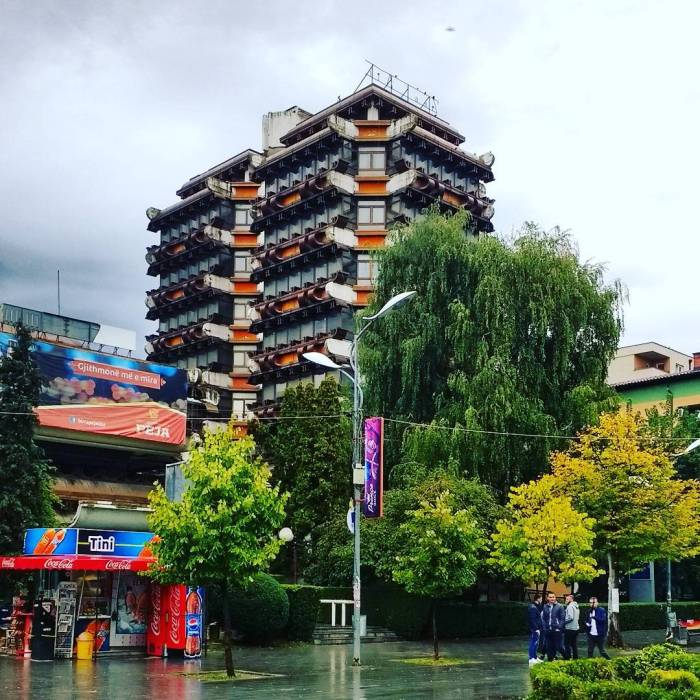
I continue walking up the main road. I soon approach a pedestrian square, where a large mid to high range hotel, Hotel Dukagjini, is located, but I am on the lookout for the more modest Hotel Peja. Close to me is an airline travel agency. I enter in the hope that someone there may know the whereabouts the hotel. The attractive and courteous young woman at the desk greets me in perfect English. She isn’t sure where exactly it’s located but she kindly offers to call the hotel and the owner duly meets me at the agency. A stocky white-haired man, perhaps in his late sixties or seventies, arrives and together we walk to the hotel. The hotel is only a couple of blocks away directly facing an enormous future-retro eyesore of a building; like something concocted by the architect of the Barbican tower blocks on acid laced Kool Aid. It is unique in it’s ugliness; the No Retreat No Surrender of global architectural monuments. My hotel is nothing noteworthy but perfectly fine for a couple of nights.
nicholas_peart_1983___BZeKOJbDWIP___

Eyesore or work of art?

I spend the remainder of the rain drenched afternoon and early evening mildly exploring what I can of this city within relatively close proximity to my hotel. In no time I discover a small bazaar like street named “William Wolker” street. William Walker, not to be confused with the clumsy failed wannabe 19th century American conquistador, was the head of the Kosovo Verification Mission, which was a peacekeeping mission established to put an end to the Kosovo War of the late 1990s. Former president Bill Clinton and former US general Wesley Clark also each have a street named after them. As does Tony Blair. Many people view Blair as a “war criminal” owing to his involvement in the 2003 Iraq war, but not the people of Kosovo. Here he is regarded very highly and some families who survived the Kosovo War even went as far as calling their sons ‘Tonibler’. The side of WW street is decorated with a maze of tangled black electricity wires, like its trying the outdo the legendary dishevelled mess of wires found in most of the narrow old bazaar alley ways of Old Delhi, but no matter how hard it may try it will never come close.

nicholas_peart_1983___BZiMtB8D43l___

In Kosovo Tony Blair is held in very high regard

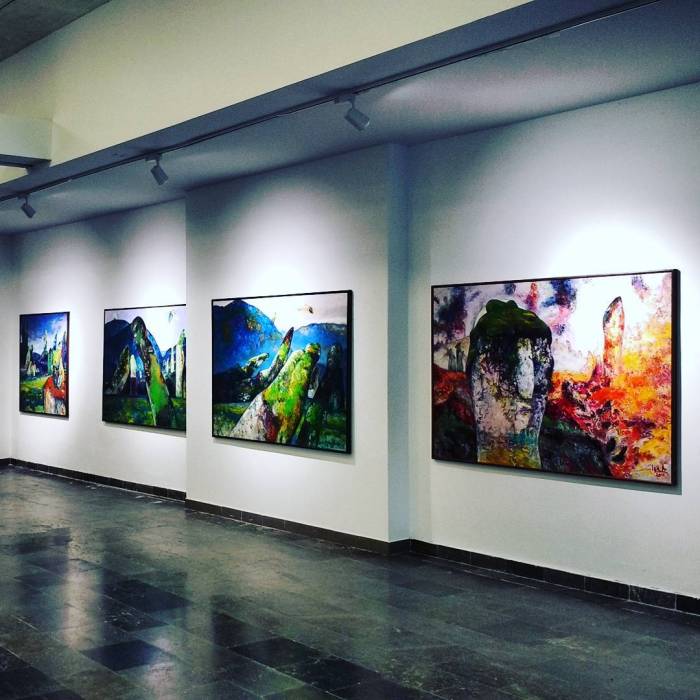
My meanderings soon lead me to the Peja Arts Gallery featuring a solo exhibition of beautiful paintings by the local Kosovo artist Isa Alimusaj. Sadly the gallery appears to be closed even though all the lights inside are blazing. As much as I want to enter, I cannot find anybody who is in charge. Next to the gallery is a library called the ‘Azem Shkreli” library. I wonder if Azem is related to the controversial American-Albanian multimillionaire “Pharma bro” businessman Martin Shkreli? Although I later discover that Shkreli is quite a common Albanian surname. Not far from my hotel by the river is a statue of Mother Theresa, who was originally from Albania. And nearby is a memorial to four soldiers who died during the Kosovo War. In the evening the temperature plummets. I buy a bottle of water and some pears and retire to my room at the Hotel Peja.

Day Two: Tuesday 26th September 2017
Visiting the Patriachate of Peć and Visoki Dečani monasteries

21911065_273615596375837_4854419565494403072_n

The old Ottoman era bazaar of Peja

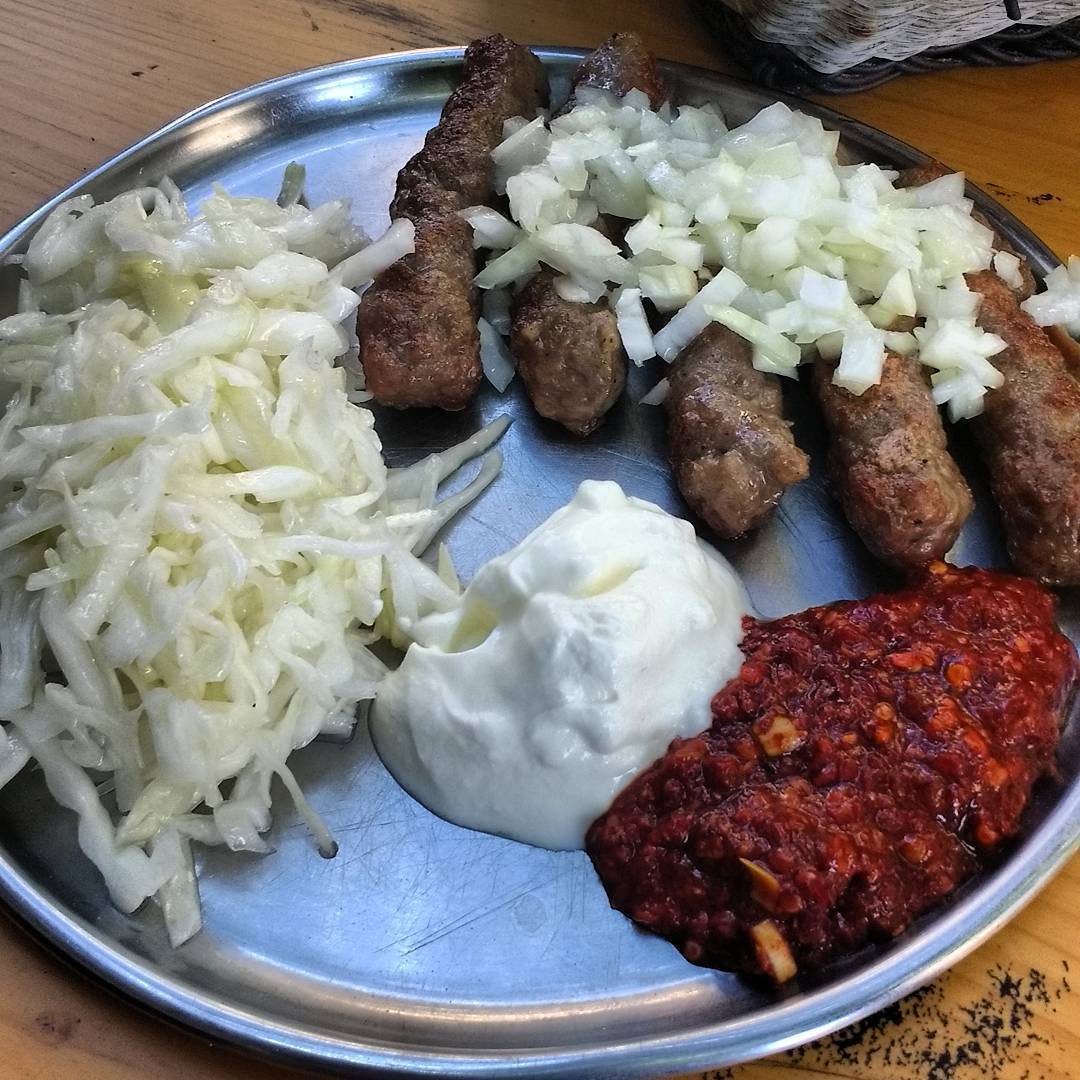
Early in the morning I leave my hotel room and walk to the main square where I find a tourist information office. It is staffed by a woman who speaks excellent English. She provides me with a map and highlights all the places I want to visit. My first destination is the city’s old bazaar; like a miniature version of the Baščarsija bazaar in Sarajevo. Walking through the bazaar I try to locate somewhere where I can have breakfast. Ordinarily I skip breakfast, but not this morning. I am so hungry I could burn down cities in return for a large plate of čevapi. I follow my nose, towards the source of the pungent smells radiating from the town’s burek and čevapi eateries. I am led to a čevapi joint called Oebaptore Meti. And what a good call that was. The Cevapi here is as good as it gets in the Balkans. Not only that. I also receive a generous side of salad and grilled vegetables. And all for €2.50. The overpriced pretentious bistros of Paris can do one. The food here is divine. I think Anthony Bourdain would concur.

nicholas_peart_1983___BZiLDhUjwGU___

The best cevapi in Peja

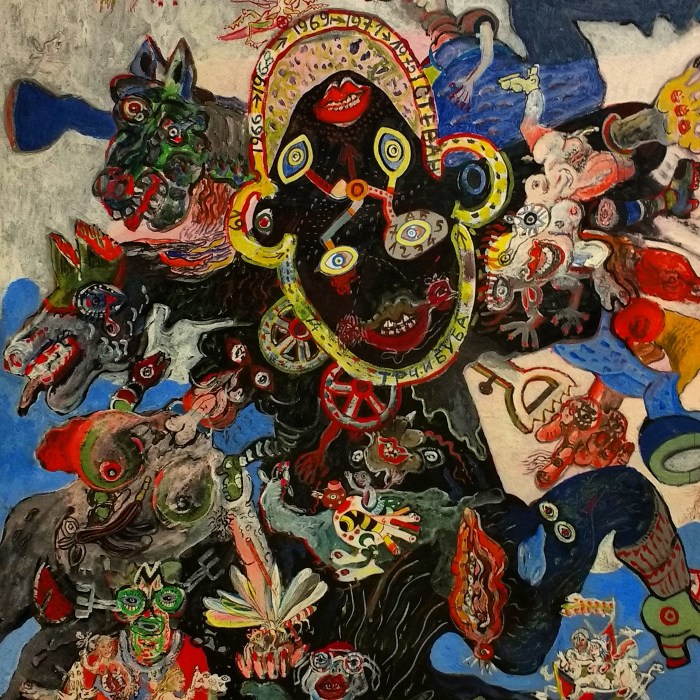
Belly overstuffed and belt loosened, I revisit the Peja Arts Gallery containing all those magical paintings by Isa Alimusaj. Initially I come to the conclusion that the gallery must be closed, but after giving the retro gallery entrance door a firm push, to my delight, I stumble inside. The paintings of Alimusaj are magnificent. Wow! What a privilege it is to discover such a brilliant and gifted artist in the unlikeliest of settings. Those paintings don’t deserve to be hidden in some remote and hard to reach corner of Eastern Europe. They should be on the walls of the Royal Academy of Art. I could reference some well known artists when I look at his paintings; Klimt, Dali, Munch and Bosch perhaps. But the truth is they are like no other artist. Alimusaj is in a league of his own.
nicholas_peart_1983___BZiJTQhjqEq___

Paintings by local Kosovan artist Isa Alimusaj at the Peja Arts Gallery

Feeling lifted by seeing such magnificent art, I make the 2-3km walk towards the Patriachate of Pec monastery. As I walk further out of town, I see houses and buildings that were scarred from the war of the late 1990s; destroyed areas covered with newer bricks next to older bricks. The scenery on the walk is beautiful. Even with the sky heavy with low nimbostratus clouds, the mountain countryside sparkles. The entrance to the path leading to the monastery is guarded by NATO’s Kosovo Force (KFOR). At the entrance I show my passport. A group of other visitors soon arrive. A young Englishman called Jack from somewhere in Essex stands out like a whirlwind. He has beautiful long blond curly hair like a youthful Robert Plant and is clad in neo-dandy/hipster ware with shades of his Essex soul brother Russell Brand. He’s with his travelling companion who is an older reserved American who looks like an academic scholar on early Native American history. I get talking with the dude from Essex. They both arrived at the entrance in a battered Mercedes taxi. ‘The taxi geezer charged us 15 euros from the bus station to here. I think he charged us too much’. I think so too. Then apropos of nothing, he points to his reserved travelling companion and blurts out, ‘E’s a West Ham fan too!!’ And here I was thinking, perhaps naively, that I was going to have a quiet uninterrupted trip to this monastery, in a hard to reach little travelled part of Eastern Europe, where I’d have it all to myself. How wrong was I. I like Jack though and he seems to be having a thoroughly great time travelling and seeing awesome things and not allowing himself to be trapped in some depressing-ass road to nowhere job in Basildon or someplace around his neck of the woods.

nicholas_peart_1983___BZiQmpEjp26___

The Patriarchate of Pec monastery 

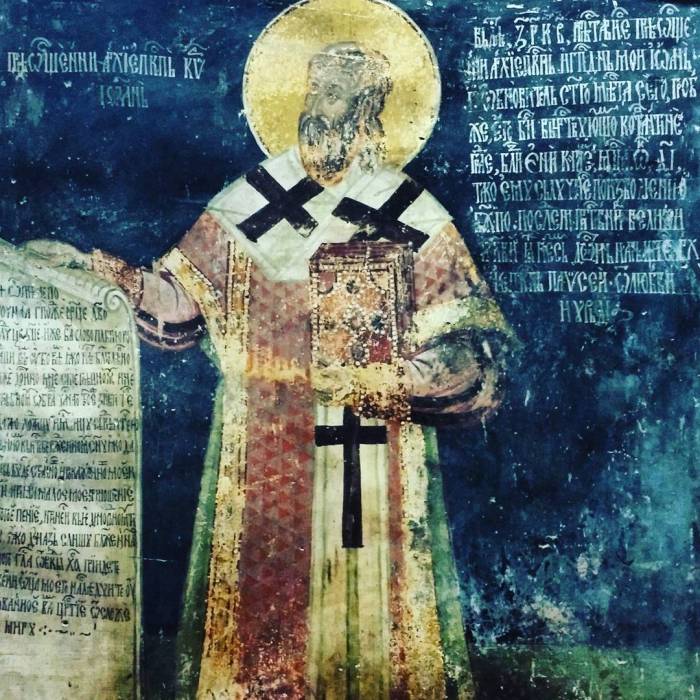
The Orthodox Serbian monastery dating back to the late 13th century is a jewel painting in red-terracotta. Yet it becomes even more spectacular when I enter. What immediately impresses me are the frescos covering all the walls and ceilings; rich, luxurious and brilliant. Its hard to comprehend how after over seven centuries they are still so alive. The extraordinary skill of them is up there with the very best of the early Italian Renaissance painters. I am particularly spellbound by a specific ceiling fresco, which, through centuries of decay, has morphed into a composition that makes even Goya’s most dystopian works look tame. This fresco appears like its engulfed in Mother Nature’s foulest weather and Tesla’s coil violently erupting. I stay at the monastery for a while, marvelling at the frescos before walking back to town.
nicholas_peart_1983___BZiSgeEj8A-___

nicholas_peart_1983___BZiRZkEjOPP___

13th century frescos from the monastery 

As I reach Pec town I head towards the bus station to visit another monastery called the Visoki Decani monastery located outside of the town of Decani, which is situated between Pjac and the town of Gjakove. When I arrive at the bus station I have half an hour to kill before my Decani bound bus leaves Peja. So I walk across the main road to a bar and on a whim I order a large cold bottle of Peja beer for only one Euro. Time marches on as I begin to feel the initial effects of tipsiness. Before I know it I have just five minutes remaining. I am no barfly but I drain the remainder of my bottle of beer in a way that would have made Oliver Reed proud. When I get on the bus I indicate to the driver that I want to get off at Decani specifically to see the monastery. Nobody speaks passable English on the bus, but I think the driver gets the message. Forty minutes later as we appear to approach what looks like my destination, the driver signals for me to disembark and points to a road that will lead to the monastery. Decani town seems down at heel and depressed and I don’t think the war was kind to this town. There are memorials to soldiers who died in the war and about ten minutes away on the road back to Pec there is a massive, and I mean gigantic, cemetery, where many citizens who died during the war are buried.

I walk for almost 30 minutes along a quiet country road with lush forests and mountain scenery before I approach the beginning of the entrance to the monastery. This monastery has much more security than the Patriarchate of Pec monastery; its almost as if you are going to a Royal Family wedding. I hand over my passport and rucksack at the entrance before entering the compound. It is a handsome white monastery dating back to 1327 during the reign of the Serbian King Stefan Decanski who was the father of King Dusan who ruled Serbia during the golden age of the Serbian Empire. Yet the monastery has a turbulent history becoming the target of many attacks and attempted attacks. Since the Kosovo war, the monastery has been extremely vulnerable to attacks including an incident on 30th March 2007 when suspected Kosovan Albanian insurgents threw hand grenades at the monastery. Fortunately, not much damage was created. This is one of the reasons why the monastery is under constant tight security.

nicholas_peart_1983___BZjxX4Tn3LB___

By the Decani monastery

Like the Patriarchate, the Decani monastery is decorated with monumental frescos. When I enter a procession is already in full swing. The main area of the monastery is exquisite with a sky-high ceiling, elaborate frescos and many tall candles on a suspended chandelier, which one of the orthodox monks would put out one by one with a long metal candle snuffer stick.

nicholas_peart_1983___BZjynHDnhKv___

Inside the Decani monastery 

It has been an awesome and active day today. I am exhausted by the time I return to my room at the Hotel Peja.

Day Three: Tuesday 27th September 2017
Travelling from Peja to Pristina

At midday I check out of my hotel room. The young woman who is in charge arranges a taxi to come and collect me to take me to the bus station from where I will take a bus to the Kosovan capital of Pristina. She is very kind and speaks excellent English. Last night she made me a complimentary mint tea. She tells me that a taxi to the station should not exceed one Euro. I ask her, out of interest, how much a taxi should cost from the station to the Patriarchate monastery? She tells me two euros. I mention my Essex friend paying 15 euros. She looks at me as if he jumped out of a plane without a parachute. As I go to my taxi she insists that I don’t pay more than three euros for a cab from Pristina bus station to the location of my accommodation over there.

The taxi driver is a stocky middle age Kosovan-Albanian with a severe crop. He doesn’t speak a lick of English, but he can speak some German having lived in Germany for 18 months as a refuge during the war. I communicate with him in my fractured German.

nicholas_peart_1983___BZiVXSzjgaZ___

Inside Peja bus terminal 

At the bus station I locate my knackered old school Pristina bound bus. I nod in and out of consciousness for the duration of the journey. As we approach the outskirts of Pristina my first impressions are not full of joy. Arriving at the rundown bus terminal I begin to feel that the city centre, and more importantly my guesthouse, is no stone’s throw away. I haven’t the faintest notion where I am in relation to the city centre. With no map to guide me and no SIM card in my phone it is going to be challenging. My hopes lift when I get talking with a young man at the information desk in the terminal who speaks reasonable English. He gives me the password for the terminal wi-fi and finally I can take advantage of good ol’ Google Maps. I have already mapped out my journey from the bus station to my accommodation. When I approach two outside taxi drivers they both want at least ten euros to take me to my accommodation which is more than triple what I was advised to pay by the young woman back at Hotel Peja. I walk on. Even with the assistance of Google Maps, I am obstructed by a loud and aggressive dual carriageway with no infrastructure to cross it. No way am I going to cross this death-trap with vehicles driving at out of sight speeds. I swiftly come to the realisation that paying ten euros for a taxi may not be such a bad idea after all. So I approach another taxi driver. This one speaks no English. Nevertheless I show him the address of my accommodation. After looking at the scrap of paper with the address for what seems like an age, he brusquely says, ‘OK!’. When I press him on the taxi fare, he grunts in German, ‘Drei, vier Euro’. Fuckin’ A. Lets go.

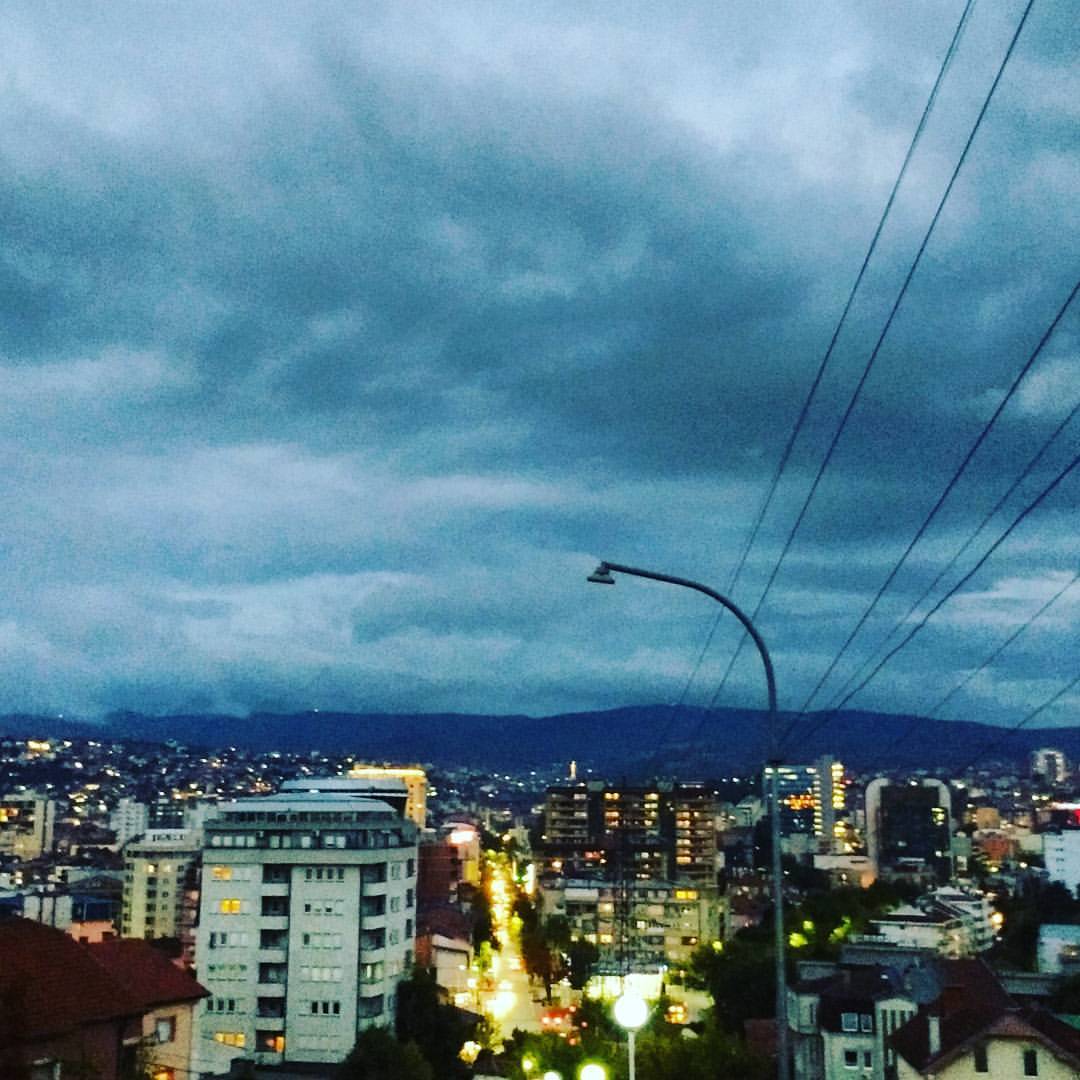
Everything goes swimmingly until we approach the district of the city where my accommodation is supposed to be located. It is situated on the edge of a hill overlooking the city centre. After driving aimlessly across multiple narrow streets, the taxi driver stops at a small convenience store to ask for directions to my place. A middle age woman with red curly hair appears. She speaks refreshingly good English and advises me to go to an Italian restaurant located further down the street, which may be able to better assist me. When I tell her that I am from England, she almost gets down on her knees repeatedly telling me, ‘I love England! The war was so terrible and you defended us!’ The taxi driver then proceeds to drop me off at the Italian restaurant, continually apologising in German for his navigation blunders. I tell him not to worry and get out of the cab. At the Italian restaurant, I find a waiter who speaks excellent English yet he has no idea regarding the whereabouts of my accommodation. Happily though he allows me to use the wi-fi in the restaurant. I call my host via WhatsApp telling him where I am. He duly arrives in a black BMW X5 looking like the ring leader of a human trafficking gang. I am absolutely petrified of him. On arrival at the location of my accommodation it appears that I got more than what I expected. Not only do I have my own private room, I have my own mini apartment all to myself with a breath-taking view over Pristina. As I take it all in, he ominously barks, ‘Pay!’. I have a look inside my wallet and discover that I only have six euros. I ask him whether I can pay later? He’s not happy with my response. ‘Ok come with me I drive you to cash machine’. And so I put back on my shoes just as I took them off and we had to his black mafia mobile. He drives me to some BNP Paribas cash machine located outside of the city. As I attempt to withdraw 100 euros, the bank tells me there will be a flat five euro withdrawal fee. So I double my withdrawal amount to 200 euros. When I pay him he becomes less intimidating. The hard as nails Lennie McLean façade morphs into soft as butter Dr Phil. He offers to drive me all the way to the centre of the city.
22069766_272601449913147_8573444292700274688_n

Pristina at night

My impressions of Pristina become more positive the closer I get to the centre. My quest to find a tourist information centre and a map fails miserably. On a positive note, I ask two random young guys for directions to a city centre based hostel where my chances of finding a city map are high. They are both wonderfully friendly and speak fluent English. At Hostel Hun, located on the forth floor of a building, I meet a young hostel worker who speaks perfect English. He gives me a map of the city. I am not a fan of dormitories, but this hostel is quiet, clean and appears well run. I make a reservation for one night in the six-bed dormitory room for my third night in Pristina.

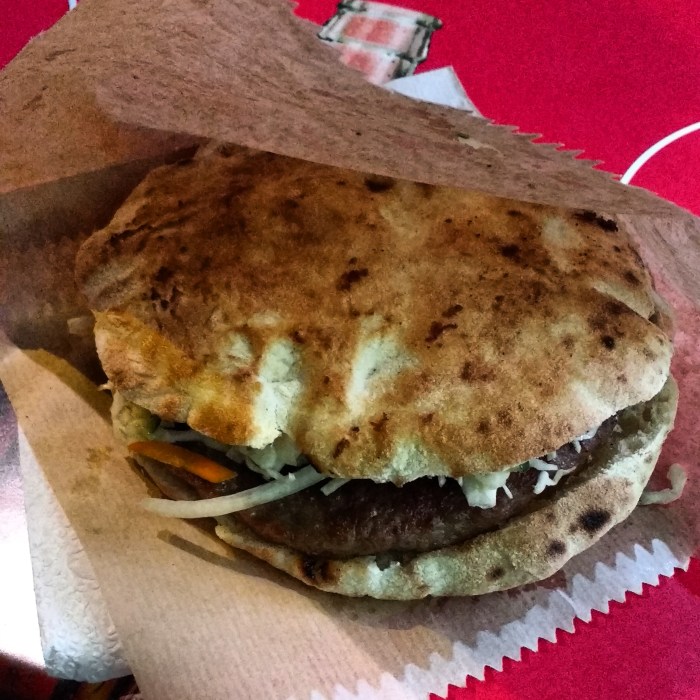
Afterwards I walk to a nearby diner where I order a combo of chicken and beef kebab meat with chips and salad. I haven’t eaten all day. I am still peckish after finishing my meal and so I order a sandwich with small hamburger-like patties and salad. Then I head back towards my mini apartment. On the way I pause at a modern café/bar and order a slice of the Three Milks cake. It is delicious. Later I amble up the hill back to my pad.

By Nicholas Peart

(c)All Rights Reserved 

Photographs From Mostar

I visited the town of Mostar in Bosnia and Herzegovina during my two month long Balkans trip back in September 2017. The town is one of the highlights of the country and is easily accessible from either Sarajevo or the historic Croatian town of Dubrovnik. I took the train from Sarajevo, which I highly recommend. On most bus journeys its not uncommon to hear the latest chart music playing on the speakers. Instead during this two hour train journey I was treated to a non stop 60s and 70s rock n roll extravaganza of Thin Lizzy, Free, Deep Purple, Credence Clearwater Revival, The Rolling Stones and lots more classic music from that era.

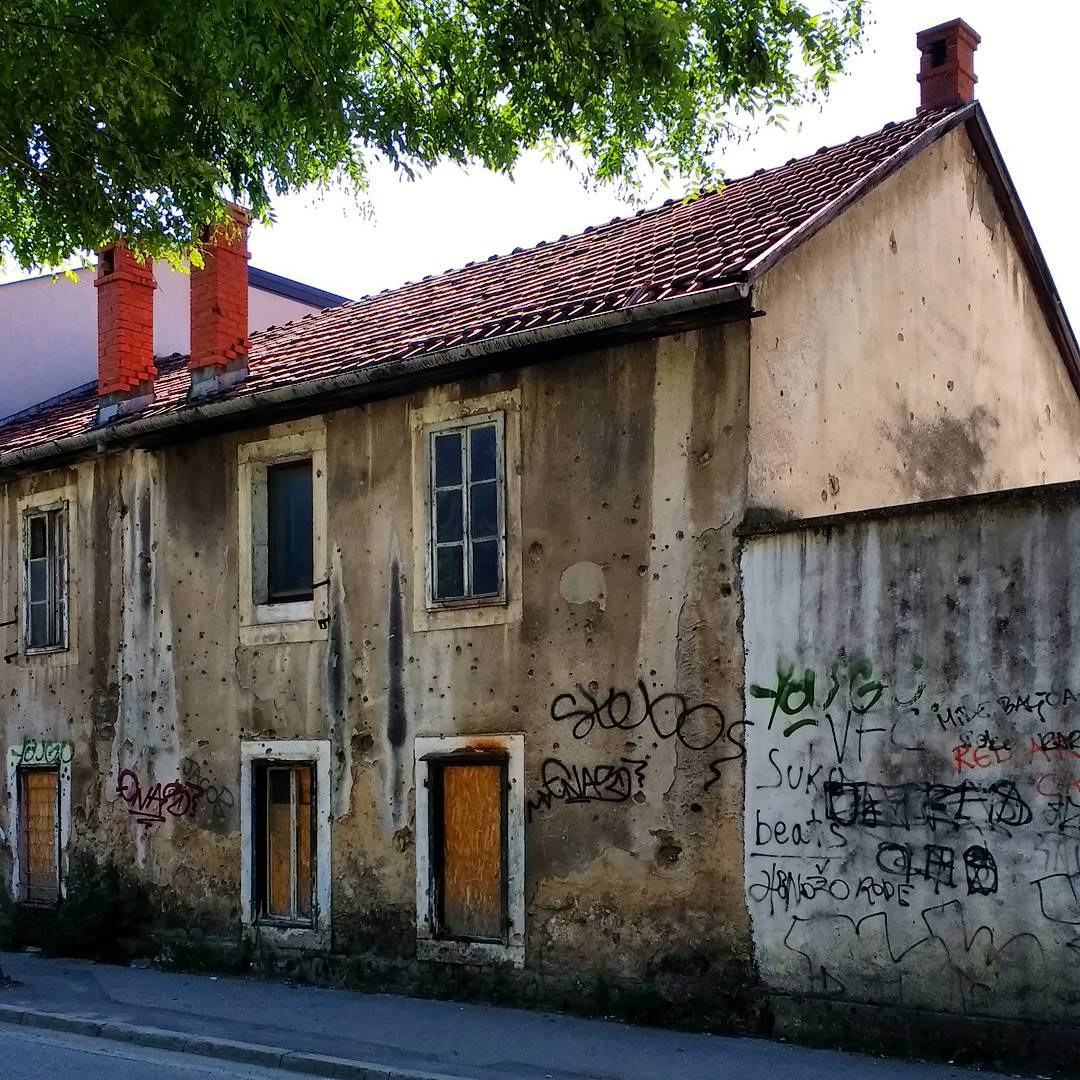
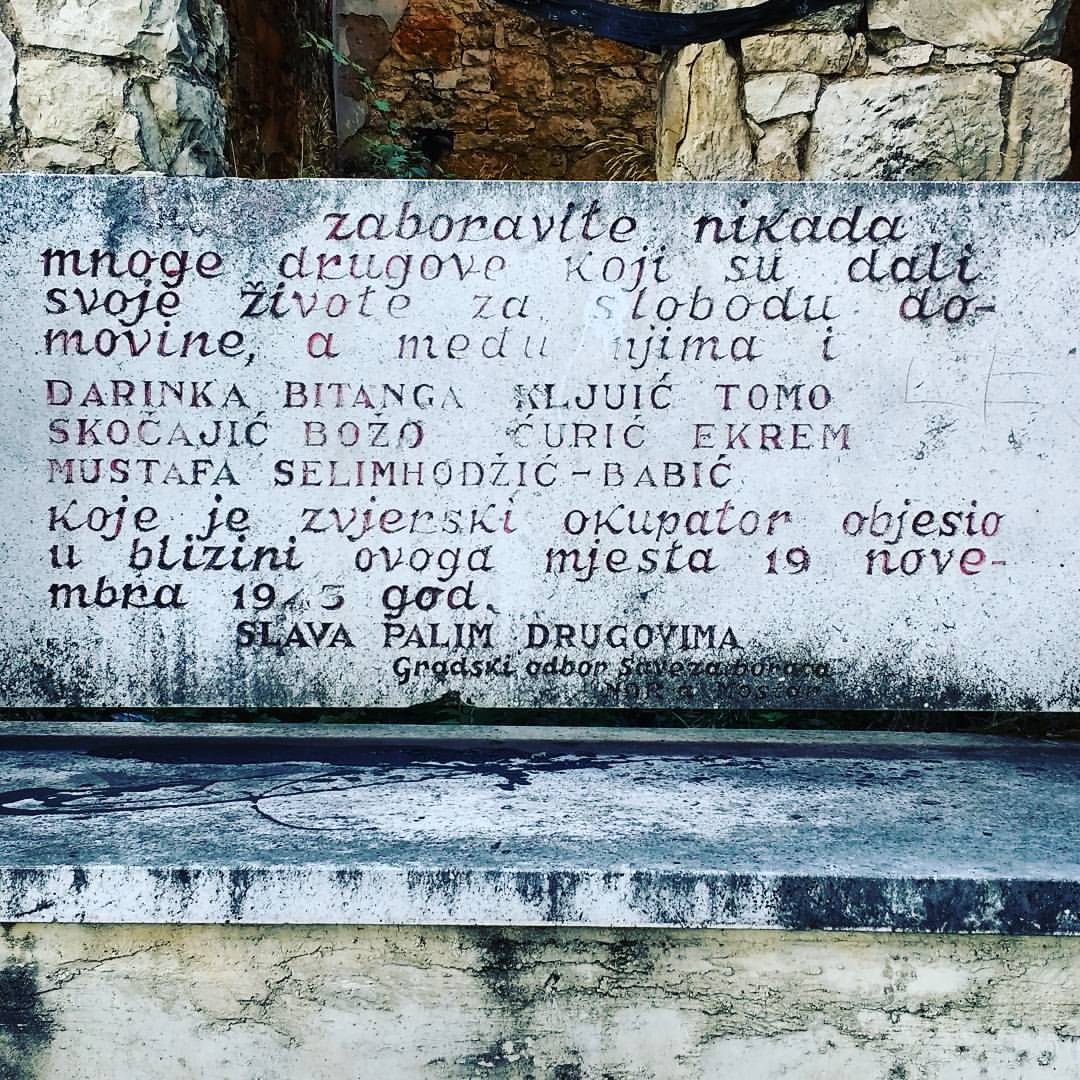
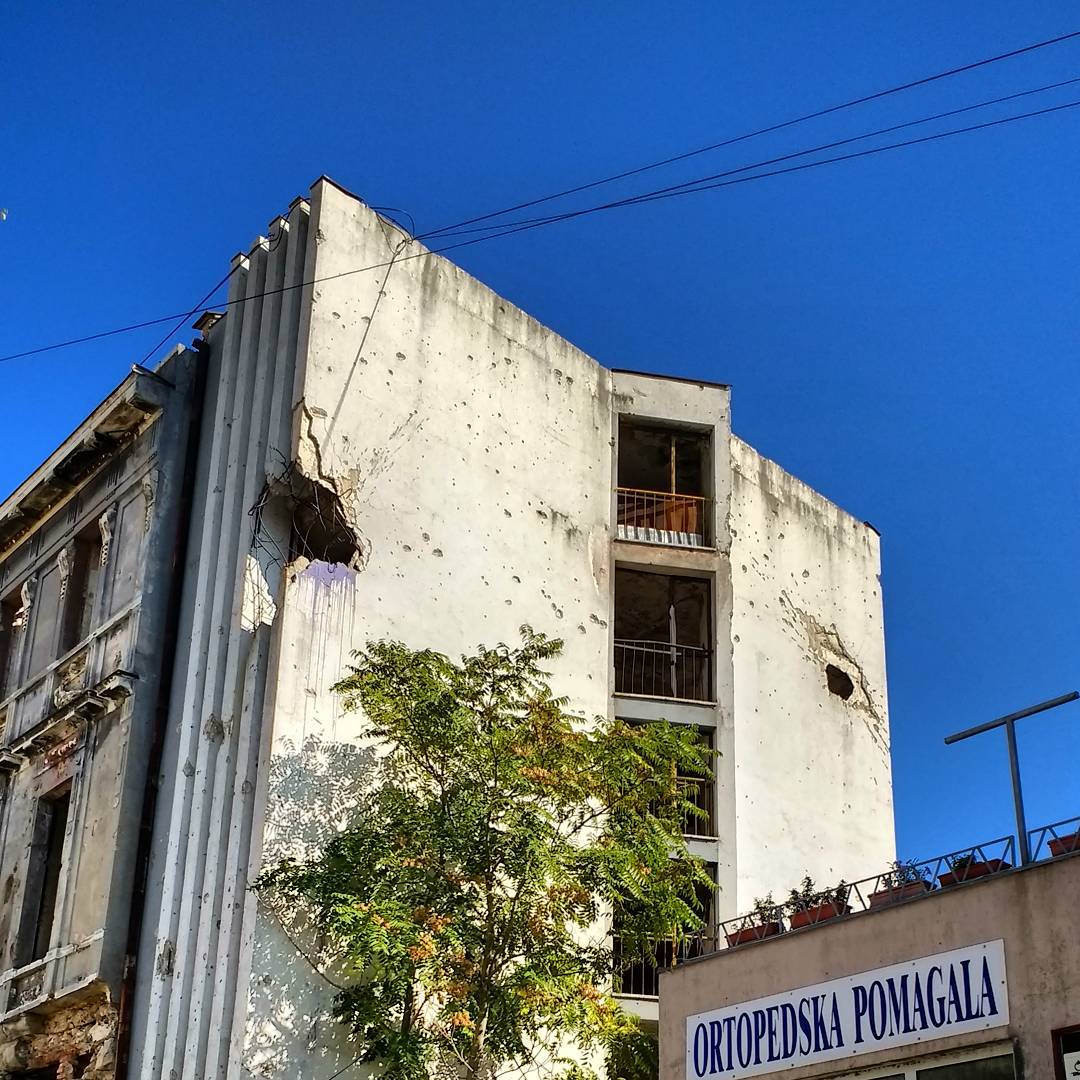
Mostar is well known for its famous Ottoman era landmark bridge in the old part of town. During the Bosnian war in the 1990s the bridge was completely destroyed as was much of the town. In fact if you take a good walk around Mostar you will see many remnants of bombed out and dilapidated buildings from that awful time. The current bridge is a beautiful and meticulous reconstruction of the original bridge.

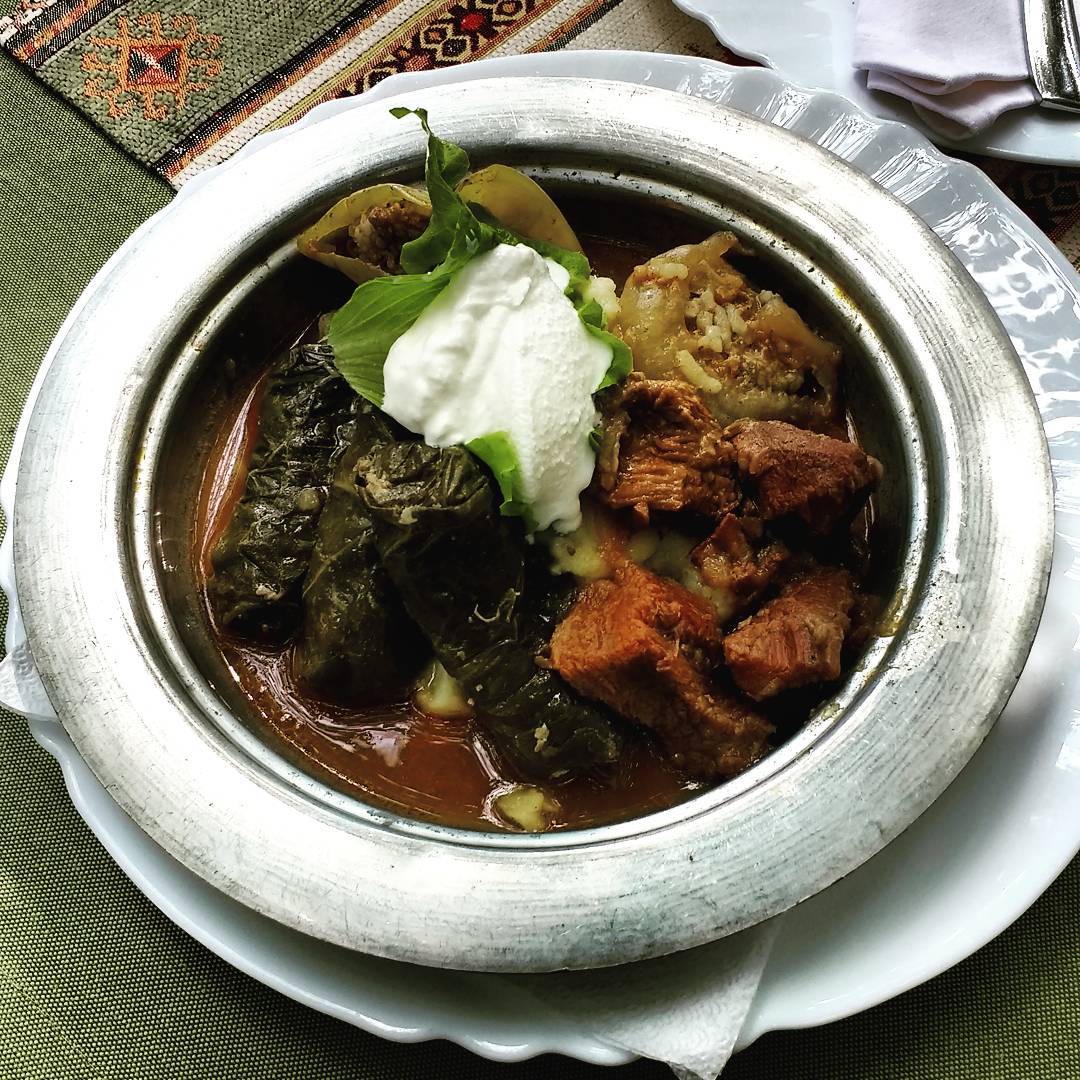
There’s a popular restaurant in the old part of town close to the bridge called Sadrvan, which serves delicious and inexpensive traditional Bosnian cuisine. Look out for the Mostarian Sahan (a traditional local mixed hot pot) and the Duvec (a rich vegetable stew).

This is a pleasant and charming old historical town in a beautiful setting. Most places are walking distance away and you can easily spend 2-3 leisurely days here. Away from the main tourist drag there are some good bakeries selling cheap and tasty pastries.  The best thing to do here is to walk and explore the streets and side streets. Lots of interesting nooks and crannies can be unearthed. Below I am sharing with you all some of my photographs from this interesting slice of the Balkans…

21980328_682601675243390_5797842993582964736_n

21689042_287204848431086_4031590272092602368_n

21980962_117815588886711_6986500468633501696_n

21910072_2114720135417683_6114904149457895424_n

21879493_1845667795744456_2948873529812058112_n

21911429_514433475588526_2837874352064561152_n

21879681_104991570225090_8804041189901729792_n

21911079_1620588721331953_2263239918639644672_n

21910916_1865312173782882_3448435246322679808_n

21879788_117570678954264_8893532614539870208_n

21878896_1169497499818990_2435692403286343680_n

21909200_132688007359728_6240875411400556544_n

21980283_298692230611489_7557218802417532928_n

21879196_128025467786670_4554843543604035584_n

21909503_1700780453327448_5383545788171288576_n (1)

Photographs and text by Nicholas Peart

(c)All Rights Reserved
Visiting the Albanian towns of Gjirokaster and Berat

IMG_20171128_134158162

My first visit to Albania was earlier this year in late September when I visited the northern Albanian town of Shkoder en route towards Montenegro after having spent a week in neighbouring Kosovo. Visiting the rest of the country wasn’t on the agenda on that trip but I vowed to return to Albania later in the year. Since the beginning of November I had been based in Athens for almost three weeks. Yet I made sure that I would return to Albania before the end of this trip.

From the northern Greek town of Ioannina, I took an early afternoon bus directly to the southern Albanian mountain town of Gjirokaster. I was the only tourist on the bus. Ioannina is a mountain town located on a plateau of around 500 meters. The entire sky was heavy with thick low lying clouds and I was wearing my warmest garments. During the two hour bus ride we drive through some awesomely stunning mountain landscape. There is no heating on the bus and my feet are turning to ice. The border crossing feels like its located at the same altitude as La Paz in Bolivia. On the Greek side we all have to get off the bus and I make an inward groaning sound. Uniquely for border crossings, the Greek border official is full energy and excellent humour. His English is impeccable…‘So Mr Nicholas Alexander, what the hell are you doing on the Greek-Albanian border?’ When we approach the Albanian side I feel relieved when we don’t have to disembark the bus. Instead the bus driver takes all our passports to give to the Albanian border official before handing them back to us.

IMG_0793

By Lake Pamvotis in the northern Greek town of Ioannina

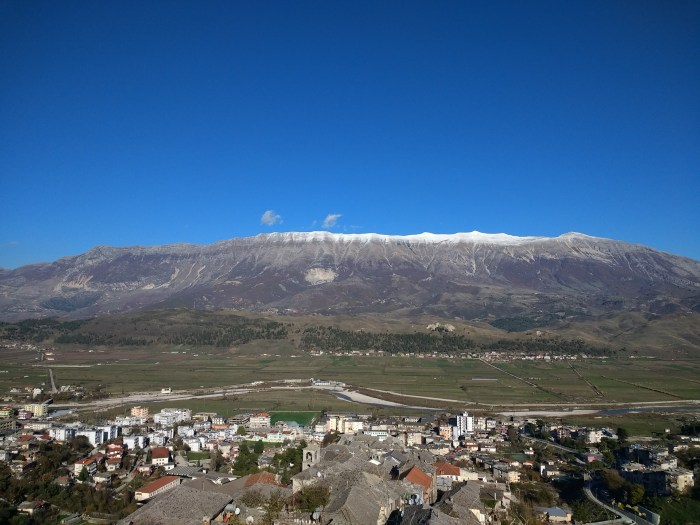
On arrival in Gjirokaster, the bus stops on the side of the main town boulevard, Bulevardi 18 Shtatori. Multiple red Albanian flags line the middle of the boulevard. I establish my bearings towards my guesthouse via Google Maps. With hindsight, it would have taken an age to find my place without all this digital cutting edge technology at my disposal. From the boulevard, I walk up multiple ascending narrow stone paths. As I get closer to my destination, the older part of town with its old historic Ottoman style houses (some splendidly dilapidated) slowly reveals itself to me. I wish I were wearing my hi tech Merrel brand boots with their tough Vibram grip. My trendy hipster Vans shoes are not made for walking these jagged stone paths. As I walk further up one of the paths, a young man on a donkey with a small cart attached to it passes me by.

Google Maps is on my side and eventually I reach my final destination, Mele Guesthouse, or at least I think I have? An elderly couple greet me at the gates and take me inside their house. I ask them for the whereabouts of Mele, but neither of them speak a lick of English. We sit down on the sofa in the living room and the lady goes to the kitchen and returns with a tray carrying a bowl of sweats and an oversized shot glass of raki. With weather as cold as this, the raki is like a hot woodfire stove in my belly. I am also presented with a photo album of the couple with two of their children, a son and a daughter, in Venice. I assume that the daughter is Mele. After some time, a man in his late 30s/early 40s appears. I have a giant lemon sweet drop in my mouth disabling me from speaking clearly. Mele, I learn, is the surname of the man who’s name is Edmond. He speaks excellent English and I follow him to his house next door where my room is located. There is a balcony by my room with a tremendous view over the rest of the city and of the dramatic wide snow capped mountain symbolic of this town. My room is not warm but Edmond tells me to use the air conditioning unit on the wall, which doubles up as a radiator during this time of year. Edmond and I sit on the sofa in the heated living room. He makes me a delicious and warm organic tea and mentions that he once lived in Milton Keynes for two years back in 2005. Nowadays he works as a metal welder in town and lives in the house with his partner and their adorable young kid.

I spend the remainder of the afternoon walking around the old town. I need to withdraw some local cash so I head back towards the new part of town where I originally arrived. Instead of the arduous multiple narrow paths route I earlier in the day, I find a descending stone paved road leading directly into that part of town. After withdrawing my cash, I enter a bakery and order a slice of cheese and spinach pie and a wedge of halva cake. It all comes to about one Euro in the local Leks currency. That same purchase down the road in Ioannina would have cost me three times more. I am served by a young woman of about 20 who speaks passable English. She is so lovely and kindhearted, and admits to me that she cherishes all the opportunities to practice her English. Her name is Ada and she’s a student at a local university.

When I return to the old part of town, I try to find Taverna Kuka, a restaurant recommended to me by Edmond. The wooden taverna is aesthetically very tasteful and well heated. On one wall, there are several framed pencil sketches of assorted areas of the old town by a local artist. My first choice, the moussaka, is unavailable so I settle on a plate of qifqi, a local ball-shaped delicacy made from rice, dhjozme, egg, salt, pepper and milk.

IMG_20171127_171316709

Taverna Kuka


IMG_20171127_172925074

A plate of qifqi and meatballs

At night the temperature drops below zero. The air-con is humming away converted ice cold air into warm air. It’s a cumbersome and electricity wasting process and nothing beats a radiator, whether portable or nailed to the wall. Entering my private bathroom, which is unheated I must add, is like accidentally wading into a winter in Vorkuta. I pee and brush my teeth with haste before exiting back into a warmer vacuum. Edmond has kindly provided me with enough blankets to prevent the entire population of Gjirokaster from developing hypothermia.

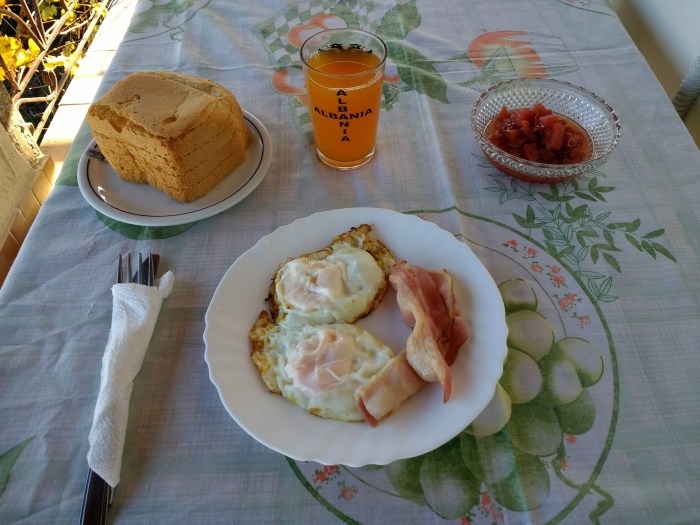
When I wake up at 7am the next day, I roll up the shutters covering the sliding balcony glass doors. I am rewarded with a pristine blue day. The wide mountain and town skyline are majestic. I am served a decent breakfast of bacon, eggs, bread, sweet pickles and a Nutella crêpe. Wolfing down my breakfast, I tell myself Carpe fucking Diem. I am going to live today like its one of my last. I have the energy of James Brown, sans angel dust.

IMG_20171128_084357571_HDR

View of Gjirokaster from the balcony of my guesthouse room


IMG_20171128_085811954

Breakfast on the balcony

The first site in town I visit is the former childhood home of the Albanian president-for-life Communist dictator Enver Hoxha. Hoxha ruled the country for over 40 years from 1944 until his death in 1985. During his rule he cut off the country from most of the world. Albanian civilians were not allowed to leave and his regime tortured and killed thousands. Albania was comparable to Fidel Castro’s Cuba or present day North Korea during this period.

IMG_6692

Enver Hoxha 

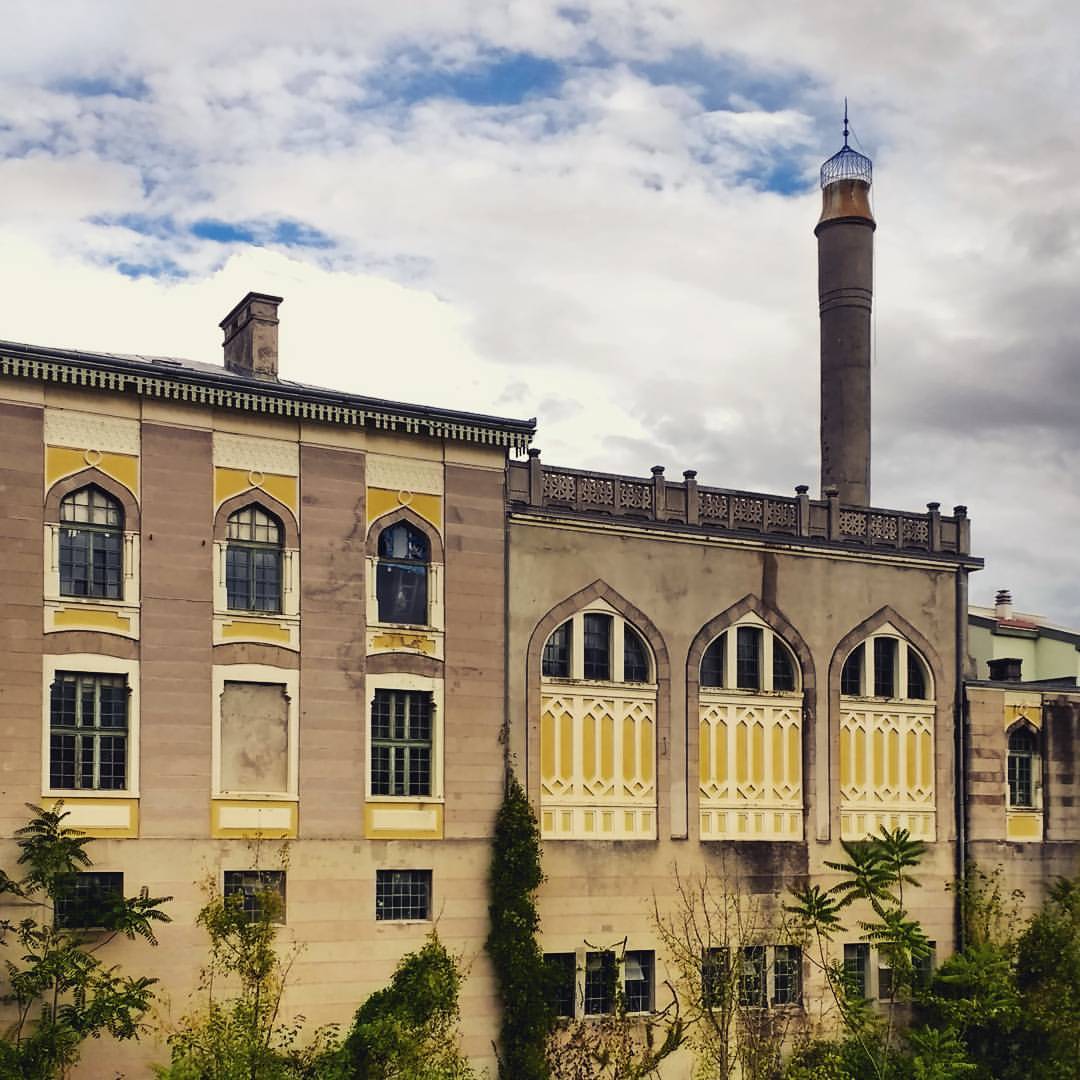
Hoxha’s childhood home is an old Ottoman style house over 100 years old, which has been converted into the town’s ethnographic museum. Most of the wooden features and designs of the house appear to be original and well preserved. In contrast to this, many of the old historic Ottoman style houses dotted around the old town look neglected and in a decaying state of disrepair. In the vestibule of the first floor of the house, there is a small corner table with two black and white photographs of Hoxha resting on the wall. The living and guest rooms of the house are furnished with long sofas, antique carpets, intricate Ottoman style wooden reliefs on the wall and also some artillery pieces like the two rifles in one of the rooms.

The childhood home of Enver Hoxha now the Ethnographic museum in Gjirokaster


IMG_20171128_101402448

IMG_20171128_095936217

IMG_20171128_100545920

IMG_20171128_100456706

Photographs from inside the Ethnographic museum in Gjirokaster

Another figure to come from Gjirokaster is one of Albania’s best known literary figures, Ismail Kadare. I visit his former home, which has been reconstructed after a fire in the 1990s destroyed the original structure and features. It is used as an exhibition space today and when I visited there were a number of Expressionist style oil paintings by a local artist dotted around the home. In one room there is a small table with black and white photographs of Ismail as a young boy, some books, the hat he wore whilst he was a journalist in Vietnam during the war and a certificate honouring Kadare for winning the Jerusalem Prize for the Freedom of the Individual in Society of 2015.

IMG_20171128_105409414

Inside the former home of Albanian writer Ismail Kadare 

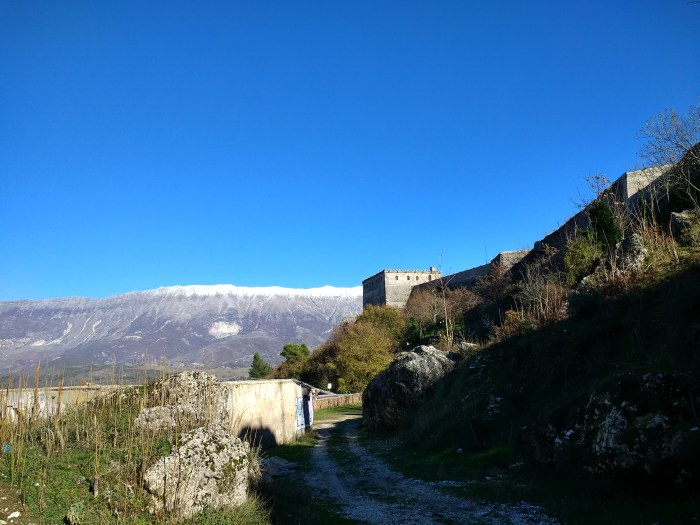
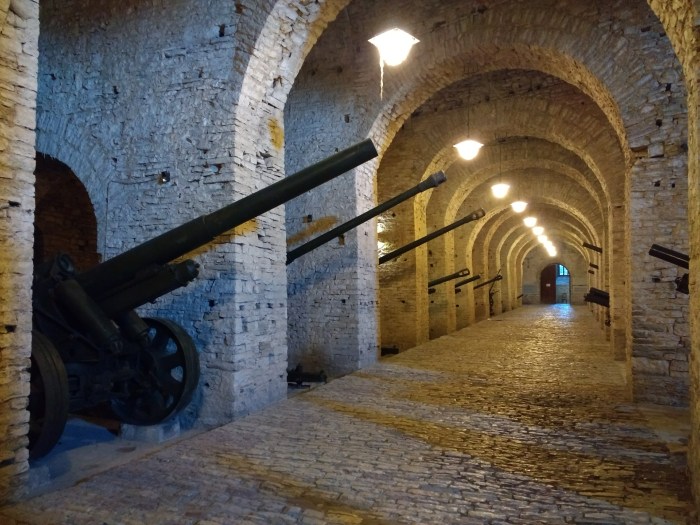
Afterwards I head to the enormous hilltop fortress of Gjirokastra. Just before I walk up the steps towards the fortress, I get lost walking up some of the mazes of surrounding stone pathways. The higher I climb the more awesome a view I have of the fortress and the old bazaar. The wide snow capped mountain in the distance, visible from my balcony, augments the beauty, rawness and authenticity of this historic slice of Albania. When I enter inside the fortress, I arrive at an area with great tall multiple stone arches and a collection of artillery dating back to the Second World War. Most of these weapons belonged to German and Italian forces, which occupied Albania during that time. The fortress is also home to the Museum of Gjirokaster. The museum contains numerous displays and information documenting the history of the city from as far back as pre-historic times. Of most interest to me is the period of history starting from when the Ottoman Empire conquered the Balkans region. In 1417, Gjirokaster became part of this empire. Since that time the town grew immensely and Islam became the dominant religion, although the Ottomans were tolerant towards the existing Christian communities.

IMG_20171128_123048971_HDR

Fortress of Gjirokaster


IMG_20171128_125256773

The artillery gallery inside the fortress

By the time of the 18th and 19th centuries, Gjirokaster was an important administrative centre for the empire. It was around this time in 1811 when the city was captured by Ali Pasha of Ioannina, the last town I visited before I arrived in Gjirokaster. To say that Pasha was a formidable ruler would be an understatement. From the modest bits and pieces I’ve read up on him, he strikes me as the quintessential larger than life colonial despot; an intimidating and nightmarish version of Louis XIV of France on an eternal cocaine comedown. Or more generously, a PG certificate Ghenghis Khan. Lord Byron famously visited his court in the walled Turkish Kastro in Ioannina in 1809 and had conflicting feelings about the man. On one hand he was impressed by the ruler’s cultural refinement and the opulence of his court yet he was shocked by his propensity for off the charts barbarism as he wrote in a letter to his mother, ‘His Highness is a remorseless tyrant, guilty of the most horrible cruelties, very brave, so good a general that they call him the Mahometan Buonaparte…but as barbarous as he is successful, roasting rebels, etc, etc..’ An example of his brutality include tales of drowning people who rubbed him up the wrong way by bundling them into sacks loaded with stones and then tying up the sacks before proceeding to drop them in Lake Pamvotis below the walls of his court. I recalled walking by that lake close to the Kastro and former court of Ali one cold and overcast day on my way to the bus terminal hellbent on getting to Albania. All the leaves on the trees by the lake were golden autumn brown. Ignorance is bliss and all I can remember is being struck by the beauty of the nature of my surroundings. Ali Pacha of Ioannina back then was just a name and I knew almost nothing about the man and the history of the town I was passing through.

IMG_0796

Ali Pasha

But back to Gjirokaster before I digress any further. The origins of the fortress date back as far as the 12th century but it wasn’t until the time when Ali Pasha first seized the town that major changes occurred. He instigated an enormous building project to expand the fortress with the help of his chief architect, Petro Korçari. His expansion project included new fortifications, the clock tower and an aqueduct to transport water from a mountain spring to fill the huge cisterns in the castle. The fortress was large enough to house up to 5000 soldiers along with their weapons and other supplies. An arsenal of 85 assorted British made state of the art arms were added to further protect the fortress from invasions. Not surprisingly, during Ali Pasha’s rule, the fortress never came under attack.

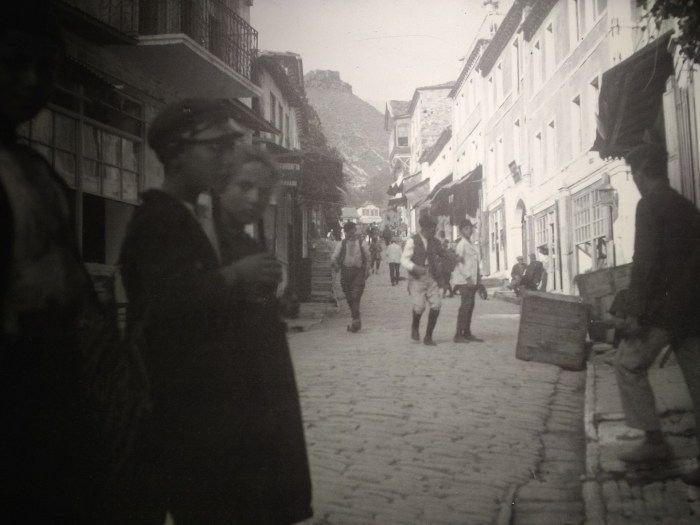
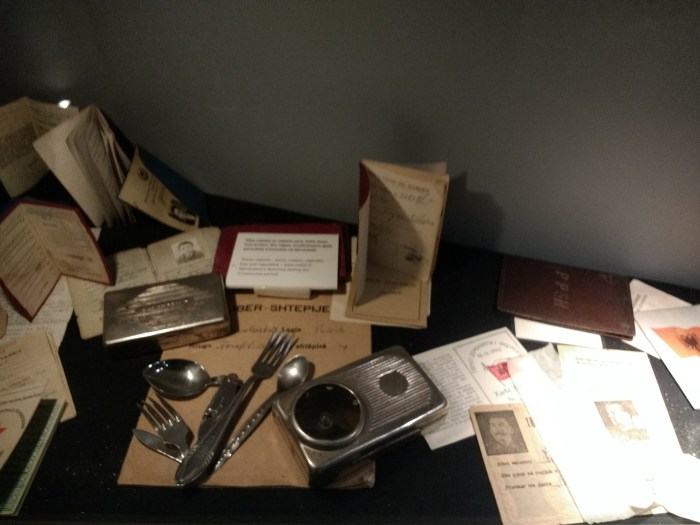
Some other interesting things I discovered in the museum about Gjirokaster include how fond the English landscape painter and poet, Edward Lear, was of the town. He visited two times in 1848 and 1859 on his travels through the Balkans. There are two black and white photographs which ignite my curiosity. One is a photograph of the old town from 1925 and the other is a photograph of locals hacking away with a hammer at the large town statue of Enver Hoxha after the fall of Communist rule in 1990. Although Gjirokaster is his place of birth and the town where he grew up, during his 41 year rule of Albania from 1944 until his death in 1985, he only visited his hometown a few times. There is also a display of miscellaneous ephemera from the Communist era such as political propaganda papers and identity documents.

IMG_6694

Painting of the fortress and the connecting aqueduct by the 19th century English painter and poet Edward Lear 


IMG_20171128_132136277

The old town of Gjirokaster in 1925


IMG_20171128_130943313

Locals posing by and hacking away at the statue of Enver Hoxha in Gjirokaster after the fall of Communism in the early 1990s


IMG_20171128_131326263

Objects and ephemera from the Communist period

From the top of the fortress, one is rewarded with a monumental view of the famous wide mountain of Gjirokaster. Ali Pasha’s clock tower is located near the end beneath the backdrop of the mountain. Elsewhere there is a large metallic dome shaped structure over a circular stage. This is where the National Folk Festival is held every four or five years.

IMG_20171128_133844191

The Ali Pasha built clock tower of the fortress of Gjirokaster

With less than a couple of hours remaining of light on these preciously short days, I make my way towards Zekate House; a grand Ottoman era house and probably the most spectacular of all the grand houses in Gjirokaster. It was built between 1811-12 and was a gift from Ali Pasha to Beqir Zeko (whom the house is named after) who built the house for him. It is located on a high slope over looking the rest of the old town. The view from the top of the house over Gjirokaster is just as epic as the view from the top of the fortress. The house is incredibly well preserved with almost all of its original features. One of the guest rooms comprises of ornate Ottoman style art on the walls and a beautifully designed wooden ceiling in the same style. Some of the windows feature multicoloured glass pains.

IMG_20171128_153759661

The grand Ottoman era Ali Pasha constructed Zekate House 


IMG_20171128_152247367

One of the guest rooms inside Zekate House

In the evening the temperature drops dramatically hovering around the -5/-6 Celsius mark. Even with the aircon unit going into overdrive to pump warm air it isn’t enough and dispite having all the blankets in the world, I consider sleeping in my clothes. All this aside, the guesthouse is very homely and Edmond and his partner did their very best to make my stay as pleasant as possible. Edmond organises his friend to collect me after breakfast the next day to drive me to a part of town from where my bus to the town of Berat, further north of the country before the capital of Tirana, would depart. His friend arrives in a black Mercedes Benz parked at the bottom of the path leading up to Edmond’s home. With hindsight I am glad I opted for a cab. I most likely would have got hopeless lost had I gone it alone. Edmond’s friend doesn’t speak a word of English and the young lady at the office of one of the bus companies is not much better. Fortunately I have my phone so I give Edmond a call and he communicates with both his friend and the lady. I later learn that the bus to Berat will be arriving at a later time. Two minutes later I am bundled into a white mini van destined for the Albanian town of Lushnjë from where I have to catch another bus to Berat. When I enter the van it is close to full capacity and I find a seat in the row of seats right at the back of the van.

Leaving Gjirokaster, we slowly descend to a lower plateau and the temperature becomes noticeably milder, but I am still wrapped up. There is no heating system in the van. Before we reach Lushnjë, the bus driver points to a sign indicating the direction to Berat. The driver speaks zero English yet he directs his hand pointing frantically to a small bay area by the connecting road. I assume a Berat bound bus will be stopping there? Still I am not sure so before disembarking the bus I make an impromptu call out to all the passengers on the bus beginning by asking whether anyone speaks English? Thankfully a young lady with dyed platinum hair comes to the rescue and is able to confirm in modest English that I need to go to the bay area the bus driver keeps relentlessly pointing at. I say the Albanian word for thank you, faliminderit, about a dozen times putting my right hand to my heart.

Like some travelling 1930s Mississippi Delta Bluesman, I trudge with all my stuff over to the other road and the small bay area. Within five minutes a Berat bound battered furgon appears and I nudge myself inside with my suitcase. I am dropped off somewhere outside of Berat from where I board a local bus to the centre. The ticket seller on the bus asks me in broken English what football team I support? I am not a football man but I tell him Tottenham. He looks at me and smiles, exposing a set of truly disgusting broken and jagged nicotine stained teeth; a sight so disturbing I conclude this is someone not suitable to be around young kids. ‘Chelsea!!!’ he howls at me in a voice so piercingly loud all the other passengers stop what they are doing.

IMG_20171202_110447916

Berat

From the centre of town I disembark with my suitcase and walk, via trusty Google Maps, to my guesthouse located in a quiet and desolate location on the margins of the centre of town. It is a small newly built bungalow home with a few rooms. The outside of the house is no great shakes, but the few rooms inside are all in immaculate condition. In spite of this the rooms are very cold and even the air con unit doubling up as a heater doesn’t sufficiently heat up the room. The floor is cold as ice and the bathroom is one big freezer with a wooden door. The owners, an old Albanian couple, have a heart of gold though and the price per night is ridiculously cheap and good value. Too good in fact, especially if you consider that the price included a very generous breakfast of assorted slices of ham, jams, bread, feta cheese slabs and cut pieces of cucumber and tomato. Yet the cold temperature of my room means I sadly have to move on to another place the following day. The second guesthouse I stay at is more expensive, but is closer to town, run by a lovely family and has warmer rooms.

IMG_20171202_120736821_HDR

The old Ottoman Gorica Quarter of Berat

Most of my stay in Berat is handicapped by ferocious torrents of rain. In fact the rain was so severe across most of the country that whenever I watched the national news it was all total mayhem; monumental floods, overflowing rivers, main highway roads blocked by mud and sludge etc. I was even wondering whether I’d make it on to Tirana on time? The entire second day of my stay in Berat was spent inside my room. When on the third day the rain still hadn’t softened, I was so determined not to spend another day bunkered in my room, I decided to brave the deluge. All I had was my small black umbrella I purchased from a vendor in the Omonia district of Athens for a couple of euros.

IMG_20171201_100611492

Castle walls of the old hilltop Kalaja neighbourhood in Berat

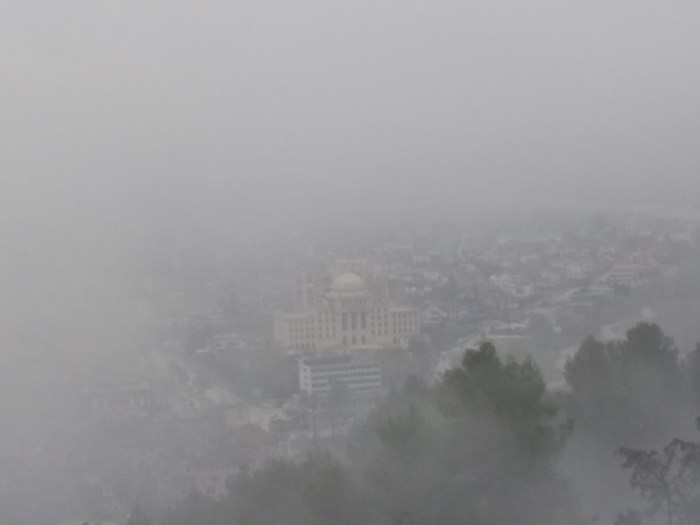
I wanted to visit the old Kalaja neighbourhood located on top of a hill within the walls of the old city castle. It is a quite a shlep to get there and with the lashing rain and low hanging clouds even more challenging. About two thirds of the uphill stone path have turned into rapid streams of water. I invariably step into the steams and my busted Vans are already soaked to the bone. Yet I persevere and make the entrance of the castle walls at the top of the hill. From where I am, all of the town below is smothered in substantial puffs of nimbus clouds.

IMG_20171201_112914632_HDR

A cloud smothered view of Berat from the historic hilltop Kalaja neighbourhood

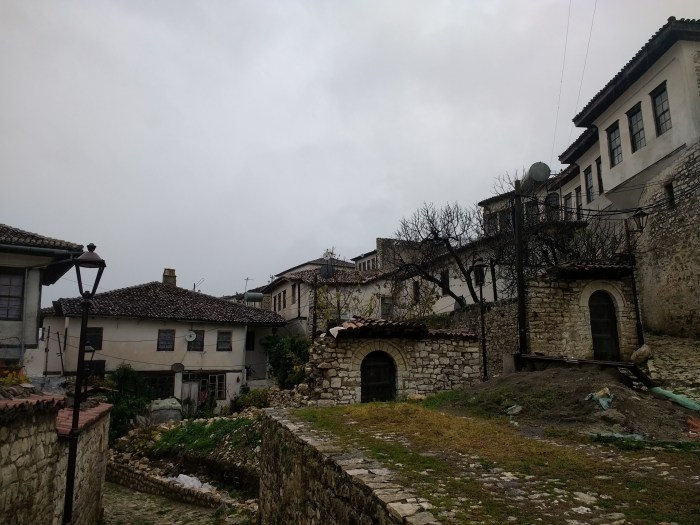
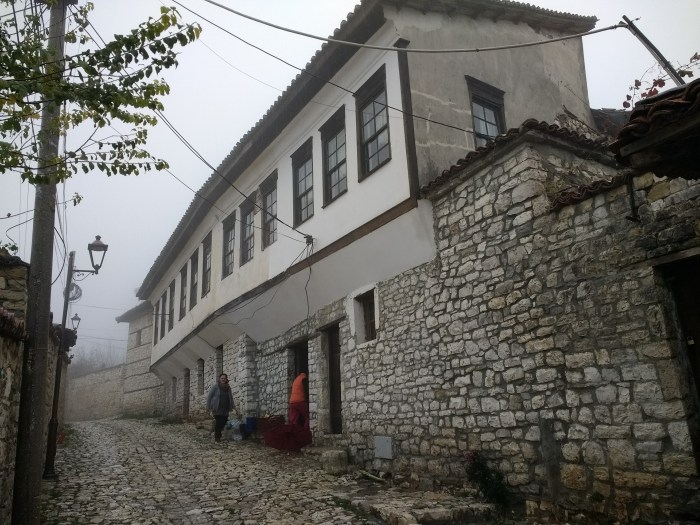
Yet I am glad I made it. The old neighbourhood within the castle walls is a gem of stunning old Ottoman architecture and narrow stone alleys and passages. Walking through this maze evokes mental images of passing though a slice of medieval England with a Turkish twist. It feels very authentic here and this is no museum. It is a living and breathing neighbourhood where locals go about their daily lives.

IMG_20171201_112538945

IMG_20171201_102411157

Photographs from the old Kalaja neighbourhood

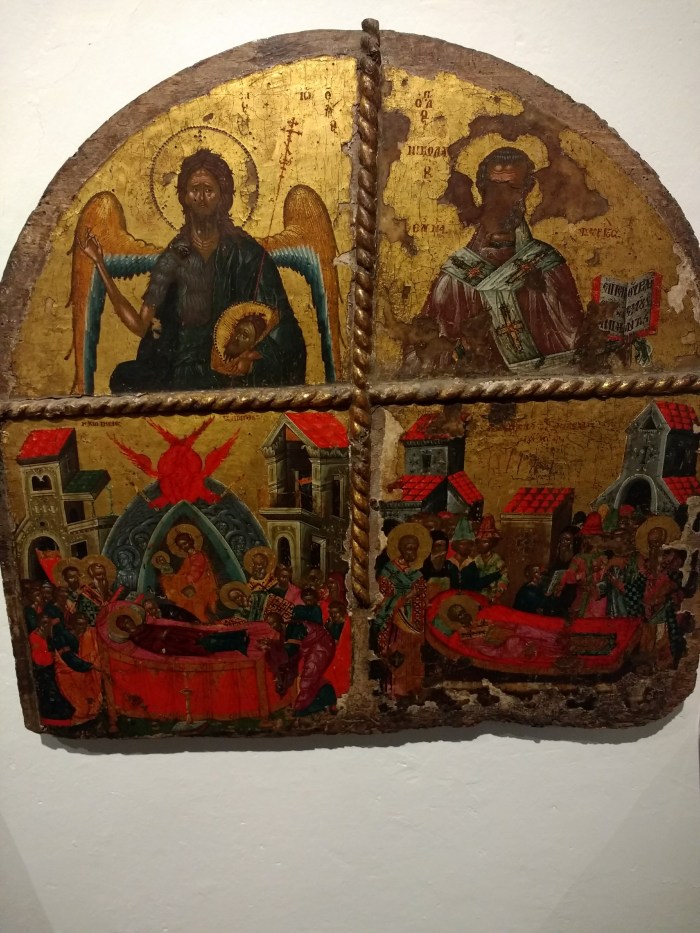
What is interesting is that for a long time Kalaja was a Christian neighbourhood and at one point had around 20 churches. Today there are fewer churches, yet the largest church in the district, the Church of the Dormition of St Mary (Kisha Fjetja e Shën Mërisë), is an old church still in existence dating back to 1797 and was constructed on the base of a church from the 10th century. This church is the site of the Onufri Museum. Onufri was a 16th century Orthodox icon painter and Archpriest priest of the Albanian town of Elbasan. He is considered the most significant icon painter of a group of Albanian icon painters from the 16th century who were instrumental in reviving the style of old sacred religious icon painting which flourished during the pre Ottoman Byzantine period. Some of his panel paintings are featured in the museum along with works by other Albanian Iconographical painters made between the 16th and 20th centuries. The enormous and ornate iconostasis situated inside the church is magnificent and one of the finest creations of the 19th century by the very best Albanian wood-carving masters. The iconostasis features two rows of icon paintings created by the ‘Grabovar’ icon painters from the Çetiri (or Katro) family under the leadership of the master icon painter Johan Çetiri. The carving of the iconostasis is documented to have been constructed by two master craftsmen, Masters Andoni and Stefani. It’s prohibited to take photographs but I am so blown away by the works that I sneak a cheeky pic on my Motorola smartphone.

IMG_20171201_103510533

The elaborate gilded 19th century iconostasis inside the Church of The Dormition of St Mary


IMG_20171201_111507667

16th century icon painting on wood by Onufri

Outside the church there is a display of black and white photographs of Berat from the early 20th century. They show scenes of life in the town including a photograph from 1918 of the old Gorica quarter of Berat with its many old Ottoman era houses all grouped together on the side of a hill.

IMG_20171201_110738923

Photograph of the Gorica Quarter from 1918


IMG_20171201_110910050

Photograph of the old bazaar from 1908

The rain is still fierce and by the time I return to my guesthouse my shoes, socks and rucksack are soaked. In the evening I have dinner at a local taverna restaurant called Weldor. I’ve already eaten there a few times and I am always served by a cordial young waiter who speaks faultless English. He’s never been to England but for many years he worked in a hostel run by a guy from Newcastle. The restaurant serves delicious and authentic Italian pizza, pasta and risotto dishes made by an Albanian cook who spent many years in Italy working as a chef. The local staples are also excellent and tonight I order a homemade casserole dish made with aubergines and served with some of the finest bread I have ever tasted.

IMG_20171201_191123663

Traditional Albanian cuisine at Wildor restaurant

By the next morning the rain has stopped and there are even some patches of blue in the sky. I seize this morning before I depart to Tirana to walk and explore the town in a way that was long denied to me. The main pedestrian promenade in the centre of town is covered in sludge. Already there are men at work with shovels and hose pipes trying to remove and wash away all the mud. Watching the people at work is like witnessing the aftermath of some natural disaster. I return to my previous guesthouse where I’d left my pyjamas. The owners greet me with a smile and hand me a plastic bag containing them. I tell them I am staying with a friend.

IMG_20171202_114752327

The aftermath of days of heavy rains, which flooded many parts of Albania

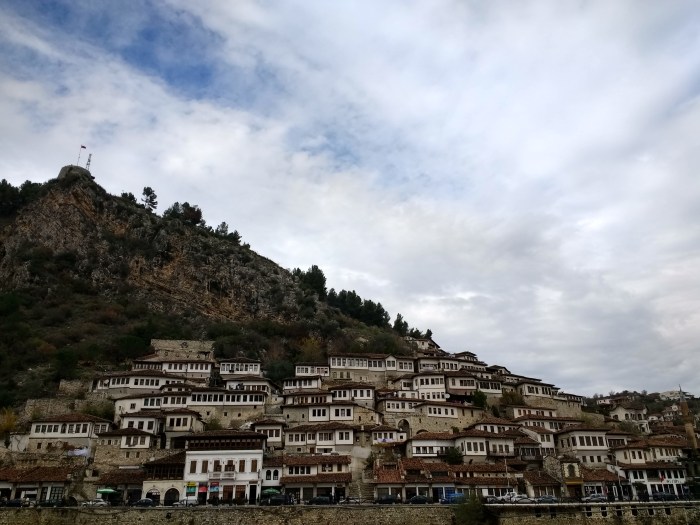
I walk over the river to the old Gorica quarter. Most of the cobbled paths are smothered in sludge with huge puddles making walking a challenge. From Gorica, I have a super view of the old town on the other side. Both this district and the old town are full of old classic Ottoman style houses each side mirroring the other and both responsible for this being known as the Town of 1000 windows.

IMG_20171202_114031789_HDR

The old town of Berat from the other side of the river

The family at my guesthouse arrange for me to go to Tirana via an acquaintance who will be driving there. I spend the remaining couple of hours of my time in the foyer with the family and their two adorable dogs, Spiky and Lucky, before a silver hatchback Golf pulls up to take me to my next destination.


By Nicholas Peart

©All Rights Reserved
Sarajevo History and Wonderings

IMG_20170916_185628_858

Visiting Sarajevo was an enriching and memorable experience. Even though I am a seasoned traveller who has already traversed across a sizeable chunk of this crust, Sarajevo impressed and inspired me. This city gave my accumulated travel experiences another exotic dose of red hot spice. Sarajevo is sometimes referred to as the “Jerusalem of Europe” owing to its rich multi religious and cultural history.

I stayed at a modest but homely and warm family guesthouse located up on a hill in the Bistrik district south of the Miljacka river and only a few minutes walk from the Ottoman era Baščarsija old bazaar district. This historic district was constructed in 1462 by the Ottoman Empire general Isa-beg Ishaković just after the Ottomans arrived. Before they arrived, the biggest settlement then in Sarajevo was a village square called Tornik located today at the junction between Marsala Tita and Relisa Dzemaludina Čauševica streets where the Ali Pasha mosque is situated several blocks west of the Baščarsija district. Ishaković built a mosque named “Careva Džamija” (the Emperor’s Mosque) in 1457, which is the oldest mosque in Sarajevo. The original structure was destroyed by the end of the 15th century before being rebuilt in 1565.

IMG_20170912_225945_504

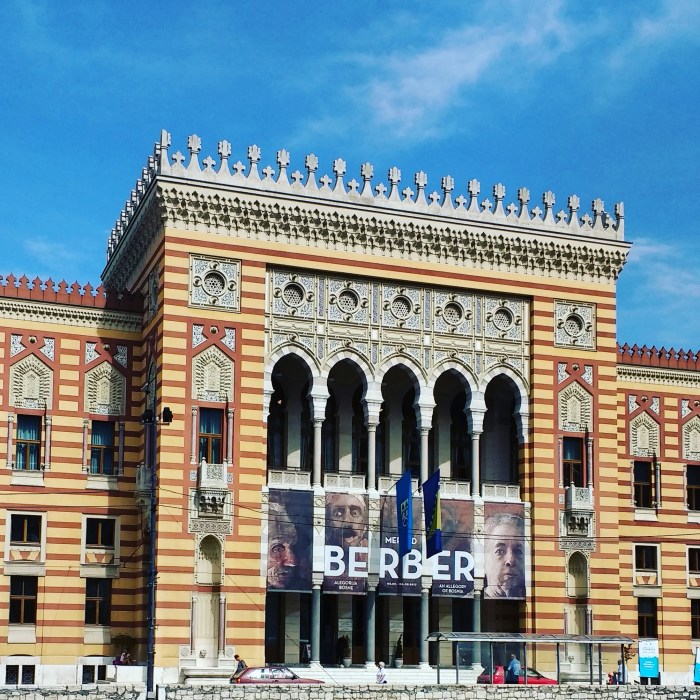
Sarajevo City Hall

Crossing over the Miljacka river and walking past the large Moorish style City Hall building, I commenced my adventure through the old Baščarsija streets. Most of the places along the first street I walked across are small eateries selling bureks; spiral pastry pies filled with potato, meat, cheese, or spinach and even pumpkin. On my first evening in Sarajevo, I took a chance on an authentic looking burek place with a magnificent open coal oven where the bureks and other specialities are cooked in large closed circular pans covered in crushed coals. The bureks here at Buregdžinica Asdž are very good and cheap.

IMG_20170914_204211_765

Buregdžinica Asdž: Great burek eatery in the Baščarsija district 

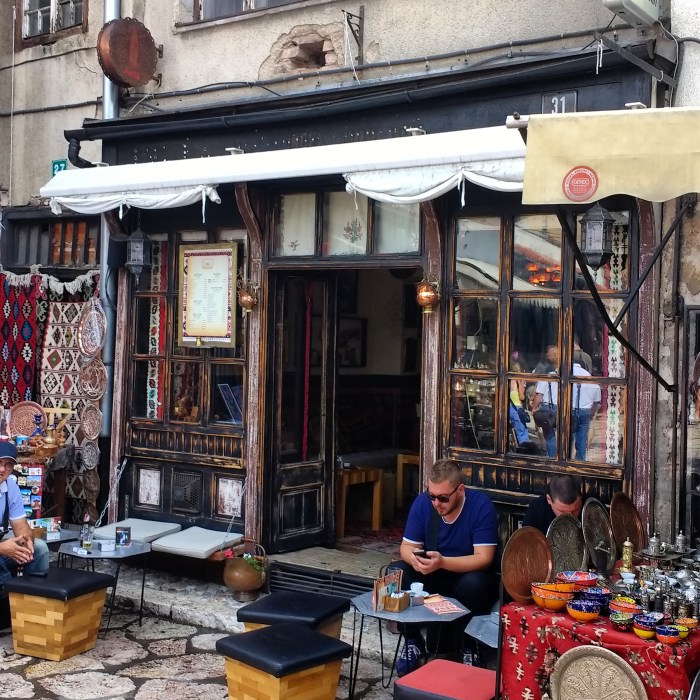
I venture down another smaller street and the oldest street in Baščarsija named Kazandžiluk street, better known as “Coppersmith Street” where small shops sell copper cups, plates, bowls and tankard-like jugs. Walking through this street feels like walking through one of London’s medieval streets around Fleet Street or St Bartholomew’s church with an Arabian tinge. At the end of this street there is an antique wooden coffeehouse where you can drink authentic Bosnian coffee.

IMG_20170912_223935_639

Coppersmith Street: the oldest street in Baščarsija 


IMG_20170912_224223_522

On Coppersmith street


IMG_20170912_225519_706

Wooden coffeehouse on Coppersmith street 

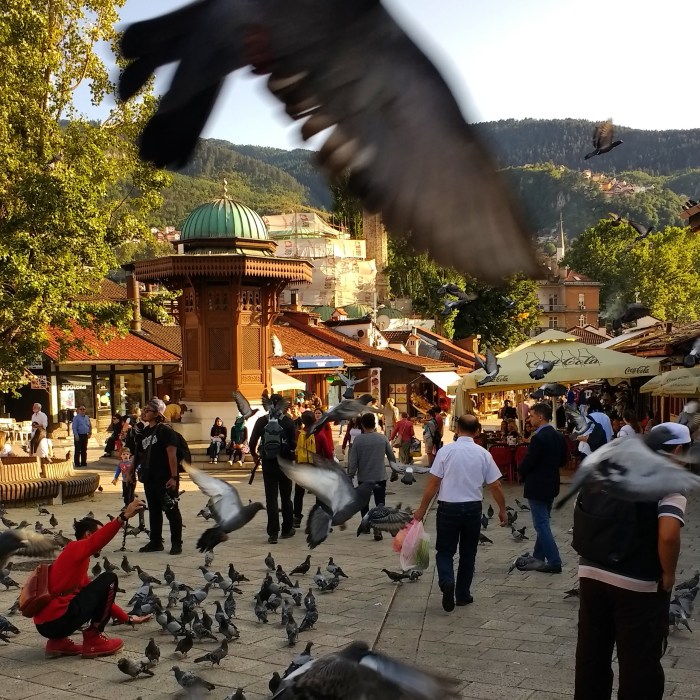
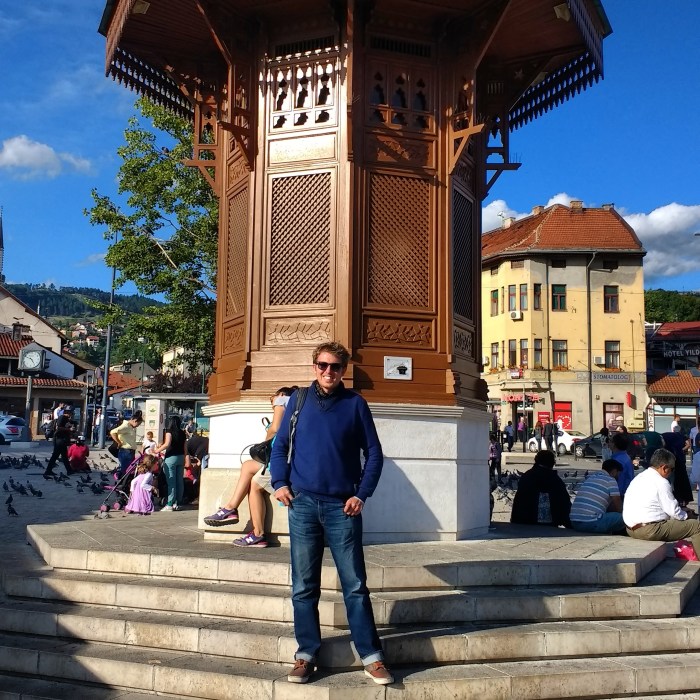
Anyone who visits Baščarsija will unavoidably cross paths with the main square or Pigeon Square as it’s sometimes better known as, because of the large concentration of pigeons at any given moment just like in London’s Trafalgar Square. In the middle of this square is an old Ottoman style wooden fountain called the Sebilj. It was originally built by Mehmed Pasha Kukavica in 1753 and then in 1891, during the Austrian-Hungarian era, it was repositioned by the Austrian architect Alexander Wittek.

IMG_20170914_185348_719

“Pigeon Square”: The main square in Baščarsija 


IMG_20170914_105342_399

By the Sebilj

Close to the Sebilj on Mula Mustafe Baseskije street is the old Orthodox Church of the Holy Archangelo Michael and Gabriel. It is a Serbian Orthodox Church and the oldest church in the city dating back to 1539 (although it’s original structure may date back even earlier).

IMG_20170912_223321_308

Old Serbian Orthodox church: The oldest in the city dating back to 1539

An integral part of my experience in Baščarsija was delving into the area’s history associated with Gazi Husrev-beg. Gazi was born in 1480 in Serres, Greece where his father, Ferhad-beg, was a governor. From 1521 until his death twenty years later in 1541, he was the Ottoman governor of Bosnia and had contributed immensely in the establishment of the city of Sarajevo. By the time of his death, Sarajevo had already developed into a thriving and successful trading center at the crossroads between east and west. He had invested most of his fortune (his endowment or ‘waqf’) towards the development of the city and was a great philanthropist and humanist who cared deeply about the welfare of his people.

IMG_20170914_191230_060

Gazi Husrev Beg mosque: built in 1531 and the largest in the country 

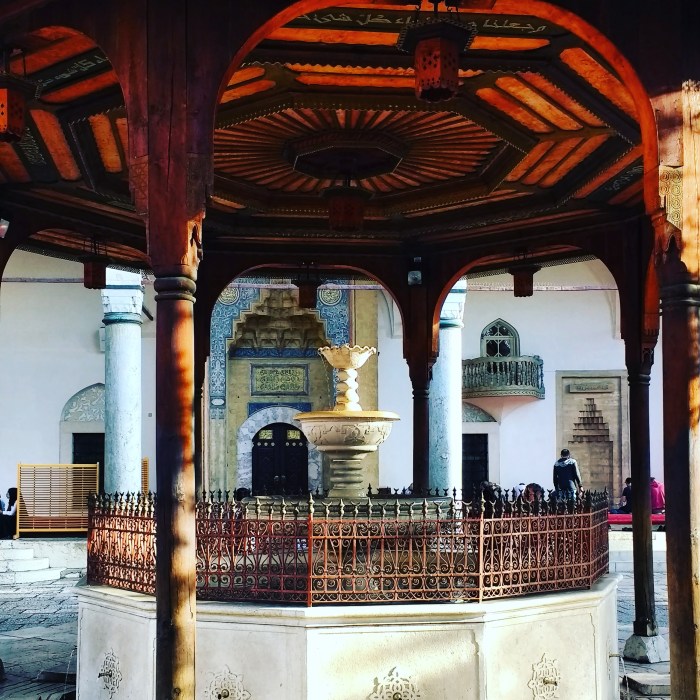
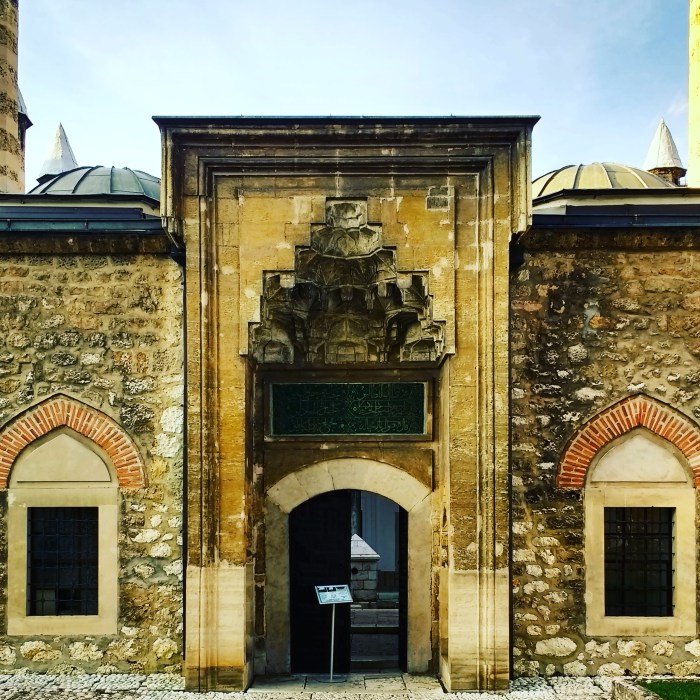
The most notable landmark associated with Husrev beg is the Gazi Husrev beg mosque built in 1531 and located in the heart of Baščarsija. It is the largest mosque in Bosnia and Herzegovina and an outstanding example of Ottoman architecture from that time. Within the mosque compound in the courtyard is an old fountain (‘shadirwan’) similar to the fountain in the main square yet this fountain is over 200 years older dating back to 1530. Situated on the west side of the mosque is the tall stone Sahat Kula clock tower built in the 17th century. It was restored after being damaged in a fire in 1697. The clock shows the lunar time meaning that the day ends at sunset after which a new day begins. Close to the clock tower, there is a water system created by Husrev beg for the city (he also built a public toilet in 1529 which back then was very rare) where the water was transported via ceramic pipes from a wooden aqueduct under the ground. Even today the water system is still in operation and locals (and tourists) continue to come to the fountain to drink the water. I drank from the fountain and I have to say that the water is some of the purest and freshest I’ve ever tasted. Also within the mosque complex is Husrev beg’s mausoleum.

IMG_20170912_230829_607

The Sahat Kula clock tower


IMG_20170914_191451_218

The old ‘Shadirwan’ fountain by the Gazi Husrev Beg mosque dating back to 1530


IMG_20170916_182453_540

The mausoleum of Gazi Husrev Beg


IMG_20170916_184526_891

Drinking from the Gazi Husrev Beg fountain. The water is excellent and comes from the oldest water system in the city dating back to 1529 and engineered by Gazi Husrev Beg

Opposite the mosque is the Ghazi Husrev beg Madrassa (or learning institute) built and established in 1537 for the education of the local population. Husrev beg stated that any money remaining after the madrassa had been built should go towards buying good quality books for the madrassa. Today the collection of those original books is housed in the new modern Gazi Husrev beg library which opened in 2014 and was financed via a $8m grant from Qatar. Within the old madrassa complex is the small Ghazi Husrev beg Museum, which is an excellent place to learn and understand more about him and his unique and generous contribution to the city of Sarajevo.

IMG_20170914_193300_826

By the entrance of the old Gazi Husrev Beg Madrassa which today houses the Gazi Husrev Beg museum 


IMG_20170918_205421_429

Gazi Husrev Beg museum 


IMG_20170918_210358_407

Gazi Husrev Beg library 

Yet the Gazi Husrev Beg journey isn’t over yet. Halfway between the mosque and the Sebilj is the Morića Han which was a ‘caravanserai’ or roadside inn. In its day it was able to accommodate as many as 300 travellers and 70 horses. It was built in 1551, 11 years after Gazi’s death, and funded using his endowment or ‘vakuf’. Since during this time Sarajevo was an important international trading centre, it was important to establish lodging facilities to accommodate travelling traders who travelled long distances via their horses often from other parts of the Ottoman Empire (which around the time the inn had been built had covered all of modern day Turkey and other parts of the Middle East, North Africa and almost all of south Eastern Europe). Today the Morića Han is transformed into a lovely historic courtyard with cafes and a small market bazaar selling textiles and various crafts.

IMG_20170916_185027_927

By the outside of the old Morića Han


IMG_20170914_193658_322

Inside the courtyard of the Morića Han 

Heading towards the western edge of Baščarsija is Gazi Husrev Beg’s Bezistan which is an indoor bazaar. The original structure of the bazaar was likely built around 1540 financed via Gazi’s endowment. During the period of the Ottoman Empire, the shops inside the bazaar traded textiles. Running parallel to the Bezistan is the old goldsmith street (Zlatarska) today known as Gazi Husrev Begova street where goldsmiths and jewellery shops owned by metal workers sold gold and silver jewellery.

IMG_20170916_182955_202

The entrance of Gazi Husrev Beg’s Bezistan 


IMG_20170917_155209_613

Inside Gazi Husrev Beg’s Bezistan


IMG_20170917_160327_441

The old goldsmith street of Baščarsija

The ruins of the original Tašlihan stone inn, constructed around the same time as the Bezistan to accommodate travelling merchant traders like the Morića Han, can be found in the summer garden of the historic Hotel Europe.

IMG_20170917_155827_812

The ruins of the original Tašlihan stone inn

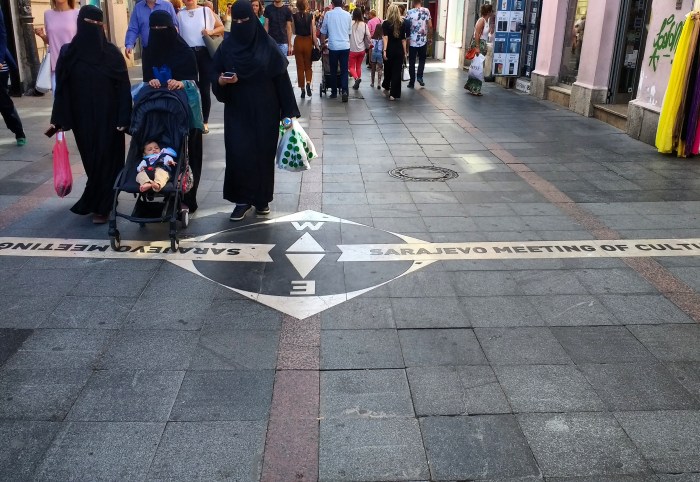
Leaving the Baščarsija and the eastern Ottoman part of the city we literally cross over to the western part of the city over the “East-West: Sarajevo Meeting of Cultures” line.

IMG_20170916_212204_775

The “East-West: Sarajevo Meeting of Cultures” line marking the border between the Ottoman eastern part of the city and the western part of the city  

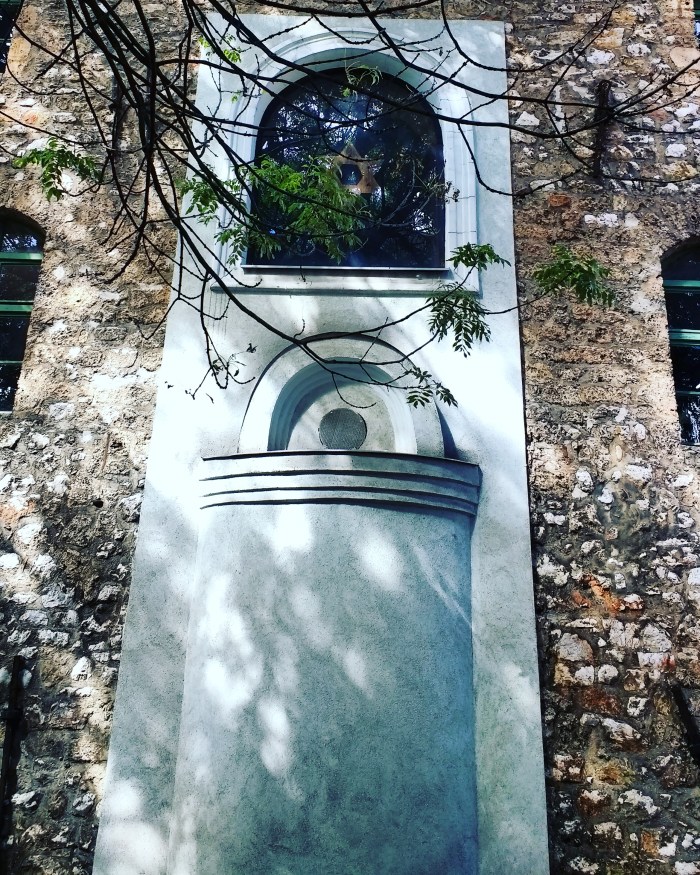
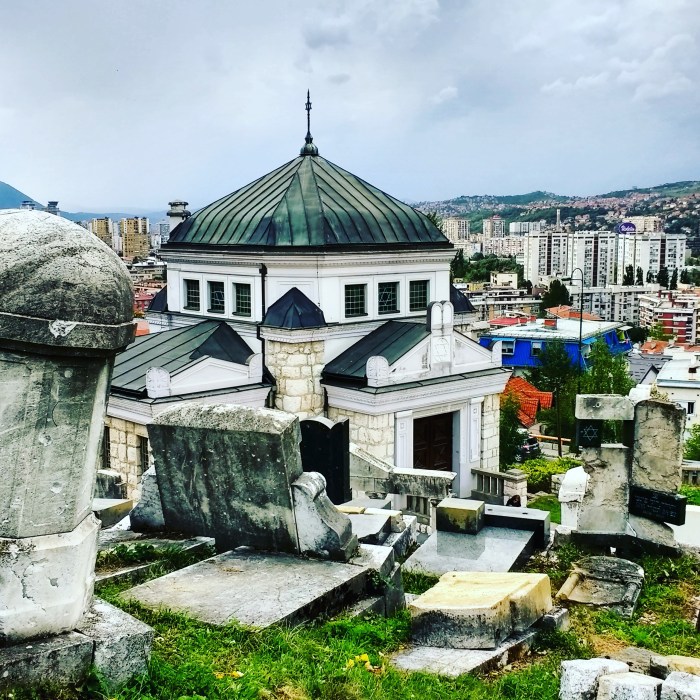
Our first port of call is the old stone Jewish synagogue built sometime towards the end of the 16th century. Since it’s establishment it was damaged several times before being reconstructed again. The current physical structure of the synagogue dates back to 1813. In 1941 it was raided and occupied by the Nazis and subsequently demolished. The Nazis detained Sarajevo’s remaining Jewish community here before they were taken to concentration camps. After enormous reconstruction, in 1966 the synagogue was turned into the Jewish Museum of Bosnia and Herzegovina.

IMG_20170918_202453_405

The old stone Jewish synagogue. In 1966 it was turned into the Jewish Museum of Bosnia and Herzegovina

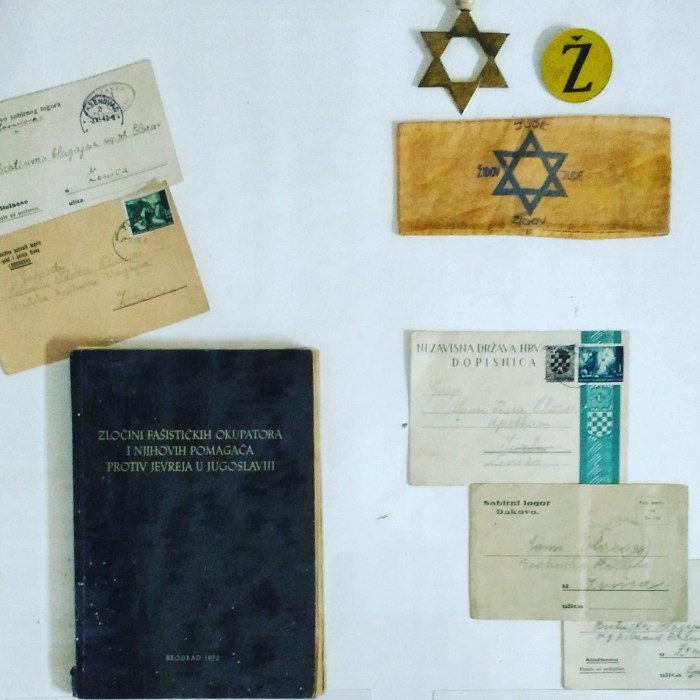
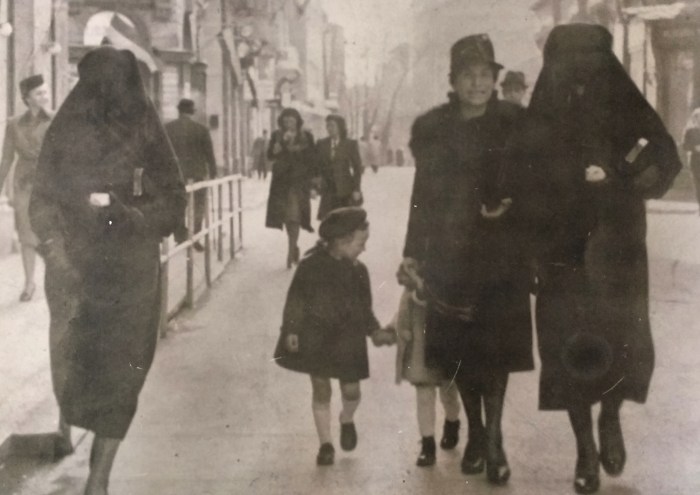
Inside the museum, there are various artefacts and fragments of traditional Jewish life in Sarajevo. There are moving and poignant displays and photographs from the time of the Nazi occupation in Sarajevo. Some of the written displays include stories of gifted Jewish teachers and intellectuals in Sarajevo whose lives were cut short by the Nazis. There is one black and white photograph from 1941, when it was a very dangerous time to be a Jew in Sarajevo (as in many other parts of Europe), showing a Jewish mother and her two children walking alongside two Muslim women. The Muslim woman in the right of the photograph is covering the Jewish woman’s Star of David symbol which she is wearing on her left arm.

IMG_20170918_204615_709

Paraphenalia in Sarajevo’s Jewish museum dating back to WW2 when the Nazis occupied Sarajevo and the city’s Jewish population was rounded up and sent to concentration camps. The postcards in the photograph are postcards from the concentration camps 


IMG_20170918_204955_000

Black and white photographs of captured Sarajevo Jews 


IMG_20170918_203831_130

Photograph dating back to 1941 showing a Jewish mother and her two children walking alongside two Muslim women. The Muslim woman on the right of the photograph is covering the Jewish woman’s Star of David symbol which she is wearing on her left arm

The history of the Jewish community in Sarajevo (and the rest of Bosnia and Herzegovina) dates back to 1492, the year when Christopher Columbus discovered the New World, and also the year when the first wave of Jews arrived in Bosnia escaping the Spanish and Portuguese Inquisitions. They were welcomed by the Ottoman Empire ruler of the time, Sultan Bayezid II. In the time when Bosnia and Herzegovina was part of the Ottoman Empire, the Jewish community prospered and were well-treated living peacefully with the Bosnian muslims. They had a large amount of freedom and rights including the right to buy property and land and establish trade in any part of the Ottoman Empire. By 1856, a law was passed within the Empire granting Jews (and other non muslims) full equality. The Jewish community continued to flourish during the subsequent Austrian-Hungarian Empire rule until the beginning of World War One. The rise of Nazism and the Second World War caused many Jews to flee Sarajevo and Europe. By 1940 there were around 14,000 Jews in Bosnia of which 10,000 were in Sarajevo. When former Yugoslavia was invaded by the Nazis in April 1941 most of the remaining Jewish population were deported to Auschwitz or concentration camps in Croatia. After the war, most of the Jewish survivors emigrated to Israel. Today only about 1000 Jews are living in all of Bosnia and Herzegovina. If you have some time, I recommend a visit to the city’s Jewish cemetery located outside of the city. The local tour agency Funky Tours combine a visit to the Sarajevo Tunnel Museum with a visit to the cemetery.

IMG_20170920_181401_177IMG_20170920_175404_100

Photographs from Sarajevo’s Jewish cemetery. You can see the effects of the 1992-5 Bosnian War from the shelling marks on the gravestones 

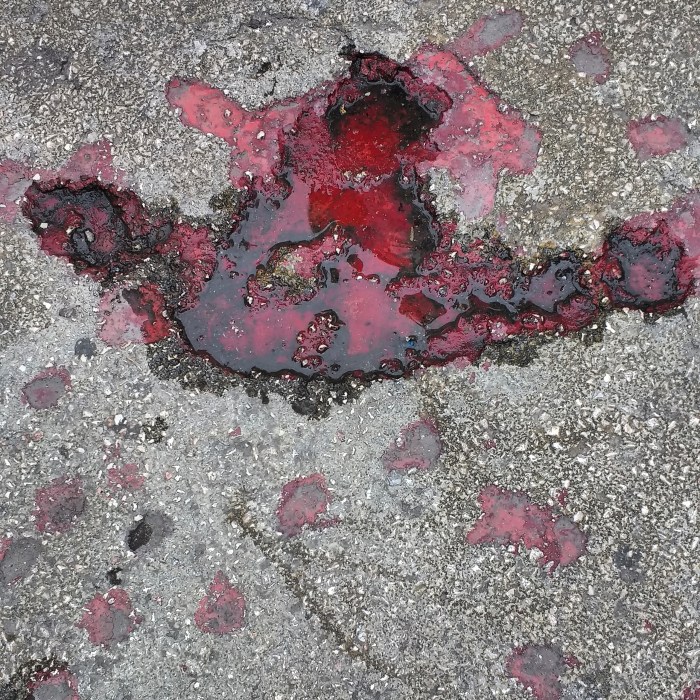
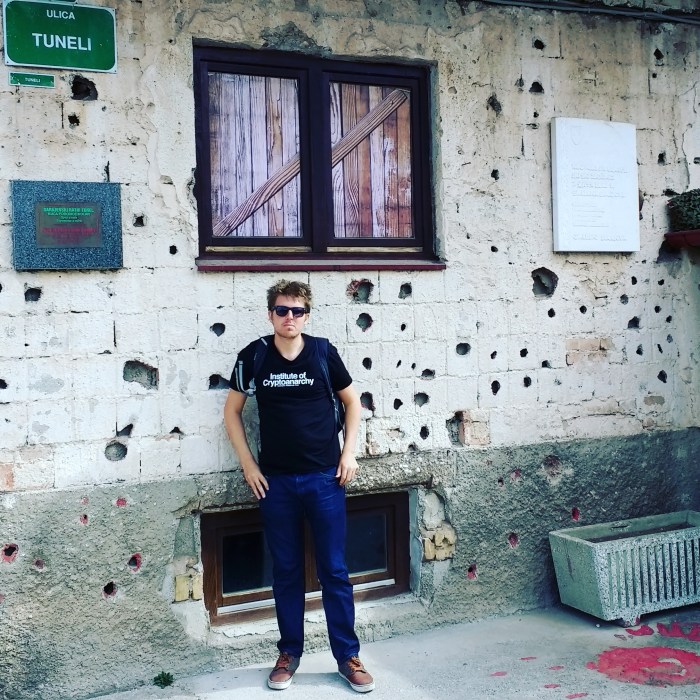
The western part of the city is full of elegant and ornate buildings dating back to the era of the Austrian-Hungarian empire hand in hand with austere, brutalist architecture from the post WW2 communist Tito years. If you look closely, you may notice many buildings still scarred by intense shelling when Sarajevo was under siege during the Bosnian War from 1992-5. You may also see shelling scars on the streets you walk on. Some of these scars are painted red and known as ‘Sarajevo Roses’ marking the location where civilians died from mortar explosions during the war.

IMG_20170916_111920_605

Architecture dating back to the time of the Austrian-Hungarian empire 


IMG_20170916_112711_678

Brutalist architecture in the city 


IMG_20170914_195632_138

Scars from the 1992-5 Bosnian War


IMG_20170916_102041_722

‘Sarajevo Roses’: red painted street scars from the war marking the locations where civilians died from mortar explosions during the war

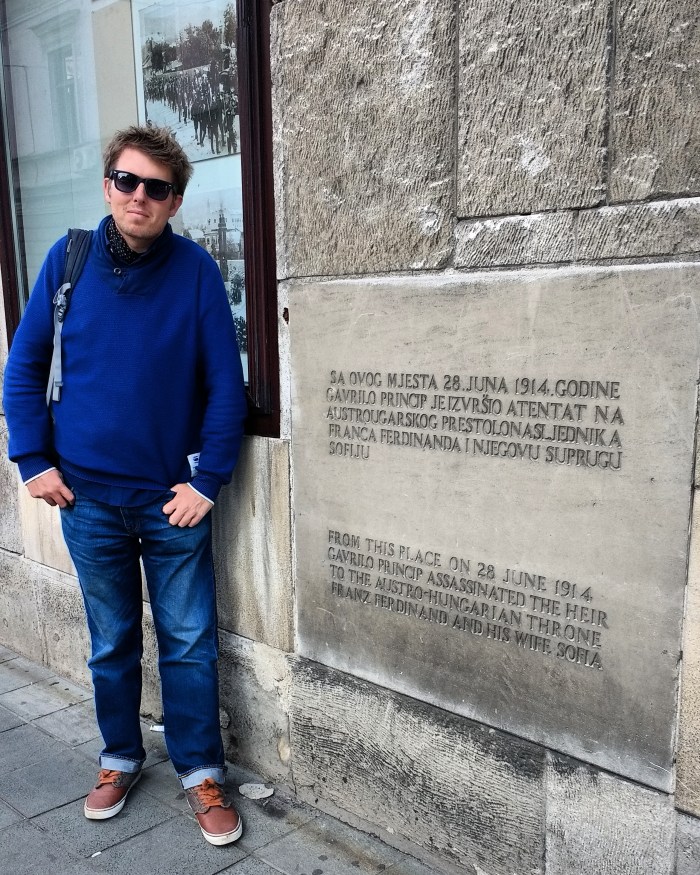
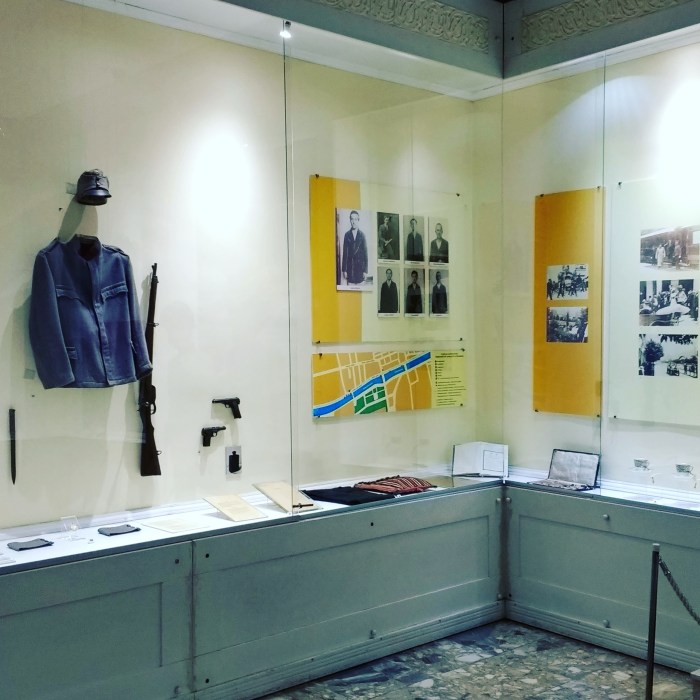
On the corner of Obala Kulina Bana street by the main river and Zelenik Beretki street is the Museum of Sarajevo 1878-1918 and the location from where the young Bosnian revolutionary Gavrilo Princip assassinated Archduke Franz Ferdinand who led the Austrian-Hungarian empire. His assassination was the catalyst for the First World War and the collapse of the empire. The museum documents the period of Austrian-Hungarian rule in Sarajevo as well as the assassination featuring photographs of the Archduke with his wife in their car after they were both shot, and original artefacts like the trousers Gavrilo Princip was wearing and the gun he used to assassinate the archduke.

IMG_20170914_194902_827

At the location from where Gavrilo Princip assassinated Archduke Franz Ferdinand


IMG_20170918_201517_069

Inside the Museum of Sarajevo 1878-1918 which houses the trousers Gavrilo Princip was wearing and the gun he used to assassinate the Archduke


IMG_20170918_201831_563

Original photograph of the Archduke with his wife in their car just after they were both shot

Walking back towards Ferhadija street and west, you will eventually come face to face with the Sacred Heart Cathedral of Sarajevo, which is the largest cathedral in Bosnia and Herzegovina dating back to 1884, only a few years after the city came under Austrian-Hungarian rule. Viennese contractor Baron Karl Schwarz along with supervising architect Josip Vancaš designed the cathedral in a neo-Gothic style.

IMG_20170917_162545_706

The Sacred Heart Cathedral of Sarajevo: the largest cathedral in Bosnia and Herzegovina dating back to 1884

Close to the cathedral is the Orthodox Church of the Most Holy Mother of God, which faces Liberation Square. Here you will see locals playing chess like they have all the time in the world; un-restless and un-hurried.

IMG_20170916_181047_958

Orthodox Church of the Most Holy Mother of God


IMG_20170916_181427_860

Chess on Liberation Square

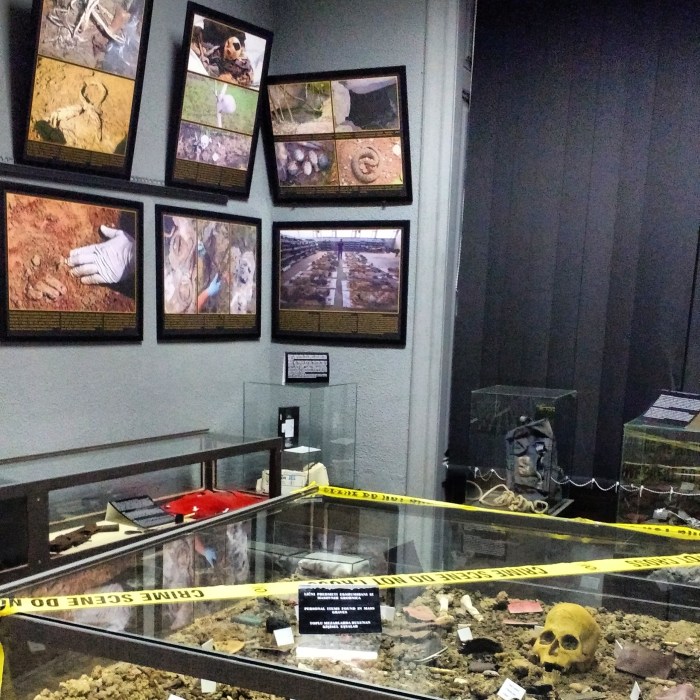
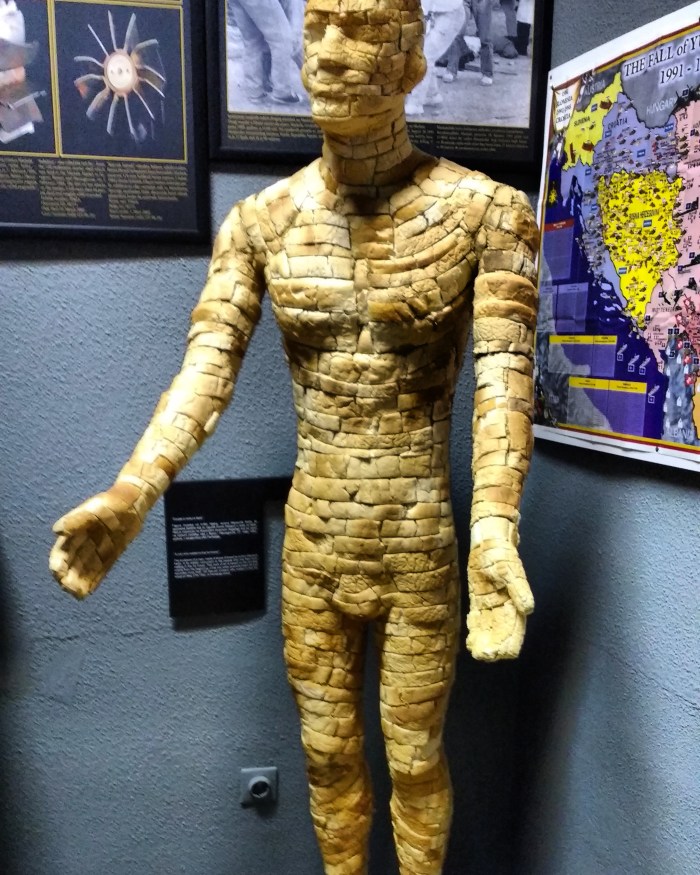
Not far from the square is the Museum of Crimes Against Humanity and Genocide which the documents the 1990s war in Bosnia and Herzegovina. Amongst the many photos documenting this horrific period there is a display of a dug up mass grave where one can see a human skull, bones and miscellaneous scattered personal items. During the war 34,946 civilians went missing in Bosnia and Herzegovina and more than 5,000 locations containing body parts and mass graves have been discovered across the country. Through conventional methods of clothes/items recognition and more advanced DNA analysis, about 23,000 victims have been identified. Yet around 7,000 people as of today are still missing. Elsewhere there is a display of torture methods and devices used on victims during the war. On one wall there are graphic photographs of victims exposing shocking injuries inflicted on various parts of their bodies and photographs of war refugees cramped and lying on the floor of a building in sleeping bags to keep warm. On another wall there is a framed letter from Arnold Schwarzenegger to a Bosnian heavy weights star who lost members of his family in the war. In the letter Arnold tells him, in spite of all the trauma and destruction from the war, to move forward and take care of his mother. He also mentioned enclosing gifts in the letter. As I near the end of the Museum there is a sculpture of a man made from slices of bread by Mensud Kečo dedicated to the victims of the May 27th 1992 bread queue massacre. 26 civilians were killed and over 100 were wounded as they queued for bread on Ferhadija street.

IMG_20170917_163559_353

Mass grave display at the Museum of Crimes Against Humanity and Genocide


IMG_20170917_164007_828

A sculpture of a man made from slices of bread by Mensud Kečo dedicated to the victims of the May 27th 1992 bread queue massacre on Ferhadija street

To gain a good understanding of the Siege of Sarajevo, I embarked on a half day tour with Funky Tours. My guide was a middle aged man named Adnan who experienced and lived through the siege and was injured in his hip by flying shrapnel. With his unique experience he is also a charismatic and engaging guide, and it was riveting to listen to his stories. On this tour we visited the Sarajevo Tunnel located on the outskirts of the city. It was built discreetly by the Bosnian Army to link the neighbourhoods of Butmir and Dobrinja. At the time the entire city was surrounded by the Bosnian Serb army and it was very difficult to escape. Civilians were trapped and the tunnel enabled them to flee and get access to essential humanitarian aid. Today the house whose cellar acted as the entrance to the tunnel has now been transformed into the Sarajevo Tunnel Museum. When we entered the house we walked down the narrow 20 metre length portion of the original tunnel from its entrance. Inside the house there are photographic displays and War artefacts like military uniforms and equipment and also some examples of the humanitarian aid and food staples smuggled via the tunnel.

IMG_20170918_015519_109

By the Sarajevo Tunnel Museum


IMG_20170918_015810_237

Inside the Sarajevo Tunnel

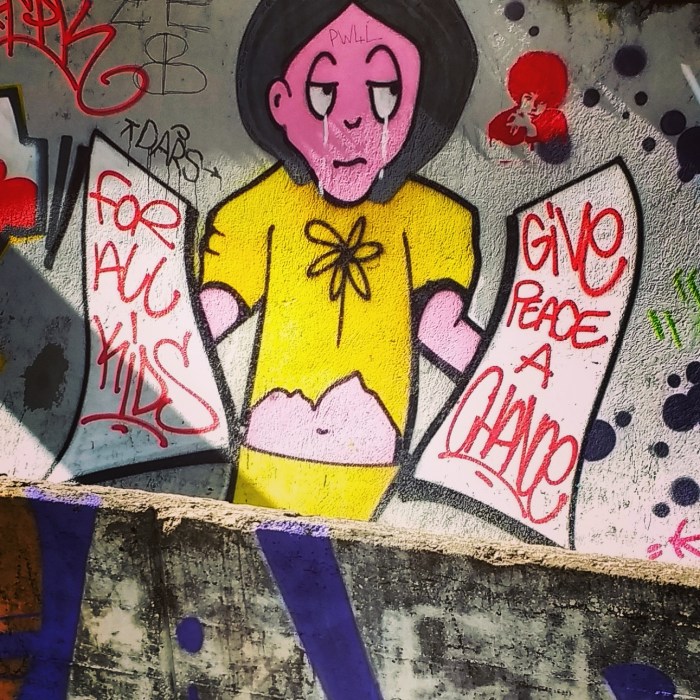
Afterwards, Adnan drove us to the bobsleigh track built for the 1984 Sarajevo Olympics. Eight years later from the start of the Bosnian War, the track was destroyed by the Bosnian Serb Army and also utilised as an artillery position. Today the track is a heavily graffitied relic. One area of the track has been graffitied with the image of a young girl crying wearing a yellow shirt with a flower. She’s holding two signs in each hand. The right sign features the John Lennon and Yoko Ono slogan ‘Give Peace A Chance’ whilst the left sign continues the sentence with ‘For All Kids’.

IMG_20170918_021526_297IMG_20170918_020843_545

Bobsleigh track photographs


IMG_20170918_020305_243

View over Sarajevo 

Close by the track we stopped at the side of a mountain road from where we had an incredible vista of the city of Sarajevo and its surroundings. All of the city is located in a valley surrounded by mountains. As magnificent as the scenery is, the heartbreaking truth is that such as setting made it relatively easy for Bosnian Serb Army troops to almost completely surround and lock the city.


Text and photographs by Nicholas Peart

©All Rights Reserved


Visiting Mokra Gora and Višegrad

IMG_20170907_191723_373

The countryside of Serbia is truly extraordinary. After experiencing Belgrade, I decided to spend a week in the southern Serbian mountain town of Zlatibor. At around a kilometre above sea level, it has a cooler climate and made a welcome change to the melting Satan-hot summer temperatures of Belgrade. It has been said that Zlatibor has some of the cleanest air in all of Europe. Zlatibor is a resort town and is a very popular skiing destination for Serbians in winter. For a week I had my own mini studio-cube apartment at the top level of a warm family home on the outskirts of town.

Zlatibor is also a launchpad from which to visit the region’s surrounding areas of which there are many gems. However without your own vehicle it can be challenging to visit these places. Fortunately I met a very interesting and knowledgeable young man named Bogdan who has his own small tour business. It was already the beginning of September when I arrived in Zlatibor and by then much of the peak August crowds had left meaning the town wasn’t over crowded and finding/extending accommodation was never a problem.


Mokra Gora

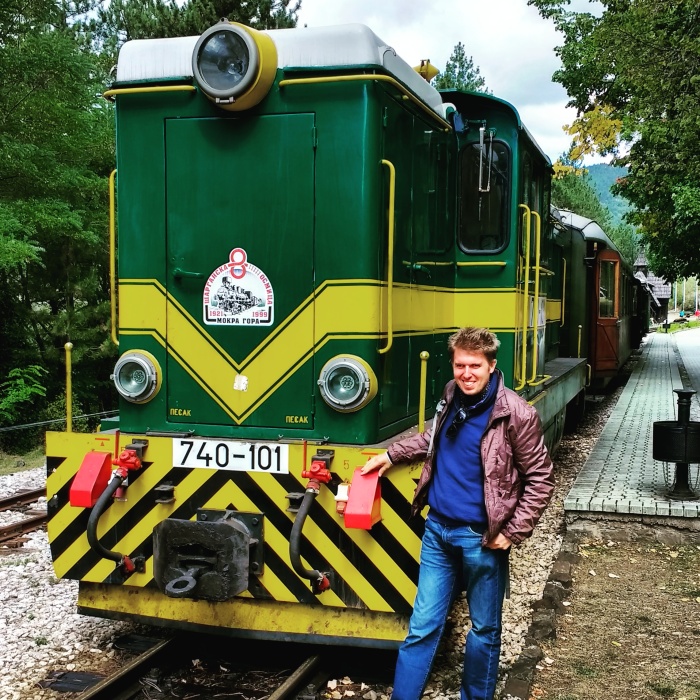
One day I embarked on a day tour with Bogdan and a small group of Serbian tourists to the nearby region of Mokra Gora close to the Bosnian border. Mokra Gora is an authentic and traditional slice of the Balkan country with some magnificent vistas. For the first leg of our Mokra Gora excursion, Bogdan drove us from Zlatibor to Mokra Gora railway station, from where we would travel on an old school train on the short but memorable Sargon Eight narrow-gauge railway line. This line was originally built in 1921 just after the First World War. It took four years to build and is over 15km long. The construction of the line was increasingly gruelling and often life threatening. 3,000 – 5,000 workers were involved in its construction and 200 died. As well as laying down the track, 22 tunnels and 5 bridges were built to make way for the line. The longest tunnel has a length of 1669 metres.

IMG_20170906_124317_173

By the Ćira train on the Sargon Eight narrow-gauge railway line

Rather tragically, not long after the railway line was completed, it became abandoned and defunct. It was only in 1999 when it re-opened as a tourist attraction. The classic and vintage narrow gauge train is known as the “Ćira” train. Being on this train brings back happy childhood memories of riding the famous Bluebell Railway train in East Sussex. The spirit of Thomas the Tank Engine throbs. All that is missing is Ringo Starr. I can imagine him being the conductor of that train in another life, taking ample swigs from a cheap bottle of plum rakija in the colder winter months whilst entertaining passengers with off-beat anecdotes via the tannoy.

IMG_20170906_121447_712

Mokra Gora

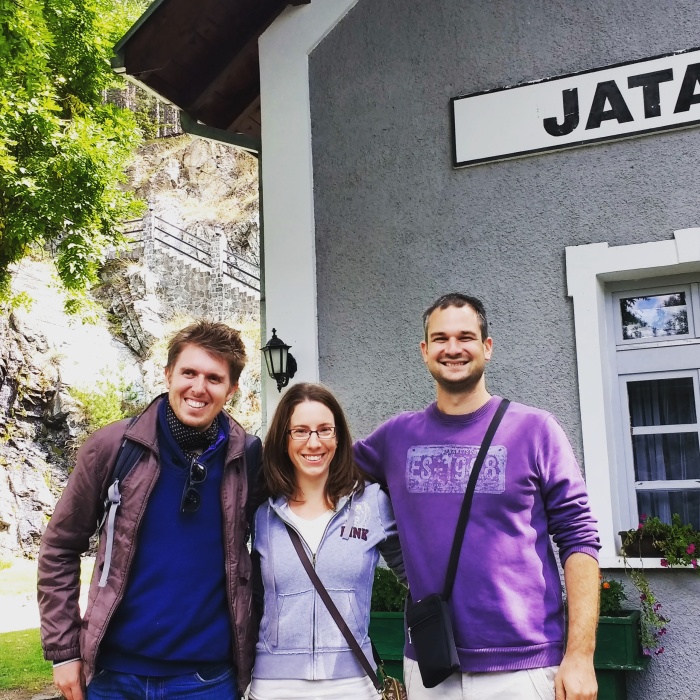
The landscape and views throughout the train journey are sublime. It is a true joy to ride on this train and simple stare and marvel at the fertile green mountain scenery. All that hard graft to build the railway line was not all in vain. The first station we stop at is called the Ninth Kilometre. It is so-called since there are nine kilometres between the station and the Bosnian border. Then we stop at Jatare Station. Here I take a short hike up a small rocky hill with a young Serbian couple from Belgrade for some lovely vistas. Jatare used to be a water station and resting place and is also known by the fact that not one ticket was ever sold at the station.

IMG_20170906_124656_212

In Jatare with some Serbian friends

We make a few more stops to admire the country scenery before returning to Mokra Gora station where we are reunited with Bogdan. From here we travel to a nearby small village called Bela Voda, which is well known for its natural spring with healing water. The water is known to cure and treat skin diseases. What is also unique about the water here is it is highly alkaline with a pH of 11.5 and is ranked as 5th in the world in terms of its pH level. In addition to treating skin diseases, the water can be drunk in small doses and can cure stomach ulcers and gastritis. It is good for digestion and is also known as ‘eye water’ since it can treat eyelid inflammation.

IMG_20170904_131838946

Bela Voda

Bela Voda is a paradise of a place with an attractive cherry-red stone church by the water stream, which augments the beauty and etherealness of this special village. I fill my empty bottle with some of this water from the well. Nearby there are wooden huts that are available to rent. I think to myself how delightful it would be to spend a long summer here completely forgetting any notions of time and space.

IMG_20170904_153221402

Drvengrad

From Bela Voda, Bogdan drives us to a hillside village not far from Mokra Gora railway station called Drvengrad. This completely wooden village was built by the Serbian filmmaker Emir Kusturica for his 2004 film Life Is A Miracle. It’s a unique, brilliant and unusual place with small streets and squares named after famous filmmakers, writers, visionaries, revolutionaries, sports-stars etc. I’ve written a separate article on the wonders of this magical place in another article which can be viewed here.


Višegrad

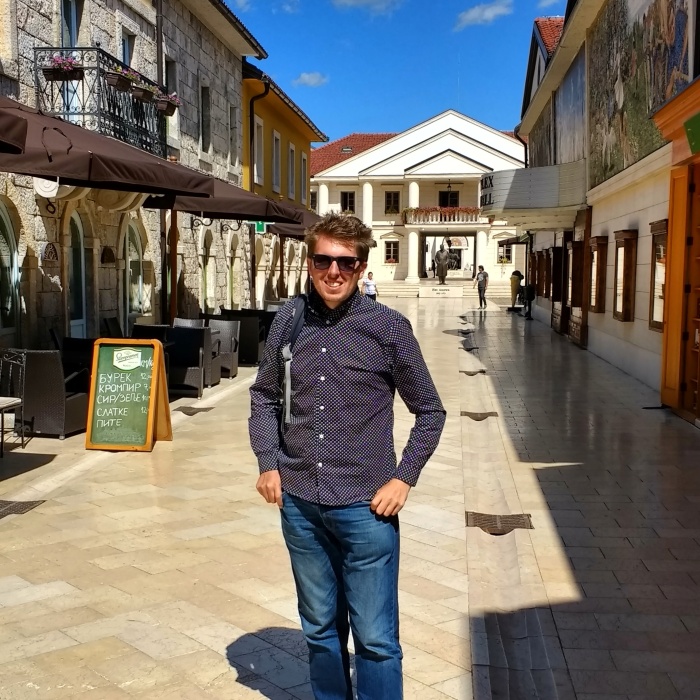
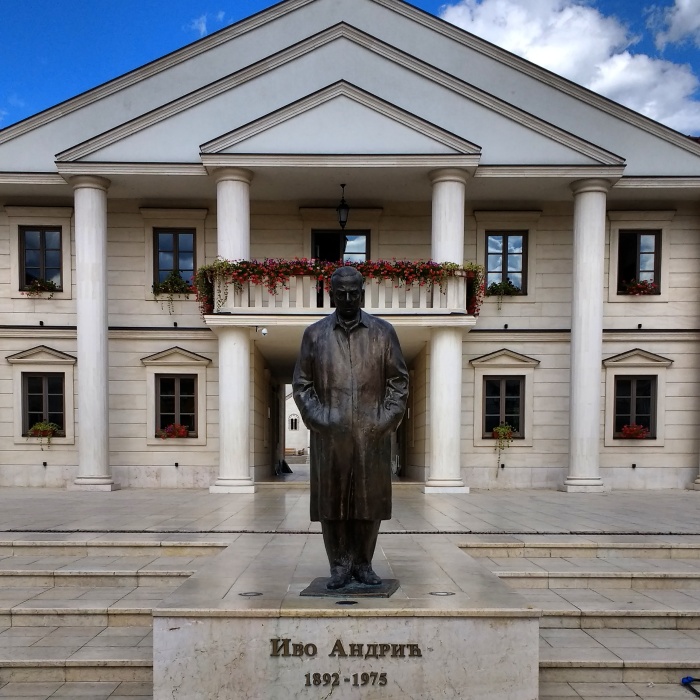
Early in the morning the next day, I meet up again with Bogdan for another tour this time visiting the historical Bosnian town of Višegrad. Višegrad is famous for its landmark Ottoman-era Mehmed Paša Sokolović Bridge, which is a UNESCO world heritage site and was the bridge immortalised in the Nobel prize winning writer Ivo Andrić’s novel The Bridge On The Drina. It is also the site of another village complex built by Kusturica called Andrićgrad after Ivo. Unlike Drvengrad, this village is completely made from stone and there is a statue of Andrić.

IMG_20170907_180212_247

Dobrun monastery

Before crossing the Bosnian border, we make a stop at the old monastery of Dobrun, which was constructed in 1343 by Duke Pribil and his sons Stefan and Peter. Originally all of the interior of the monastery was decorated with frescoes. Today, just a fraction of those original frescoes survive. Fortunately the one of Tsar Dušan with his wife Jelena and their son Uros still remains. Tsar Dušan, who was also known as Dušan the Mighty (born in 1308 – died on 20 December 1355), was the King of Serbia from 8 September 1331 and the Emperor of the Serbs and Greeks from 16th April 1346 until his death in 1355. This was the golden age of Serbia and at the time of his death, the Serbian Empire included most of modern day Greece, Albania and large swathes of former Yugoslavia.

IMG_20170907_182332_396

14th century fresco of Tsar Dušan with his wife Jelena and their son Uros inside the monastery 

Unfortunately since the era of Tsar Dušan, the monastery was under attack on several occasions. The first attack came in 1393 when the Ottoman Turks occupied Bosnia. Yet it faced the greatest destruction during the Second World War when it was used by the Germans to store ammunition. On their withdrawal in 1945 at the end of the war, they blew up the monastery. It was restored the following year. In spite of the monastery’s turbulent history, it is a handsome and immaculate building in beautiful surroundings. The decoration of the front facade of the monastery is a work of art.

Afterwards we cross the border and head to Višegrad. In 1454 Višegrad was conquered by the Ottoman Empire headed by Osman Pasha. The town remained under the empire for over four centuries until 1878 when the Austro-Hungarian Empire controlled Bosnia and Herzegovina. More recently, the town suffered greatly during the Bosnian War from 1992-5. Much of the town was bombarded by JNA (Yugoslavian National Army) troops and many houses were destroyed and an estimated 3,000 Bosniaks were killed.

IMG_20170907_191723_373

The landmark Ottoman-era Mehmed Paša Sokolović Bridge in Višegrad

Most of the arches of the famous bridge were badly damaged (and some even completely destroyed) during both world wars. The bridge was also the scene for the killing of hundreds of Bosniaks by Bosnian Serb forces during the Bosnian War.

IMG_20170908_234426_162

In Andrićgrad

Filmmaker Emir Kusturica’s nearby village complex, Andrićgrad (also referred to as Kamengrad or ‘Stonetown’), officially opened on 28th June 2014 to mark the 100th year anniversary of the assassination of Archduke Franz Ferdinand by the young Bosnian revolutionary, Gavrilo Princip. When you enter the complex and walk along the Main Street with cafes, you may notice two large rectangular mosaic murals by the Multiplex Dolly Bell cinema. The first one features Gavrilo Princip with other members of the Young Bosnian movement who wanted to end Austrian-Hungarian rule in Bosnia by assassinating the Archduke. This led to the start of the First World War. In the other mural a group of men featuring Kusturica appear to be engaged in a ‘tug of war’. In a way this mural is a homage to the perseverance and resilience in realising Kusturica’s vision of Andrićgrad. Looking at the mural more closely, you may notice the Serbian tennis star Novak Djokovic in the background.

IMG_20170909_213542_777

Mural of Gavrilo Princip and members of the Young Bosnian movement 


IMG_20170909_212015_197

Mural of Kusturica (with Milorad Dodik, president of the Republika Srpska) and Novak Djokovic in the background 

The town’s style is a mix of Ottoman, Byzantine, Renaissance and Classical periods of architecture which reflect the history of Višegrad. There are statues of Ivo Andric, scientist and visionary Nikola Tesla and Petar II Petrović-Njegoš, who was a Prince-Bishop of Montenegro as well as an important poet and philosopher who’s works are seen as some of the most significant in Montenegrin and Serbian literature. In addition to his literary talents, Njegoš is seen as one of the fathers of the modern Montenegrin state and Kingdom of Montenegro, and for his struggles with the Ottoman Empire as he tried to expand Montenegro’s territory. His poem Gorski Vijenak (The Mountain Wreath) is considered a classic and it became the Montenegrin national epic. It had a big influence on Gavrilo Princip, who knew it off by heart. The poem is significant for many Serbians as its a reminder for them of their solidarity with Montenegro against the Ottoman Empire.

IMG_20170909_211536_267

Statue of the writer Ivo Andrić whom Andrićgrad is named after


IMG_20170909_210830_111

Statue of Petar II Petrović-Njegoš by the Crkva Svetog Cara Lazara orthodox church

Aside from the bridge and Andricgrad, Višegrad is a small but interesting city to explore on foot. If you have the time, walk along the bridge to the other side of the river. From there you can take a walk up one of the hills along a heavily debris laden path. From the top you have an incredible birds eye view over Višegrad.

On the way back down, keep on walking along the other side of the river and very soon you will stumble upon the childhood home of Ivo Andrić. It is a crimson-pink house, but it’s not possible to enter since it is a private residence.

IMG_20170908_231734_974

The childhood home of Ivo Andrić in Višegrad

Just before I left Višegrad for Zlatibor, I was at a small cafe close to the bridge where I had an exceedingly good slice of baklava cake. Oh boy it was so good. If I could remember the name of the place I would tell you, but alas I can’t.


By Nicholas Peart 

©All Rights Reserved
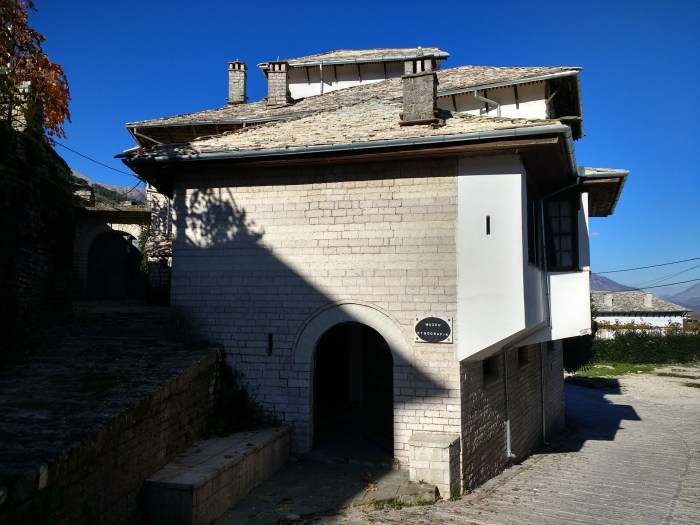


References

Wikipedia

-srbvoz.rs

-panacomp.net

-“The Town That Emir Kusturica Built” : excellent article by Peter Aspden in the Financial Times, where he writes extensively about Andrićgrad and also features an interview with Emir Kusturica

Investigating Belgrade’s Art Scene

21224635_832989996868999_7311805797053235200_n

If anyone had a chance to look at my photographs from Belgrade’s Savamala district one could not unreasonably come to the conclusion that Belgrade is art. It may not be an ostentatiously lovely city like Paris or Prague with its magnificent buildings (although there are many impressive buildings here) but it has an atmosphere that is hard to beat. Many people have compared Belgrade with Berlin and for many years Belgrade has been touted as the ‘new Berlin’. I love Berlin too and there are obvious similarities but comparing the two cities is unhelpful. Yet its unavoidable. For many years Berlin was and still is one of the world’s premier cities for artists to reside. It’s close competitors are London and New York yet unlike those two cities Berlin for a long time was a much more affordable city for artists to live. But recently some artists in Berlin have began to feel the pain of increasing rents in the city and thus are forced to seek out other cities. But I digress. I find Belgrade an atmospheric, raw and, at times, an intense city. These are the perfect ingredients for artistic inspiration. A view over Lake Geneva, as nice as it may be, doesn’t quite cut it for me.

Art is everywhere in Belgrade. Not just in the galleries. But in the mixed and diverse architecture of the city’s buildings, in the wealth of street art, and in the air and rhythms of the city. Handsome and regal-like buildings from the age of the Austrian-Hungarian empire can be easily spotted hand in hand with imposing cigarette ash grey Communist era Brutalist blocks. Despite their wealth and history, many are in slow and crumbling decay. Very few are ‘tarted up’. I particularly admire the old yellow Belgrade railway station building at the edge of the city. In that part of the city the pressure is high and its Belgrade’s very own Gare du Nord; flourishing and radiating with warts and all flowers of life. There are no ‘must do’ sites here but the energy is pulsating and pungent. I think the writers Charles Bukowski and Jean Genet would have fallen in love with this neck of the woods.

IMG_20170826_210058_760

Mural of The Clash lead singer Joe Strummer 

Street art bathes all corners of Belgrade. The Savamala district has the lion’s share and you can see one of my other posts here where I document that area with many photographs. One can find a lot of this kind of art in the Dorcol district. Look out for murals of Morrissey and Joe Strummer. In Savamala there is a mural of the young Bosnian revolutionary and assassinator of Archduke Franz Ferdinand, Gavrilo Princip and probably the most impressive and imposing street art mural in all of Belgrade of a man with his mouth open wide with all his teeth painted as rows of buildings. In his hand is a tree which could pass for a piece of broccoli.

21147841_119685432023977_8638263410850529280_n

Mural of Gavrilo Princip; the young Bosnian revolutionary who assassinated Archduke Franz Ferdinand

Sadly the Museum Of Contemporary Art in Belgrade is currently closed for renovation works. It’s been closed for some years but hopefully it should be reopening its doors soon. What I originally envisaged to be a large setback regarding my plans to tap into the city’s contemporary art scene has not been much of a hindrance at all since during my time in Belgrade I was very fortunate enough to visit many of the city’s galleries and discover the works of a large number of exciting artists.

IMG_20170901_231148_355

Opening at the Remont gallery of a solo exhibition by Serbian artist Goran Stojcetovic

The first gallery I check out in the city is the Remont gallery off Maršala Birjuzova street, which is an important core art gallery in the city for promoting the latest local contemporary art. I am fortunate enough to attend the opening night of an exhibition of works by the Serbian artist Goran Stojcetovic. He is the founder of Art Brut Serbia after the term coined by French artist Jean Dubuffet referring to ‘outsider art’ created by artists working outside of the art world and art institutions. Goran’s signature blue ink works on papers are brilliant, pure and highly idiosyncratic works of art. There are also elements of humour too as can be seen where he ingeniously transforms the front page cover star of some Serbian celebrity gossip magazine into one of his trademark blue Bosch devils. Serbian surrealism at its finest.

IMG_20170901_231901_014

IMG_20170901_235156_548

Works by Goran Stojcetovic

I catch the tail end of a group exhibition of Hispanic artists entitled Chinese Whispers/An Image, A Memory at an experimental art space called U10 close to Terazije street. Peruvian artist Rudolph Castro’s seven charcoal drawings entitled Walls (2017) is a powerful work of art in the context of the history of brutal Latin American dictatorships and the war and violence throughout the 1990s after the fall of former Yugoslavia. Chilean artist Benjamín Altermatt’s video The Land Which Is Not comprises of a series of old photographs taken in Belgrade accompanied by random sounds with the intention of creating a new real or unreal territory debased from its original identity.

IMG_20170831_235340_349

Chinese Whispers group exhibition at the U10 gallery

IMG_20170901_001535_925

Walls (2017) by Rudolph Castro

IMG_20170901_000729_193

The Land Which Is Not by Benjamín Altermatt

A little further up Terazije towards the city centre, I visit Gallery SULUJ where there is group exhibition of sculpture and installation works entitled Soft Sculpture – Hard Thoughts. Myrsini Artakianou’s Zero Past, Infinite Future is a collection of fragile and organic life forms disjointed but brought together to make their desolation alive. Bleak close up, but as beautiful as the rarest of pearls from a distance. Sonja Hillen’s Thoughttorture is a ‘knitted brain’ in a knitted grey/blue puddle. The third work to catch my vision is a participatory installation entitled Shaping by Danica Bićanić. It is a soft rubber ball-like sculpture which she invites viewers to reshape and remould from its original form.

IMG_20170901_011715_475

Zero Past, Infinite Future by Myrsini Artakianou

IMG_20170901_013753_641

Thoughttorture by Sonja Hillen

IMG_20170901_013010_634

Shaping by Danica Bićanić

South of Terazije off Kralja Milana street is the SKC or Student’s Cultural Centre. Historically this was a very significant institution as this is where Serbian and Yugoslavian conceptual art was born at the start of the 1970s. The famous Serbian performance artist Marina Abramovic was a key artist in that original scene (as was her former pre Ulay partner; the noted Serbian conceptual artist Nesa Paripovic). One of her early landmark and legendary performance art pieces, Rhythm 5, was performed here. For this performance she made a five-pointed star from wood and dowsed it in 100 litres of petrol. She then walked around it, cutting her hair and nails and throwing them into the flames. Whilst it was on fire she proceeded to lie down in the middle of the burning star.. The iconic German artist Joseph Beuys was in the audience and it’s rumoured that he saved her from the growing flames when she lost consciousness. All this awesome history aside, I had very little luck here. There seemed to be nothing happening. The two people at the reception of the centre resonated apathy and indifference, like I was wasting my time coming here.

IMG_20170831_233903_342

The SKC (Student’s Cultural Centre)

IMG_0731

Rhythm 5 by Marina Abramović

The Savamala district which I’ve mention in another post, has many art spaces (many temporary pop-up spaces it feels) and studios. The creative nexus of the area is the KC GRAD. As well as being a bar and a space for interesting live music and experimental events, there is an exhibition space upstairs. When I visited there was no exhibition on display but the KC Grad is a good place to frequent to meet creative people and establish connections in the area. I haven’t been to the following but from what I’ve read, art spaces to check in the area include Magacin, Gallery KM 8 and Zavod. Although the Savamala is one of the main creative hubs and exciting ‘up and coming’ districts in the city, I had a hard time trying to find some of the galleries I wanted to visit. That’s why I recommend maybe spending some quality time at KC Grad and networking there for insider info and where it’s all at.

IMG_20170901_153508_795

The KC Grad

On the outskirts of the city is the Museum of Yugoslavia, which also houses Tito’s mausoleum. When I visited there was a temporary exhibition of black and white photographs documenting Tito’s many trips to Africa. In one photograph a group of young black Africans all in white shirts hold up in the air a placard saying ‘Long Live Tito Man Of Peace’. In another photo Tito’s wife Jovanka is pictured in Ghana dressed in local attire by a group of Ghanaian women. The next photograph to catch my eye shows Tito with the Gaddafi family in Libya sometime in the 1970s. Colonel Gaddafi is kneeling down and smiling on the left whilst Tito is sitting down on the sofa with two of Gaddafi’s sons by his sides.

IMG_20170903_173525_258

The Museum of Yugoslavia

IMG_20170902_154632_170IMG_20170902_160239_425IMG_20170902_155658_387

Photographs from the Tito In Africa exhibition at the Museum of Yugoslavia 

If you ever do make it to the museum, try to allocate some free time to visit the nearby former home of the important Serbian/Montenegrin painter Petar Lubarda. His home has been immaculately restored and contains a solid collection of some of his most significant paintings. Some of his paintings were in very bad condition and even missing after he passed away but they have been restored very well. Lubarda was well known in his lifetime but over time seemed to have faded into almost obscurity. But this museum does a fantastic job in preserving his legacy. The first room I enter contains his striking red paintings. When you enter that room you immediately come face to face with his enormous rectangular painting entitled Man and Beasts from 1964. It is a magnificent painting. Like the Bayeux tapestry blended with the most nightmarish paintings by Goya and the English Romantic painter John Martin. I am in awe of this painting and it would look phenomenal in any spanking blue chip modern art museum. Another brilliant painting by Lubarda on display in another room is a large painting entitled The Battle of Kosovo from 1953. This is probably his most well known painting. The 1389 Battle of Kosovo was a very big influence on much of his work.

IMG_20170902_004502_239

Man and Beasts (1964) by Petar Lubarda

IMG_20170902_004838_834

Close-up of Man and Beasts

IMG_20170902_112904_167

The Battle of Kosovo (1953) by Petar Lubarda

By the Studentski Square park in the centre of the city is a small gallery called Gallery KNU where there is a solo exhibition of paintings entitled Swimmers by Ivana Živić. In her realist and surreal dreamlike paintings, the interior of opulent palatial art museums are flooded in water. In the painting Museum (2017), a young lady in red (yes like the Chris de Burgh song) appears either lifeless like Orphelia in the iconic mid 19th century painting by pre Raphaelite artist John Everett Millais or in a blissful cosmic dream, like the kind of dreams you never want to wake up from. In another painting entitled Red Room (2014), the lines between dreams and reality are increasingly blurred to the point where the subject appears to be leaving her body and the physical world becoming at one with the metaphysical invisible world. It is a profoundly spiritual and powerful painting.

IMG_20170901_180956_668

Museum (2017) by Ivana Živić

IMG_20170901_175752_469

Red Room (2014) by Ivana Živić

On Belgrade’s main Knez Mihailova high street are a few interesting art spaces. My first port of call is the Zepter Museum. This is an excellent art museum with three floors of modern and contemporary paintings, photography, sculptures and installations by artists from former Yugoslavia. Look out for artist Ljubomir Ljuba Popovic’s epic and ethereal masterpiece Les Signes Du Déluge (2007). Other delights include Steven Knezevic’s off the wall (but firmly on the wall) painting Jitterbug (1966/74) and Vera Bozickovic Popovic’s Horizontal Composition II (1960) painting.

IMG_20170903_174754_114

Les Signes Du Déluge (2007) by Ljubomir Ljuba Popovic

IMG_20170903_210737_754

Jitterbug (1966/74) by Steven Knezevic

IMG_20170903_220211_448

Horizontal Composition II (1960) by Vera Bozickovic Popovic

Afterwards I visit a smaller commercial art gallery on the Knez called Gallery ULUS. There was a solo exhibition of paintings by the artist Marko Antonovic when I visited. His paintings are bold, energetic with hard lashes of hot and cold rays and are reminiscent of the German Expressionist paintings of the Die Brucke movement artists such as Ernst Ludwig Kirchner.

IMG_20170901_182536_714IMG_20170901_184718_047

Paintings by Marko Antonovic

One evening I attended the opening of an exhibition of black and white photographs by the American film director David Lynch entitled Small Stories at the small art gallery of the Cultural Centre of Belgrade on Trg Republike just off the main Knez thoroughfare. His photographs are dense multi dimensional works with several overlapping narratives. Like interpretations of our wildest and most disjointed and unexplainable dreams, these photographs make them tangible. The opening of the exhibition is heaving with people and it’s only later in the night just before the gallery closes and there are less people around that I can freely walk around and look at the photographs undisturbed.

IMG_20170906_102914_119IMG_20170906_103242_456

At the opening of the David Lynch photography exhibition Small Stories at the Cultural Center of Belgrade

IMG_20170906_104016_052

Hello My Name Is Fred by David Lynch 

On the same night there is another opening of a joint exhibition called In The Same Space at the Salon of the Museum of Contemporary Art featuring the artists Selman Trtovac and Vladimir Frelih. Both artists exhibit challenging and ambitious works.

IMG_20170906_112609_162

Kat. No 13 041 664 (2005-17) by Vladimir Frelih

Frelih’s Kat. No 13 041 664 (2005-17) is an ongoing project comprising of 183 photos where each photo is a different shade of red. All the photos are individually framed and were developed in different photo studios across Europe over a 12 year time period.

IMG_20170906_110921_803

Consequences – Magnetic Brain Stimulation (2017) by Selman Trtovac

Trtovac’s Consequences – Magnetic Brain Stimulation (2017) is a project documenting the artist undergoing a non-invasive magnetic brain stimulation, whilst creating a series of drawings, used to treat people with dementia and also used on pilots of the US army during training to help them improve the speed of their reflexes and reactions. Trtovac’s aim with undergoing this procedure was to tap more acutely into his mind and mental faculties and understand better the relationship between the mind and the creative process. These drawings creating during the procedure, entitled Spiritus Movens (2014), are also featured in the show.

By Nicholas Peart

12th September 2017

©All Rights Reserved
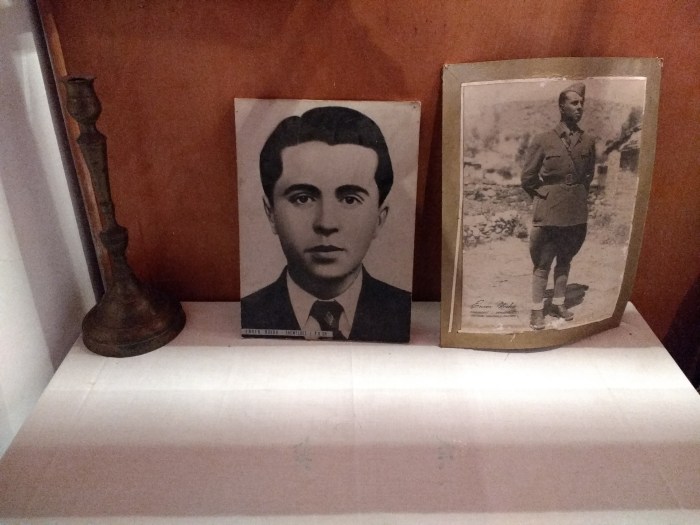
.

The Village That Emir Built

21435972_336129863477420_273343486927831040_n

The wooden village of Drvengrad is a unique creation nestled in the mountains by the border between Bosnia and Serbia. It was built by the Serbian film director and all round maverick Emir Kusterica originally for the setting of his film Life Is A Miracle. But this place is more than just a film set, this is a white hot design for life. A place of hope and positivity, where one can spiritually flourish and be inspired. It almost sounds like the self sustainable community of Auroville in India. But not quite. Auroville is an enormous place with a substantial international community in the thousands. Drvengrad is a floating micro galaxy with its own idiosyncratic vibes and charms.

The landscape around Drvengrad in the Serbian region of Mokra Gora is breathtaking. And even if this awesome village didn’t exist, the scenery alone is a paradise of the highest level for anyone simple wanting to relax, re-energise, unwind, tune out, drop out etc. If the world ever got too much, this part of the world would be on my list of places to disappear to. Rimbaud went to Harar in Ethiopia. I will come here to Mokra Gora.

When one enters Drvengrad, the first thing one most likely notices is the Russian style wooden church at the end of the main square. It is dedicated to St Sava who was the founder of the Serbian autocephalous christian Orthodox Church (as well as the founder of Serbian law). All the squares and streets (more like paths) are named after various famous people. The main wooden square at the entrance is named after the highly revered visionary, humanist and pioneer of Alternating Current Nikola Tesla. Diego Maradona also has his square by the Latin quarter of the village which houses the Damned Yard bar. This bar is full of black and white photographs of Latin American revolutionaries like Che Guevara, Fidel Castro and Emiliano Zapata. On one side of the bar is a montage of photographs of Emir Kusterica with Johnny Depp, Jim Jarmusch, Maradona, Mike Tyson and others. Cuban music plays on the stereo and I feel like I am back in San Cristobal de Las Casas in the Mexican state of Chiapas. Adjacent to the bar is a large indoor swimming pool and an underground gym and cinema.

The nearby Visconti restaurant is more sedate and formal than the Damned Yard bar. Aesthetically there are shades of the architect Le Corbusier in the internal design. It houses a substantial collection of books and a large collection of wines. Close-by is a children’s playground and an art gallery, which was unfortunately closed when I was there. But fortunately there is the Van Gogh hut, inside where there are murials and recreations from his famous paintings. There is also a tiny market square where one can buy local artisan crafts, oils and honeys. When I visited this market corner there was an old lady sitting down by one of the stalls knitting.

On the side of one wooden hut is a large mural of the Russian writer Dostoevsky. At both ends of the mural are a clutch of super sized colouring pencils ingeniously created from tree trucks.

Serbian tennis superstar Novak Djokovic has his own street with a couple of outdoor tennis courts at the end. Film directors Frederick Fellini and Igmar Bergman also have streets named after them as does the Nobel prize winning Balkan writer Ivo Andric. Stanley Kubrick’s name is also stamped into this village in the form of the Stanley Kubrick Theatre.

Each year Drvengrad hosts the international Kustendorf film festival, also founded by Kusturica. Johnny Depp, the Mexican actor Gael Garcia Bernal and the directors Jim Jarmusch and Abbas Kiarostami are some of a handful of well known faces to have visited.

Below I am sharing some of my photographs of this awesome village.

21435445_1906780262918699_1567878348275712000_n

21371946_823290654499630_1063955758195933184_n

21436218_116123282428217_6446753393129029632_n

21435710_472726389764359_1236882995642630144_n

21436128_498481867170524_7254550541512998912_n

21435427_116502405687677_6018818588515762176_n

IMG_20170906_134228_868

IMG_20170906_131246_018IMG_20170906_131826_746IMG_20170906_141517_577IMG_20170906_183228_375IMG_20170906_183743_072IMG_20170906_184034_987IMG_20170906_185605_484IMG_20170906_135430_370IMG_20170906_184736_272IMG_20170906_184527_099IMG_20170906_190157_402IMG_20170906_190513_350IMG_20170906_190856_065IMG_20170906_185817_315IMG_20170906_185202_135

Text and photography by Nicholas Peart

©All Rights Reserved

Photographs From Belgrade’s Savamala District

21147807_1927405347498394_695216941635207168_n

Belgrade’s Savamala district is one of the most interesting parts of the Serbian capital city to explore. It stretches from the main railway and bus station up until the Kalenegdan fort complex. Walking around this area one is rewarded with a mess of different styles and periods of architecture. There are some splendidly ornate buildings in perpetual decay and many more Brutalist structures. In fact, walking around Belgrade for the most part feels like being in an odd blended bubble of Vienna and the Barbican district in London.

Savamala was badly destroyed in both World Wars. For many decades since the end of WW2, it was a very run down place and had a negative reputation. However in the last few years it has developed as the creative hub of Belgrade and many bars and art spaces keep popping up. To get a good and accessible taste of the area’s scene, head to Braće Krsmanović street by the Sava river. The beginning of the street is marked by a disused shell of an old antique crumbling building. Further on is the KC Grad cultural centre. This is an indispensable cultural landmark with live music and happenings. Upstairs there’s an art exhibition space. Further along the street is a clutch of bars.

Architectural delights aside, there is some magnificent street art if you look hard enough. The area around Zeleni Venac market is a hive of activity and an interesting place to explore. Lots of cheap snacks and street venders selling anything from books to football t-shirts and some t shirts with the face of Vladimir Putin on them.

Below I am sharing my photographs accumulated from my wonderings around this fascinating part of Belgrade

21224203_757546017739828_761511479835885568_n

21147755_360362011043806_5135320348027256832_n

21107476_118035852254256_5009966633662283776_n

21107493_1653271874746619_6716810508520914944_n

21042594_1621162187908166_2157378934822404096_n

21149320_1391413594311125_5179758218565386240_n

21107168_342306229540502_8387930048002260992_n

21107226_1819068508405233_1964536548204478464_n

21107401_708993529299666_5396275912322842624_n

21224338_114650735900700_3499742444604358656_n

21107169_1980143332270721_7781824937500606464_n

21149518_815189668662455_1199123515781939200_n

21107233_342516679535641_3588759511579492352_n

21148122_139302033341336_7084834792847441920_n

21148972_1237253709714268_269641255183450112_n

21224464_1216131325200137_1622765792640630784_n

21149539_705839419603764_3814601665235910656_n

21107951_115379915863015_3950314570135896064_n

21107778_135996850346893_2467930599608811520_n

21224769_259061641271347_2370649848052449280_n

21107636_2177722482454618_6996814136810143744_n

21108023_1889444804476411_4734104371753648128_n

21147807_1927405347498394_695216941635207168_n

21227737_870557186441792_6313472556410077184_n

21149422_1815404225417609_8392437070718566400_n

21147816_409231822812123_87173027061563392_n

21227504_336788500108412_193016002080931840_n

21224635_832989996868999_7311805797053235200_n

21148959_276292199530522_9183619511780114432_n

21224339_362635617490199_3059867261541023744_n

Text and photography by Nicholas Peart

©All Rights Reserved

Munching Your Way Through Belgrade

Belgrade is a fantastic and great value city to eat your way around and a fabulous food destination in its own right. It is a cosmopolitan city and you can find good international food outlets in addition to more traditional places. Anyone’s who’s travelled across Serbia may be familiar with the countries pekaras, which are traditional bakeries often open 24/7. At these eateries you can pick up a late night sandwich or pastry for only a few coins. Often the ladies who work at these places are delightful and very patient with my bad to non existent Serbian. In fact, quite a few of them speak very good English.

In Belgrade, like the rest of Serbia and most of former Yugoslavia, there are plenty of places selling traditional foods such as Cevapi (Balken sausages), Bureks (Balken pies) and pljeskavicas (hamburgers done the Serbian way) etc. I had my first taste of a burek at some hole in the wall place by Dolac market in Zagreb and I was dying for a bowl of vegetables and water after just a few morsels. My mouth was a cave of low-grade grease. A pljeskavica, on the other hand, is a wonderful thing. I don’t think I’ve ever, in all my time in Serbia, had a substandard pljeskavica.

The Best Cevapi in Belgrade: Drama Cevapi

21107790_1788509177843020_4083004505254264832_n

Cevapi places, or Cevaperias as I like to call them with a Latino tinge, are ten a penny around most of former Yugoslavia. Yet I’ve never tasted Cevapi as divine as the ones I was served here at Drama Cevapi. They are so tender and almost melt in your mouth. For less than $3 you get a metal plate with five Cevapi topped with a handful of chopped onion accompanied with shredded cabbage, a dollop of clotted cream and chilli sauce and some bread. There are other items on the menu but this is the signature dish and what this place does best

Pljeskavicas in Belgrade

IMG_20170823_120816_619

It’s hard to pick one place in Belgrade as there are a few places which all do equally good pljeskavicas. Depending on where you are based in the city there are three places which do mean pljeskavicas and they are all open til late so perfect and very convenient after a night out thrashing the rakija and Jelen. I have to admit I probably had the best pljeskavica when I was in Novi Sad, but I was so smashed I can’t for the life of me remember the name of the place. If you are in the centre of the city, at the corner of Kolarčeva and Makedonska, is the eatery chain Gyros In City. They do very filling pljeskavicas as well as excellent and cheap Greek style kebabs. I also love the people that work there; jokers of the highest order who always brighten up my day.

Nearby on Maršala Birjuzova is Mikan Restaurant, which serves local food. Adjacent to the main restaurant they have a smaller eatery where you can get Cevapis, pljeskavicas, hamburgers, hotdogs etc. I was served a very generous pljeskavica here by an old lady who spoke no English for 200 Diners. The board menu was all in Cyrillic, which I can read, even if I speak almost no Serbian. A wee tip; if you ever go to Russia (or any country which uses the Cyrillic alphabet), your life will be far less painful if you can decode Cyrillic. Doesn’t matter if you speak little to no Russian. If you can’t decipher Cyrillic you may as well be gallivanting on the moon.

Finally in the Dorćol neighbourhood on Gospodar Jovanova is the small eatery Loki. They are the pljeskavicas specialists and they don’t mess about. There are many cool bars in this neighbourhood and this is a great place to go for a late night pljeskavica.

The Bakeries That Never Sleep

Serbia is famous for its 24/7 bakeries. In almost all cities in Serbia you will stumble upon a bakery or pekara, which never closes. Super convenience aside, some serve serve a dazzling range of treats and are very inexpensive. I have two favourite pekaras in Belgrade. The first one is called Skroz Dobra Pekara and located right next to the king of pljeskavicas, Loki, in the Dorćol neighbourhood. You can find filling sandwiches for less than 200 Diners and strudels, pies, cakes and other assorted pastries for less than 100 Diners. What’s more, the ladies who work here are super nice.

21107636_2177722482454618_6996814136810143744_n (1)

In the centre of town and right by the queen of pljeskavicas, Gyros In City, is another outstanding 24/7 bakery called Pekara Tomo. It is almost identical to Skroz and equally excellent and well stocked with cheap sandwiches and pastries as well as a small side pizza parlour.

Znak Pitanja (also called ‘ ? ‘)

21042852_509987276000936_4088481202736988160_n

If you ever fancy having a proper slap up traditional Balkan meal with all the trimmings Znak Pitanja is a top notch choice. This restaurant also has the unique distinction of being the oldest tavern or kafana in the city at over 200 years old. I chose the 1kg pork knuckle. It arrived on a large glass tray accompanied with an ample supply of baked potatoes and a side of homemade horseradish sauce. I am not kidding, when the thing arrived it was enough to feed the entire population of Novi Sad. It was perfectly good no nonsense Balkan food.

21147197_1964466147126482_7856965265790074880_n

I hear they also have traditional live music here so may be worth reserving a table here for a Balkan feast with plenty of pivo and rakija when there is. I think great fun can be had.

Vegetarians and vegans in Belgrade: Radost Fina Kuhinjica

21371967_124818664836696_689731031447633920_n

I feel your pain. With the mammoth non stop cevapi/pljeskavica meat feast assault, travelling in Serbia can be a veritable drag. But once in the capital things brighten pretty quickly. I know there are a few veg establishments in the city and that will only grow as more and more people become vegetarian or vegan. In fact in both the cities of Belgrade and Novi Sad you will notice quite a number of ‘Go Vegan’ slogans graffitied throughout both cities. If this keeps up maybe I’ll be eating vegan cevapis and pljeskavicas when I return in five years or so.

I can’t just live on cevapis and pljeskavicas for the rest of my life. Even the most rampant of carnivores need something green from time to time. I read glowing things about a veg restaurant called Radost Fina Kuhinjica so one day I decided to investigate. Aesthetically this restaurant gets full marks. It’s a stylish and trendy place and all the menu booklets are enclosed in old hardback books. There is a backyard area where you can eat. When it’s dark all the tables have lit candles in old school metal candle holders. Instead of local music, I detect The Smiths, Coldplay, Lana Del Ray and The Strokes on the sound system.

21373206_184919848732826_996211458079457280_n

I order the veg burger consisting of tofu and red kidney beans. For the price I was expecting one large juicy veg burger. Instead I got two miniature burgers accompanied with a salad. All the ingredients were no doubt fresh and organic and the salad was perfectly good yet I was a little disappointed with the burgers. They were too plain. There was not enough zing or omph. This is not a bad restaurant and is certainly a cut above many ‘hipster cool’ vegan eateries which are a triumph of style over substance. Perhaps the veg burgers are not where it’s at? Maybe if I had the veg lasagna I would be raving about the place. Either way, as I mentioned before, with the passing of time, the veg scene here in Belgrade will only grow and maybe when I return a few years from now I may find a dazzling of choice of new and great no nonsense veg eateries.

By Nicholas Peart

©All Rights Reserved

Photographs From Novi Sad

Arriving in the city of Novi Sad was my first taste of Serbia; a country I’ve always wanted to visit. After four days in this city, it certainly has not disappointed. In fact I had a real blast. Serbia’s second biggest city, after the capital Belgrade, has been a joy to explore and get to know. The attractive city centre around the main square is full of handsome buildings dating back to the time of the Austrian-Hungarian empire. There are lots of cafes to have a cheap cappuccino or bottle of Jelen beer along with a slice of Sachertorte or a couple of scoops of delicious ice cream. And all for just a few coins. Paris also has nice cafes and are great way to pass the day…..if you have deep pockets.

There are a plethora of sites to see in Novi Sad, but I recommend simply walking around this city. One great walk you can do is to walk towards the main bridge over the Danube river and on to the old Petrovaradin fortress. On sunny Summer days you will see locals bathing on the banks of the river. Once over on the other side, you are in the old part of town full of old buildings; many of them in splendid dilapidation. I seldom go to the gym but the walk up to the fortress more than compensated for that! When you’ve reached the top, you are rewarded with an amazing vista of the city and the Danube. There are also a couple of bars at the summit.
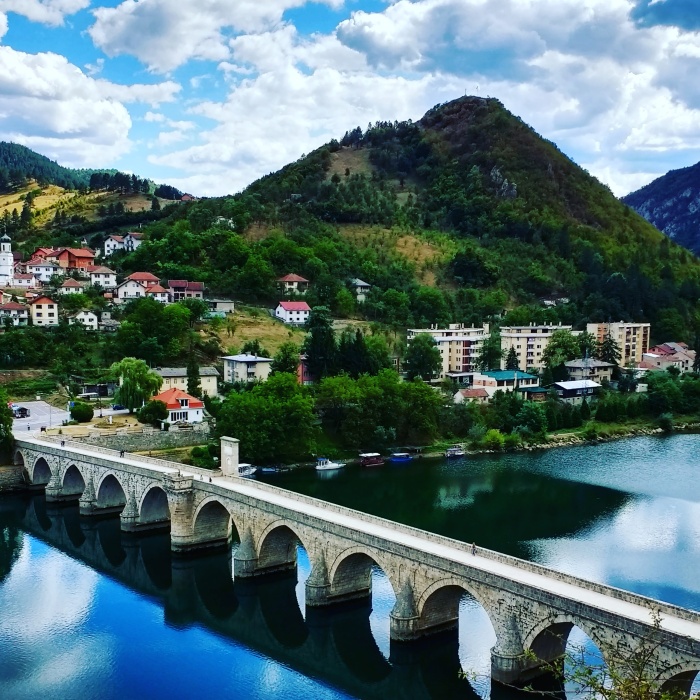
There is a small but interesting space which holds temporary art exhibitions at the Museum of Contemporary Art of Novi Sad, which is part of the larger Museum of Vojvodina on Dunavska street. When I visited, there was an interesting exhibition by a Bosnian artist called Igor Bosnjak entitled Projekat EUtopija. Next to the space there is a small display about the history of the Vojvodina region (of which Novi Sad is the capital) from before the start of the First World War until the end of the Second World War. It providing a very interesting understanding regarding what sowed the seeds for the First World War and the conflicts between the Austrian-Hungarian empire and Serbia. Directly opposite the museum is Dunavski park, which is a lovely spot to relax and have a walk. Look out for the statue of the Serbian poet and painter Djura Jaksic. He is sitting down and wearing a hat, looking uncannily like Don Quixote.

In the evening head to Cafe Veliki (one of the best and most authentic restaurants in the city) and order the Goulash. You won’t regret it! In the evening there are lots of bars to choose from. I had the good fortune to meet an interesting Anglo-Serbian guy from Manchester and a friend of his who took me on a tour of the city. We wound up the day in some bar, which I can’t recall the name of, where we had a few Jelens and some rakija. Rakija is a fruit brandy popular throughout south eastern Europe and comes in different flavours. At the end of night we went to a snack place for a pljeskavica; one of the national dishes of Serbia. You gotta have a pljeskavica if you ever come to Serbia! And it is perfect post-drinking food. There are also a smattering of bakeries open 24/7 where you can pick up a cherry strudel whenever you are feeling peckish.

There are many places to stay in Novi Sad. I stayed at the Hostel Podbara located outside of the city centre, but only a 10-15 minute walk away. It is a very tranquil and quiet place and almost feels like you are in the middle of the countryside. What’s more, the rooms are very comfortable and it’s incredibly good value for money; especially if you are on a budget. And the family who run the hostel are very kind and welcoming.

So, walk around and get stuck in! Don’t feel like you have to “do” Novi Sad. Grab a cafe and some cake. Have a Jelen and a pjeskavica. And just have fun!

Živeli!!!

20969003_143858632872707_8327567001371279360_n

Novi Sad’s main square Trg Slobode

IMG_20170822_135502_097

By the main city centre church 

IMG_20170823_091932_659

Statue of the Serbian poet and physicist Jovan Jovanović Zmaj (1833-1904)

IMG_20170823_105903_332

Old town of Novi Sad

IMG_20170823_111832_575

Old town of Novi Sad

IMG_20170823_112039_416

Petrovaradin Fortress

IMG_20170823_110631_921

View of the old town from the fortress 

IMG_20170823_111435_762

The river Danube

20969209_1569779229756034_8766650574717321216_n

Novi Sad train and bus station

20905443_1595060097212861_6908385738052599808_n

Outside Novi Sad train and bus station 

20987266_469372196751744_7793700736822411264_n

Street art in Novi Sad

20987143_1535672023166564_3733733405351739392_n

Street art in Novi Sad

20987465_1636654156354259_1034937138078023680_n

Goulash at Cafe Veliki

20987346_164106884140087_915426765373964288_n

Projekat EUtopija exhibition by Bosnian artist Igor Bosnjak at the Museum Of Contemporary Art 

20987042_522309034770478_435694539206819840_n

Outside the Museum Of Contemporary Art

IMG_20170823_104152_145

In Dunavski park posing by a statue of the Serbian poet and painter Djura Jakšić

IMG_20170823_120016_642

Jelen beer and rakija on a night out

IMG_20170823_120816_619

A pljeskavica

IMG_20170823_113852_743

Novi Sad Synagogue

IMG_20170823_112652_471

Novi Sad in the early evening

Photographs and text by Nicholas Peart

©All Rights Reserved