Touring The Local Pubs Of Glasgow

Earlier this month I visited and stayed with a couple of friends of mine in Glasgow. I had an absolutely stellar time over there. Yet one integral aspect of what made my time in Glasgow truly memorable was visiting some of the city’s local boozers. In this article I will be selecting some of these pubs which I particularly enjoyed.


Kelly’s Bar

img_3556


This pub is a proper authentic Irish boozer located off Polokshaws Road south of the city centre and an important part of Glasgow’s traditional and historic Irish community. My friends both took me there on my first night in Glasgow after we had a delicious vegetarian Indian feast at nearby Ranjits Kitchen. As we all ordered pints of Tenants a stocky Irish lad was playing songs on his acoustic guitar. Many of the songs were traditional Irish songs with a smattering of pro IRA ditties thrown in for good measure. You can take it or leave it, I suppose. But I like this pub. Not many outsiders venture here. There is nothing ostentatiously hip or pretentious about this place and if you want a cheap pre or post curry pint, you could do far worse than rock up here. Most of the time the pub is refreshingly devoid of big crowds except when Celtic are playing.


Saracen’s Head

img_3557


The Saracen’s Head, or ‘Sarries Head’ as its better known to locals, is a notorious Glasgow pub directly opposite the Barras market and very close to the Barrowlands concert venue. As I was ordering our drinks, I was mulling over whether to order a separate glass of the infamous Glasgow brew called Buckfast Tonic wine. The guy serving me was three parts Billy Connolly and two parts Gregor Fisher. He gave me a strong look to break my indecision and said, ‘ya cannoe gorra Glasgow and no av a wee bita Buckfast lad’. It seemed I had no other choice in the matter.


img_3559

At the Saracen’s Head pub with my Tenants and Buckfast


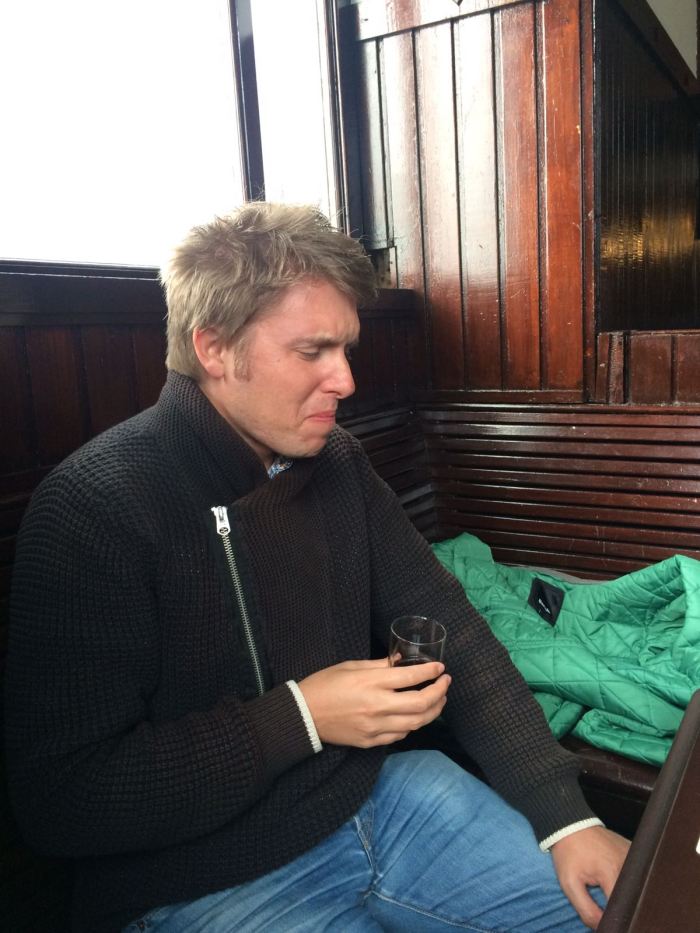
My friends and I found a corner of the pub to sit down. There I was with my Tenants in one glass and deep crimson Happy Shopper cassis in the other. I approached the Buckfast like it was a glass of black mamba venom. This toxic liquor was absolutely vile. I badly needed a kale, kiwi, cucumber – you get the picture – one of those uber healthy raw juices to cleanse by desecrated internal body after this legendary assault.
 

img_3278

Not feeling the Buckfast


The Star Bar

img_3551


The Star Bar is located on the corner of Pollockshaws and Eglinton streets. On the surface this is an unassuming and nondescript place. But once you open the doors and enter you are immediately catapulted into a genuine and uncorrupted slice of Glasgow. All the Rab C Nesbit stereotypes are pungent here. Yet this place exudes warmth. My principle reason for coming here was to sample their 3 course meal for only £3! I have never heard of anywhere else offering such deal. I loved the sound of it and I thought it would be rude not to resist.


img_3552

I couldn’t say no


The landlord was monumentally friendly to an outsider like myself and even offered me a free half pint of Carling as I was about to order my drink. A salt of the earth person with a heart of gold. I was very touched. My starter came in the form of canned minestrone soup. I could handle it, almost.


img_3553

Course One: Canned minestrone soup


Then for my main I received a Scots pie with fat green beans and boiled potatoes. This was by far the most ‘wholesome’ part of the three course meal even if the pie and mince inside was about as processed as processed pies got but you would have to be a real wolly to complain considering the price. And besides, I would be dead offended to be served anything remotely representing ‘gourmet’ quality here.


img_3554

Course Two: Scots pie with potatoes and green beans


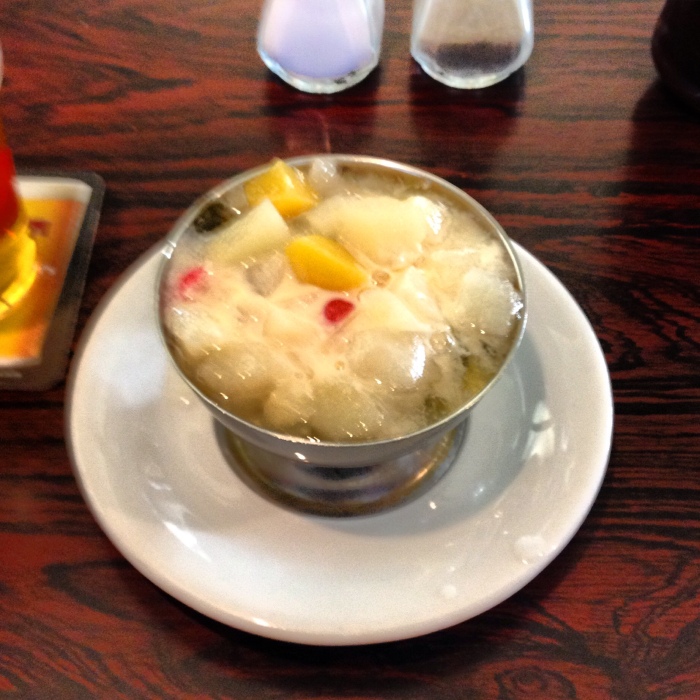
Finally for dessert (or ‘sweetie’ as the landlord called it) I was served green jelly, tinned fruit and cream in a small tin cup. This was more challenging. I could handle the fruit but not the rest.
 

img_3555

Course Three: Green jelly, canned fruit and cream


The Brazen Head

img_3345


Further up Pollockshaws road and past the Star is the Brazen Head. I was expecting a gritty, rough and tumble affair judging by some of the online reviews I’d read. The Sunday Times even wrote an article on it entitled ‘Inside the Gorbals hardest pub’. Yet I was unexpectedly surprised to discover a rather pleasant and friendly Celtic Irish pub. On the other hand it was verging on dead when I was there save for two or three long timers. Perhaps I should go there when the football is on to give this place a more realistic assessment? I found a corner at the far end of the pub nestled amongst a galaxy of Celtic memorabilia. The widescreen plasma TV was on mute as I quietly drank my pint of Guinness.


The Alpen Lodge
img_3547


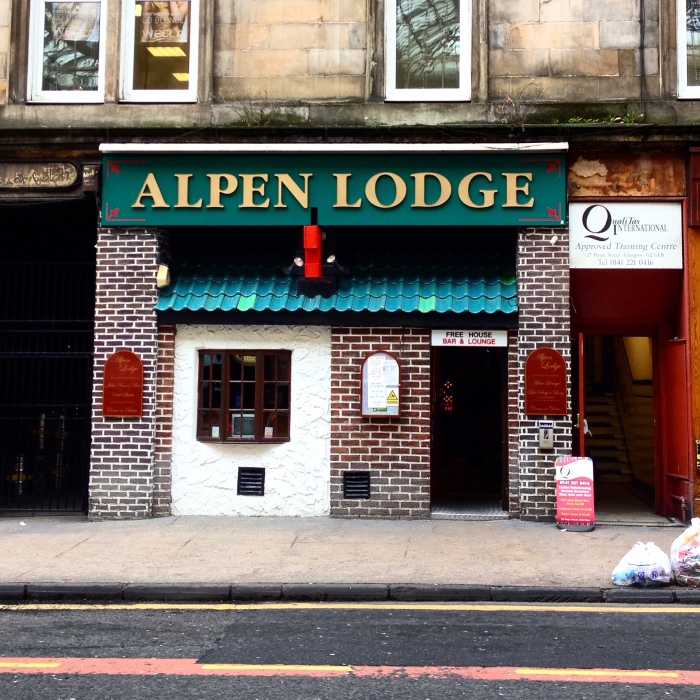
Around central Glasgow station are a number of down and out local boozers which are unlikely to ever make an appearance in a Lonely Planet guidebook. The Alpen Lodge is one of those places. Here it is semi packed yet everyone mostly keeps themselves to themselves. There is absolutely nothing remarkable about this pub but if you want to visit an authentic Glasgow boozer, albeit uncomfortably voyeuristically, you can do far worse. After a while I just wanted to get the hell out of here. Out of all the pubs I had visited in Glasgow, it was here where I felt the most self conscious. Yet as I drank my pint of Tenants in haste, I discovered a very enlightened poem on the wall next to me entitled Smiling which began…

‘Smiling is infectious,
you catch it like the flu,
When someone smiled at me today,
I started smiling too…’

I read the entire poem and immediately felt more relaxed and at ease. I savoured the remainder of my pint.


The Laurieston
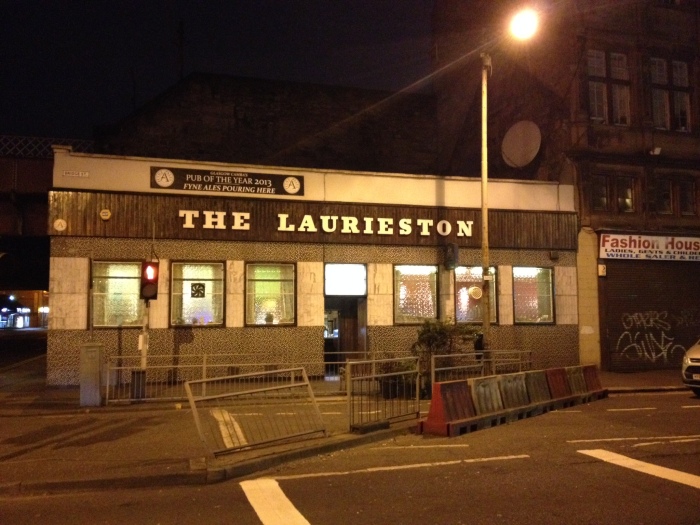
img_3271


Saving the best til last, The Laurieston is the granddaddy of all the pubs I’ve mentioned. An institution and a unique and untouchable gem of Glasgow. What a place! On the outside it could be mistaken for a typical council estate drinking den. This pub is similar to the Star Bar in some ways. Both places exude legendary Glaswegian warmth and are as authentic as pubs get. Yet whereas the Star Bar projected a fatigued and rather downbeat vibe, here the energy is infectious. What’s more, all kinds of people come here; long timers, football fans, students, local trendies and even a smattering of tourists like myself. It was on the awesome recommendation of my Glasgow based friends that I first became aware of this place. This pub has been in the family for decades who, amazingly, have so far resisted any offers to sell the place. The family who own the Laurie are very proud of their pub and I feel a change in ownership could potentially dent a great part of what makes this pub truly special.


img_3267

Inside the Laurieston 1


img_3268

Inside the Laurieston 2


img_3269

At the Laurie sipping my pint of Guinness


As my friends and I sip our pints, I venture over to the jukebox which is free. There is a large selection of songs much of which are from old 60s, 70s and ‘Now That’s What I call Music’ compilations. I select Blondie, Thin Lizzy, The Troggs and Status Quo before I return to my friends and my pint of the black stuff.


By Nicholas Peart

26th October 2016

(All rights reserved)

My Favourite Things To Do In Liverpool

img_0370

Liverpool waterfront*


Liverpool is a great city to visit. There are simply tons of things to do here to occupy you for at least several days. I was in Liverpool for only a few days and I still feel like I would like to go back and visit certain places I didn’t get the chance to visit this time around. However I did do some internet research before coming to Liverpool and already had a few specific places in mind which I wanted to visit. There are all the obvious sites such as all the Beatles related landmarks (which I could not possibly shun especially since I myself am a huge fan of their music). There are also some world class art museums such as the Tate Liverpool and the Walker Gallery – sadly I didn’t have enough time to visit the latter although I hope to visit it on another trip to Liverpool. If I do return to Liverpool I would like to explore more of the city’s local arts and music scene. There is a building on the waterfront, right by the Tate Liverpool, which houses the Liverpool Maritime museum and the Slavery museum – both definitely worth a visit to gain a better understanding of the city’s history. Like Glasgow further north, the shipping industry flourished in Liverpool during the 19th century and brought incredible prosperity to the city. At one point Liverpool was wealthier than London. Evidence of this past wealth can be seen in many of the architecturally beautiful buildings dotted around the city as well as the rows of handsome Georgian houses on many of the city’s streets.

Below I am featuring certain sites and places in Liverpool which I particularly enjoyed.


Beatles Landmarks

img_0372

Those Fabulous Four**


For me my favourite Beatles related thing to do is to visit the houses where John Lennon and Paul McCartney grew up. There are some agencies which offer tours but in reality you can visit independently. However if you want to go inside John Lennon’s house that can only be done via the tours offered by the National Trust. Both houses are located several kilometres outside of the city centre in the suburb of Allerton. I decided to check out Macca’s childhood gaff first but before I did I thought it would be rude if I didn’t break the journey in Penny Lane which is located en route via the 86 bus from the centre. The Penny Lane street sign is completely defaced just like the Abbey Road sign at St Johns Wood in London. I ask a passerby to take a photo of me next to it. Listening to the music of the Beatles and my second favourite band from Liverpool, the La’s, I develop many romantic notions in my head of the city some of which I can’t explain in words. Penny Lane is quite an ordinary street yet it’s thrust and propelled into a dauntingly significant part of history because of that song.


img_3477

The Beatles song Penny Lane was named after this street


I get back on the 86 bus before disembarking at the junction of Mather Avenue and Forthlin Road. The latter street is where Paul McCartney’s childhood home is located. Macca’s house is very modest and nondescript. Now I am sure he can easily afford to buy up the whole street and still barely make a dent on his vast fortune. There is no one else on the street but myself until a few moments later a mammoth tour group arrives all descending on Paul’s humble childhood abode.


img_3482

The childhood home of Paul McCartney


John Lennon’s house is located about 20 mins away off Menlove Avenue. To get there I walk via the Allerton Golf club. I am using Google Maps on my iPhone and try to utilise the shortest route possible. Lennon’s childhood home is larger than Macca’s with its own front drive. A blue plaque adorns the front of the house. There is the option to enter the house if you do one of the National Trust tours yet I feel there is nothing more I need to gain. I would rather spend that time losing myself in his amazing music.


img_3492

Outside John Lennon’s childhood home


I return to the city centre from where I take another bus north east of the city to the suburb of West Durby. It is here on a leafy and seemingly affluent street with some lovely villa-like properties where the Casbah Coffee Club was once located. It was established by Mona Best (the mother of Pete Best, the original Beatles drummer who was unceremoniously fired from the band just before they hit the big time) in the celler of their substantial family home in a beautiful rural setting to provide a space for local bands to play and socialise.


img_3497

The Casbah Club was located in the celler of the pre Ringo drummer, Pete Best’s, family’s home


The club was established in August 1959. It was here where the Beatles, then known as the Quarrymen, played their first gig. This was before they would regularly play at the legendary Cavern club in the centre of town which at the time was only putting on Jazz.


img_3507

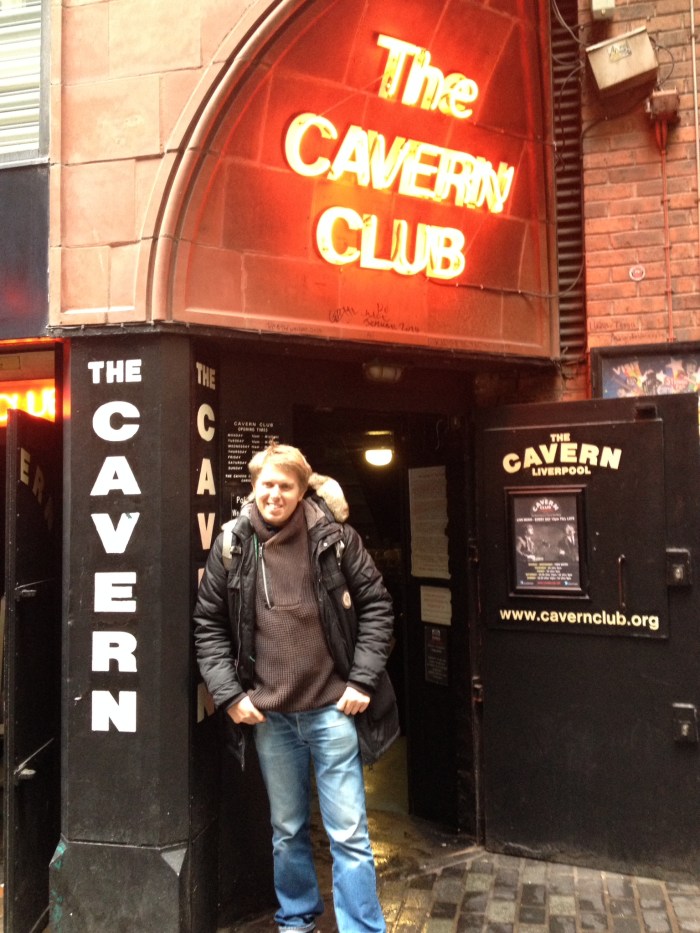
Outside the famous Cavern Club which was the epicentre of the early 1960s Merseybeat scene in Liverpool where the Beatles regularly played before they hit the big time

 
Chinatown and St Luke’s Church

image

The famous Chinatown Arch


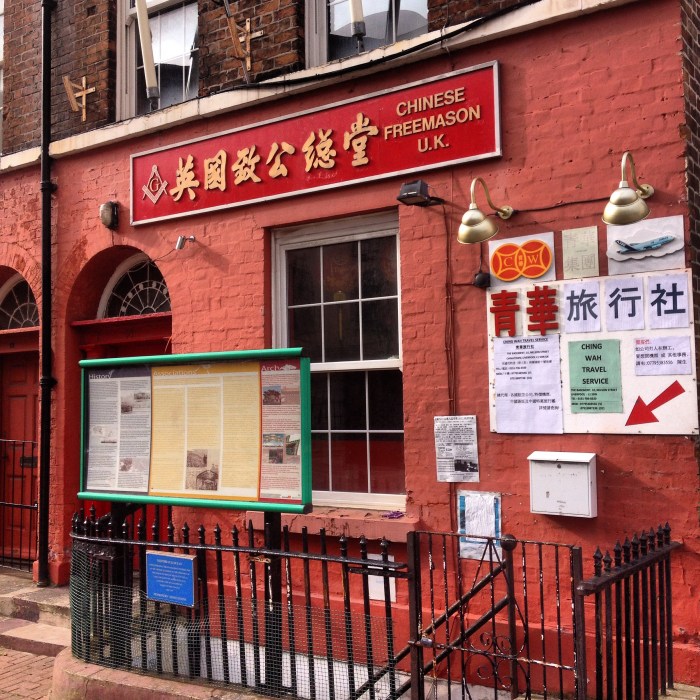
Liverpool’s Chinatown is the oldest Chinatown in Europe. I’ve already touched upon this historical part of Liverpool in a separate post which can be viewed here. The roots of Liverpool’s Chinese community date back to the 1860s with the establishment of the Blue Funnel Shipping Line by Alfred Holt and Company which employed many Chinese seamen who came all the way from Shanghai. The original Chinatown was established around Cleveland Square close to the docks. When that entire area was bombed during the Second World War, a new Chinatown was established on Nelson Street and surrounding streets where it continues to flourish today.


img_3527

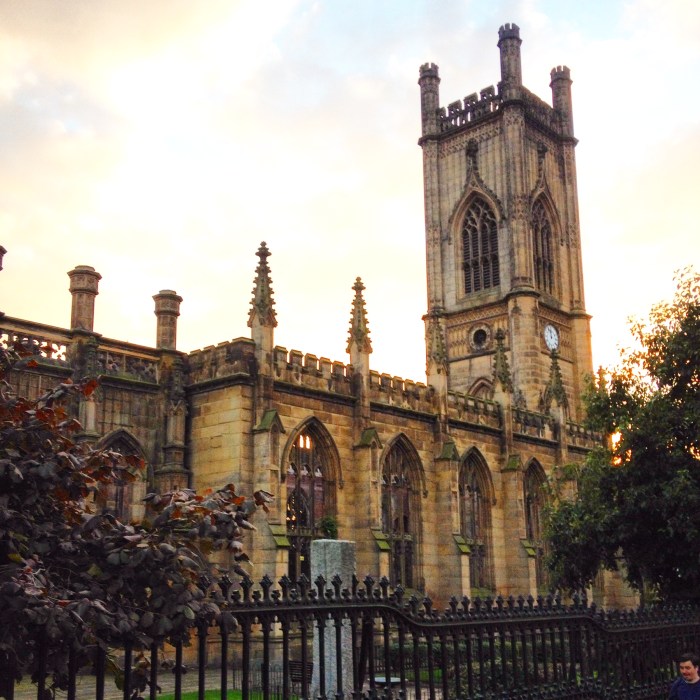
St Luke’s church


At the intersection of Berry and Renshaw streets which marks the unofficial beginning of Chinatown is a bombed out church called St Luke’s, which was destroyed during the Second World War. This church reminds me of St Dunstans to the East in the City Of London close to Tower of London.


img_3535

St Luke’s church today resembles more an ancient negleted ruin as a result of heavy bombing during World War Two

 
The Ye Cracke and Dispensary pubs

img_3524

The Ye Cracke pub


The Ye Cracke pub is a great old fashioned pub on Rice Street off Hope Street, close to the Philharmonic Hall. This place is crammed full of early pre Beatles history. John Lennon’s uncle was a regular here as was John himself and his girlfriend Cynthia when they were both at art school in the 1950s. I love this pub. When I stopped by one mid afternoon there was just a mere smattering of punters and I had a whole wing of the pub to myself. I ordered a pint of Thwaites for only a couple of quid. In my corner Beatles related artwork by local junior artists adorned the walls.


img_3520

Inside Ye Cracke. Notice both the black and white photos on top left corner which feature a young pre Beatles John Lennon from the 1950s. John was a regular here.


img_3536

At the top of the photo is a very early back and white Beatles photo when Pete Best was still in the band


In front of me was a turquoise portrait of John Lennon by a local artist. In the portrait, John’s face appears tired and washed up; like he’s been on crystal meths for two weeks. In the entrance there are a few black and whites photos featuring a young John Lennon in the 1950s plus one of the very early Beatles line up when Pete Best was still in the band.


img_3539

The Dispensary pub


The Dispensary pub is a cracker. A proper place with all the original features, warts, shit stains and all. Something of a rarity today. And boy do they do amazing ales. Have a pint of the Plum Porters. It is one of the best and tastiest ales I’ve ever had. The songs Hush, Mr Tamborine Man and Tiger Feet seem to be on continuous repeat on the jukebox. Being here I feel like I’m in the Newcastle pub Michael Caine enters at the beginning of Get Carter where he asks for a pint of bitter ‘in a thin glass’. On various online forums there is a lot of talk about the pub’s notorious ‘volatile’ landlord, ‘Crazy Dave’. Immediately I think of the low budget 1993 US film Red starring legendary hard man Lawrence Tierney as the cantankerous and unstable landlord of some dive bar in Philadelphia. In the film he gets periodically prank called and every time ends up losing his shit at the offender down the phone. I was at the Dispensary two times and on both occasions Dave was present. In the wake of reading all the online stories about him, I felt a perverse temptation to add to the existing chain of Crazy Dave agro and order a Smirnoff Ice with a straw but I chicken out. Astonishingly, on my second visit Dave recognises me and greets me with an unusually cordial ‘alright mate’. Yet examining him further, he looks like the sort of person who wants to keep his place local and wouldn’t hesitate to crush a Shoreditch trendy like a butterfly on a wheel if they rubbed him up the wrong way. This is a place where Trip Advisor reviews mean jack shit. The Dispensary ain’t The Old Blue Last, that’s for sure


Breakfast at Shiraz Café

img_3545

Full English breakfast at Shiraz café


Come to Shiraz, located on Williamson square, for breakfast (or lunch) and order the Full English Breakfast for £5.50. This is one hearty and powerful Full English. My only complaint about it is the black pudding ring which at times feels like you are chewing on a cooled melted ice hockey pick. Yet apart from that the breakfast is top here and great value. All stripes come to Shiraz. This is an institution and an invaluable reference point if you are ever hungry and don’t want to break the bank. The Full English aside, Shiraz also does good size portions of cheap no nonsense comfort fare dishes like Chilli Con Carne, casseroles, lasagna etc. On one of my many trips here I ordered a half roast chicken with a mountain of fries, rice and salad for a little under £6. The vegetarian Mediterranean breakfast is a healthier alternative to the full English but before you order it request that they don’t put so much sauce over the feta salad which on its own is perfectly fine. A good local cafe/restaurant which I highly recommend.

 
Zanzibar club

img_0373

The Zanzibar club***


Whilst in Liverpool I wanted to find a good non pretentious live indie/rock music venue similar to the Camden Barfly in London or the now defunct CBGBs in New York. There is no shortage of live music venues in Liverpool yet I hand picked this venue because of its focus on unsigned indie/rock bands and also it’s history especially regarding the city’s local music scene during the last 15-20 years. During the early 1960s the Cavern Club on Mathew Street was the epicentre of the emerging Merseybeat music scene with the Beatles it’s most successful band. Then later towards the end of the 1970s during the whole punk and new wave movements the nearby club Eric’s also on Matthew Street was the centre of that scene where local bands of that time such as Echo And The Bunnymen, The Teardrop Explodes and The Mighty Wah emerged from. The Zanzibar club located on Seel Street, which has a number of trendy bars and clubs, has been an integral part of the local Liverpool music scene for close to 20 years. Two key Liverpool bands, The Coral and The Zutons, used to gig here regularly when they were still relatively unknown. Noel Gallagher also once played a solo gig here in 2003. I came one Saturday night when four local unsigned bands were playing. I managed to catch two. Neither band was particularly original nor did they ooze much charisma or play a set that was truly memorable. On the other hand the first band where the members were around the 19-20 mark played a good tight set. Perhaps with time their musical influences will expand and they may start making some very adventurous and challenging music. It is incredibly hard and gruelling work being in a band in these digital post internet days (unless you are the Rolling Stones), especially with the collapse of much of the music industry. In a way I think local bands should be supported now more than ever before. Most bands essentially do their best whether I am a fan or not.


By Nicholas Peart

 20th October 2016

(All rights reserved)


*Image source: http://www.wikipedia.com

**Image source: http://www.bilboard.com

***Image source: http://www.mycityvenue.com


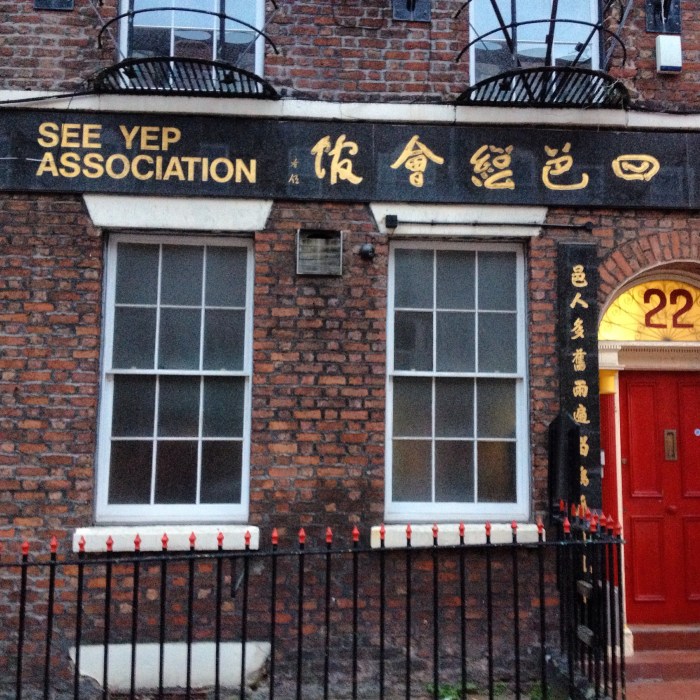
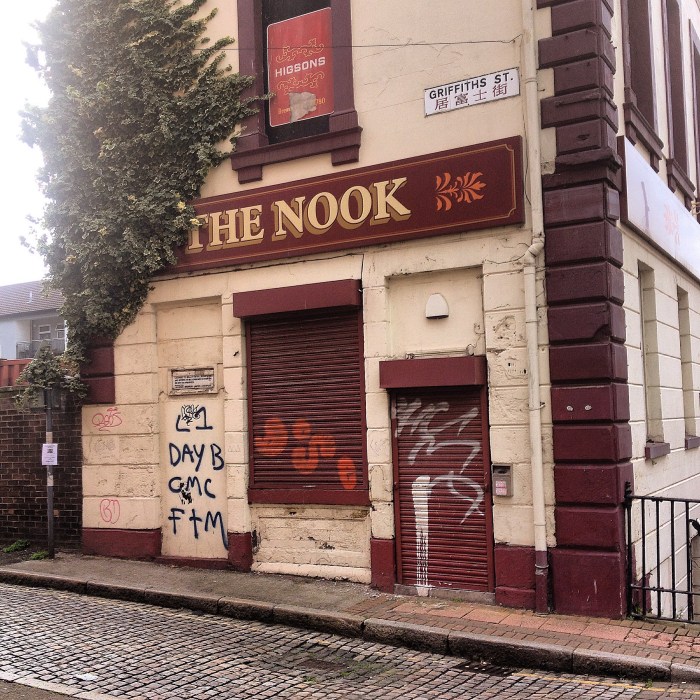
Photographs from Liverpool’s Chinatown

image


The Chinatown quarter of Liverpool has a very interesting history. It has the unique distinction of being the oldest Chinatown in Europe. During the 19th century when Liverpool was a thriving and increasingly prosperous port city through the booming shipping industry, and when Britain was an enormous colonial power, it was trading with most of the world.

The seeds of Liverpool’s link with China go back to 1834 when the first ship from China arrived in Liverpool to trade products such as cotton wool and silk. Yet it wasn’t until the creation of the Blue Funnel Shipping line in the 1860s by Alfred Holt and Company, which employed many Chinese seamen, when the first real migration of Chinese to Liverpool began. This shipping line established robust trade ties between the cities of Liverpool, Shanghai and Hong Kong.

The Chinese seamen who stayed on in Liverpool settled by the docks on and around Cleveland Square, where the Holt Shipping Company built boarding houses for them. This was the beginning of the original Chinatown in Liverpool. Around the 1890s, some of the Chinese settlers set up their own businesses mainly for the sailors who worked on the Holt shipping lines.

When the First World War broke out in 1914, there were around 6000 Chinese seamen in the British Merchant Navy with a quarter of them in Liverpool. Much of the original Chinatown around Cleveland Square was destroyed during the Second World War. Liverpool was already by then a city in economic decline.

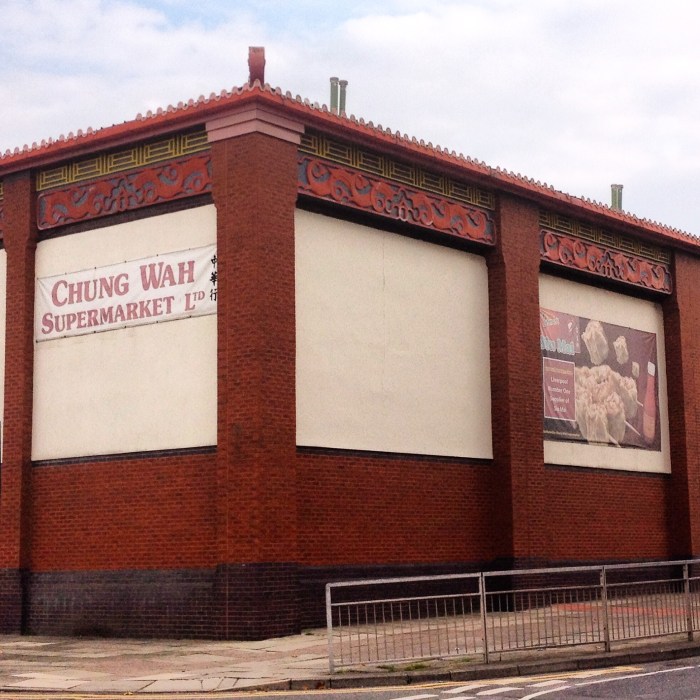
The Chinatown one sees today in Liverpool was only established in the 1970s on Nelson Street as its official street, although it extends along Berry Street up to where the bombed out church, St Luke’s, is located. On these two streets and some surrounding streets are a plethora of Chinese restaurants and some supermarkets such as Chung Wah and Hondo. The imposing and ornate Chinatown Arch at the beginning of Nelson Street was officially opened in the year 2000 on Chinese New Year. The arch was constructed from an estimated 2000 block components manufactured by the Shanghai Linyi Garden Company Ltd and shipped over to Liverpool from Shanghai along with twenty specially selected Shanghai craftsmen to build the arch.


Text and Images by Nicholas Peart 

19th October 2016

(All rights reserved)


image


image


image


image


image


image


image


image


image


image


image


Photographs from The Barras

img_0368

The Barras*

The Barras is a popular weekend market in Glasgow in Scotland and the biggest in the city. It is located in the East End district and right by the famous Barrowlands concert venue where many well known bands and singers have played.

The genesis of the market goes back to the early 20th century where traders would be selling their products from handcarts (‘barras’).

Many different types of items can be found here. It is a great place to hunt for bargains. You may get lucky and find a rare vinyl record for a few coins or a scarce out of print book or perfectly fitting tweed jacket in excellent condition for a fraction of its real value.

Most of all, it is the atmosphere and energy here which is the main draw for me. If I find something I really like for a good price, that is a bonus.

After the market, head down to the nearby Saracen’s Head pub (or ‘Sarie’s Head’) for a Tenants and (if you are feeling a brave) a Buckfast tonic wine.


image

image

image

image

image

image

image

image

image

image

image

image

image

image

image

image


Text and Images by Nicholas Peart

18th October 2016

(All rights reserved)

*Image source: yelp.com

The Famous Cafés Of Saint Germain

The cafés of Saint Germain in Paris have a long and interesting history. This area is the infamous Left Bank traditionally an area associated with prominent intellectuals and many famous writers and artists.

The café is an important feature of Parisian life and is the quintessential place to meet up with friends, talk business and watch the world go by or as the great French writer Emile Zola once said of the cafés’ clientele, ‘great silent crowds watching the street live’.

The cafés I am featuring in this post are famous for the many notable figures who once came through their doors. I am also featuring the first cafe in the world, Le Procope, which first opened it’s doors in 1686.

Nowadays these cafés are very much trading on their enviable and dazzling history and those exciting and golden days of Sartre, Voltaire or Hemingway in these digital post-internet times are dead as Dillinger. On top of that the prices will kill you if you are on a tight budget – the cafés here are a far cry from the hole in the wall dives of La Goutte d’Or. Still if you want to experience a vicarious slice of those culturally magical times, it is well worth the splurge. Yes it is touristy but for a reason. With just a small handful of cafés on and around one boulevard boasting so many famous names and bursting at the seams with cultural history it is not difficult to see why.


Cafe de Flore

image


This café located on the corner of Boulevard Saint Germain and Rue Saint Benoit first opened in the 1880s during La Belle Époque.

The celebrated French poet Guillaume Appolinaire began to spend regular amounts of time here from 1913. It was Appolinaire who coined the term surrealism and with him he brought along other figures associated with the movement such as André Breton to the café.

Since then many of the cafe’s regular clientele included the famous writers and philosophers Georges Battaille, Robert Desnos, Leon Paul Fargue, Jean Paul Sartre, Boris Vian, Simone de Bouvoire and Raymond Queneau. Sartre virtually lived in the café. Pablo Picasso was also a regular.


image

Two overpriced Expressos

When I was there donning my silly Ben Sherman Beatles shirt which would have made those earlier serious French philosophers and great thinkers sniff at me with contempt, I ordered a tiny expresso for €4.80 whilst my sister ordered a decaffeinated coffee for the same price. I shit you not these were two of the cheapest things on the prestigious menu bar perhaps a laughably small bottle of Evian water and a small cup of hot milk. On top of that the waiters can be a tad rude yet they can afford to be rude with an endless and non stop stream of chump tourists like myself coming here for the history.


Les Deux Magots

image


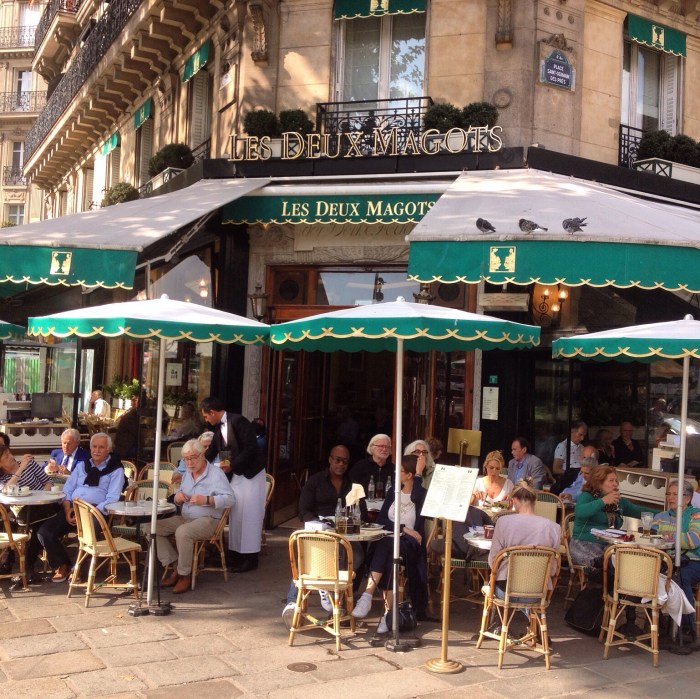
Right opposite Cafe de Flore, Les Deux Magots was for many years (and perhaps is still today) it’s rival. Both cafés have for years been the two titans of the cafe scene on Saint Germain with equally illustrious and distinguished clientele.

Les Deux Magots was originally a novelty shop founded in 1812 at 23 Rue de Buck before moving to its current location on Boulevard St Germain in 1873. In 1885 the shop eventually became an alcohol serving café where around that time the legendary French poets Arthur Rimbaud and Paul Verlaine as well as fellow Symbolist poet Stéphane Mallarmé became regulars.


image

Inside Les Deux Magots

This café subsequently became associated with many more distinguished names most notably the American writer Ernest Hemingway. Writers and artists such as André Gide, Fernand Léger, Louis Aragon, Elsa Triolet, Picasso and André Breton regularly frequented the café.

I was very impressed and dazzled by the interior of the café which as well as its elegant well preserved old school aesthetics, also had black and white portraits of many of its famous clientele. Like Café de Flore my sister and I sat at one of the outside tables and ordered two small expressos around the five euro mark each. Sitting at a table right next to ours were two lovely old ladies from Argentina with whom I began a conversation in my seldom excercised Spanish regaling them with tales of my time in Argentina and other parts of South America.


Le Bonaparte

image


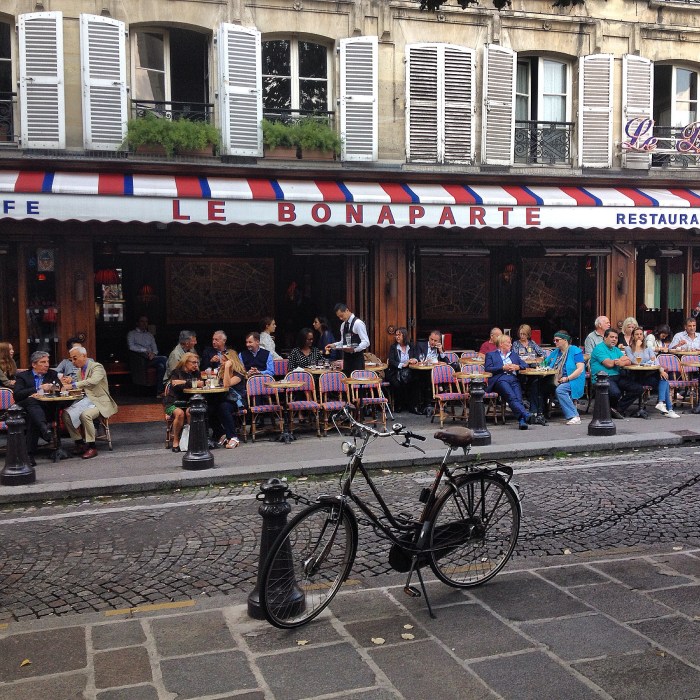
This is another good cafe within spitting distance of both the Flore and Deax Magots. While this place may lack the prestige and even authenticity and aesthetics of the other two places this is still a solid choice which also boasts a history of artists, writers and poets through the ages. It is also quieter and slightly less overrun and hectic than the other two places and almost often there is delightful street music outside.


image

Chocolat Chaud Maison at Le Bonarparte

We had a very good and delicious authentic chocolat chaud maison (hot chocolate) even if the price was a little steep at over 6 euros each (but then I already warned you all at the beginning of the post).


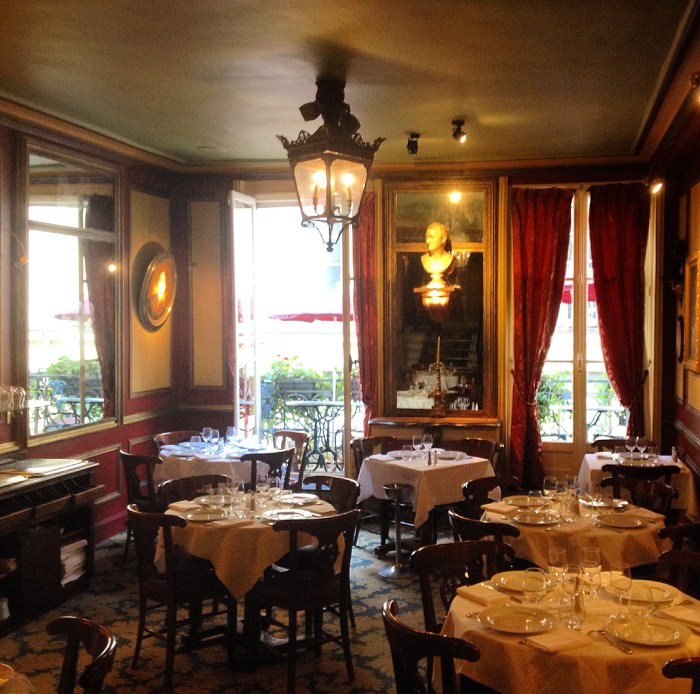
Le Procope

image


Le Procope, further up Boulevard St Germain on Rue de l’Ancienne Comédie and close to Odeon metro station, has the unique distinction of being the oldest literary café in not just Paris but the world first established in 1686 by a Sicilian man from Palermo named Francesco Procopio dei Coltelli. Many distinguished figures become regulars here most notably the 18th century writers Voltaire and Jean-Jacques Rousseau. Le Procope was a hotbed for liberal ideas throughout the 18th century and the history of the Encyclopaedia is linked to this café. Prominent figures of the French Revolution towards the end of the 18th century met here such as Maximilien Robespierre, Georges Jacques Danton and Jean-Paul Marat. Around this time, Napoleon left his cocked hat at the bar as collateral.


image

The opulant and elegant interior of Le Procope

Both of my sisters and I visited this prestigious café one late afternoon (Le Procope only operates as a café from 3pm – 6pm. Outside of these times it is a fancy restaurant). When I was not tendering to my expresso and biscotti, I was walking around the establishment spanning over three centuries and admiring and absorbing the history as well as the opulent and ornate decor full of old oil paintings and other artefacts including Napoleon’s hat.

I don’t think I would frequent these cafés regularly but for a one off taste of their awesome history it is absolutely worth it.


By Nicholas Peart

29th September 2016

(All rights reserved)
 

Photographs from La Goutte d’Or

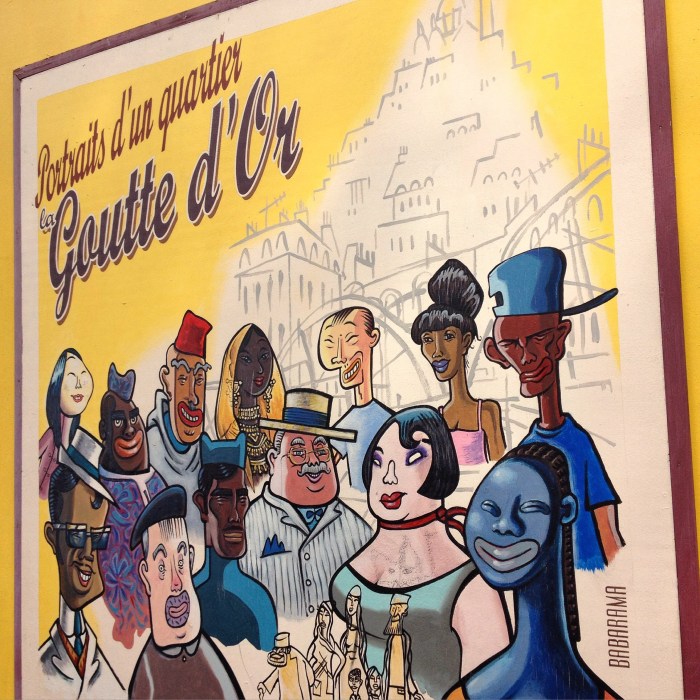
La Goutte d’Or is a district in Paris and a raw and vibrant slice of this city. The vast majority of its population is made up of people from the former French colonies most notably North African countries such as Morocco and Algeria and West and Central African countries such as Senegal, Mali, Burkina Faso and the Congo.

This is a very interesting part of the city to explore, especially if you’ve already experienced many of Paris’s more obvious highlights such as the Eifel Tower, the Louvre, the Champs Élysées etc.

For bearings one could carve up the district as being the triangle with its points the metro stations Barbés Rochechouart, La Chapelle and Château Rouge.

The Rue Goutte d’Or has a couple of good and traditional North African restaurants to eat at. I particularly recommend an establishment called Agad’Or, which serves a substantial portion of Couscous Maison (daily homemade couscous with a soupy vegetable stew with chicken or meat and a medium baguette) for only six euros. Opposite Agad’Or there’s a cheap little boulangerie/patisserie where you can pick up a generous pan au raisin for only a euro. The Rue Goutte d’Or is in many ways the heart of the North African community. The first wave of North Africans arrived at the beginning of the 20th century and a more substantial wave of North African immigrants arrived here in the 1950s (during this time countries such as Morocco and Algeria were French colonies) mainly to work in the automobile industry.

Turning left up ascending Rue Polonceau, on your right there is a hole in the wall Congolese restaurant. I know almost next to nothing about the DRC or the traditional cuisine from that part of the world. Yet I was curious and intrigued. Maybe another time I’ll take a punt on it.

A little further up Rue Polonceau on your right is Rue St Luc which will take you towards the large church St Bernard de la Chapelle. On 23rd August 1996, the church hit international headlines when around 300 undocumented immigrants who had taken refuge at the church (including a few who went on hunger strikes) over a long period of time were expelled by force by the police.

On the corner of Rue St Luc and Rue Cavé, I stumble across a corner art gallery/work space which is currently showing a small but intresting exhibition on the history of public graffiti art in the streets of Paris beginning with the legendary early 1980s French graffiti artist Blek Le Rat who became an enormous influence on later more well known graffiti artists such as Banksy.

On Rue Cavé, there is a lovely lush garden representing an oasis of Eden like tranquility and blissfulness amongst the gritty streets. The street was named after François Cavé, who was a significant figure during France’s industrial development in the 19th century. What’s more, he provided bread to many of the residents of La Goutte d’Or.

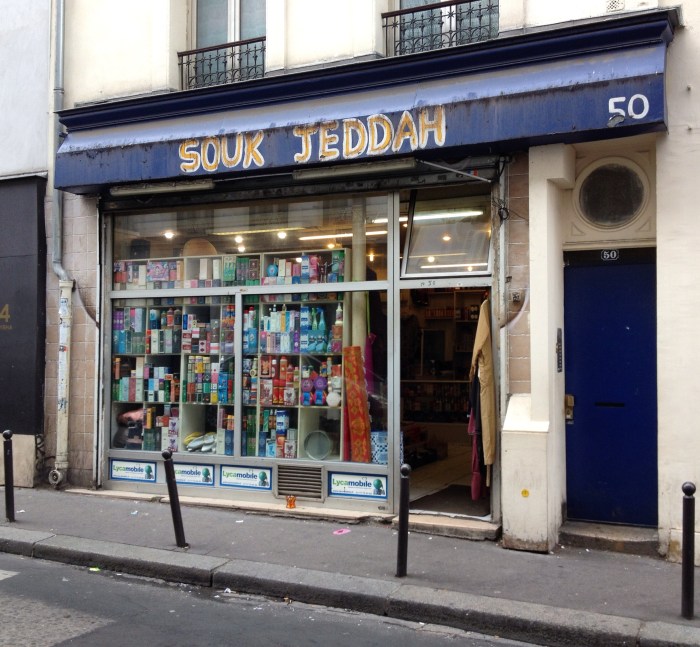
If Rue Le Goutte d’Or is the heart of muslim North Africa, Rue Myrha is christian Sub Saharan Africa. Here I spot a small Senegalese hole in the wall eatery called Touba Resto which serves traditional Senegalese dishes daily such as maffe (a delicious peanut based stew), yassa and thieboudienne (the national dish of Senegal consisting of fish, rice and tomato sauce). At no46 Rue Myrha is a small ramshackle shop called Binta which sells herbs, barks and an array of intriguing traditional artisan products from Mali. It is packed to the gills with stuff and I can barely motion my way around especially with my cumbersome rucksack. There are many shops like this including quite a few informal fabric and clothes shops were one can see people sewing and making traditional garments. There is a also a world music shop called Pala Pala Music but unfortunately it was closed.

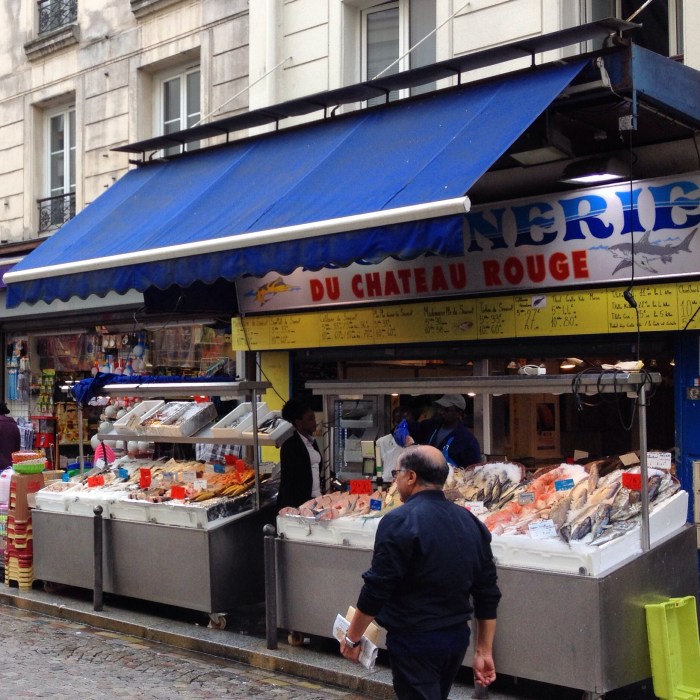
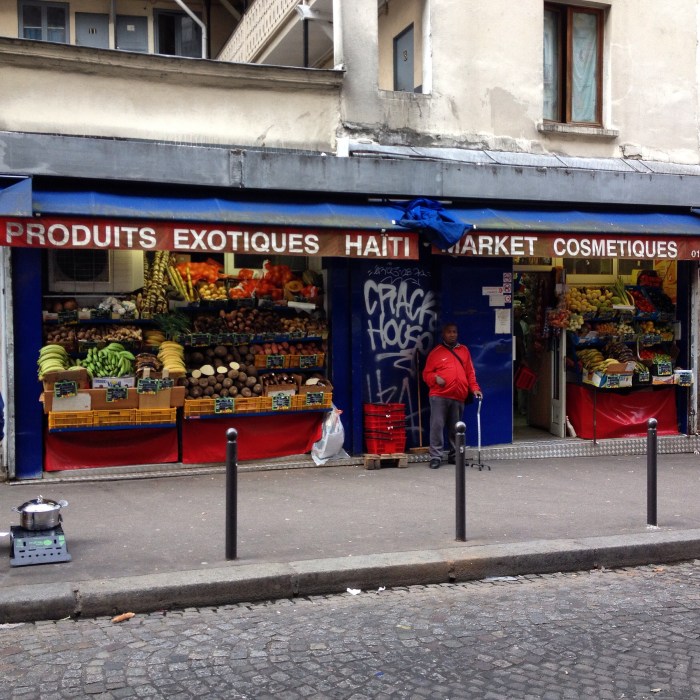
Walking onto the Rue des Poisonniers and the junction with Rue Dejean is the Marché Dejean with fruit and vegetable traders, fish mongers etc. It is a hive of activity. Around here I also see shops and people from other parts of the French speaking world such as Caribbean countries like Haiti and Guadalupe. This is the area around Chateau Rouge metro station. I find this part of Paris really alive and a great place to just watch life go by. I love the history and the infamous cafés of St Germain and the Left Bank (which I’ll be touching upon in another post) yet here is real life warts and all.


Text and images by Nicholas Peart

28th September 2016

(All rights reserved)


image

On the Rue La Goutte d’Or


image

The Moroccan restaurant Agad’Or


image

Couscous Maison at La Goutte d’Or


image

Another North African restaurant also located on Rue La Goutte d’Or


image

Halal butchers on Rue La Goutte d’Or


image

Hole in the wall Congolese restaurant on Rue Polonceau


image

St Bernard de la Chapelle church which police stormed in August 1996 to forcibly remove many undocumented immigrants who for a long time had taken refuge at the church


image


image

A beautiful garden oasis on the Rue Cavé.


image

A Senegalese restaurant on Rue Myrha


image

Pala Pala world music shop


image


image

This shop sells traditional herbs, bark and crafts from Mali


image


image


image

On Rue Dejean in Château Rouge


image

Château Rouge


image

Château Rouge


image

Château Rouge


image


image

Haitian shop in Château Rouge


image

Senegalese and Togo restaurant

Four Great Places To Eat In Paris

image

Image source: http://www.viator.com


Paris has a reputation for being quite a difficult city to find good value places to eat. Most restaurants are overpriced and combined with the colossal amount of people who visit the City of Love this means that it is not uncommon to experience lacklustre levels of service on top of the high prices. However with some research and a healthy sense of adventure gems can be unearthed. I have picked four eateries. Two budget eateries (under 10 euros per head), one mid range restaurant (10-20 euros per head) and one splurge (20-35 euros per head).

If you are really watching the centimes my advice to you would be to stick to baguette sandwiches for 3-4 euros from the ubiquitous boulangeries found all across the city. If you have kitchen facilities in your accommodation, the main supermarkets like Carrefour and Monoprix (or even better one of the big markets in the city) are good places to buy fruit, vegetables, cheeses, meats, wines etc

 
Maoz Vegetarian

image


The rue Xavier Privas in the 5th Arrondissement close to the river Seine and Notre Dame cathedral is chock a block full of cheap eats whether you are looking for cheap kebabs or Moroccan staples like couscous and tagines and many mediocre tourist trap restaurants. But by far the best of the cheapies is the falafel eatery chain called Maoz Vegetarian. This budget eatery is probably the healthiest of the four places I am recommending (that’s if you just count the falafels and salads and not the chips and soft drinks). Five euros gets you a pitta with falafel balls and you can choose your salads from the small but excellent salad bar. You can add humus for a euro more. For €8.50 you can include a soft drink and fries. Personally I am happy with just the pitta, fallafal balls, humus and generous salad helping. For six euros this is a super deal.

 
Agad’Or

image


Another budget choice. You have more chance of bumping into a back from the dead Jim Morrison here than another tourist here. This is far from haute cuisine. But if you want an authentic ethnic establishment serving cheap hearty portions of food full of locals with roots from the Maghreb then this Moroccan place located in La Goutte d’Or district in the 18th Arrondissement can’t be beat.

The Couscous Maison is what it’s all about here. You receive a mountain of couscous in a bowl served with a stew of chickpeas and vegetables. In another bowl you either get a chicken or meat stew. I went for the chicken. It also comes with a small baguette for breaking and dumping into the food. And it’s all yours for only six euros.


image

Couscous Maison at Agad’Or


It is no-frills food but it is good and filling especially if you are hungry. What’s more the experience and ambiance of the place could easily mislead one to believe they are in a typical Moroccan diner in the ville nouvelle de Tanger.

 
Bouillon Chartier

image


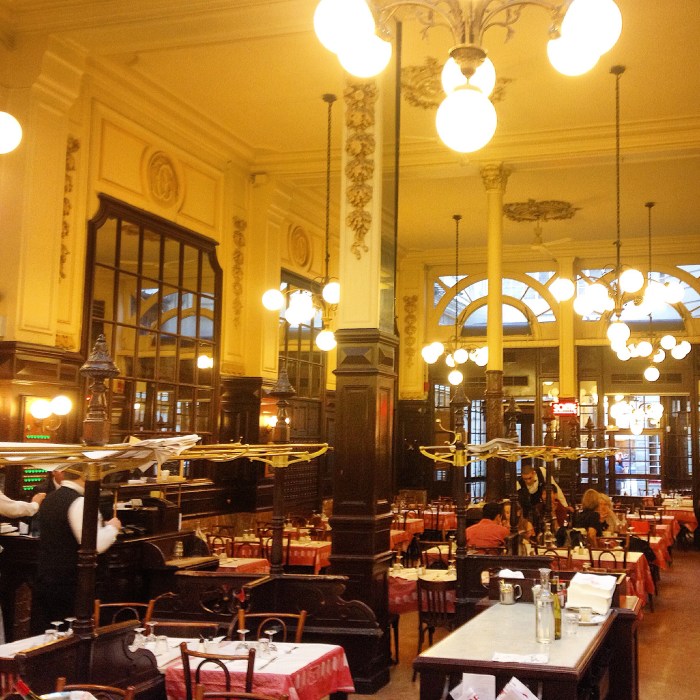
This places serves run of the mill traditional French food and perhaps I am making a big mistake including this but a pilgrimage here is a prerequisite for anyone who wants to experience a taste of the old Paris. This restaurant has been in existence for over 100 years and the architecture and interior decor remains unchanged. Some of the waiters have a reputation for being brusque but instead of being annoyed by this I say bring it on!! This is all part and parcel of the experience of dining here. There is no shortage of tourists that come to dine here at this legendary establishment so the waiters can afford to be jaded and downright indifferent. There is one burly old timer waiter here who looks like he’s been working here all his life. What’s more he has a face straight out of a Van Gogh or Manet painting. This restaurant is 1901 Montmartre Paris mixed with Faulty Towers. A rare thing in these aggressively globalised times. I love it!!


image

Inside Buillon Chartier


Now for the food. For my starter I had six Escargots (snails) lathed in massive amounts of garlic and butter.


image

Six Escargots 


There were standard snails and I suppose I only picked them to say that I had tried French snails. They were good but certainly not Michelin Star quality.

For my main course I ordered the infamous French dish Steak Tartare or raw meat. I thought this was going to be rank but it was surprisingly quite tasty (yet I will definitely not be having this regularly for lunch or dinner). The side of frites and Dijon mustard were a good accompaniment.


image

Steak Tartare


When the waiter came to calculate our bill he sketched it all down on the paper table cover. The experience of eating at Chartier will always trump the quality of the food, but it is definitely worth it.

 
A La Biche Au Bois

image


If there is one place which I would consider worthy of that elusive splurge, this restaurant close to Gare de Lyon would be it. I went here one Saturday evening for dinner with my two sisters and a friend. We all went for the fixed dinner menu priced at €32.80 a head. This includes a starter, a main, a selection of different cheeses from the legendary cheese board (a work of art in itself) and a desert.

For my starter I went for the Terrine de Canard (two fat slabs of homemade duck pâté). It was just how pâté should taste and be made.


image

Terrine de Canard 


However more impressive was my main course of Coq au Vin which came served in a heavy old school saucepan with a side of mashed potato in a gold coloured scallop shaped dish. The Coq au Vin was rich and delicious and I could barely make my way through all of it.


image

Coq Au Vin


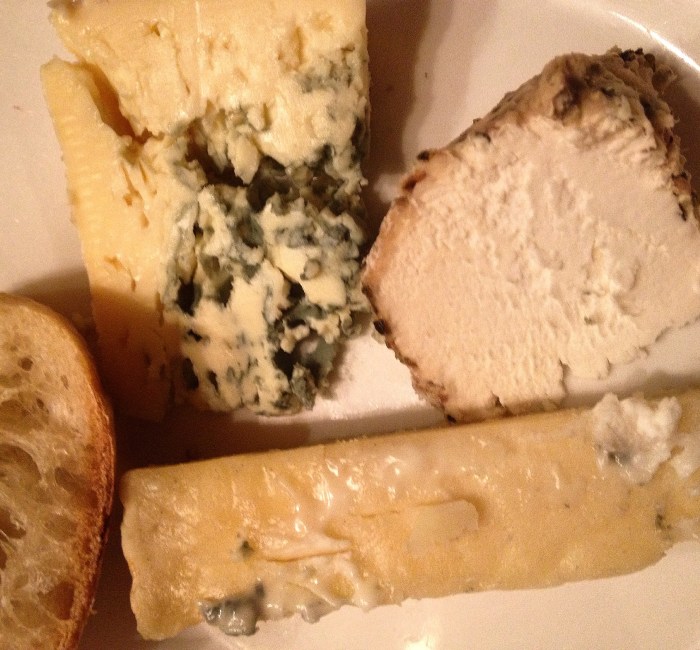
By the time the waiter came with the enormous cheeseboard I was almost game over but I persisted. I went for a wedge of Roquefort, a lump of peppered goats cheese and a slice of tangy Comté cheese. The strength of the Roquefort alone could have shut down my heart but it was a veritable delight as were the other two cheeses.


image

Fromage!


Finally for dessert I was going to go for the Creme Brûlée but instead I went for another French dessert called Ile Flottante which literally translates as ‘Floating Island’. It is like a sweet foam square shaped cloud floating on a sugary egg yolk lake. It was a refreshing and pleasurable end to a hearty marathon of authentic and traditional French food.


image

Ile Flottante


I’ve got very little patience for stylish, jazzed up food and especially nouvelle cuisine which makes me mad. I just want hearty portions of delicious and authentic food from any part of the world that I visit. In the case of French Cuisine, A La Biche Au Bois does a sterling job.

 
By Nicholas Peart

25th September 2016

(All rights reserved)
Mona Lisa Madness At The Louvre

image

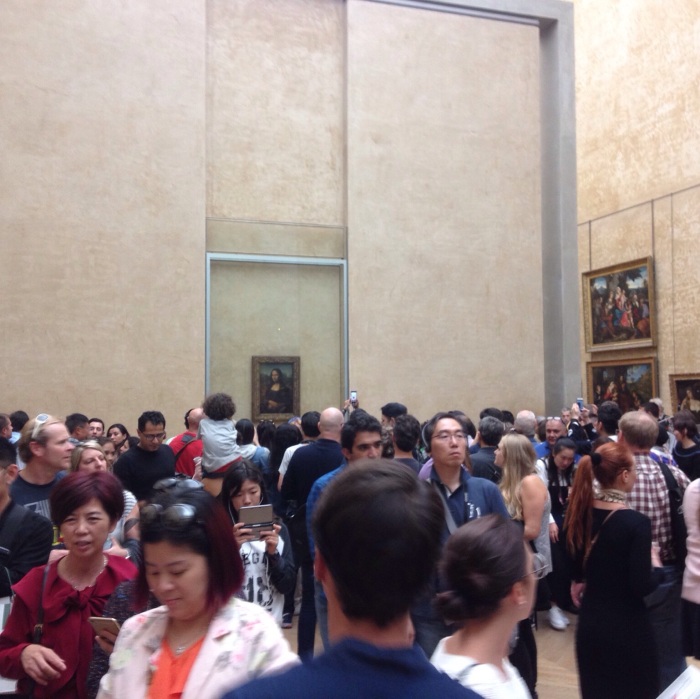
Mona Lisa frenzy at the Louvre museum, Paris


I don’t think I’ve seen anything else quite like this in any other art museum I’ve been to around the world. The Mona Lisa by Leonardo Da Vinci is arguably the most iconic work of art in the world and the most well known. Perhaps the only other work by an old master with an iconic status almost equal to (but not quite of the same magnitude of) the Mona Lisa is The Girl With The Pearl Earing by the Dutch painter Johanes Vermeer.

It is actually quite rare that a random member of the general public knows the title of a work of art by a famous artist. Everyone has heard of Picasso but how many can name the title of one of his many works? The same for Andy Warhol, the same for Jackson Pollock, Damien Hirst etc.

I am quite fascinated by the monumental popularity of the Mona Lisa. The stampede to even just catch a glimpse of this painting is akin to trying to catch a glimpse of a famous rockstar doing a signing at some small record store. As much as I wanted to get up close to see the Mona Lisa, I eventually gave up. Instead I channelled my energies into immersing myself into the nearby epic painting entitled The Cornation Of The Virgin by the Italian master Tintoretto.

But why is the Mona Lisa the most iconic painting in the world? Firstly its provonence. Since it was completed in 1519, it has been in the hands of French kings and emperors before finally settling in the Louvre. The genesis though of its current global popularity can be traced back to an 1867 essay on Leonardo by the English essayist and art critic Walter Pater where he dissected and wrote very passionately and poetically about the Mona Lisa (or La Gionconda as it was known back then). Pater’s essay is not only one of the most famous essays on any single piece of art, at the time it was seen as quite groundbreaking especially since art criticism was a fairly new concept back then. Since then the painting has been caught in the crossfire of a series of high profile events. In 1911 it was stolen from the Louvre. Picasso and his friend the French poet Guillaume Appolinaire (who once demanded that the Louvre be ‘burnt down’) were seen as two potential suspects. Eventually the thief was revealed to be a Louvre employee at the time, Vincenzo Peruggia. In 1956, part of the painting was destroyed when someone hurled acid at it. Then it was vandalised again in 1974 when a woman sprayed red paint on it. The painting is now kept behind bullet proof glass as can be seen in the photo above this post.

The painting has also been appropriated by other artists. Most famously by the father of conceptual art, Marcel Duchamp, who added a mustache to the painting in his 1919 piece ‘L.H.O.O.Q’. Later famous artists like Salvador Dali and Andy Warhol have also appropriated the painting in their work.

The truth is that the Mona Lisa has the greatest legacy out of any other single work of art ever created hence the unprecedented fascination in it. This painting would go for a whopping sum of money if it were ever released on the open market at auction in either Sotherby’s or Christies. The record paid so far for a single work of art to date is $300 million in September 2015 for the painting ‘Interchange’ by the abstract expressionist painter Willem de Kooning. I predict that if the Mona Lisa were ever auctioned (perish the thought) it would breach the billion dollar mark. It is that important and as a financial ‘security’ or ‘instrument’; tremendously desirable.

As for me, I like Da Vinci’s work but I’ve always been more interested in his mind, his ideas and ways of working than the actual finished pieces of art. His sensitivity to nature and the world as well his acute understanding of the anatomy of the human body have always impressed me.

His thinking was incredibly ahead of his time. His dreaming and vision had no boundaries. I love his sketches. Some of his skeches contain many of his inventions – one looking like a modern day helicopter. Incredible to think that these were concocted over half a millennium ago.


by Nicholas Peart

22nd September 2016

(All rights reserved)

(Self) Knowledge Is Power

image

Not all knowledge (image source: http://www.leahsblessings.com)


All my life I have always been curious and even if I may not have always come across as the quintessential person with a lust for life always oozing bucketloads of positive energy, I have always been greedy for experiences and knowledge. I have retained much of my curiosity since day one but what about the root of my thirst for knowledge? Well I suppose it goes hand in hand with my curiosity and a mind traditionally never still and corrupted by ferocious restlessness and obsessions. When I was growing up in the 80s and part of the 90s before the internet entered our homes, I used to pester my mum relentlessly to purchase for me an encyclopaedia whenever we were shopping in town. By the time I was about 10 I had about 5 different encyclopaedias. Anybody remember Dean Tell Me The Answer? I had one of those bad boys. Before my profound interest in music entered my life when I was 12, studying my encyclopaedias, painting, tennis and collecting precious stones occupied most of my leisure time. No aimless Facebook and YouTube video trawling. I even once created my own encyclopaedia which I entered for a school competition and won the grand first prize of three English pounds.

From the age of 12 to 19 music almost had the monopoly on my total interests and I lapped up so much of it new and old; more than my brain could handle. Then at university I had a good friend who got me interested in good quality films and then a year later I became interested in literature. Even though I was taught certain literature at school, I was seldom interested or inspired by what I was taught.

Yet the big quantum leap in my thirst for knowledge began ten years ago at the age of 23 when I travelled by myself to Morocco for two weeks. That trip was the catalyst for a life long interest in travelling and exploring the world. I have spent so much of my time since then travelling and learning about different countries and cultures. My knowledge and understanding of the world was so much more myopic before my interest in travelling began.

However these last few years I have begun to question the concept of knowledge and what it means. For too long I arrogantly took to my bosom the phrase that ‘Knowledge Is Power’. Now whenever I see this quote in public places, I feel so inclined to brandish one of those spray cans and to add the word ‘Self’ before the word ‘Knowledge’. I have acquired all this bountiful knowledge but what use is it when my level of self-knowledge is next to zero? I had spent so much of my time looking out but how much had I really spent looking in. I liked to think that I was this deep person but deep down (no pun!) I was kidding myself. There’s this well known cliche about travelling to find yourself, yet I’d been travelling in many ways because I was afraid of myself and dealing with reality and society. I had learnt so much about many different countries, their histories and cultures and even though I had zig zagged across enormous swathes of the world I could seldom bring myself to search and explore myself. It is interesting how after a long time abroad, many travellers return to their home countries feeling lost, confused, depressed and out of synch with the rhythm and flow of their external environment. I believe most of the root of this is the great disconnection within themselves. I don’t believe it’s just because of their home countries being so different to the countries they visit. If you truly know yourself, you by extension are able to understand better other people regardless of their position in society: whether they are accountants, magicians, lawyers, painters, computer programmers, musicians, billionaires or beggars – this doesn’t matter. If you barely know yourself you will struggle to see beneath the facade of others. You will always become affected and a slave to other people’s behaviour: perhaps many times playing the victim role as opposed to taking more responsibility of your life.

Yet the journey in getting to know yourself is no pleasure cruise. Especially if you are always in constant fear of yourself. Yet this fear can be transcended. With the guidance of a good therapist or healer (preferably someone who has experienced all these challenges and overcame them) then this journey can truly begin. But they can only be your guide or facilitator. They cannot be a rescuer or saviour – there can be no dependence as with dependence there can be no true awakening.


By Nicholas Peart

4th September 2016

(all rights reserved)

Remembering The Great Fire Of London

image

The Great Fire (image source: http://www.museumoflondon.org.uk)


Today marks the 350th Anniversary of the Great Fire Of London. To recognise this the Museum of London currently has on display until April 2017 an excellent temporary exhibition. As well as a wealth of information, there are also original artefacts on show like the original leather buckets and fire squirt pipes residents used to stop the fire as well as some of the possessions affected residents tried to salvage from their burning homes.

Only a year before the Fire, London was devastated by the Great Plague of 1665 which killed 100,000 people (a fifth of the city’s population). There are a few reasons why the fire had the devastating impact it had. Firstly, most of the buildings of the city of London back then were made out of timber. The city at the time also didn’t have the proper facilities to reduce the fire. There were certainly no fire brigades and sadly one of the only ways to effectively put out the fires was to tear down many of the wooden houses to prevent the fires from spreading further. It had also been a very dry and hot summer and combined with a strong wind from the east, those initial small flames began to spread to almost all of the city of London.

The fire began very early one morning on Sunday 2nd September 1666 at a bakery on Pudding Lane close to London Bridge. The mayor of London at the time, Sir Thomas Bludworth, two hours after the fire didn’t take it seriously and was reported to have said, ‘Pish! A woman might piss it out’. Later in the morning the great London diarist of the time, Samuel Pepys, told the King in Whitehall ‘that unless his majesty did command houses to be pulled down nothing could stop the fire’. By the evening the fire had already grown half a mile wide enveloping great parts of the city.


image

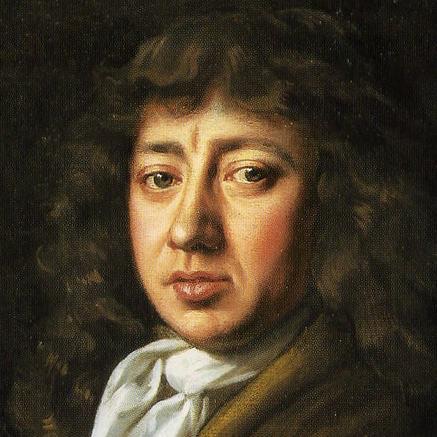
A portrait of the 17th century MP Samuel Pepys who witnessed the Great Fire and wrote about it in his famous diary (image source: http://www.twitter.com)


Most of the residents of London were ill-equipped to deal with the fire. Most of the methods the residents used were ineffective. Water carried in heavy leather buckets and fire squirts were used to try and reduce the fire, but with little to no success. It was, however, Charles II and his brother James who established firefighting bases around the city on the morning of the next day on Monday 3rd September 1666 to tackle the fire. It seemed that Samuel Pepys was indeed right when he said that the only way to reduce the fire was to pull down many of the wooden houses. By doing this not only was the fire prevented from spreading further, it also created gaps between the rows of wooden houses which the flames couldn’t cross. The first major casualty of the day were the printers of the London Gazette which earlier in the day printed the news that ‘a sudden and lamentable fire’ is burning down London.

On Tuesday the next day, the fire has engulfed even greater parts of the city. By 6am, one of the most important streets of the city of London, Cheapside, began to burn. When night fell, gunpowder was used to blow up houses to prevent the fire from reaching the Tower Of London. Around 8pm, the fire had burnt large parts of St Paul’s Cathedral. Fortunately, as the night progressed, much of the wind began to die down and by the morning of Wednesday 5th September, most of the fire had been eradicated.

The fire had left many residents homeless. More than 13,000 houses, 87 churches and 436 acres of the city were in ruins. It had also created a great housing shortage and rents for the properties unaffected by the fire were extortionate. Whilst residents were fleeing their homes they also tried to scavenge many of their possessions. Money, musical instruments, pets and Parmesan cheese were some of the things residents tried to save. Some unscrupulous carters helping residents to save and transport their stuff made a killing with some charging residents £20 (£3000 today) to hire their carts. Samuel Pepys was one of the fortunate few who’s house was unaffected by the fire. He also protected his Parmesan cheese and wine from the fire by burying them in his garden.


image

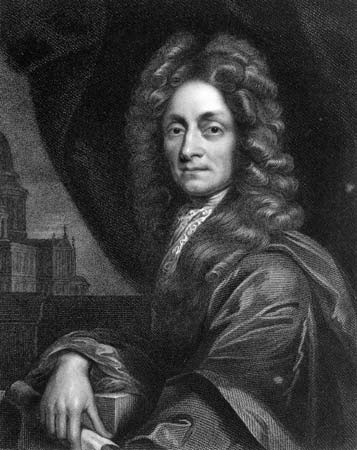
The architect Sir Christopher Wren who was responsible for rebuilding  the city of London (image source: http://www.britannica.com)


The principle person involved in rebuilding London was the great architect Sir Christopher Wren who redesigned St Paul’s Cathedral and many other churches and buildings affected by the fire. All new homes, churches and buildings were made with brick instead of wood in order to be able to withstand future fires. Few original relics (one example being the Tower of London) of London before the Great Fire remain and in many ways the year zero of the London that one sees today is the London of Christopher Wren.


by Nicholas Peart

2nd September 2016

(all rights reserved)