The French artist Louis Cane once said to me when he was going through a catalogue of my paintings that I should “make a lot of noise”. However, he wasn’t very specific regarding what kind of “noise” I should be making. For me, there are two kinds of noise. There is “cheap noise” and then there is “expensive noise”. “Cheap noise” is of the vulgar shouty variety. Sometimes though it can work and it has worked for several artists, but it is a slippery slope. It reeks of desperation and shameless whoring. And it runs the risk of cheapening good work. The focus ceases to be on the work. “Expensive noise”, on the other hand, is more august. This is a fine and subtle noise where stealth rather than shouting reigns supreme. In this case, you create something so powerful and profound that people naturally gravitate towards it and sometimes in a furious stampede-like way. And the artist hasn’t muttered a word.
The entrepreneur and investor Peter Thiel in his book Zero To One states that competition is for losers. I sometimes thought that competition was a corrosive thing and that I was above it. After all, with my art I create my own world and that world is nobody else’s but my own. I am not competing with anyone.
But what is competition and is it a bad thing?
Within the realm of art and the art world, one could objectively and in a plain vanilla black and white way come to the not unreasonable conclusion that it is a highly competitive space. And along those lines I guess one could look at competition in two different ways;
To view competition as a healthy and positive thing. Dare I say, as something inspirational. That it is used as fuel to be not just a better and more driven and committed artist. But also to be a better person; a less self absorbed and narcissistic person who better understands other artists and what they are trying to convey rather than to just be stuck, entangled and rutted in their own world.
To view competition as a threat resulting in chronic envy whenever an artist, especially an artist you may know, becomes very successful while you find that success is always eluding you. You begin to develop negative and destructive thoughts along the lines of believing that you deserve success just as much simply because you believe yourself to be a unique artist and that “mediocre or bad art should not be rewarded”. This mindset is a one way ticket to terminal misery. It is a veritable road to perdition.
I think that being too fixated on the morality/fairness aspect of the art world is deadly; it is like drinking from a cup of slow acting poison. What is “bad/good art” anyway? As I said, getting into the shoes and mind of an artist you do not rate and whose work you think “doesn’t cut it” is far healthier than explicitly condemning them and lamenting “how unfair” and “how full of sh*t” the art world is.
We all have insecurities and having some insecurities can be good. It keeps you on your toes and ignites a fire in the soul. Too much comfort often leads to lethargy and inertia. However, being submerged in insecurities to the point where it is toxic and unhealthy, instilling bad vibes and negative energy, is not a good thing.
The art critic David Sylvester said that, “Artists must be allowed to go through bad periods! They must be allowed to do bad work! They must be allowed to get in a mess! They must be allowed to have dud experiments! They must also be allowed to have periods where they repeat themselves in a rather aimless, fruitless way before they can pick up and go on.”
Sylvester said this all in 1969. Yet, I think today, in the age of social media, his words are more important then ever. Social media platforms like Instagram can be useful vehicles for making connections and sharing our artwork and processes. However, it can sometimes breed in us a rigid perfectionism; that we must showcase the best of what we have to offer and never be encouraged to fail and take risks. This duality of what is good and bard art is unnecessary and quite destructive. Similarly is being too precious to the point where it kind of functions as a straitjacket and we don’t realise the whole totality of everything that we have to offer.
The right to make “bad art” is almost paradoxically a very emancipating, inspiring and edifying thing. To the point where it renders perfectionism a cul-de-sac.
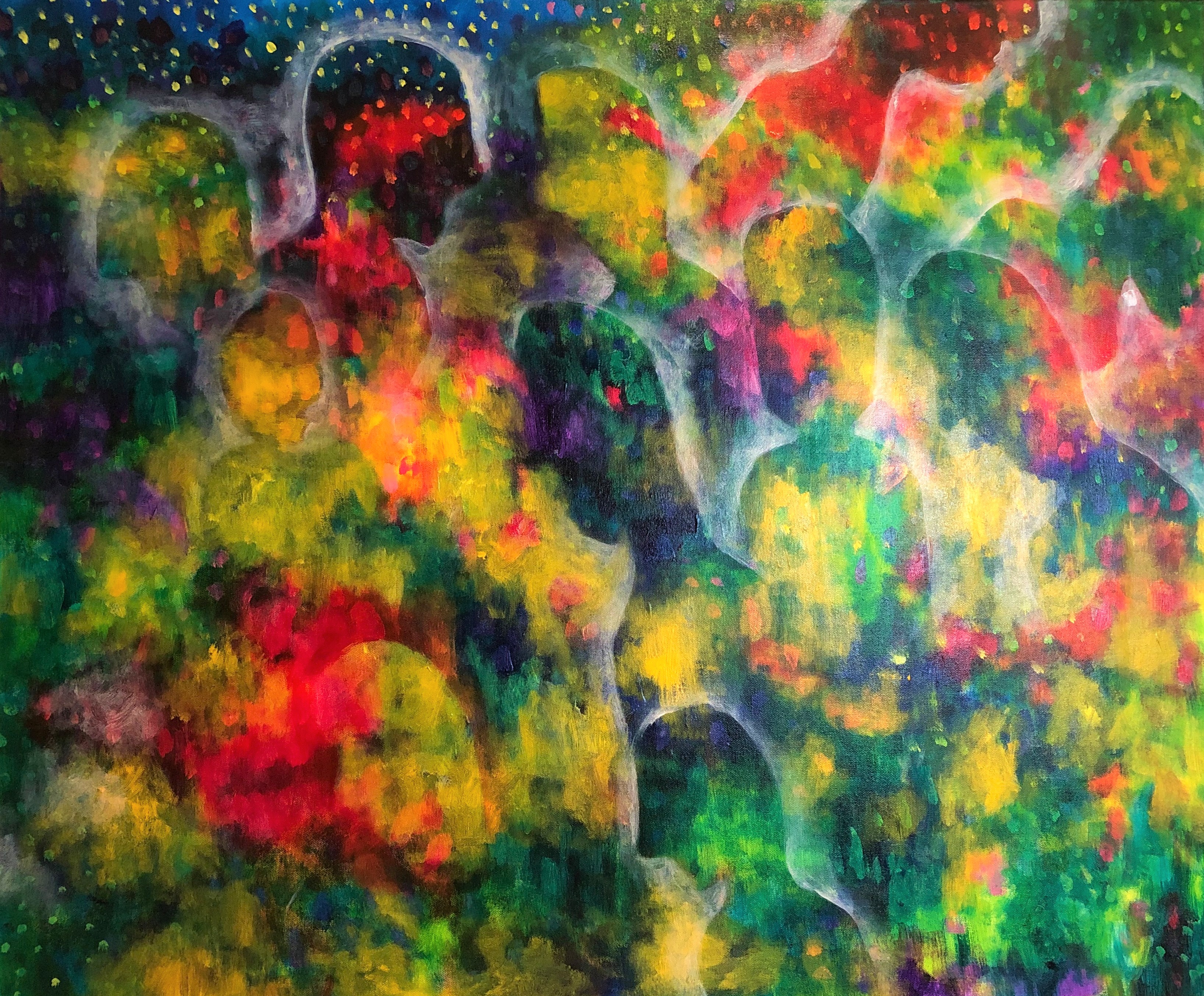
As an artist I’ve come to the realisation that I now care less regarding whether I and/or my work is “understood”. It is of little to no importance to me since I do not paint or create works with a primary overarching mission to “be understood”. In fact, there is nothing to understand in my paintings. I don’t have any “goal” nor am I trying to make any kind of statement. If I have to say anything in relation to my work it is what I’ve said many times in the past; “I paint my feelings”. Or, more broadly, I paint my inner invisible world. And my paintings are visible artefacts of this invisible world. Thus my paintings are meant to be “felt” more than “understood”.
There are artists I admire, but there is no single artist that really influences me since essentially my core root/source is my inner world. Take the artist Jackson Pollock, for example. His paintings are not meant to be understood and its a fool’s errand to attempt to understand them. For me, his paintings are 100% about feeling. The duality of him as a person and his processes of creating are for me all about energy and feeling. No other artist matches Pollock here. And its a very permanent, primordial and universal thing; transcending the parameters of space and time.
I like to call my painting technique Spiritual Coding. In the digital world in which we currently live the word coding is used a lot. This of course refers to computer programming. A language for this age. And when I look at my paintings I am also using my own language. A language created through interacting with my ‘inner being’ and this I call Spiritual Coding. My paintings are in many ways remnants of this. Tangible photographs almost of my eternal spirit. Although they don’t capture the processes of my work they are residue formations of intense spiritual journeying and internal searching.
Making The Invisible Visible
I would like to expand further on this by saying that in my paintings I make the fleeting invisible world visible. My eternal shadow is the eternal unconscious ocean of my being. When I paint or create, I dive straight into this quarter. I hesitate to call it a vast empty quarter such as a desert, although a desert landscape can stir inside of me strong almost monolithically primordial visions and by no designs of my own. In my essay from ten years, I compared my paintings to deserts that only become alive as one becomes more connected spiritually with themselves. However, I like the metaphor of the ocean. When one dives into it it is akin to diving into the vast invisible unconscious space of our being. Roughly 70% of our planet’s surface is covered by oceans. The dry land portion of our planet is what is noticeably visible. There are hidden elements but the ocean is the true hidden portion of our world. All we see is just the skin and we are denied easy exploration. Most of the low hanging fruit is on land. When I paint I am taking a dive into this invisible and unknown unconscious world. I don’t know what I’ll discover or find and when I am painting, especially in the deeper more meditative stages of my painting process, it can feel like it isn’t me consciously painting.
Painting From The Eternal Source
Any recurring symbols or motifs in my paintings are from that same place. Like those created by prehistoric cave painters, for example. Some people say that all art is political, but I give the pollution and toxicity of politics and even culture a wide birth. It is all an anathema to the eternal source. These are ephemeral things that burn bright for just a very brief interval in the grander passage of time.
I paint at varying, alternating degrees of tempo. I don’t paint at one consistent speed. At times I attack the canvas whereas at other times I am more restrained like a cautious diligent heart surgeon carrying out a complex operation. In this moment when I decide to apply the next brush stroke is of great importance to me since by applying the stroke in the wrong place or too prematurely can alter the entire composition and metamorphization of it. Some artists say that there are no mistakes and I guess that is generally true. However, in these moments I do not have the luxury to make mistakes.
When explaining my painting process in the past I may have placed a big emphasis on spontaneity and that is a core part of my painting process. Part of “Spiritual Coding” is that direct connection to the eternal source with no external fleeting elements standing in the way. However, there are times when I have to look and observe at the totality of the composition so far before I can continue any further. Mark Rothko, for example, would spend a great deal of time observing his paintings, of what he had created so far, before continuing and making his next move. Whereas an artist like Jackson Pollock had that perpetual spontaneous carnal ferocity. I have both; painting in different tempos and time signatures. Often spontaneous, but also more controlled. However, the eternal source always guides me. When I paint, I very seldom reference any external material like any preliminary sketches for example. And that is what Spiritual Coding is; letting the eternal source be my guide.
By Nicholas Peart
9th August 2026
(c)All Rights Reserved
Image: “Deep Forest Spirits (1/3)” (2020) by Nicholas Peart